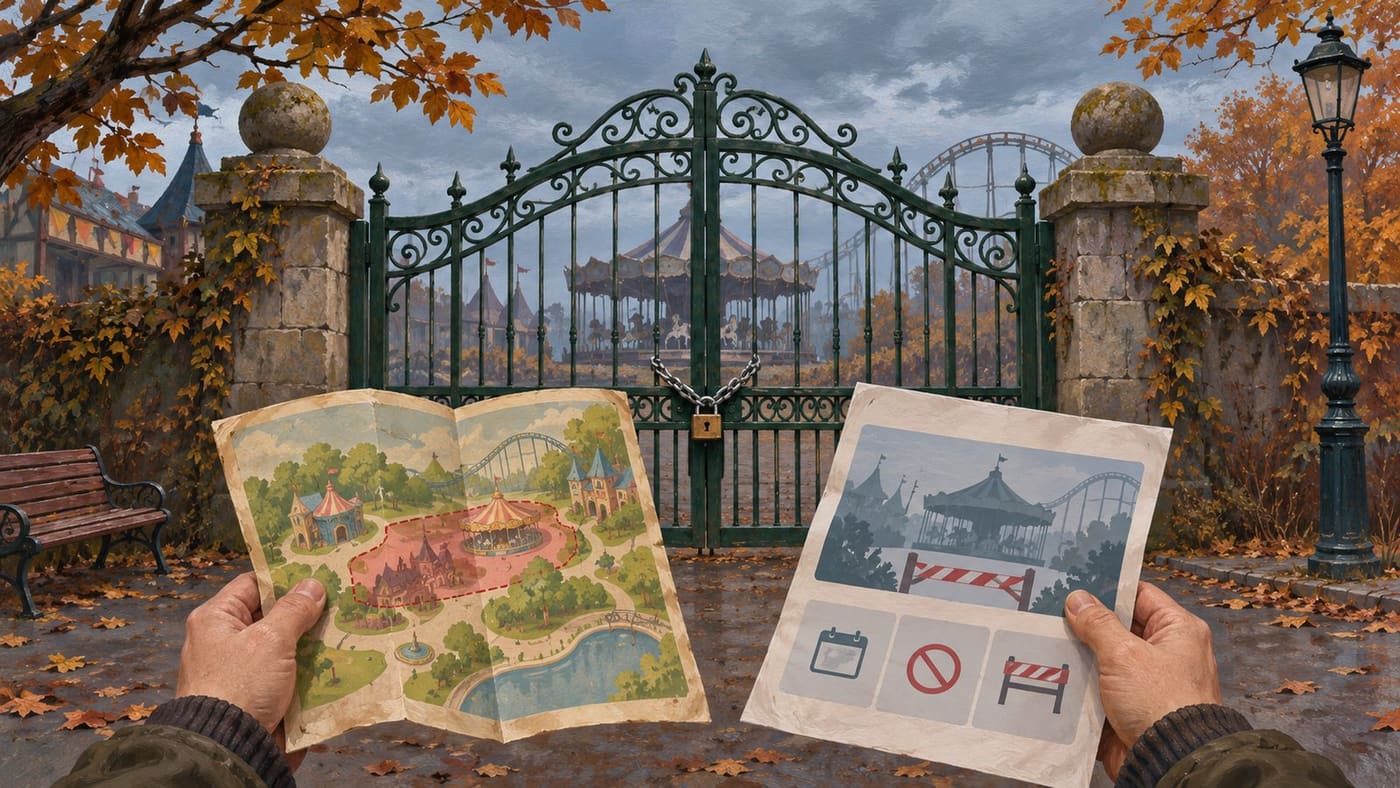
Alton Towers Resort says the World of David Walliams permanently closed from Tuesday, 3 November 2026. The announcement sits on the resort's ride and attraction availability page. It concerns the named area. Older resort pages can still show its rides, and a hotel page uses the same branding for a themed room. For someone making plans, those pages answer different questions.
The notice also says the resort is outside its main season and directs guests to check its website and app for opening information. That second point matters for anything a family might choose instead. An attraction can appear in the resort directory and still have different availability on a particular date. The dated notice is the place to start for the closed area. A date-specific check is the next step for the rest of the visit.
What the closure notice establishes
The resort uses the words “permanently closed” for the World of David Walliams and supplies an effective date. That is more specific than a queue listing marked unavailable or a ride being paused during the day. It is also more limited than an announcement about the future use of the site. The notice does not give a replacement opening date, say what will happen to the equipment, or explain the decision. Each of those would require its own confirmation.
Keep the effective date separate from the date you found the announcement. Someone searching on 4 November may see a story filed that morning, a ride description from months earlier, and the resort's dated notice together. The operative date is 3 November even if the search result that led you there is newer. The title of the page is useful too. Alton Towers put the announcement on its availability page, where visitors are directed to look for changes.
A screenshot of the notice can help a group agree on what changed, especially if several people have been researching the same trip. Include the source and the full line with the effective date. A cropped image showing only the name of the area loses the distinction between a closure announcement and an old page describing what was there.
Use the old map to identify what belonged to the area
The resort's 2023 gate map is useful for identifying attractions historically shown under the World of David Walliams. It lists Gangsta Granny: The Ride, Flavio's Fabulous Fandango, the Royal Carousel and Raj's Bouncy Bottom Burp under that heading. If you remember one of the rides but never learned the name of the area, the map provides the connection. Its date also makes its limitation clear.
An old map is a snapshot of the park at the time the map was published. Its legend can explain why an attraction appears in old itineraries and photographs, and why a child may remember a particular name. For current trip planning, check the newer availability notice and use the resort's current planning information for alternatives. A PDF downloaded during an earlier visit can remain on a phone long after its practical instructions have aged.
The same distinction applies to a ride's standalone page. The Gangsta Granny ride page describes the attraction's story and lists its historical ride restrictions. That description is relevant if you want to know what the ride was. The dated closure notice is the relevant evidence when the question is whether you should include the themed area in a new itinerary.
Treat hotel information as a separate question
Alton Towers also has a page for a Gangsta Granny Room. The page places the room in Alton Towers Hotel. A bedroom and a themed area in the park are different parts of a visit, even when they share a name and characters. The room page establishes that the resort has described that accommodation. The park-area notice does not set out what will happen to the room, and the presence of a room page does not establish availability on a given night.
If you already have a booking, find the part of the confirmation that names what you booked. Separate the room type, park admission and any individually listed extras. If a themed room appears on the confirmation, use the resort's accommodation channel to check that specific reservation. If your itinerary simply assumes that park admission includes access to every attraction you remember, update the itinerary using the availability notice and check the rest of your plans by date.
Rebuild the plan around the people going
Start with the reason the area was in the itinerary. For one family it might have been the story from a familiar book. For another, it was an indoor stop between outdoor activities. Someone else may have picked it because members of the group could share a ride without splitting up. A replacement is useful when it serves that same purpose. A list of the resort's most prominent rides may not help if the group needs something that is suitable for a younger child or someone who would prefer a quieter part of the day.
Say a family had scheduled the area as its first stop because everyone agreed on it. The useful question is what the group wants to do together before branching off. Use the resort's attraction directory to make a short list and check the availability of each choice for the date. Read the individual conditions before promising anything. A listing describes an attraction, while its conditions tell you whether the people in your group can use it. Current availability is a third check.
For a group with mixed preferences, write down one shared stop and one optional stop for each subgroup. Agree on a meeting place independently of those activities so that a change does not leave half the party looking for the others outside a closed area. A flexible meeting point is especially useful when a group has people travelling separately or staying in different accommodation. Put the date on the plan so nobody follows the version shared before the closure.
Parents can make the change easier to understand by explaining what the old pictures show and then offering a choice from the updated plan. A child who remembers the ride from a visit is remembering a real experience. A child who saw it in an old video may have assumed it was still available. In either case, a specific explanation about the area and its closing date is clearer than saying that a favourite ride has simply disappeared from the map.
Check access and timing together
A replacement can look suitable on a map and still introduce a practical problem. Consider a family that chose its first stop to accommodate someone who needs regular breaks. If the new plan places two activities far apart, that family should look at how the routes fit together before treating the second activity as a substitute. Start with what the group needs for the visit and consult the resort's theme park accessibility information for the options and guidance the resort provides.
Do the same for a group using ride restrictions to decide where to split up. A height rule copied from the old map applies to the named ride shown there. A new choice has its own published conditions. Use the information for that specific attraction and check any accompaniment requirements alongside the minimum height. If the relevant information is unclear, ask the resort about the particular attraction. Asking whether a park is generally accessible is a much broader question than asking whether an individual can use a specific ride.
Availability can also change the order of the day. If a stop was intended as a break after an outdoor activity, the substitute needs to be available at a useful time and within a workable distance. The resort's live information becomes more useful once there is an actual visit date. For a later trip, build the plan around options and check them again closer to the visit. Treat any opening hours saved from a past visit as historical until you have a current date-specific source.
Keep the park and the hotel on separate lines
Consider a booking that mentions a Gangsta Granny room and a family plan that includes the similarly named ride. The confirmation can tell the family what is attached to their booking. The ride availability notice can tell them what has changed in the park. The accommodation description explains the theme of the room. None of those pages needs to answer all three questions.
A useful way to share this with another adult is to make two lines in the trip notes. On the accommodation line, put the room name and where the reservation can be checked. On the park line, put the closure date and the revised plan. Leave any unconfirmed questions as questions. That lets a family change the park itinerary while awaiting an answer about the room, without assuming the two decisions must move together.
The same method helps when someone else made the booking. They may have sent a link to the resort's description rather than the actual reservation. A screenshot of a room page is useful for recognising the room but cannot tell you which dates the organiser booked. Work from the confirmation for the booking and from the availability notice for the park. If travel or accommodation is still only an idea, keep it separate from the question of what the closure announcement means.
Match each claim to the page that can answer it
If someone shares an old photograph of the Royal Carousel, the historical map can help locate it in the former area. The dated closure notice can establish when the named area closed. The photograph cannot confirm what happened to the structure after that date. The same distinction applies to a current article with an archival image. The date of the article and the date of the image are separate pieces of information.
An old ride listing may be the first result for someone who searches a ride by name. It can be a perfectly good description and still be the wrong page to use as an opening schedule. Look at the purpose of the page before choosing which source to trust. The closure notice describes a change in operations. A ride profile explains the experience. A map documents where things were. A booking confirmation identifies a particular reservation. Each has a different job.
There is a similar trap in the phrase permanent closure. It describes the status of the named area in the notice. It does not give the public a timetable for removal of individual equipment. It also supplies no basis for predicting when a new area might open. If someone asks what will replace it, the closure notice itself leaves that question open. The appropriate place for a confirmed answer would be a future announcement from the resort.
Keep one up-to-date itinerary for the group
When you share the revised plan, put the date of the visit and the date you checked availability at the top. Add a second choice for the stop the closure affected. A person reading the message later can then tell whether it reflects a check for their visit or an earlier plan that happened to be forwarded again. If the resort updates the availability page on the day, change the shared copy first so the whole group can refer to the same version.
Conclusion
For a visit after 3 November 2026, start with the resort's dated notice that the World of David Walliams is permanently closed. Use the older map to understand what belonged to the area, and consult the resort's current information to decide what fits your visit. If you are checking a themed hotel stay, use the actual reservation and the separate accommodation information. Those steps let you update the day without drawing conclusions about the hotel, the future of the site or the reason for the closure from a notice that does not address them.
The Ireland Google Trends selection came from the past 24 hours, sorted by search volume. “David Walliams” appeared seventh with 5K+ searches and was marked as having lasted 19 hours when retrieved on 4 November. Higher rows were passed over because of coverage overlap or insufficient direct evidence for the proposed treatment. The article follows the dated closure confirmed by the resort.
For another example of reading dated information alongside older records, see how the Auckland ODI target changed during play.
Sources consulted 4 November 2026 include the resort's ride availability notice, 2023 gate map, Gangsta Granny ride and accommodation pages, attraction directory and accessibility information.