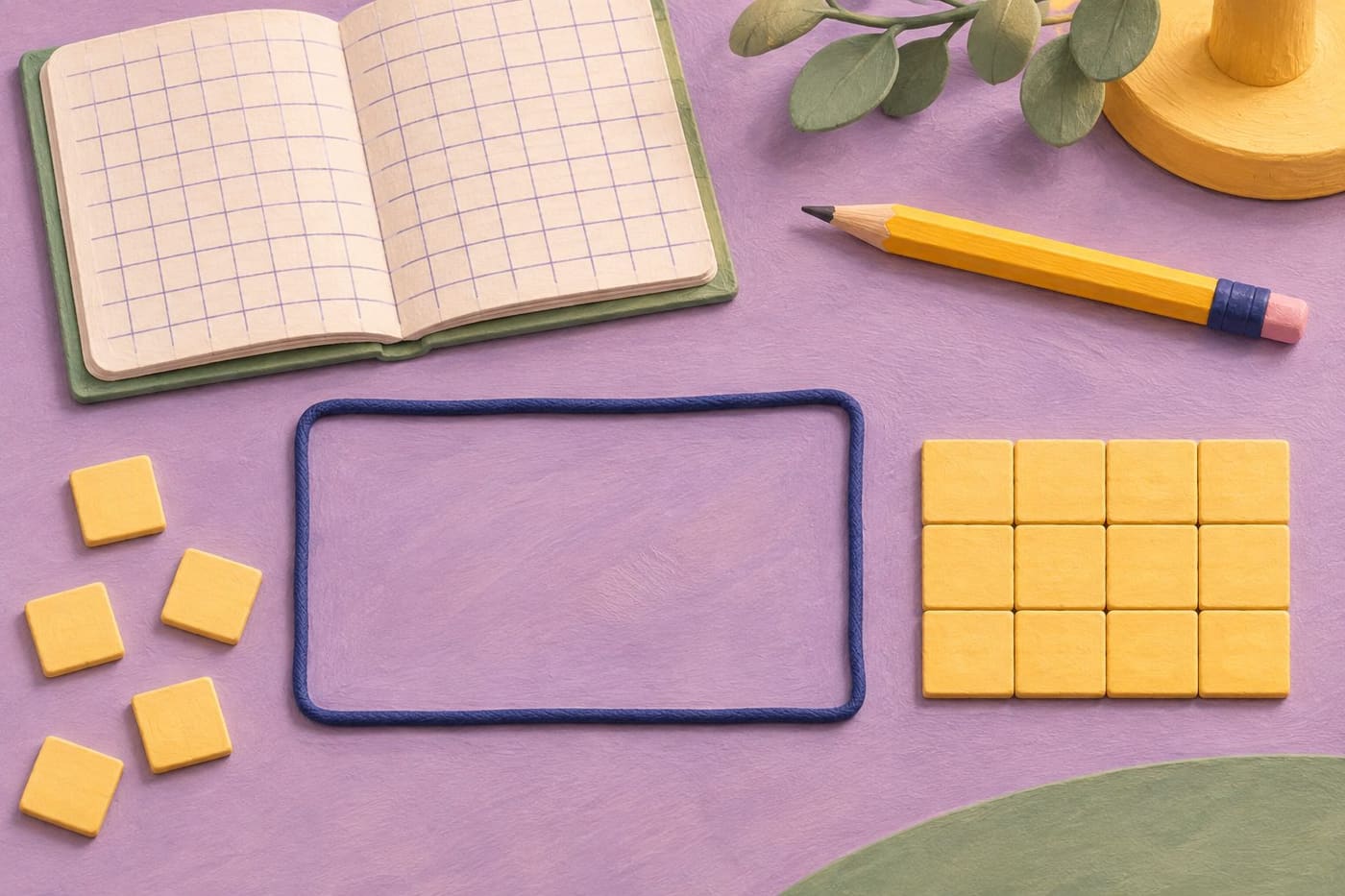
A rectangle can be described by the surface it covers and by the distance around its edge. Those descriptions concern the same shape, but they do not measure the same thing. Counting the tiles inside a rectangle answers one question; tracing its outside boundary answers another. A correct calculation starts by deciding which question you are answering.
This guide develops that distinction through original worked examples using equal square units. It is intended for a learner working with a teacher, parent or study partner who can check the drawing and the explanation. The activities are suggestions, not a tested lesson sequence or a claim that a particular child will master the topic in one session.
The educational sources include England's mathematics curriculum and non-statutory guidance, NCETM teaching points, Cambridge's NRICH resources and an Australian Maths Hub planning page. Their year labels belong to their own contexts. This article is not a Bangladesh curriculum requirement or an assessment of any student's age, attainment or learning needs.
Decide whether the task concerns inside or around
NCETM's area and perimeter teaching points distinguish perimeter as distance around a two-dimensional shape from area as a measure of its surface. Perimeter uses length units; area uses square units. The distinction supplies a reason for the units in an answer, rather than treating the units as decoration added after arithmetic.
Draw a simple rectangle and ask the learner to indicate what they would measure before choosing a calculation. For perimeter, follow the complete outside path. For area, indicate the region to be covered. A learner can point, trace or describe the difference aloud; the important part is that their response identifies the intended measurement.
Use a plain description alongside any story problem. "Ribbon around a card" suggests one situation, but a learner still needs to identify the complete boundary being counted. "Covering a card" suggests another, but the surface and covering unit must be clear. Do not rely only on a memorised keyword. Restate what is actually being measured and connect it to the drawing.
Set the unit before counting
Choose one grid interval to represent one unit of length. A square cell with sides of one unit then covers one square unit. If the notebook's printed grid has not been measured, call the length a unit rather than confidently naming it a centimetre. A digital image resized on a screen also should not be measured as though its displayed size were a physical specification.
The Australian Maths Hub planning tool discusses measurement with repeated square units, rows and columns, and the importance of avoiding gaps or overlaps. This gives the covering task a condition: use the same unit consistently across the region you are comparing.
For an original exercise, make a rectangle with five equal cells in each row and three rows. State explicitly that every cell is one square unit. Before calculating, ask what would happen if some cells represented a larger square than others. Counting the same number of unequal pieces would not establish equal covered area. The unit is part of the model, not an optional detail.
Count the surface in an organised way
In the five-by-three rectangle, count fifteen unit squares. You could count one at a time while marking each counted cell, or count five in each of three rows: 5 + 5 + 5 = 15. The multiplication 3 × 5 records that repeated structure. The area is 15 square units.
Now explain what each number means. Three is the number of rows; five is the number of equal square cells in each row. The result counts the cells covering the whole rectangle. It is not the number of lines on the grid and does not include an extra row because there are four horizontal grid lines marking the three rows.
England's mathematics programme of study includes counting squares for rectilinear area and connecting area with arrays and multiplication. Here, the original example makes that connection visible. Ask the learner to show the fifteen squares that the expression represents, rather than accepting an unexplained product as the whole solution.
Trace the complete boundary separately
Use the same rectangle for a different job. Travel five units across the top, three down the right, five across the bottom and three up the left. The path returns to its starting point. Adding those four lengths gives 5 + 3 + 5 + 3 = 16 units of perimeter.
The inside grid lines do not belong to that outside journey. Nor does counting fifteen square cells measure the boundary. To check the distinction, colour the outside path differently from the covered cells. Use the colours as a temporary aid and ask the learner to identify the two measurements without depending on the colour alone.
The Department for Education's non-statutory Year 4 guidance, in its perimeter section, contrasts counting boundary unit lengths with incorrect grid counting. It also connects rectangle perimeter with adding and doubling. In this example, 2 × (5 + 3) is a shorter calculation for the same four-sided path; it does not introduce a different measurement.
Explain why square units do not mean doubling
Suppose every unit length in the exercise is defined as one centimetre. Each cell is then a square centimetre: a one-centimetre-by-one-centimetre square. The rectangle's area is 15 cm², while its perimeter is 16 cm. The raised two in cm² identifies the square unit; it is not an instruction to double fifteen.
Ask a learner who has written "15 cm" for the area to describe the thing they counted. If the answer is fifteen squares, connect the written unit to those squares. If the answer is a route around the shape, revisit which measurement the question requested. The same wrong written answer can arise from different reasoning, so the explanation matters.
Keep the unit statement attached to the drawing and the calculation. A bare number can hide a correct idea or an incorrect one. A complete answer says what was measured, how it was counted or calculated, and which unit the model uses. This is a suggested checking routine, not a scoring rubric claimed to match every school or examination.
Rearrange a fixed number of tiles
Use an original set of eighteen equal unit-square tiles. Arrange them into a one-by-eighteen rectangle, a two-by-nine rectangle and a three-by-six rectangle, using every tile without gaps or overlaps each time. All three arrangements cover 18 square units. Their outside journeys, however, have different lengths.
For the first, 1 + 18 + 1 + 18 = 38 units. For the second, 2 + 9 + 2 + 9 = 22 units. For the third, 3 + 6 + 3 + 6 = 18 units. Keep these perimeter answers alongside the repeated area answer so that the comparison stays visible.
NCETM's later area and perimeter teaching points explicitly distinguish equal area from equal perimeter. Our eighteen-tile exercise illustrates the distinction; it does not prove a rule about every possible shape by showing just three rectangles. Ask the learner to explain what stayed fixed and what changed in these particular arrangements before making a broader claim.
Notice that the three-by-six example has eighteen in both answers. That numerical coincidence does not make area and perimeter the same quantity: one answer is eighteen square units and the other is eighteen length units. If each unit length in that model represents two centimetres, the rectangle is six centimetres by twelve centimetres. Its area is then 72 cm² and its perimeter is 36 cm. The shape has not changed between those two descriptions; the named unit has. Return to what each answer measures instead of using equal numerical values as a test of whether two measurements have the same meaning.
Hold the perimeter fixed instead
Now choose a different condition: every rectangle in the next exercise must have perimeter 20 units. A one-by-nine rectangle has perimeter 1 + 9 + 1 + 9 = 20 and area 9 square units. A two-by-eight rectangle also has perimeter 20, but its area is 16 square units.
A three-by-seven rectangle has perimeter 20 and area 21 square units. A four-by-six rectangle has perimeter 20 and area 24 square units. A five-by-five square has perimeter 20 and area 25 square units. These are complete rectangles with positive whole-number side lengths; the list does not attempt to enumerate arbitrary curved or irregular shapes.
Before calculating, invite a prediction about whether equal boundary lengths must produce equal covered surfaces. Then use the drawings and arithmetic to check that prediction. NRICH's Changing Areas, Changing Perimeters teaching resource addresses the misconception that the quantities must always increase together. Its published card activity is separate from the original numerical examples here; no source worksheet or diagram is reproduced.
Inspect a shared edge before adding boundaries
Imagine two identical rectangles, each three units long and two units wide. Place them side by side with a complete two-unit side shared, making one six-by-two rectangle. Each separate rectangle covers 6 square units and has perimeter 10 units. The combined region covers 12 square units.
The new outside perimeter is 6 + 2 + 6 + 2 = 16 units. Simply adding the old perimeters would give 20, which counts the shared two-unit edge twice even though it is now inside the combined region. Trace the new outside path to locate the four units that should not remain in the total.
State the arrangement carefully. These rectangles share a whole side, have no gap and do not overlap in area. Changing those conditions changes the problem. This exercise concerns the outside boundary of one combined rectangle; it is not a general instruction to subtract an imagined join from every diagram. If the drawing is unclear, clarify the geometry before choosing the arithmetic.
Use a changed drawing to check understanding
Return to the five-by-three rectangle, then describe a different rectangle with sides ten and six units. Every side length has doubled. Its perimeter is 10 + 6 + 10 + 6 = 32 units, compared with the original 16. Its area is 10 × 6 = 60 square units, compared with 15.
In this particular comparison, the boundary length doubled while the area became four times as large. A sketch with equal unit squares can show why: there are twice as many cells along each dimension. The calculation is not evidence that all changes which double a perimeter must quadruple an area; it applies here because the whole rectangle was enlarged by the same scale factor in both dimensions.
Ask the learner to explain the change without saying only "the shape got bigger." Which lengths changed? How many equal square units now fit? A specific explanation exposes the assumptions behind the numbers. If the learner changes only one side length, work with that new case explicitly instead of pretending it is the uniform enlargement just described.
Finish with an explanation you can check
For a final original practice question, use a seven-by-four rectangle in the same unit system. Ask for area and perimeter, with an explanation for each. The area is 7 × 4 = 28 square units. The perimeter is 7 + 4 + 7 + 4 = 22 units. A partner can check the covered cells and the boundary independently.
If only one answer is correct, retain that success and identify the remaining question. A correct surface count does not automatically establish a correct boundary count. Conversely, an arithmetic slip in an otherwise clear method calls for a different response from choosing the wrong measurement. Use the actual explanation to decide what to revisit; this article has not observed or assessed a learner.
More study guides are available in our Education section. Sources consulted 6 November 2026: selected NCETM teaching points, England's curriculum and dated June 2020 non-statutory guidance, NRICH teacher notes and the Australian Maths Hub planning tool. All worked dimensions and suggested prompts here are original learning examples; no classroom trial or guaranteed outcome is claimed. The conceptual illustration is not a scale drawing. Keep the two jobs clear: measure a length around the boundary, and measure a surface with square units.