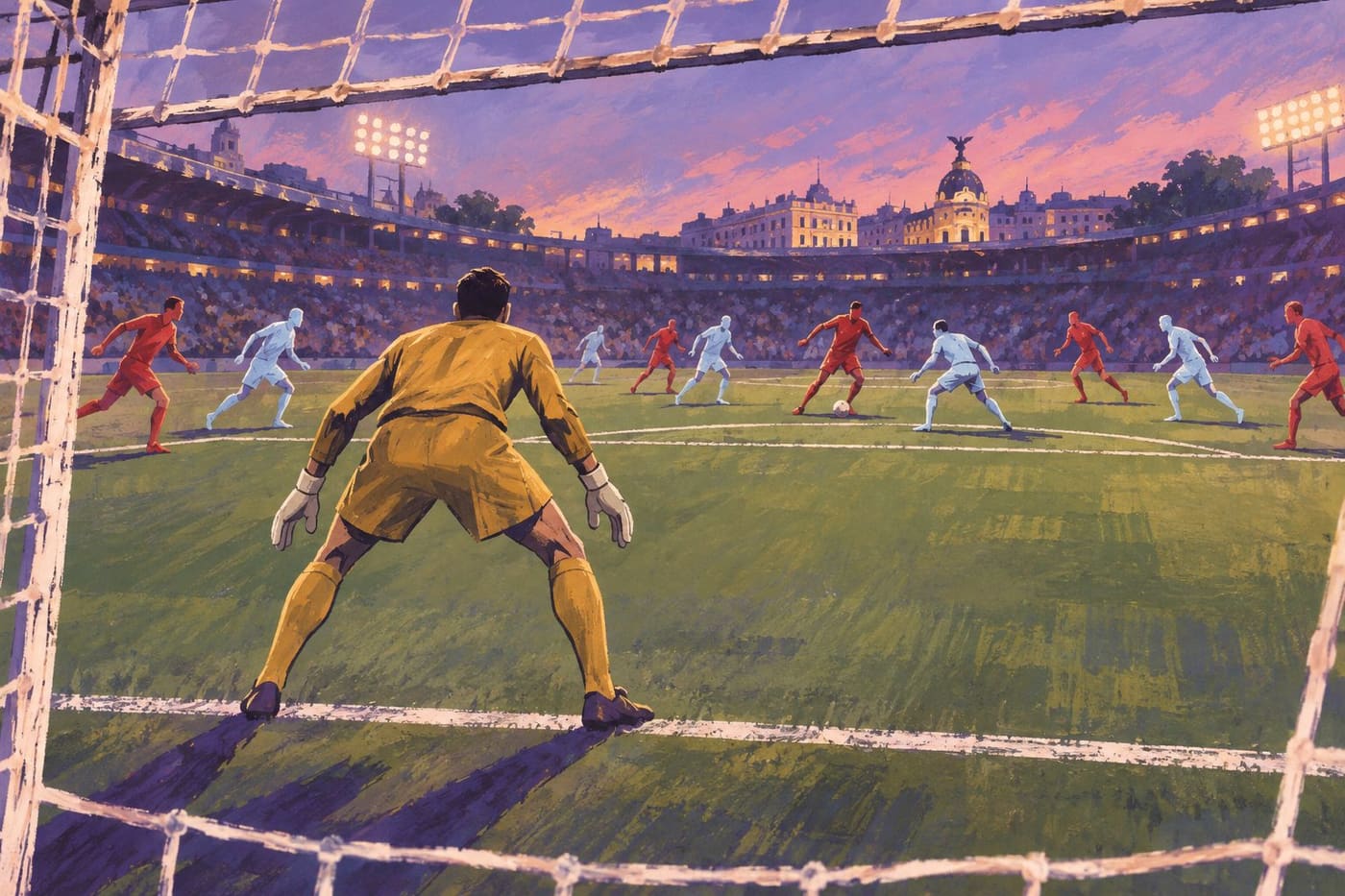
Bayern Munich beat Atlético Madrid 2–0 at the Metropolitano on 3 November 2026, with Lennart Karl scoring in the 54th minute and Konrad Laimer in the 74th. Both goals came after a scoreless first half. At the other end, Manuel Neuer and Bayern kept Atlético from scoring, including during the stretch when one Atlético goal could have brought the sides level. The official Atlético match page confirms the result and goal times.
A clean sheet is easy to describe and harder to explain. It can come from denying an opponent a clear route to goal, from a defender changing the angle of an attempt, from a save, or from the opponent missing. A match report rarely tells you how much each mattered over 90 minutes. This game offers some more specific clues. Bayern's first-half pressure left the score unchanged, Karl turned a loose ball into the opener, and Neuer had to preserve that lead before Laimer made it two. Following those passages in order makes the result more informative than the final margin alone.
Start with what 0–0 at half-time tells you
Bayern's match report describes the visitors as having more of the play early on. It records Karl shooting over in the 23rd minute after Dayot Upamecano won possession and Harry Kane helped move the ball on. Four minutes later, Laimer crossed for Kane, whose attempt went wide. Bayern also describe a later Kane shot blocked by Dávid Hancko. None of those passages changed the score.
These examples are useful because they separate reaching a dangerous area from making the goalkeeper intervene. An attack can push the defending side back and create a shot without putting the ball on target. A block may end a move that started promisingly. A cross may find its intended player, but the finish may be difficult because of the angle or the body's position. A scoreless half can therefore contain different kinds of attacking progress even when the result is the same for both sides.
For Atlético, reaching the interval level meant that the next goal could still put them ahead. For Bayern, the earlier openings offered routes to revisit without yet supplying a lead to defend. If you are reviewing the match, notice where the first-half attacks ended. The Karl effort and the chance from Laimer's cross have different starting points. One followed a recovery of possession, while the other came from a delivery from wide. Comparing them helps identify how Bayern got close before the eventual breakthrough, without assuming that each move was part of the same repeated pattern.
Karl made the loose ball count
The opener followed a second ball inside the Atlético area. Bayern's account describes a Michael Olise cross, an attempted clearance and a blocked Tom Bischof effort before Karl stepped in and lifted the ball over Jan Oblak. The UEFA round-up also identifies a turnover in the box and Karl's finish over the advancing goalkeeper. Atlético's match page records the goal in the 54th minute.
A second ball is useful to think about as a new possession decision. The earlier pass or shot may already have been stopped, but the ball is still in play. The closest defender has to decide whether there is time to control it or whether it needs clearing straight away. An attacker who reacts to where the ball is going can get a chance before the rest of the defence reorganises. Once Karl took the ball, Oblak had to close the space available to him. The lift gave Karl a way to finish over that intervention.
The replay question is how much of the goal happened before the final touch. Watch the block and see where it sends the ball. Then watch where Karl is as the defender approaches it. Finally, look at when Oblak moves out. That sequence explains the timing of the finish. The first cross did not have to become a direct assist for it to be part of the attack, and the blocked shot did not end the possession.
The goal also illustrates the limit of generalising from one incident. It confirms that Bayern converted an opportunity after an Atlético attempt to clear danger. It does not, by itself, establish how often Bayern recovered balls in the area or why Atlético made particular choices throughout the match. Those questions need more than the highlighted sequence. The opening goal matters here because of its location, its timing and what the score allowed either team to do next.
The phase when one save could protect the lead
At 1–0, Bayern still had a narrow advantage. Atlético's official timeline records a Marcos Llorente shot held by Neuer before the second goal. UEFA's round-up identifies Llorente's effort and a header from Giuliano Simeone among Atlético's better chances. The two accounts give useful evidence about what reached or threatened the goal, even though a short recap selects only some of the attempts.
A goalkeeper's role in a clean sheet can look different from one intervention to the next. Holding a shot ends the immediate attack and gives the defending team possession. A parry can keep the ball out while leaving another contest for the rebound. A shot that misses may look harmless in a box score even if the defence had to work to make the angle difficult. In this match, the described Llorente save is a specific action you can put on the timeline. It preserved a one-goal advantage at a point when an equaliser would have changed the scoreboard immediately.
That phase is also a better place to judge the importance of the save than the final 2–0 margin. An equaliser before Laimer's goal would have made the match level, not simply reduced a two-goal gap. It would have asked both teams to make new choices about where and when to take risks. We cannot know how the remaining play would have unfolded in that counterfactual. What we can see is the value of keeping the lead at the time the attempt was made.
For a closer look, compare the angle of the initial shot with the space a goalkeeper can cover. Then see whether any attacker was positioned for a second attempt. Those are separate pieces of the defensive problem. The score alone cannot tell you whether Bayern's outfield players or Neuer solved each one, so keep claims attached to the particular passages the official reports describe.
Laimer's goal gave Bayern a wider margin
In the 74th minute, Laimer scored Bayern's second. UEFA credits Kane with the pass into the move and describes Laimer's powerful finish. The clubs agree on the timing and score. At 2–0, a single Atlético goal would still have left Bayern ahead. That is the immediate difference the second goal made, regardless of what tactical adjustments either bench chose next.
Look at the two goals as different kinds of openings. Karl acted when possession was unsettled in the area and finished against a goalkeeper moving toward him. Laimer received from a teammate and could strike the ball with power. The same match produced both a chance that depended on reacting to a loose ball and another that came through a successful pass. That is more specific than saying Bayern needed better finishing after the break. It also explains why a viewer might want to replay the few seconds before each goal, when the opening was created.
The official Atlético timeline records another Bayern effort disallowed after a foul on Oblak. That entry helps distinguish moments in a highlight reel from goals that count toward the score. A replay can show the ball crossing the line. The match record tells you whether the action changed the official result. Atlético's timeline keeps the score at 0–2, consistent with UEFA and Bayern's final reports.
A two-goal lead also changes the meaning of later chances for both sides. A good Atlético opportunity could still affect the result, but the hosts needed two goals to draw level. Bayern had more room to decide whether another attacking run was worth the space it might leave behind. Those are options created by the margin. They are not evidence of a specific instruction or of a change to a particular formation.
Read the clean sheet and the league result together
UEFA noted that the match was Neuer's 164th Champions League appearance. That number gives career context. The actions against Atlético give context for this particular clean sheet. Neither number alone tells you the quality of the chances or how often a defender prevented a shot. A useful account can credit the goalkeeper with documented interventions while recognising that the zero also reflects what happened in front of him.
The win added three points to Bayern's league-phase total. Bayern's pre-match guide records one win and two draws from the opening three games, giving them five points before Madrid. That makes eight after four games. The score also improves Bayern's goal difference by two in this match. For a live position or a later comparison, consult the official league-phase results and check that both teams have played the same number of matches.
It is worth distinguishing the return from this match from the job ahead. Three points and a clean sheet are known outcomes. A finishing position depends on subsequent fixtures and the results of other clubs. The exact table position at an intermediate point in a matchday can move as those fixtures finish. Bayern's points after four matches give a stable reference for what this particular game changed.
A three-stop replay of the away win
If you only have a few minutes for the highlights, start before the first goal. Look at the initial clearance attempt and the blocked shot, then follow the ball until Karl gets to it. That shows how a chance can survive two interruptions in the same passage. For the second stop, choose Atlético's threat while it was still 0–1. Watch what Neuer has to do and note why the timing of the intervention matters as much as the fact that a save was made.
For the third stop, begin with Kane before Laimer's strike. Compare that delivery with the untidy route by which the ball reached Karl. On a second viewing, pay attention to what happens immediately after possession changes. A highlight cut can hide players outside the frame, so use those images to answer specific questions about the ball and the players you can see. The wider tactical conclusions can wait for a longer sample.
One final check is to compare the official lineup with the report. The UEFA lineup page helps identify players and their starting status. The match report records what selected players actually did in important sequences. A starting lineup cannot by itself tell you where a player stood throughout a moving attack. Used together, the sources help distinguish the names on the team sheet from the actions that shaped the result.
The two clubs' accounts also give the viewer different places to begin. Bayern describe several attacks before the interval and explain the chain of actions that preceded Karl's goal. Atlético's timeline is useful for locating a home attempt and for confirming that a later Bayern finish was ruled out. UEFA supplies a compact comparison of the goals and the main chances. When the reports use different levels of detail, start with the facts they share and attribute the more specific description to the source that provides it.
Conclusion
Bayern's win in Madrid had three distinct stages. The visitors created openings before the break but went in level. Karl converted a loose ball, and Neuer dealt with an Atlético threat while the lead was still one. Laimer then made the advantage two with a different kind of finish. The 2–0 score is the official outcome. The order of those actions explains how Bayern got there and why the clean sheet is worth examining alongside the goals.
For another match from the same night, see how three goals changed Barcelona versus Aston Villa.
Sources consulted 4 November 2026 include UEFA's matchday round-up, Bayern's report and Atlético's match record.