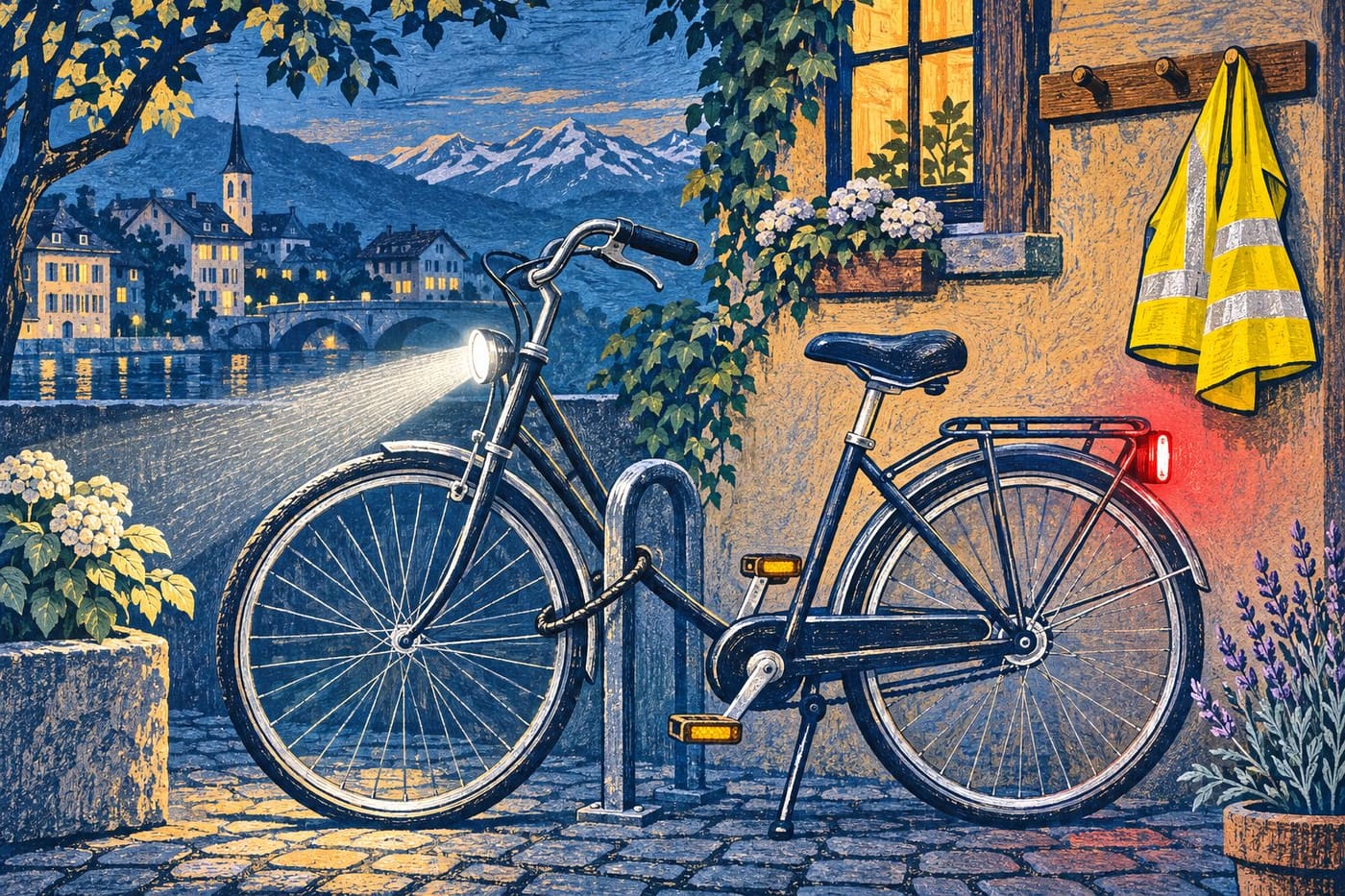
A bicycle's front lamp can help its rider see the road while other equipment helps people approaching from different directions recognise the bicycle and rider. These are connected jobs, but checking one does not settle the other. Switzerland's current visibility guidance brings together working lights, reflectors, conspicuous clothing and considerate behaviour by everyone sharing the road.
The subject has fresh relevance after the national Tag des Lichts on 5 November 2026. The following guide uses Swiss federal, cantonal police and BFU accident-prevention information consulted on 6 November. It distinguishes ordinary bicycles from e-bikes, explains the dates behind the guidance and turns the main points into a practical departure check.
The journey examples and calculations are fictional. They do not reconstruct a collision, assess an individual road user's fault or certify a particular bicycle. No equipment, battery runtime, road route or commercial product was tested for this article.
Why this is the Swiss Trending selection
The actual Google Trends Switzerland page, retrieved at 06:48 UTC on 6 November, displayed "radfahrer" second in descending search-volume order: 10K+, an increase of 1,000% and an Active status. The selected window was Past 24 hours, with All categories and All trends.
The first entry, "john nicks", concerns the same news already covered in today's German slot. This article therefore uses the next highest eligible distinct topic. The displayed order is the rank in that retrieved view, not a permanent ranking or an exact number of individual cyclists.
The broad word "radfahrer" does not establish one verified cause of the searches. This article takes a sourced cycling-visibility angle following the current national campaign. It does not claim that the campaign caused the trend, combine unrelated police incidents or identify a particular crash as the reason everyone searched.
Start with the date of the campaign and the date of the rule
The BFU's campaign page identifies 5 November 2026 as the twentieth Tag des Lichts. Its purpose is to draw attention to visibility in road traffic. The date belongs to an awareness campaign, not the beginning of every lighting requirement mentioned alongside it.
For example, the federal announcement on daytime lights for e-bikes was published on 18 February 2022 and identified 1 April 2022 as the start of that obligation. The current ASTRA vehicle guidance continues to state that all e-bike types must use lights during the day.
For your own note, keep two entries: "campaign date" and "rule or guidance consulted". A current campaign can remind people about an established requirement. Treating every reminder as a brand-new law can mislead someone who wants to know when a duty began or whether an older bicycle is affected.
Check which kind of bicycle you are using
ASTRA's vehicle-specific guidance distinguishes different vehicle categories and expressly states the daytime-light requirement for all e-bike types. An ordinary pedal bicycle and an electrically assisted bicycle should not be treated as interchangeable merely because both have two wheels.
Before applying a summary, identify the vehicle category from reliable information about the actual bicycle. A casual description such as "commuter bike" tells you how someone uses it, not necessarily which equipment rules apply. This guide does not determine a vehicle's approval status from a photograph or advise modifications to its electrical system.
In a fictional household, one person has an ordinary city bicycle and another an e-bike. They can use a common departure reminder, but the e-bike's daytime-light item remains relevant even when the journey begins in good daylight. Copying only the ordinary bicycle's dusk reminder would leave an important distinction out of the shared checklist.
Read white front and red rear as a pair
Bern cantonal police's visibility guidance explains the basic orientation for bicycle lights and reflectors: white at the front and red at the rear. It calls for lights from dusk to daylight, in poor visibility and in tunnels. Check the current requirements for your particular vehicle rather than assuming one illuminated component is the whole system.
A useful departure sequence is to look at the bicycle from both ends while it is stationary in a safe place. Confirm that the intended front and rear lights actually operate, and check for something covering them. A lamp on a shelf, or a charged battery detached from the bicycle, does not establish that the departure setup is ready.
In an invented example, a rider switches on the front light but finds that a coat has fallen over the rear lamp on the rack. The correction is to resolve that obstruction before travelling. This is a simple planning scenario, not a tested method for measuring a lamp's legal brightness or beam pattern.
A reflector and a powered lamp have different jobs
The BFU's visibility guide identifies lighting and reflectors as required equipment and describes additional visibility aids. It also notes exceptions concerning racing pedals, safety pedals and similar equipment. Avoid turning a short general reminder into a claim that every pedal design has identical requirements.
In an original checking routine, use separate lines for "lamps operating" and "reflectors present and unobstructed". A reflector is not a reason to leave a required lamp switched off. Equally, seeing the front lamp work does not tell you whether the rear reflector is covered by a bag.
Keep any uncertainty specific. If a specialist pedal design is involved, check the relevant guidance and equipment information rather than guessing from its appearance. This article does not approve components or give a full vehicle inspection. The practical benefit of the two-line check is that it prevents one successful observation from concealing another part that has not been examined.
Look at the rider's outline as well as the bicycle
The BFU guide lists conspicuous clothing, reflective accessories and features such as spoke reflectors or reflective tyres as ways to add visibility. These suggestions complement the bicycle's required equipment. A bright jacket does not settle whether the lights are operating, and a lamp does not establish that every part of the rider is readily recognisable.
Consider a fictional commuter who checks a reflective jacket before putting on a large backpack. Part of the jacket is then hidden. Repeating the check with the actual bag and coat combination makes the observation more relevant than inspecting clothing alone. It still does not reproduce all the angles, weather or headlights encountered on a real road.
Use a safe stationary location for this check. Do not stand in moving traffic to find out whether drivers notice you. The aim is to catch an obvious obstruction or missing item before departure, not to stage a roadside experiment or declare that a particular outfit guarantees safety.
The return journey may have different conditions
ASTRA's general cycling guidance identifies dusk, darkness, rain, fog and tunnels as circumstances requiring the specified bicycle lighting. Planning only for the weather and light at departure can therefore leave the return leg out of the decision.
In an invented schedule, someone leaves at 14:00 and expects to return at 18:30. The two times alone do not establish the sunset time or conditions at that location. They do show why the rider should consider both journeys and check the relevant local conditions rather than deciding that a daylight start makes lighting preparation unnecessary.
A practical note can record departure, expected return, anticipated low-visibility sections and the equipment needed throughout. Do not invent a precise safe cutoff from this example. Delays, a tunnel or changed visibility may matter independently of the clock. The useful habit is to prepare for the journey being made, including its later stages, rather than a single bright moment outside the door.
Read the BFU percentages with their definition attached
In its 27 October 2026 release, BFU reported that the share of observed bicycle and e-bike riders combining switched-on lights with at least one visibility aid worn on the body rose from 14% in 2022 to 28% in 2025. It also reported differences by vehicle type: 21% for ordinary bicycles, 36% for slow e-bikes and 56% for fast e-bikes.
These are reported observations with a particular definition. They do not mean that 28% of people are guaranteed safe, that everyone else was riding without any lights or that the figures measure November 2026 journeys. Keep the observation years separate from the later release date.
The overall increase is 14 percentage points. Relative to the earlier 14%, it is a doubling. Those are two descriptions of the same change, not two different datasets. Neither calculation establishes a corresponding reduction in collisions. A percentage describing equipment use cannot, on its own, tell you the outcome for a particular person at a particular crossing.
Seeing another vehicle does not prove you have been seen
The same BFU release highlights the distinction between seeing and being seen. Recognising another vehicle's headlights does not establish that its driver has already recognised a cyclist. That is a reason for care in interpreting one's own view, not an invitation to infer what another person must be thinking.
For a fictional reading exercise, imagine a rider who can see a car approaching from a distance. There are two separate observations to keep apart: the rider sees the car, and the driver may or may not have detected the rider. The first does not prove the second. Do not convert that uncertainty into a prediction of what either road user will do next.
A visibility check is therefore one part of preparation. It does not grant priority, remove the need to follow signals or replace attention to other people. Nor should a prevention guide be used to assign blame in an incident whose circumstances have not been established. This article makes no finding about any real collision.
Drivers and other road users have responsibilities too
Bern police's 4 November campaign notice addresses motorists and motorcyclists as well as people cycling or walking. It calls for speed and driving to match visibility and weather, clean windows, functioning lights and consideration for more vulnerable road users. The notice describes two weeks of awareness activity around the campaign date.
Visibility guidance should not be read as a transfer of every responsibility to the person on the smaller vehicle. A cyclist's equipment and a driver's attention are different parts of the shared situation. Improving one does not authorise neglecting the other.
In an original household reminder, keep the tasks assigned to the person who can perform them: bicycle lighting for the rider; clear windows and appropriate vehicle lighting for the driver. This avoids a checklist full of assumptions about what someone else has already done. It also makes the guidance relevant when the same person cycles on one day and drives on another.
Make the departure check short enough to use
A practical checklist can have four prompts: identify the vehicle, check its required lamps and reflectors, check clothing and luggage together, and consider the whole journey's conditions. Retain a separate unresolved item for equipment that needs competent attention. A short checklist is useful when each prompt refers to an observable part of the actual setup.
Keep the observation precise when recording it. "Both lamps switched on before departure" describes what was checked; "the battery will last all evening" is a separate claim that needs supporting information. For a fictional borrowed bicycle, also establish how its controls work before leaving. Familiarity with another bicycle's switch does not demonstrate that this one's lighting has been activated. These distinctions help prevent an assumption from being recorded as a completed check.
Do the check before moving. If a required component is missing or defective, resolve it before riding rather than treating a reflective accessory as an automatic substitute. Refer to the current official guidance and the manufacturer's information for the particular equipment; this article does not prescribe electrical repairs or certify a road-ready vehicle.
Sources consulted 6 November 2026: the linked ASTRA pages and federal announcement, Bern cantonal police guidance, BFU campaign, visibility guide and dated survey release, plus the actual Swiss Trends snapshot. More practical explainers are available in our Lifestyle section. All journey scenarios are fictional. The original illustration is conceptual and is not a product test, a compliance diagram or a photograph of an incident.