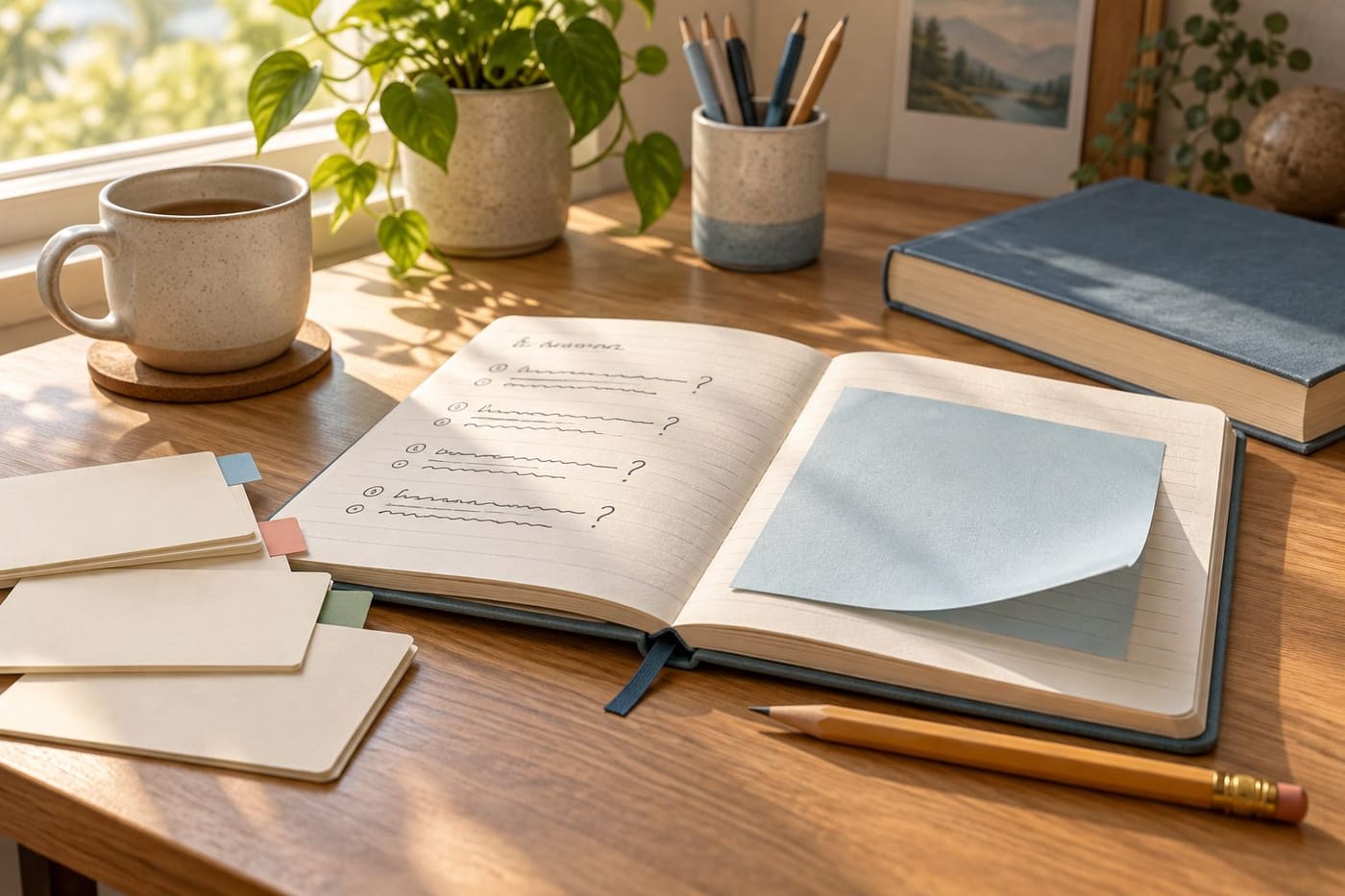
A page can feel familiar after several readings without being easy to explain when the book is closed. A small self-quiz gives you a different kind of information: what you can bring to mind, where your explanation breaks down and what you need to check next. The quiz is useful only if its questions are clear and its answers can be verified. A large pile of cards with doubtful answer keys can create more confusion than it resolves.
Start with one manageable topic, a reliable source and a short set of questions. Attempt the questions before revealing the answers, compare your attempt with the source and use the differences to decide what to revisit. This is a study routine, not a prediction of an examination score or a replacement for understanding the course material in the first place.
Know what retrieval practice means
The Learning Scientists' introduction to retrieval practice describes bringing previously learned information back to mind instead of simply looking at it again. It also recommends checking recalled information against notes or a book afterwards. Those two parts belong together: an attempt from memory and feedback about what the attempt contains.
A 2008 study by Jeffrey Karpicke and Henry Roediger, summarized in the authors' university research record, investigated repeated study and testing of foreign-language vocabulary. Repeated testing supported delayed recall in that experiment. The research provides a reason to take retrieval seriously, but its abstract does not establish a universal timetable, a guaranteed grade increase or identical results for every subject and learner. Keep the study's specific task separate from the practical examples below.
Choose a topic small enough to review properly
Do not begin by converting an entire course into flashcards. Choose a section whose purpose you can describe in one sentence. It might concern a set of historical terms, a method for solving one type of problem or a distinction between two concepts. Use the course's actual learning aims rather than a topic invented because it is easy to turn into questions.
A fictional science learner might choose the difference between mass, volume and density. That is narrower than everything about matter. A short first set makes it possible to inspect every answer key and notice whether the questions actually cover the selected idea. If the task expands, divide it into sensible parts. The number of cards is not a useful measure of understanding when many cards repeat the same point or test details unrelated to the intended learning.
Decide what each question is asking you to do
Naming a term, explaining a relationship and applying a method are different tasks. Write prompts that make the expected action visible. “Density” is an ambiguous card front. “In words, how is density calculated from mass and volume?” gives a clearer task and makes the answer easier to check.
Include more than vocabulary if the topic requires more. You might ask for a definition, a contrast and an example that uses the idea. These are suggested question types, not a prescribed scientific formula for a perfect quiz. The useful test is whether answering the set would demonstrate the understanding you are trying to practice. A set of definition cards alone may not show whether you can explain a process or choose a method in an unfamiliar problem.
Write an answer key while the source is open
Build the key from reliable material, with enough detail to judge an answer. Keep a page, section or link beside it. If two sources use different conventions, note which one the course expects rather than silently merging them. For teacher-provided material, follow the teacher's requirements and ask about genuine conflicts.
Do not create a key by guessing what sounds right and then repeatedly rehearsing it. If you cannot verify a claim, mark the question for clarification and set it aside. A self-quiz is a tool for learning, so an unresolved question is not a failure that needs to be hidden. It is information about where you need a better explanation. Keep doubtful material separate from the questions whose answers you have checked.
Keep the key specific without demanding identical wording
For an explanation question, identify the essential ideas rather than insisting on a memorized sentence unless exact wording is genuinely required. A key might need the relationship between two quantities, the condition under which it applies and an appropriate example. A differently worded answer can still express those ideas correctly.
In a fictional density question, the key could require mass divided by volume and matching units. A response that reverses the division misses the relationship even if it uses the right vocabulary. A response that gives the relationship accurately in another sentence may be sufficient. Your course or subject can require particular notation or terminology, so include those requirements when relevant. The aim is to check meaning while respecting the actual standard, not to turn every personal paraphrase into an automatic correct answer.
Hide the answer before attempting the prompt
Once the question and key are ready, separate them in a way that prevents accidental peeking. Paper cards, a folded sheet or an existing digital tool can all do the basic job. The important behavior is producing an answer before revealing the source, not selecting a particular app or buying a new study system.
Record enough of your attempt to compare it fairly. That may be a few sentences, a diagram or a worked calculation, depending on the question. Thinking that you probably knew an answer after seeing it is different from showing what you produced beforehand. You do not need a polished essay for a short prompt. You need an honest attempt whose contents remain visible when you check the key.
Review differences instead of assigning a vague feeling
After the attempt, compare it with the checked key and source. Identify what was correct, what was missing and what was mistaken. A simple note such as “relationship correct; units missing” is more useful than only labeling the card bad. It tells you what the next attempt should improve.
Keep uncertainty visible. If you are not sure whether your answer is equivalent, return to the material or ask an appropriate teacher or tutor. Do not stretch the key to fit an answer simply because the words feel familiar. Equally, do not mark a sound explanation wrong just because it does not reproduce the textbook sentence. Our guide to using an assignment rubric explores the related task of connecting a standard to evidence in your actual work.
Correct the underlying misunderstanding
If an answer is wrong, find the reason before repeating the card. Perhaps a definition was reversed, two similar terms were blended or a step in a method was skipped. Reopen the source and work through the relevant explanation. Then create a corrected account you understand, with its source still attached.
For a fictional calculation using a mass of 60 grams and volume of 20 cubic centimetres, dividing gives 3 grams per cubic centimetre. If your result was one third, inspect the setup rather than memorizing the numeral three. Ask which quantity belongs above the division and why the unit follows. These are teaching values, not an experiment. The correction should leave you better able to handle another pair of values, not only able to remember the answer to this one card.
Return later rather than only repeating immediately
An immediate corrected attempt can help you check that you understood the explanation, but it does not show the same thing as recalling it after a gap. The Learning Scientists suggest practicing retrieval again later after checking the material. Make a realistic plan to revisit the questions rather than treating one successful attempt as permanent mastery.
This article does not prescribe one ideal interval. Your timetable, the material and the course's demands differ. Keep a record of when you attempted a question and what happened, then use that evidence to guide your next session. A modest repeatable routine is more workable than a complicated calendar you cannot maintain. If every attempt is made while the answer is still in front of you, change the setup so you can distinguish recognition from an actual attempt to recall it.
Add a contrast or a new example
After you can answer a basic prompt, ask a related question that requires a different response. For a concept, compare it with a neighboring concept. For a method, use a new set of values or explain when the method would not apply. Check the new answer against suitable material rather than assuming that changing a few words produces a valid question.
A fictional follow-up to the density calculation might ask whether a larger object must have a greater density. That requires explaining a relationship rather than repeating the previous number. The purpose is not to make every card harder for its own sake. It is to inspect a different part of the understanding that the topic requires. Keep the prompt's scope clear enough that a student can tell what evidence a satisfactory answer should include.
Use diagrams as attempts, not decorations
If a topic involves a process or relationship, a simple drawing from memory may be useful. Label the parts that matter and show the direction or connection the question asks about. Artistic polish is not the objective. A neat copied illustration does a different job from a diagram you reconstruct before checking the source.
Afterwards, compare both the labels and their relationships. A diagram can contain all the right words while placing them in the wrong order. Note that difference explicitly. If the source figure is complex, begin with a simpler question rather than pretending that a quick sketch reproduces every detail. Where the subject needs scale, orientation or a specific convention, include that in the answer requirements. A conceptual sketch should not be presented as a measured scientific drawing.
Exchange questions carefully in a study group
If several people write questions, agree the topic and the source standard first. Ask each person to include a checked answer and reference. Then try the questions before opening the key. An unclear prompt is worth revising even if its author knows what it was supposed to mean.
When answers differ, return to the evidence rather than deciding by confidence or majority vote. A group member may identify a legitimate alternative explanation or a flaw in the key. Record the correction so everyone uses the revised version. Keep the session focused on the selected learning task. Generating a large shared card set is not automatically useful if nobody checks it or if the questions drift away from the course aims. Smaller verified sets can be easier to maintain.
Keep a small record that changes your next action
A useful record can be simple: prompt, attempt date, source reference and one next step. The next step might be reviewing a definition, practicing a contrast or asking for clarification. Avoid collecting so many performance labels that maintaining the tracker takes more time than studying the material.
For a fictional first session, you might record three questions answered adequately, one answer missing a condition and one question awaiting clarification. That is a description of this small practice set, not a percentage prediction for an examination. A question you wrote yourself may not represent the difficulty or breadth of the assessment. Use the record to plan learning, while also following official course guidance and legitimate practice materials supplied for the assessment you will take.
Stop a session with a clear next step
Before putting the materials away, identify what you will revisit and which source you need. Keep corrected keys distinct from earlier doubtful versions. If a question was badly worded, revise it rather than repeatedly testing the same ambiguity. If a topic is still unfamiliar, schedule time to learn it, not only time to quiz yourself about it.
A self-quiz should support understanding rather than replace all other work with recall drills. Some tasks require reading, discussion, extended writing, physical practice or feedback from a teacher. Choose the method that fits the learning aim. The benefit of the small quiz is the evidence it gives you about a particular attempt. It becomes useful when that evidence leads to a better next action.
Conclusion: make the feedback as clear as the question
A workable self-quiz has a defined topic, clear prompts, checked answers and an honest attempt before the key is revealed. Review differences against the source, correct misunderstandings and return to the material later. Use a range of question types when the learning aim requires more than definitions.
Begin with a small set you can inspect properly. The point is not to prove that you studied for a certain number of minutes or produced an impressive card collection. It is to discover what you can explain, what needs correction and what to practice next. Clear feedback makes the quiz a tool for learning rather than a collection of guesses that happen to look like revision.
Sources and research note
Research checked on 2 November 2026 using The Learning Scientists' retrieval-practice explanation and checking advice and the authors' university record for Karpicke and Roediger's 2008 vocabulary-learning study. The study was reviewed at abstract and bibliographic-record scope, not presented as a newly conducted experiment or a comprehensive evidence review. All sample students, numbers and quiz records are fictional. No score guarantee, universal spacing interval or substitute for course-specific assessment guidance is claimed. The image is an original conceptual illustration, not a real student's work or examination paper.