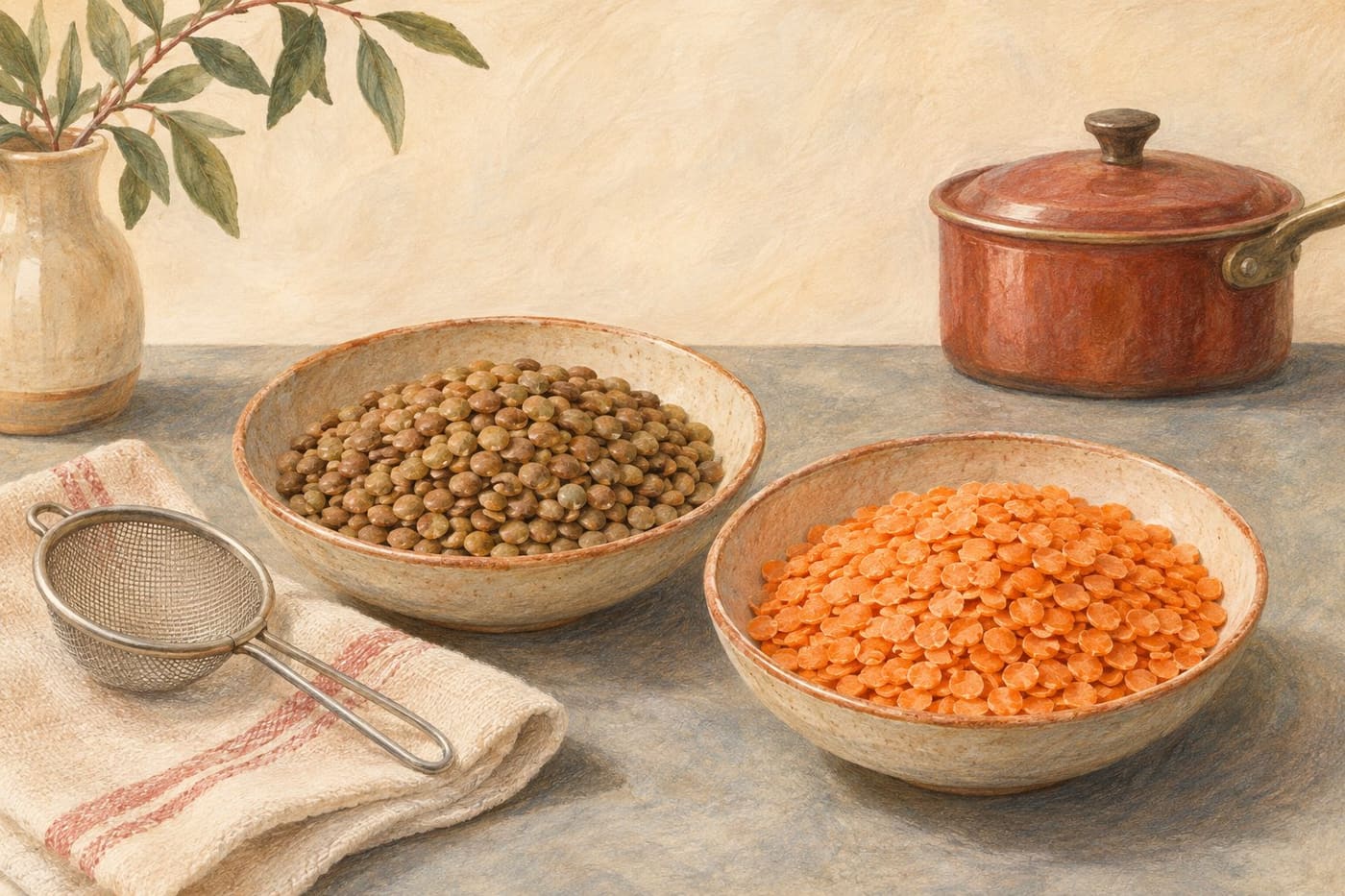
Two packets of lentils can lead to quite different dinners. One may suit a dish where the lentils remain individually recognisable; another may soften into the body of a soup. Before choosing a pan or setting a timer, read whether the recipe needs whole or split lentils and what texture the finished dish is meant to have.
That small decision is more useful than assuming every lentil behaves like the last packet you cooked. Colour helps describe a product, but it is not the only information that matters. The packet's name, preparation instructions and the recipe's intended use belong together.
This guide draws on pulse-industry preparation resources, Iowa State University Extension and UK Food Standards Agency guidance. It offers a cooking plan rather than a new tested recipe. The household examples are invented; no batch was cooked, tasted or measured for this article. Follow the instructions for the identified product and a recipe designed for that lentil type.
Read the form as well as the colour
Lentils.org's introduction explains that split lentils have had their seed coat removed and their inner seed divided. It distinguishes their quicker softening and usefulness in purées or thick soups from whole lentils used where a more defined texture is wanted. Whole and split are therefore practical descriptions, not just alternative words on the packet.
Look for the complete product description when making a substitution. A recipe that names whole green lentils is giving you information beyond the colour green. If the cupboard contains split red lentils instead, recognise the change before beginning. You may choose a different recipe rather than expecting an identical result from a different ingredient.
Keep uncertainty visible when lentils have been transferred to an unlabelled jar. Do not identify an unfamiliar pulse solely from a distant picture or treat every small split pulse as the same ingredient. Retaining the packet's name and instructions with a storage container makes the next cooking decision easier. This guide concerns identified lentils, not preparation of an unknown mixed collection of dried pulses.
Decide what the lentils need to do in the dish
The Alberta Pulse Growers lentil guide distinguishes softer red or split lentils for soups from firmer types suited to dishes such as salads. It also lists whole red, split red and green lentils separately. A useful choice begins with the desired role in the meal, rather than a belief that one form is always better.
For an invented example, Samira wants a warm bowl in which cooked lentils remain visible among vegetables. Her second idea is a spoonable lentil soup with a softer body. These are two different goals. She should find a recipe for each goal and check the specified form, instead of choosing a packet first and trying to force both dishes to match one texture.
Describe the goal plainly in a cooking note: "tender lentils with some shape retained" or "soft lentils contributing to a thick soup." That description gives you something to compare with the recipe's instructions. It does not certify a result in advance, and it is not a judgement that a soft dish is a failed version of a firmer one.
Sort and rinse before the pan goes on
Iowa State University Extension's lentil pantry guide advises inspecting dry lentils for small stones, dirt and withered pieces, then rinsing under cool running water. It also notes that ordinary lentil preparation does not require a soaking stage. Those instructions are specific to lentils; they should not be extended to every dried bean or pulse.
Give this step a place in the work plan. Have a clean tray or surface for inspection and a suitable colander or sieve for rinsing, rather than starting the pan while still searching for equipment. Make sure the openings will retain the lentils you are using. Follow the packet if it supplies additional preparation instructions for that product.
For Samira, inspection also gives a chance to check that the contents match the saved label. If the jar's identity remains uncertain, that question comes before a cooking method. Rinsing does not identify an unknown ingredient, reverse unsuitable storage or turn a damaged product into a sound one. Keep food preparation and ingredient identification as separate tasks.
Keep the method and quantities from one recipe together
The stovetop lentil section of USA Pulses' preparation guide describes rinsing, bringing lentils and water to a boil, then reducing to a simmer until tender. Its guidance distinguishes ordinary whole-lentil cooking from quicker split-red preparation. A recipe's lentil form, liquid amount and intended finish need to be read as a connected method.
Do not take a water quantity from one recipe, a pan arrangement from another and a cooking time from a third, then assume the combined instructions have been tested together. Read whether the recipe expects liquid to remain as part of the dish or be drained. A soup and a separately cooked component can ask for different outcomes even when both start with lentils and water.
Write down the starting quantity in the units the recipe uses. If you change the batch, use a reliable method appropriate to that recipe and equipment, rather than treating an ingredient conversion as proof that cooking time changes in the same proportion. This guide gives no new universal lentil-to-water ratio, appliance setting or large-batch procedure.
Use time as a guide to checking, not a universal promise
The selected preparation sources give different time ranges, and they also distinguish whole from split lentils. That is a reason to retain the context of a stated time. The number may concern a particular form, method and desired finish. It should not be detached from those conditions and presented as the minute at which every packet must be ready.
Begin with the packet and the recipe you have chosen. Set a reminder to check according to their directions, then assess the actual cooked lentils and the recipe's stated endpoint. Look for a cooked-through, tender result appropriate to the dish; a still-hard centre is not the texture intended by a tender-lentil instruction. Continue the prescribed cooking method as needed rather than treating the timer alone as the answer.
Iowa State's guide also notes that older lentils may take longer to soften. Record the packet and what happened if a batch differs from your expectation. A longer time does not, on its own, identify one definite cause. No experiment here has separated the effects of product age, cooking conditions or recipe changes, so the article does not claim to diagnose your pan from a single observation.
Keep whole and split batches separate when comparing
If you want to learn the difference in your own kitchen, choose recipes written for each type and make a modest plan. Record each product's name and whether it is whole or split. Keep its preparation directions, liquid measurement and endpoint together. This is a suggested household learning activity, not a controlled food-science study.
Samira's invented plan might give one column to whole lentils for a vegetable bowl and another to split lentils for soup. Each column names the recipe and intended texture. She can compare how useful the finished component was in its own dish without pretending that two different recipes isolate the effect of splitting alone.
If the purpose is a direct experiment, more variables would need control than this guide establishes. For ordinary dinner planning, a practical observation can still be useful: whether the identified ingredient suited the intended meal. Write that limited conclusion instead of turning one household batch into a rule about every variety or brand.
Adjust the meal plan before inventing a substitution
When the cupboard contains a different form from the recipe, start by asking whether another recipe already uses it. A planned salad need not become the test ground for every available lentil. A soup need not follow the cooking sequence of a dish designed to keep individual lentils intact.
Separate the ingredient decision from the rest of the meal. Samira can keep the vegetables she planned and choose an accompanying lentil dish that fits the packet. That changes the menu deliberately instead of hiding the substitution until the texture becomes a surprise. Write the change on the recipe so that another person cooking from it knows which ingredient was actually used.
Avoid claiming a traditional dish's identity or an exact regional method from a generic packet substitution. Lentils appear in many distinct food traditions, and this article supplies no authority to collapse them into one universal recipe. It also makes no nutrition prescription, allergy assurance or claim that one ingredient swap suits every person's dietary needs. Read the actual ingredients and relevant product information for the meal being prepared.
Plan leftovers before deciding on a larger batch
The UK Food Standards Agency's chilling guidance advises cooling cooked food and refrigerating it within one to two hours, using smaller portions to help cooling. It recommends a fridge between 0 and 5°C and eating leftovers within 48 hours or freezing them. These are the UK guidance boundaries used here, not an extension based on a longer storage claim elsewhere.
Have suitable containers and space ready before cooking extra. Label what the food is and when it was prepared, so that an indistinct container does not become a guessing exercise later. Follow any relevant instructions for the complete dish, not merely the dry ingredient. Adding other components does not make the finished meal's storage history irrelevant.
If cooling or storage conditions are unknown, do not replace that missing information with a reassuring smell or a calculation of the recipe's original cooking time. This article has not inspected a refrigerator or assessed a particular leftover meal. It gives no assurance that food with an uncertain history is safe to keep or that reheating can resolve every earlier handling problem.
Reheat the portion you intend to use
The Food Standards Agency's cooking guidance says leftovers should be reheated until steaming hot throughout and reheated only once. Its microwave advice includes following packaging and appliance instructions, with attention to stirring and standing where directed so that heating is not judged only at the edge.
For a household plan, decide which stored portion is needed rather than repeatedly warming the whole batch and returning the remainder to storage. Keep the reheating step distinct from adding a garnish or changing the texture. A softer consistency is not, by itself, evidence that a cold centre has been heated through.
Record the preparation and reheating history in a way that another person in the household can understand. If someone else will use the food later, a clear label and an agreed plan are more useful than an unspoken assumption that everybody remembers when the pan was cooked. No food was reheated or tested for this article, and the illustration does not show a verified finished batch.
Keep a short note that improves the next dinner
A useful lentil note can be brief: product name; whole or split; recipe; starting quantity and units; preparation steps; actual cooking observations; intended and resulting texture; and the storage plan. These are suggested household fields, not a requirement to produce a professional kitchen record before making a meal.
Write observations specifically. "The whole lentils were tender and still distinct in the bowl" is more informative than "perfect." "The split lentils suited the soup's softer texture" describes a use rather than a universal quality ranking. If a result did not suit the dish, identify the mismatch and decide what to change next time without inventing a scientific explanation.
For a repeat attempt, keep the original recipe available and make any chosen change explicit. Changing ingredient form, liquid amount and method at once makes it harder to know which difference mattered. You can still enjoy the meal, but the note should not claim that it proved a single cause. Cooking records are useful when they preserve what actually happened.
Finish with the ingredient and the dish aligned
Before cooking, confirm the packet, the form of the lentil and the intended texture. Inspect and rinse as directed, use a method written for that product, and check tenderness within that method. Plan how the finished meal will be served, cooled or stored before increasing the batch. Keep a substitution visible instead of expecting two different ingredients to behave identically.
More cooking guides are available in our Food section. Sources consulted 6 November 2026: selected Lentils.org, Alberta Pulse Growers, USA Pulses and Iowa State preparation pages, plus the Food Standards Agency's dated guidance now published on GOV.UK. All household scenarios here are invented, and no recipe, product or appliance was tested. The original illustration is conceptual. Choosing whole or split lentils is a small first step that makes the rest of the cooking plan clearer.