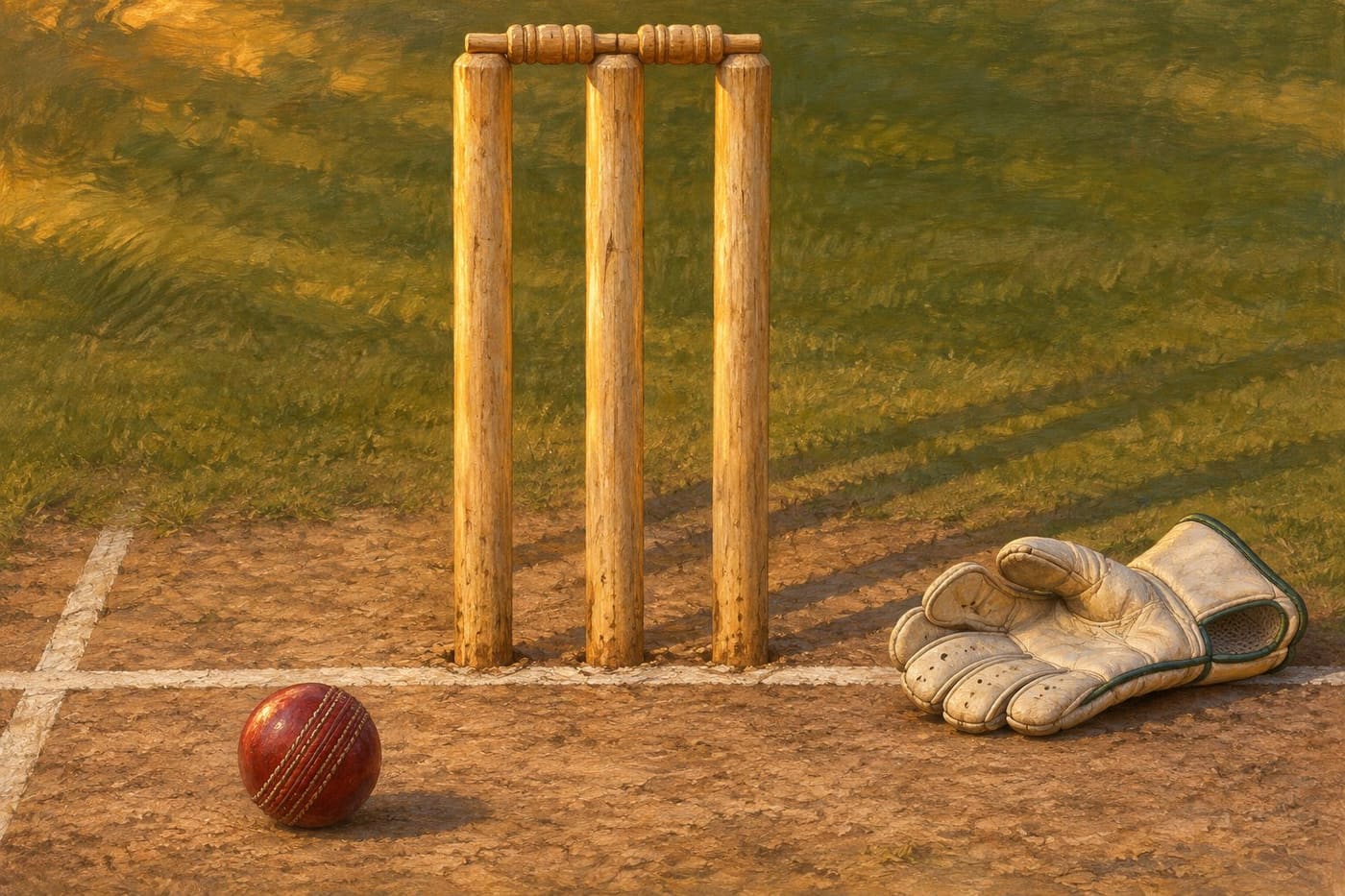
A replay shows a bail coming off, a batter stretching for the crease and a fielder’s hand close to the stumps. The camera freezes, and the discussion turns to whether the fielder controlled the ball. Before answering, look at what actually broke the wicket. A ball striking the stumps and a hand removing a bail while holding the ball involve different parts of the same problem.
That distinction prompted an MCC clarification on 8 October 2026. The clarification explains a change that took effect on 1 October. It addresses control when a fielder breaks the wicket with a hand or arm while holding the ball. It also confirms that a ball can still hit the stumps and dislodge a bail without first being held under control. The announcement is a useful starting point for reading a replay carefully.
Identify the act before judging the grip
Begin with a simple description of the action. Did the ball hit the wicket? Did a fielder’s hand or arm break it while holding the ball? Did an empty hand arrive first? Those descriptions give you a route to the relevant rule. A general statement that the ball was “in the area” leaves the decisive contact unresolved.
MCC’s clarification says that, for the hand-or-arm method, holding the ball requires complete control in the relevant palm or fingers, including those of a wicketkeeper’s glove. The rule should not be extended into a requirement that every direct hit must first have been controlled in a hand. That would change the meaning of ordinary throws and deflections into the wicket. Keep the two methods separate as you watch.
Suppose a fielder throws from cover and the ball knocks a bail off. A later image shows another fielder reaching toward the stumps. The grip of that arriving fielder may have nothing to do with how the wicket was broken. Your first job is to identify the ball’s impact and the resulting movement of the bail. Only then can you decide which close-up is relevant.
Now imagine a wicketkeeper gathers a throw and sweeps a glove into the wicket. In that example, the ball’s relationship to the glove becomes central. A frame that shows contact between ball and glove is a starting observation. To describe control, you need the surrounding action as well. The distinction between contact and holding is exactly why a replay should be read as a sequence.
Use the edition and the match conditions
The 2026 fourth edition of MCC’s Laws of Cricket provides the underlying text. The October clarification directs readers to Appendix 2.7 and 2.8 for the relevant control provisions. Save the edition along with the reference so that someone checking your explanation can find the same wording.
A competition can apply playing conditions alongside the Laws. If you are explaining a particular match, check the conditions for that competition and date. A clip uploaded in November may show a match played earlier, and a caption may omit the format or competition. Establish the event before connecting it with a change that took effect on a particular day.
For an informal discussion, you can still state the scope clearly. Say that you are explaining the MCC clarification effective from October 2026, then identify the action it addresses. For an account of a real decision, add the match, date and applicable playing conditions. That keeps a general explanation from becoming an unsupported claim about what an umpire was required to do in an unidentified clip.
This article uses invented plays to explain a viewing method. They are deliberately simpler than a full match incident. In a real decision, the officials may need to consider several conditions together, and the broadcast may show only part of the evidence available to them.
A direct hit and an arriving hand
Picture a hypothetical throw to the bowler’s end. The ball travels from a fielder’s hand, hits a stump and sends a bail away. A supporting fielder reaches across the wicket immediately afterward. If you stop the replay at the later moment, the supporting hand can appear to be part of the removal even though the ball has already done the work.
Watch backward to the beginning of the contact, then forward through it. Find the first visible change in the bail and the object that caused it. Write down what the angle shows. A side view might give a good view of the batter’s bat but a poor view of the ball behind a stump. Another angle may show the impact clearly. Use each angle for the question it can answer.
In this play, the October clarification about a hand holding the ball does not turn the throw into an invalid method. The control issue belongs to a different action. That still leaves the other requirements for a run out to be assessed. A fair breaking of the wicket and the batter’s position are separate parts of the decision.
A careful description might say that the ball appears to strike the wicket directly, after which the supporting fielder’s hand arrives. If the angle hides the initial contact, describe that limit instead. The result of the play cannot fill a gap in the visible sequence.
A gathered ball and a sweeping glove
Consider a second invented play. A throw reaches the wicketkeeper, who moves a glove toward the stumps. At one instant, the ball touches the glove. In the next, the bail begins to move. The question is whether the ball was held with the required control when the glove broke the wicket.
Follow the ball through the gather, contact and follow-through. A ball that appears secure after the wicket is broken does not automatically establish its status at the earlier instant. Conversely, a ball that comes free afterward does not by itself settle what happened at contact. The timing is the point you are trying to establish.
It can help to keep two notes. One records the earliest visible point at which the wicket is broken. The other records what the ball and glove are doing at that point. Then check whether the pictures actually support both observations. If the ball is hidden, a confident statement about the grip may go beyond what that camera can show.
This is also where the wording of a report matters. “The ball touched the glove” describes contact. “The keeper held the ball with complete control when the glove broke the wicket” makes a more specific claim. Use the stronger wording only when the relevant evidence supports it or when you are accurately reporting the officials’ decision.
A deflection that reaches the stumps
A third example begins with a driven ball touching the bowler’s fingers and continuing into the non-striker’s wicket. The bowler has not gathered it. The ball itself causes the break. MCC’s clarification expressly addresses the confusion that could arise from treating complete control as a requirement for every run out.
For a viewer, the useful observation is the route of the ball. Locate the contact with the fielder and then its arrival at the stumps. Do not replace the actual route with a different one simply because the ball was never caught. A deflection and a gather followed by a hand removing a bail should have different descriptions in your notes.
Again, this identifies the method by which the wicket was broken. It does not determine the batter’s ground, the state of the ball or every other condition of dismissal. Keep the example narrow. A rule explanation is clearer when it resolves one disputed point and then shows which questions remain.
If you are sharing the example with a new viewer, ask them to describe the action before naming a decision. They might say that the ball touched the bowler and then hit the stumps. That sentence gives you a much better starting point than an argument over whether the bowler “had it.”
Keep the batter’s ground on a separate timeline
Once the breaking of the wicket has been identified, examine the batter’s position at the relevant time. The Laws’ treatment of a batter’s ground and run outs belongs in the same decision, but it answers a different question from ball control. Record the instant you are using rather than switching between a frame of the bail and a later frame of the bat.
A bat can be close to the crease without the picture showing everything needed about its position and grounding. A low side angle, an overhead view and a camera behind the wicket can make different details visible. If the bat is obscured, state that. A dramatic diving pose is not a substitute for the relevant view.
Suppose your best angle shows the glove and bail clearly, while the bat disappears behind the wicket. You may be able to explain the control question from that angle and still be unable to decide the ground question. A second view can supply evidence, but only if the two views refer to the same instant. In an edited clip, the replay may restart at a different point each time.
The MCC Laws portal provides access to the Laws and current announcements. When using the site for a specific provision, verify the edition shown. The 2026 PDF and the dated clarification give a stable reference for the change discussed here.
Why one still image can be misleading
A still image can be excellent for locating a bat relative to a line or showing the position of a bail. It loses the movement that helps explain how the ball arrived and what the fielder did. For control questions, that surrounding movement can be crucial to understanding the action.
Before sharing a screenshot, watch the normal-speed sequence and the available replay. Note where the clip begins. If it starts after the gather, it may omit the moment that would distinguish a clean hold from a bobble. If it cuts away as the bail moves, it may hide the actual contact. The missing part should remain a limit on your conclusion.
Avoid treating a commentator’s first reaction as the final account. Live commentary often accompanies an incomplete view, and a later angle may change the explanation. A written report should identify the final decision and then describe the evidence it uses. If you are discussing only what a public replay shows, keep that scope visible.
Our guide to reading a tennis score uses a similar habit of identifying the question before interpreting the display. In cricket, the first useful division here is between the object that broke the wicket and the batter’s position when it happened.
Build an explanation another viewer can check
A short explanation can follow the order of the evidence. Identify the match and applicable edition, describe the method of breaking the wicket, locate the relevant moment and say what the ball and batter are doing. Link the official provision that addresses the disputed point. If you are quoting a decision, name it as the decision rather than presenting your own viewing judgment as an official finding.
For example, a report could explain that the dispute concerned a glove breaking the wicket while holding the ball, so the control provision was relevant. It could then say that the available angle did not reveal the ball throughout the contact. That gives a reader a clear account of the question and the limit of the evidence.
Another report might describe a direct throw striking the stumps, making the hand-control debate beside the point for that method. The report would still need to address the other dismissal conditions. The advantage of the method is that you can explain which part of the decision a rule settles and which part needs another observation.
The next time a replay freezes on a run-out attempt, begin with the action that broke the wicket. Then follow the relevant evidence in time. That sequence gives complete control its proper role in the discussion and helps you avoid asking a single camera frame to answer several different questions at once.
Sources consulted 5 November 2026. The three plays and reporting examples are hypothetical. This explanation addresses MCC’s October 2026 clarification and does not adjudicate a real match incident.