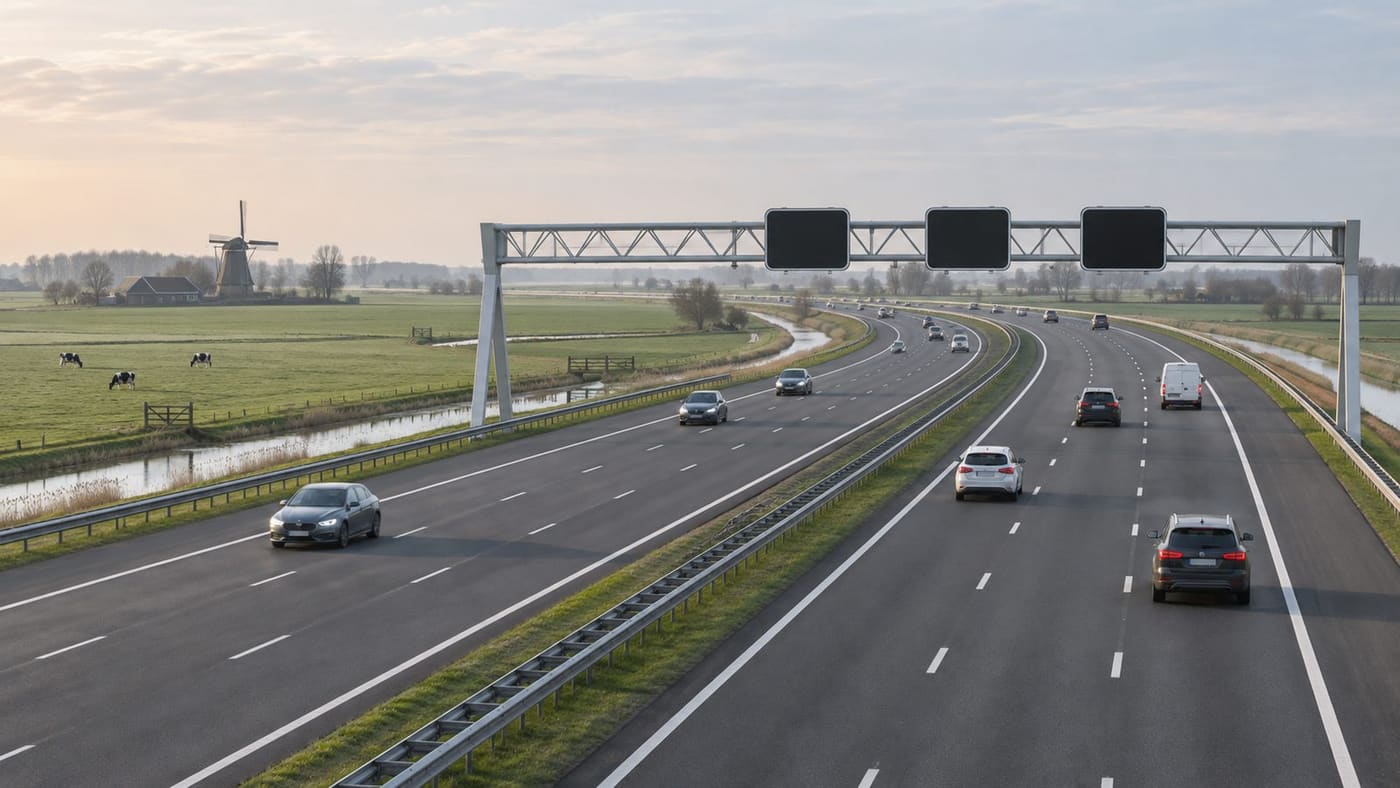
On most Dutch motorways the daytime limit for cars is 100 km/h from 06:00 to 19:00. Some sections have a lower limit and some have a higher one. After 19:00, the limit can remain 100 or rise to 120 or 130, depending on the stretch. The number you need is the one that applies to your vehicle, on that stretch, at that time. The Dutch government’s motorway speed guide explains the general pattern, and Rijkswaterstaat’s road-sign guidance explains how the signs put it into practice.
The Dutch word maximumsnelheid means maximum speed. It ranked first in a Netherlands Google Trends snapshot retrieved at 13:26 UTC on 7 November 2026. In the past-24-hours view, with all categories and trends and descending search volume, it showed 20K+ and was marked Active. That describes search activity. The sources consulted for this guide do not establish a single reason for the searches.
What the 06:00 to 19:00 plate tells you
Start with the round sign and read any plate below it. Rijkswaterstaat explains that a 100 km/h sign without a time window applies throughout the day on the section it governs. A plate giving 6–19 h limits the period for which the displayed number applies. Its example of a 100 sign with that time window uses the 130 km/h standard motorway limit outside the displayed hours. Other stretches can show a different night limit, so read the complete signs for the section in front of you.
A two-window sign can set out both numbers. Rijkswaterstaat gives the example of a section where the limit is 100 during the day and 120 overnight. In that case the second line answers the evening question. If you only remember the daytime number, look again at the whole sign and the hours next to each value. The arrangement of two rows is part of the instruction.
The evening period runs across midnight. On a hypothetical section signed 100 from 06:00 to 19:00 and 120 from 19:00 to 06:00, a car passing at 18:45 is still in the daytime period. A car passing at 19:15 is in the evening period, and so is a car passing at 05:45 the following morning. A separately posted lower limit or applicable vehicle limit can change the maximum in those examples.
For visitors, keep the unit visible. The numbers here are kilometres per hour. A navigation display set to miles per hour may show a different number for the same speed. The physical sign uses the local unit. Set the display you rely on to the unit you can interpret reliably before you set off.
Why the road number cannot answer the question by itself
An A-number tells you the identity of a motorway. It does not give you the speed limit for every kilometre of it. The same road can pass through different environments and junctions, and sections can have different time rules or work restrictions. Rijkswaterstaat’s overview of road rules provides context for the network as a whole. The sign gives you the specific instruction.
There is a difference between the default in an official explanation and what applies at a particular location. The motorway default helps explain why a 130 sign may be absent where that standard applies outside restricted hours. It does not cancel a signed 100, a works limit or a lower limit applying to the vehicle. When the route moves onto a different section, read the signs again even if the road number has not changed.
Rijkswaterstaat also distinguishes motorways from other national roads in its guidance. Some roads with N-numbers fall within the national road network. The existence of an N-number does not carry the motorway time pattern onto that road. Pay attention to the road type and local signs when following a diversion. A detour can take you off the motorway and onto roads with a different set of limits.
What a temporary overhead number means
The overhead electronic displays are often called matrix signs. Rijkswaterstaat says that where fixed signs and overhead traffic signalling both show speeds, the lowest displayed limit applies. A lowered number can appear because of a queue, an incident or other conditions requiring traffic to slow. The government’s general guide likewise explains that a speed shown on a matrix board applies at that moment.
Imagine the roadside signs give a normal night limit of 120 and the overhead display shows 70 during a queue. The lower number is the one to follow in that situation. You do not need to know the reason for the display before adjusting. The change is there for traffic approaching a condition that may not be visible from your car yet.
A changing lane layout can also matter. Rijkswaterstaat describes peak-hour lanes where the indicated speed changes when an extra lane is open. A stretch that felt familiar on a quiet journey can have a different limit when the lane is in use. The authority’s illustrated explanation of maximum-speed signs provides examples of signs. The live indication is what matters as you travel through the section.
When the displays change again, look at the current signage as a whole. A gap between gantries does not supply enough information on its own to determine whether a lower instruction has ended. A roadworks sign can remain relevant even if there is no number directly overhead. Read the next indications and be prepared to slow for conditions even when a higher limit is permitted.
An A12 example shows why the date and direction matter
A Rijkswaterstaat notice about works at Oud-Dijk described an overnight A12 closure in the Arnhem direction on 5–6 November 2026. The notice separately said that from Saturday morning, 7 November, concrete barriers would be in place on the middle lanes in both directions and a 90 km/h limit would apply at that location. Those are two instructions for different periods.
That distinction is useful when a headline still says “closure” after the closure window has passed. Read the notice far enough to find any subsequent lane arrangement, speed restriction or other condition. A road may reopen while the works continue. Conversely, a later arrangement cannot be used to infer that a road was open during an earlier closure.
The direction can also change within one notice. The overnight closure in this example concerned one direction, while the barrier arrangement was described for both. Before a trip, match the junctions, direction and dates to your route. During the trip, follow the signs at the site. For a separate example of checking route notices against the planned journey, see our Auckland Marathon road access guide.
Other works notices make the same point in different ways. The A28 Vollenhoventunnel notice described planned disruption from 9 to 13 November and said the existing 90 km/h limit would stay in place. The A1 maintenance planning page describes reduced limits in narrowed lanes on the affected works route. Each notice has a specific footprint and period. Neither supplies a rule for the entire motorway.
What an announcement about 130 km/h establishes
The government announced on 14 April 2025 that daytime 130 km/h was returning to named motorway stretches. It identified sections of the A7 on the Afsluitdijk and near the German border and a section of the A6 between Lelystad-Noord and Ketelbrug. That dated notice concerned selected sections. It should be read as a historical announcement, with the current route checked against present signage.
An earlier government announcement identifying possible sections answers a different question. It names places considered for a change. A proposal or a list of candidates can help explain how a policy developed. It has a different evidential role from an implementation notice, and both differ from a sign that applies on the road today.
A practical way to read a speed-limit headline is to look for four details: the exact section, whether it applies to both directions, the effective date and the time window. A phrase such as “on the A7” is too broad to tell you what happens outside the named junctions. A heading about the return of daytime 130 is too broad to tell you whether the change is already in force. The details usually appear in the notice body.
What to check when you are towing
The government guide specifically notes that a trailer or caravan can change the applicable maximum speed. If you are towing, use the part of the official guidance that describes the vehicle and combination you actually have. A motorway sign tells you the speed permitted for the road under the indicated conditions. A vehicle-specific ceiling can still apply below that number.
Do that check before leaving, especially if you are renting a vehicle or caravan and are unfamiliar with its weight classification. Confirm which description in the official guide matches the combination. On the road, keep the lower applicable number in mind when moving between daytime and evening sections. A higher limit on the road does not by itself change the limit for a particular combination.
The same route can therefore produce different answers for two drivers travelling together. One may be in a passenger car without a trailer, the other towing a caravan. They pass the same sign but must also consider the rules for their own vehicles. This is a reason to plan with the vehicle you will actually use instead of relying on an arrival time calculated for another car.
Match a temporary restriction to the section you are using
Suppose the approach to a junction runs through two sets of works. The first involves a narrowed lane and a lower posted speed. The second is a closure scheduled for later that evening. A driver looking only at an online map may see both notices attached to the same road number. The useful comparison is the exact direction, start and end points and time period for each notice. That lets you distinguish the restriction you will meet first from a closure that may affect the return journey.
If a road operator publishes a revised plan, the newer issue can change which lanes will be available without changing the basic day and night rules elsewhere. Save the link to the current notice, and check whether it includes an update date. An earlier screenshot may still accurately describe what was planned when it was taken. It may no longer describe what the operator is doing.
The local signs are especially important where traffic is moved onto temporary lanes. Drivers can be on the same named motorway but pass through a different lane arrangement than they remember. The maximum speed is a ceiling for that section. Leave room for traffic to merge and adjust to the road in front of you. A clear plan gives you the time to do that without treating the posted limit as an arrival-time target.
A way to check a route before leaving
Start with the motorways you expect to use and the local time you are likely to pass through each area. Then look for notices covering the exact junctions and direction. If the journey spans 19:00, assume you will have to read the time-window signs again rather than assigning a single limit to the whole evening. If you are returning before 06:00 the following day, use the clock for the actual return trip.
Keep the route information separate from the speed information. A navigation service can help estimate an arrival time and identify a diversion. Its displayed limit can lag a temporary sign or miss a vehicle-specific rule. If a number in the navigation display differs from a clear road instruction, follow the applicable signs. Check the route before departure so you can focus on the road once moving.
The short answer to maximumsnelheid is that most Dutch motorways use 100 km/h during the daytime window, with exceptions and varied evening limits. For a specific trip, read the fixed sign, any hours below it and the current overhead displays. Where the roadside and overhead numbers both apply, use the lower indicated limit. Check separately for restrictions on the vehicle you are driving.
Sources consulted 7 November 2026. The dated works and policy notices are examples. Use current signs and official guidance for the road and vehicle in question. The image is an original conceptual illustration.