A tree can become familiar long before its seasonal changes become easy to describe. You may notice that it looks greener, barer or more colourful without knowing when the change began. A small observation notebook helps turn that impression into a record whose dates, definitions and missing visits remain visible.
The aim is manageable: follow one individual tree and learn to say what you actually checked. You do not need to produce a climate study, identify every plant in a park or photograph an entire landscape. You need a tree you can recognise again and a question you can answer consistently.
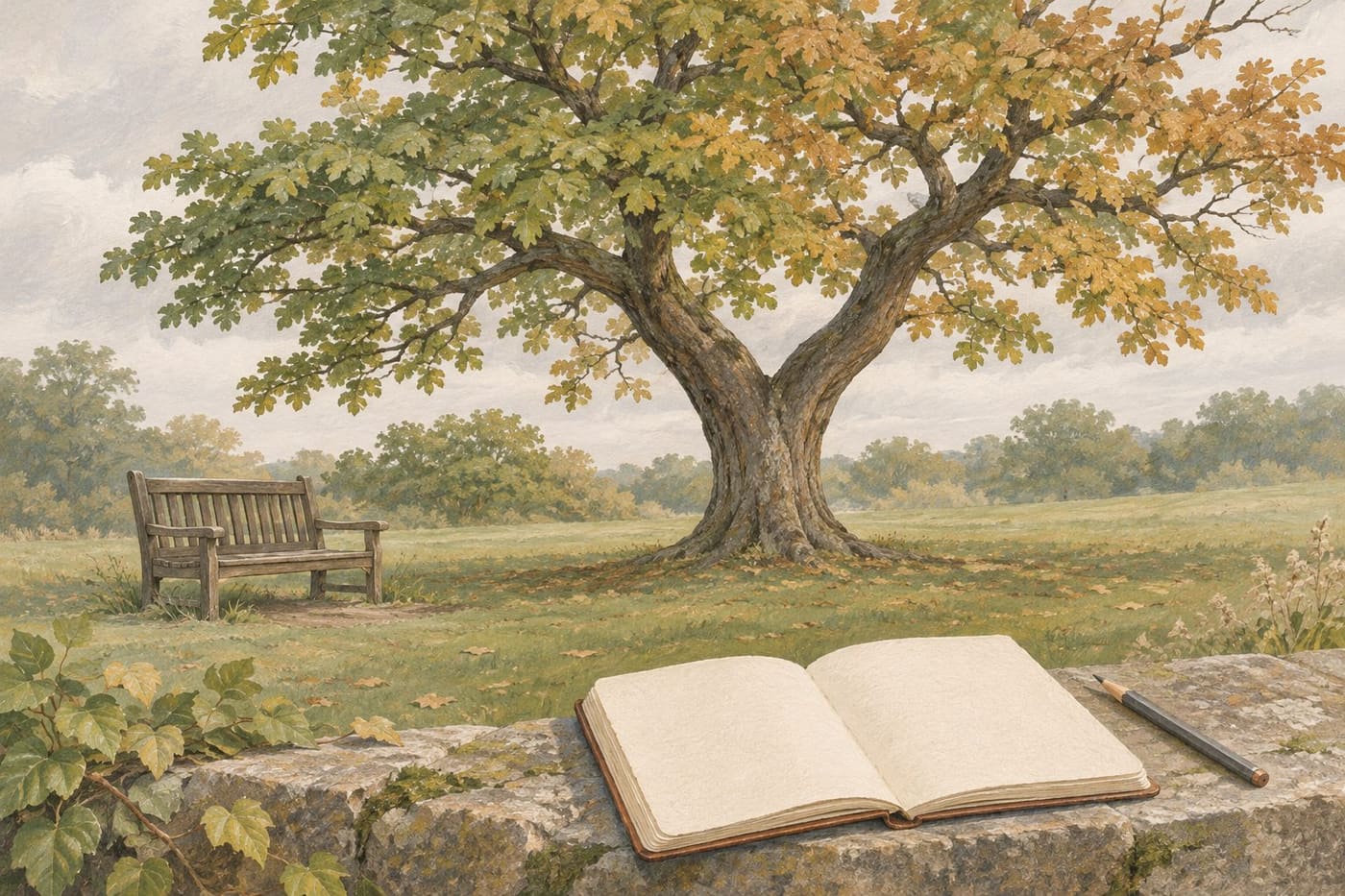
This article includes an original fictional notebook exercise. The observer, dates and entries are invented, and no field observations were submitted to a monitoring project. The accompanying original illustration is conceptual art, not a species identification reference or evidence of an observed tree.
Begin with a tree you can find again
In the fictional exercise, Sam chooses a tree near a bench on a permitted walking route. Sam gives it the private notebook identifier T01 and draws a small location sketch. The sketch distinguishes it from two nearby trees rather than relying on a description such as “the big one.”
The first page includes a whole-tree photograph reference, the forked trunk as a recognition feature and the position of the bench. These details make the practice record usable after a gap. A photograph alone could become confusing if several neighbouring trees have similar crowns.
The Woodland Trust's Nature's Calendar guidance asks observers to use the same tree for multiple events such as budburst, first leaf and flowering. It also recommends regular checks and recording the same location across years. Those are instructions for that project, whose species and event definitions should be read before participation. Source: https://naturescalendar.woodlandtrust.org.uk/what-we-record-and-why/how-to-record-a-quick-guide/
Sam's private exercise is not a substitute for registration or a project's site requirements. If the tree cannot be identified confidently, the notebook can retain a provisional description while the identification is checked. A guessed species should not acquire apparent certainty simply because it appears in a tidy spreadsheet.
Choose the question before choosing the answer
“Has the tree changed?” is an inviting question for a walk, but an awkward heading for a repeatable record. A bent branch, new leaves and a different camera angle could all produce a yes. Sam instead writes separate questions and leaves space for notes about what each answer means.
A phenophase is a recurring stage of a plant's seasonal activity. Nature's Notebook explains that different phenophases can overlap: breaking buds, unfolded leaves and increasing leaf size may be present together. Each question needs its own answer rather than treating the stages as mutually exclusive boxes. Source: https://usanpn.org/nn/faq/Nugget1
Sam keeps a reference to the selected protocol beside the practice sheet. A short personal reminder can help at the tree, but it should not silently replace the formal definition. If a detail is hard to interpret, the next task is to resolve that detail, not to invent an easier threshold.
For a purely personal diary, you can define a narrow question of your own. Label it as your own question. Do not later describe that private measure as an official observation unless it actually meets the receiving project's requirements.
Keep not observed separate from observed absence
The University of Maine's Signs of the Seasons field guide distinguishes yes, no and uncertain answers for phenophase observations. It also asks observers to use the species-specific information and record the observation date. These choices communicate different kinds of evidence; uncertainty is not a defective version of no. Source: https://extension.umaine.edu/signs-of-the-seasons/volunteers-field-guide/how-to-observe/
Sam's private notebook has an additional visit-status field. This is an editorial aid for the exercise, not a claim about a project's submission form. It distinguishes a completed visit, a missed visit and a visit with a restricted view. The phenophase answer belongs in a separate field.
Suppose Sam cannot see the relevant part of the crown because the usual viewpoint is unavailable. Writing no would imply a check that the note does not support. The record instead describes the limitation and uses the protocol's appropriate uncertainty or missing-data treatment.
A missed visit needs even less interpretation. It says nothing about whether a phase was present. Resist the temptation to copy the previous answer into the blank space. That creates a second apparent observation even though only the first one happened.
Work through four invented dates
Here is Sam's fictional practice sequence for one clearly defined phase. The dates illustrate record interpretation only; they do not describe a real species' seasonal calendar.
On 3 April, Sam checks the tree and records that the phase is absent under the exercise's definition. On 6 April, the planned visit does not happen. On 9 April, Sam records the phase as present. On 12 April, another completed visit records it as present again.
The first positive observation in this sequence is 9 April. The notes do not establish the exact moment the phase began. If the initial absence and later presence are reliable and comparable, they bracket a transition between those visits. The missed 6 April visit cannot narrow that interval.
Sam's draft summary originally says, “The phase started on 9 April.” The revision says, “First observed present on 9 April, after an absent observation on 3 April; the planned 6 April visit was missed.” The longer sentence preserves the useful distinction without pretending to know the missing day.
If Sam had started the notebook on 9 April, even the earlier bound would be unavailable. The record could still report presence on that date. It could not recover an onset date from enthusiasm, memory of a different tree or an attractive photograph found online.
Let several answers be true together
A single tree need not fit a neat sequence of one label per visit. In a second fictional exercise, Sam can see both some breaking buds and some unfolded leaves. The worksheet should allow both answers rather than forcing a choice between “bud stage” and “leaf stage.”
Nature's Notebook's overlapping-phenophase example demonstrates why separate questions matter. Its definitions distinguish what is visible, and its example records several concurrent yes answers. This is a useful reason to retain individual fields instead of compressing everything into one season-stage label. Source: https://usanpn.org/nn/faq/Nugget1
Sam tests the worksheet before using it repeatedly. Can it store two positive answers on the same date? Can it preserve uncertainty for one question while another is answerable? Can a later reader tell which definition went with each answer?
If the sheet cannot do those things, changing the sheet is better than simplifying the tree. The practical design goal is to preserve observations that do not fit the observer's first expectation. An orderly form should make complicated evidence easier to retain, not make it disappear.
Separate presence from an amount
For the private exercise, Sam uses one field for whether a chosen feature is present and another for an optional estimate. These are different questions. A small visible amount can support presence without supporting a confident estimate of its proportion across the crown.
If an official protocol asks for intensity, use its categories and denominator. Do not add an invented percentage because a numerical column looks more complete. A note such as “estimate not made” is more honest than an exact-looking number produced without a method.
Sam experiments with a personal sketch showing where a feature was visible. The sketch has a clear caption: view from the bench, not a survey of the whole tree. That limitation matters because the unseen side is not automatically identical to the visible side.
The same caution applies when comparing two visits. A close photograph of one branch and a distant photograph of the entire crown answer different visual questions. Preserve the scale and viewpoint before deciding that the pictures demonstrate a change in abundance.
Use photographs as supporting notes
Sam's proposed file names begin with the tree identifier and observation date, followed by a view description. For example, T01-2027-04-09-whole-tree is an invented naming example. The photograph itself would need to exist and match that date before it became evidence.
A whole-tree view helps with identity and overall context; a closer view may help explain a specific observation. Neither automatically proves every answer on a form. Keep the written note that connects the image to the particular question being considered.
When taking a repeat view, note a change in position rather than cropping away the evidence that the view is different. A moved bench, blocked path or new fence may affect what can be compared. The record can survive such changes if they are visible in the notes.
Keep original files alongside any smaller copies used in a personal summary. If an image is edited for presentation, avoid edits that alter the feature being discussed. A brightened illustration belongs in a different category from a field photograph used to support an observation.
Make the routine small enough to keep
A repeatable observation plan begins with access that is practical and permitted. The University of Maine field guide emphasises convenient sites, appropriate permission and safe observation. It also asks observers to document unusual site conditions rather than treating every location as interchangeable. Source: https://extension.umaine.edu/signs-of-the-seasons/volunteers-field-guide/how-to-observe/
Sam chooses two possible visits in a weekly personal diary, while recognising that an actual project may require a different frequency. The plan includes time to check the tree and make the note, not just time to walk past. A missed visit remains missed; the calendar is a plan, not a record of attendance.
Before leaving, Sam checks that the correct reference sheet and tree identifier are available. After returning, Sam transfers any paper notes while keeping the original page. This modest routine makes it less likely that several days will be reconstructed from a single late memory.
If the route becomes unsafe or access closes, the visit stops. There is no need to climb, enter restricted ground or disturb the tree to avoid a gap. A clearly explained gap is part of a usable record.
Compare years without overstating the result
At the end of the fictional season, Sam has a notebook about T01, not proof of a regional trend. Before comparing it with another year, Sam checks that the individual tree, phase definition and observation method are the same. A changed definition can produce an apparent difference that is not a comparable measurement.
Suppose one year's first positive entry follows a two-day gap and the next year's follows a twelve-day gap. Reporting only the two first-positive dates hides the different uncertainty around them. Keep the preceding observations and gaps beside any comparison.
A single tree's diary also does not establish why a difference occurred. Notes about weather or surroundings may suggest questions, but a causal conclusion requires evidence beyond the dates in this exercise. “Earlier in this notebook” and “caused by a particular environmental change” are different claims.
The useful end-of-season product can be modest: a timeline of actual visits, clearly defined observations, representative photographs and a short account of missing information. That is enough to support a more informed next season without turning a personal project into a study it was never designed to be.
Review the record before sharing it
Read a few entries as if someone else had made them. Can you identify the tree, understand the date and see which question was answered? Can you distinguish a repeated observation from a copied value? Can you tell whether a number is an estimate?
If an error is found, retain a correction note describing what changed and why. Do not silently rewrite the old account to match a preferred story. Where a monitoring platform is involved, follow its current correction process rather than assuming that a private spreadsheet change updates the submitted record.
For another example of keeping observation limits attached to a record, see our guide to a birdwatching checklist: https://monetizearticle.com/article/a-birdwatching-checklist-you-can-explain-record-effort-counts-and-uncertainty-c5e1ce. Its bird-counting rules are different from plant protocols; the shared lesson is to preserve what the record actually describes.
Finish with an answer you can defend
Following one tree becomes worthwhile when the notes explain both change and uncertainty. Keep the individual tree consistent, use explicit definitions, answer overlapping questions separately and leave missed visits visible. Photos and a simple routine can support those choices without replacing them.
Sam's revised summary does not announce an exact onset that nobody witnessed. It reports the first observed presence, the earlier absence and the gap between them. That is a more useful ending to the exercise: a small observation that another reader can understand, question and revisit.
Sources consulted 18 November 2026
Woodland Trust, Nature's Calendar recording guide: https://naturescalendar.woodlandtrust.org.uk/what-we-record-and-why/how-to-record-a-quick-guide/
USA National Phenology Network, overlapping phenophases guidance: https://usanpn.org/nn/faq/Nugget1
University of Maine Cooperative Extension, Signs of the Seasons field guide: https://extension.umaine.edu/signs-of-the-seasons/volunteers-field-guide/how-to-observe/
The notebook exercise and workflow examples are original fictional teaching material. The linked projects have distinct protocols; this article does not combine them into a new official submission standard.