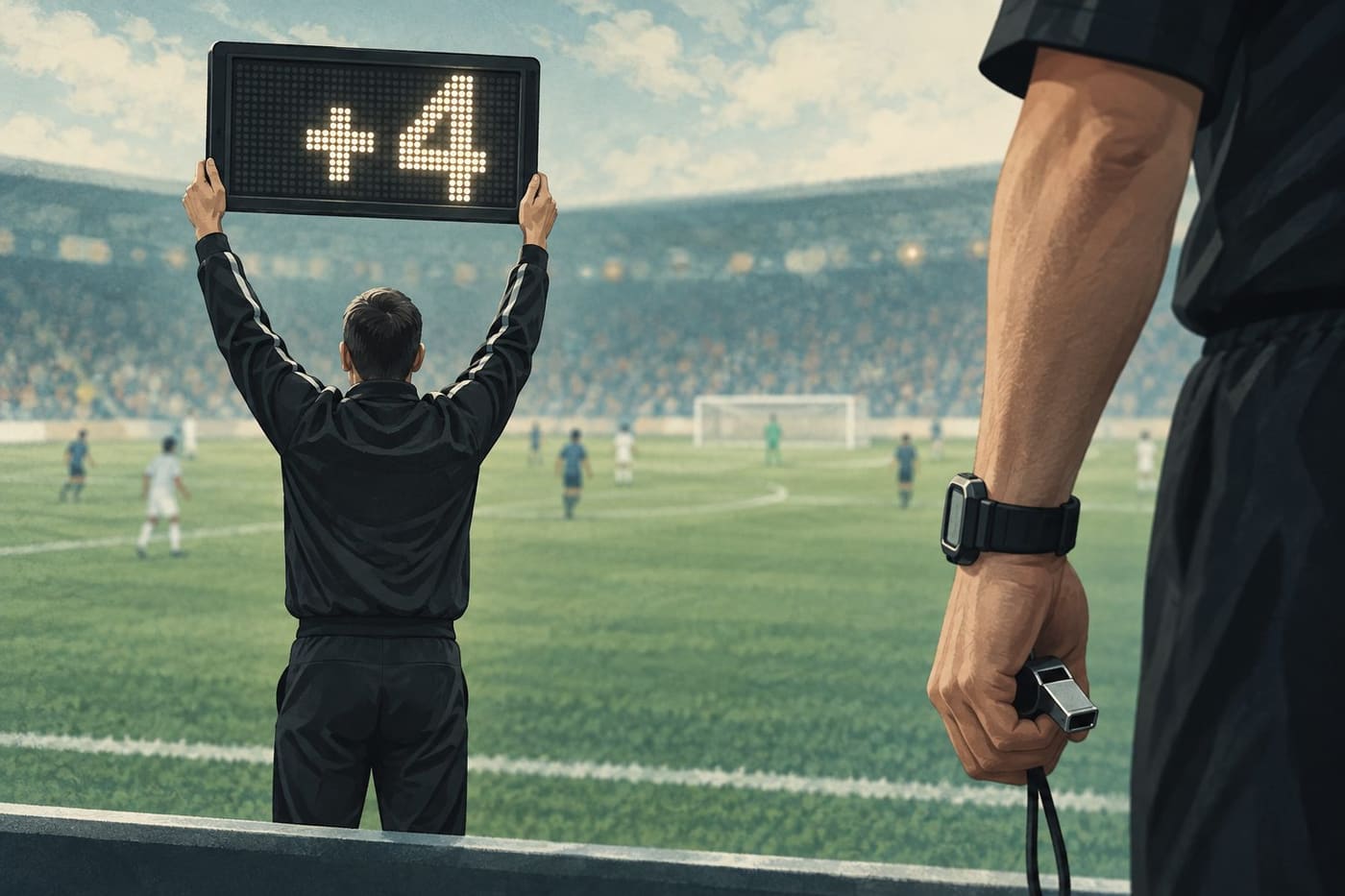
The fourth official raises a board, the television graphic shows an extra number, and supporters begin calculating how long their team has left. A few minutes later, the match is still going. That does not automatically mean that the announced time has been ignored. The number on the board and the final whistle do different jobs. Understanding that difference makes a tense finish easier to follow without treating a broadcast clock as the referee's decision.
This guide explains additional time, the referee's timekeeping role, separate extra-time periods and a penalty taken at the end of a half. It uses the IFAB pages displaying the 2026/27 Laws, checked on 31 October 2026. Competition rules and permitted variations still matter for a particular match. All teams and timelines below are invented; this is not a retrospective judgment about a real referee, disputed finish or betting outcome.
Start with what the board actually announces
Under [IFAB Law 7](https://www.theifab.com/laws/latest/the-duration-of-the-match/), ordinary full-length play consists of two forty-five-minute halves, subject to the permitted arrangements described in the Law. Allowance is made for playing time lost in the relevant half, including specified interruptions. At the end of the half, the board communicates a minimum allowance selected by the referee. The referee may increase that allowance; the displayed minimum is not reduced.
The useful distinction is between an announced lower bound and a countdown to an automatic ending. A broadcast graphic can help you follow the situation, but the arithmetic on your screen is not itself a whistle. If you want to describe a finish accurately, record the announced allowance separately from when the referee actually ended the period. That preserves both observations without assuming they must be identical.
For a simple original viewing note, use separate spaces for the board, notable later interruptions and the final signal. Leave any item you did not observe blank rather than reconstructing it from a short highlight. This note is an optional way of following a match, not an official referee's timekeeping sheet or a method for reproducing an official calculation from incomplete television coverage.
Keep the referee's role separate from the screen
[Law 5](https://www.theifab.com/laws/latest/the-referee/) gives the referee the timekeeping role as part of controlling and recording the match. Other officials can assist, but the television graphics team does not take over that responsibility. A spectator's stopwatch is another record with its own start point and limitations. It may be useful for a personal observation, but it is not a substitute for knowing what the match officials recorded.
Imagine a fictional match between Harbour and Hill. A viewer joins the broadcast late and begins a separate timer. Even if that timer is precise, it does not contain the preceding events. Another viewer may be watching a delayed stream. Their screens can show different moments at the same wall-clock time. Neither situation, by itself, establishes an error in the match's official timekeeping.
This is why a confident allegation needs more than a photograph of a clock. Identify the match, the relevant period, the announced minimum and the sequence being questioned. Then distinguish an observed discrepancy from an explanation of its cause. The distinction leaves room for a genuine error to be investigated without turning every unfamiliar finish into proof of wrongdoing.
Additional time and extra time are different stages
Additional time belongs to a period already being played. Extra time, where the competition uses it, is a separate tie-deciding procedure. [Law 10](https://www.theifab.com/laws/latest/determining-the-outcome-of-a-match/) describes the permitted methods when competition rules require a winner after a drawn match or tie, including two equal extra-time periods of no more than fifteen minutes each and a penalty shoot-out. The actual competition rules determine which permitted procedure applies.
That makes the phrase they played extra minutes ambiguous in an informal conversation. It might mean allowance at the end of the second half, or it might mean the match entered a separate extra-time stage. A useful report names the stage rather than relying on the word extra alone. If you are reading a score page, look for its explicit status and the competition's format before deciding what happened.
Do not assume that every knockout match takes the same route. A draw at one stage might lead to a different next step from a draw in another competition. Nor does a familiar club badge identify the rules for every match that club plays. Check the actual event. The purpose is to understand the sequence, not to build a universal timetable from one final you remember watching.
A longer review is not a fixed deduction from the match
Video review brings another clock into view: time spent on a check or review. IFAB's [VAR protocol](https://www.theifab.com/laws/latest/video-assistant-referee-var-protocol/) prioritizes an accurate decision and does not impose a maximum duration for the review process. That is different from saying every delay is ideal, or that viewers can infer the final decision from how long the process takes. Duration alone does not tell you the outcome.
For an invented viewing situation, suppose the broadcast spends a while showing a monitor, a replay and waiting players. A careful note might record when the visible process began and when play resumed, while acknowledging that the broadcast may not show every communication. It should not claim to know the entire officials' conversation or classify the incident solely from the elapsed time.
Keep the two questions apart: how was the decision reviewed, and how was the resulting delay treated in timekeeping? They are related operationally but not interchangeable. A correct decision does not explain every aspect of the clock, and a question about time does not prove the decision was wrong. A useful explanation identifies which question it is answering before moving to the next.
Other officials help preserve the timing record
[Law 6](https://www.theifab.com/laws/latest/the-other-match-officials/) describes the responsibilities of other match officials. Among the assistant video referee's duties is recording time lost when play is delayed for a check or review. That helps explain why the timing process is not simply a spectator guessing how long a replay seemed to last. It also does not give the public access to a complete record of a specific incident.
This distinction matters when editing a clip. A ninety-second excerpt can show an incident but omit what came immediately before and after it. The excerpt may begin after the stoppage started or end before play resumed. Treating its running length as the exact duration of the whole interruption would add a claim the clip does not support. Describe the available evidence at its actual scope.
For Harbour and Hill, the fictional viewer can therefore separate a visible replay interval from a confirmed official record. If the report does not provide the latter, the viewer can say it is unavailable. That is more informative than filling the gap with an invented calculation and presenting it as the officials' arithmetic. Precision includes knowing which number you do not have.
Read an end-of-half penalty as its own situation
A half can be extended so that a penalty kick is taken and completed. [Law 14](https://www.theifab.com/laws/latest/the-penalty-kick/) sets out the relevant completion conditions for this situation, including the ball stopping, leaving play, specified subsequent touches or the referee stopping play for an attacking offence. An extended penalty is not an open-ended invitation to play an ordinary sequence of rebounds until the attacking team is satisfied.
Consider an invented report that says a team scored from a penalty after the period's normal time had elapsed. Before retelling it as a penalty shoot-out, establish which phase it describes. A penalty within the match, including one completed under the end-of-half provision, is different from a shoot-out used to determine a winner afterward. The method by which the event occurred belongs in the explanation.
You do not need to memorize every penalty offence to keep those stages distinct. Start with whether the report describes a kick during a period, a kick for which that period was extended, or a shoot-out. Then consult the applicable rule for any detailed dispute. A short replay and a timestamp are not enough to settle every question about completion, infringement or a required retake.
A shoot-out does not become another period of match play
IFAB states in Law 10 that a penalty shoot-out takes place after the match has ended. That separation helps readers interpret result summaries. A match score and a shoot-out score describe different things. Do not add the successful shoot-out kicks to the match's goals and then describe the resulting number as an ordinary scoreline. Read the competition's result presentation and keep its labels intact.
For a fictional summary, Harbour and Hill could finish level in the match and Harbour could then win the shoot-out. A clear retelling would preserve both pieces of information and identify how Harbour advanced. Saying only that Harbour won may be adequate for a brief headline, but a fuller report should explain the route. It should not manufacture a goal total by combining unlike records.
The same care applies to player statistics. A goal scored during the match and a successful shoot-out kick are different events. This article does not define every statistical provider's database fields, but the stage distinction is enough to warn against casual addition. If you need a player's official total, use the relevant competition or statistical record and check what it includes rather than counting every ball entering the net on a highlight reel.
Extra-time periods still need their own timekeeping
IFAB's accessible [playing-times guide](https://www.footballrules.com/game-events/playing-times/) explains that the same general timing principles apply during extra time: equal halves, an interval and allowance at the end of each half. Extra time is therefore not a single undifferentiated block on a stopwatch. A displayed running total may help orient a viewer, but the period being played remains important to the explanation.
In a fictional text conversation, one person might say that the match is at 108 minutes while another says it is in the second extra-time period. Those can be compatible descriptions of the same stage. They do not tell the reader the competition's next procedure if the score remains level. For that, the event's rules and confirmed match status are still needed.
When planning around a match, leave uncertainty visible. A scheduled start is not a guaranteed finishing appointment. The actual format, interruptions and tie-deciding procedure can affect when play ends. This is an ordinary planning observation, not a forecast of a particular fixture's duration. If transport or access arrangements depend on the event, consult the venue and provider information rather than treating a rough sporting calculation as a confirmed timetable.
Write the match note before writing the accusation
An original spectator's note can record five things: the competition and date, the period, the displayed information, the visible event and the official outcome once confirmed. Those headings help preserve what happened without requiring the writer to invent a hidden explanation. They also make it easier to correct an early impression when a fuller replay or official account becomes available.
Suppose a viewer initially writes that the match ended at the wrong time. A better first note might say that the broadcast showed a particular clock value when the referee signalled the end, with the announced allowance and preceding sequence still to be checked. That wording does not dismiss a possible issue. It states the evidence needed to assess it and avoids claiming that a screenshot contains the whole match.
Keep a correction visible if the initial interpretation changes. A timestamp, a minimum allowance and an official outcome answer different questions; combining them carelessly can create a story that none of the records supports. This habit is useful whether you are discussing the match with friends, writing a club newsletter or reading a heated social-media thread. Being clear about uncertainty is compatible with being an engaged supporter.
Conclusion
Read the board as information about the minimum allowance, follow the referee's signal, and identify the actual stage of the match. Additional time, separate extra-time periods, an extended penalty and a shoot-out should not be collapsed into one category of extra minutes. For a detailed disputed incident, use the complete relevant sequence and the competition's rules rather than a confident calculation from a cropped clock.
For another rule that rewards following the sequence, read our [football offside explainer](https://monetizearticle.com/article/offside-in-football-watch-the-pass-then-the-involvement-b78ac6). Timing and offside ask different questions, but both become clearer when the reader separates the event, the applicable rule and the evidence available to judge it.
Sources and research note
IFAB Laws 5, 6, 7, 10 and 14, the VAR protocol and IFAB's accessible playing-times page were checked on 31 October 2026. The Law pages displayed the 2026/27 edition. Only the relevant timing and phase distinctions are summarized; complete competition procedures and every penalty or VAR exception are outside this explainer's scope. All Harbour and Hill references and viewing-note examples are original hypothetical illustrations. No real match result, officials' private record or allegation is asserted. The image is original AI-generated conceptual artwork, not a photograph of an actual match or a verified scoreboard.