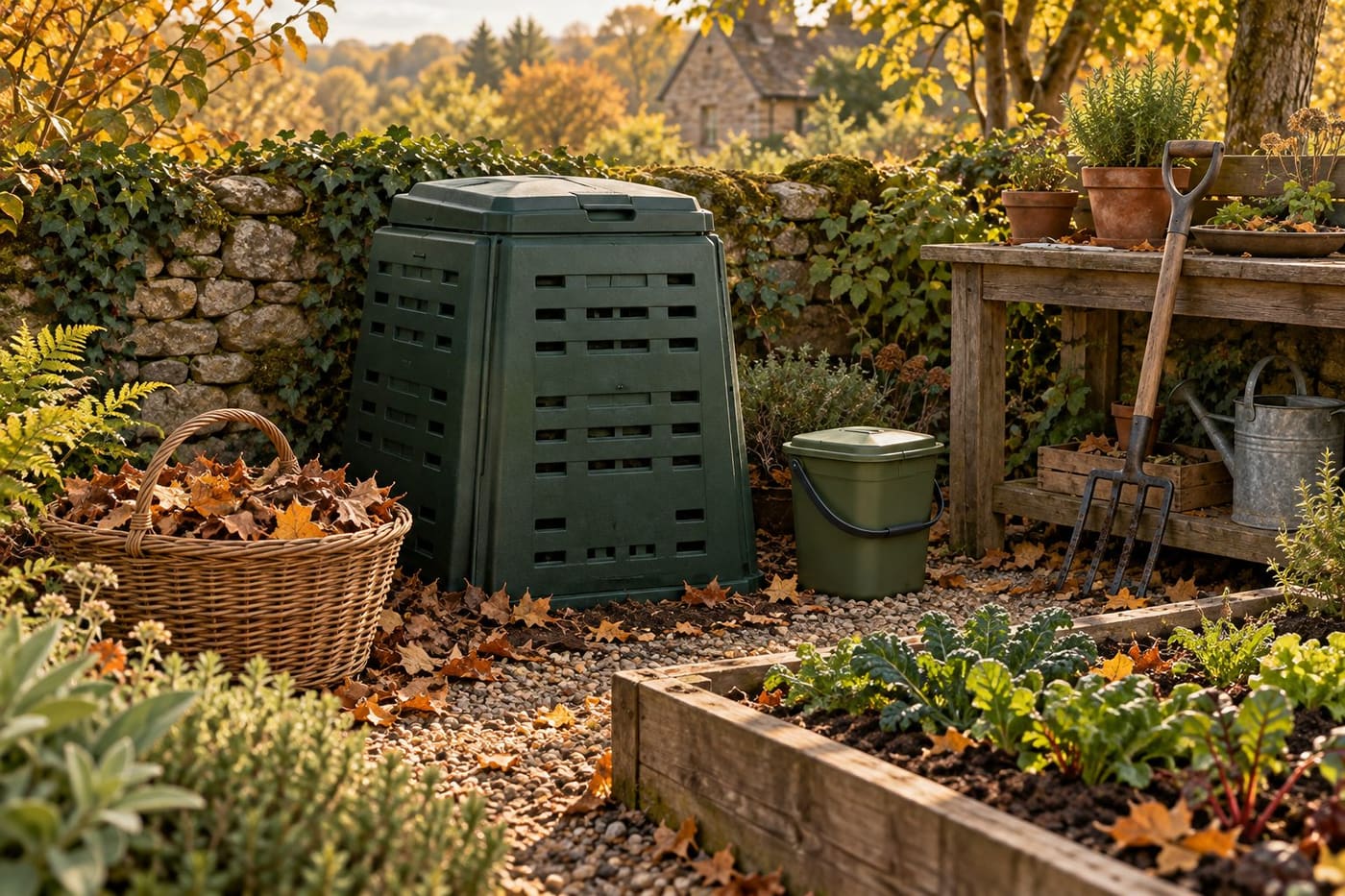
The kitchen caddy is easy to imagine. The harder question comes later: who empties it, what happens to the contents and where will the finished material go? A home composting plan begins to make sense when those ordinary details have answers. Buying a bin is only one decision in a longer routine.
For a household considering backyard composting, the useful starting point is a manageable flow of suitable material and a place where someone can maintain it. For another household, a local collection or drop-off service may be a more workable choice. The aim is an arrangement that can be cared for, rather than equipment that looks reassuring on the first day.
This article combines a limited summary of primary environmental and gardening guidance with an original planning example. The fictional household below is not a tested case study. No volume of diverted waste, emissions saving, cost reduction or gardening result is claimed for it.
Know what process you are choosing
The US Environmental Protection Agency describes composting as managed biological decomposition that needs oxygen. Its home guide identifies carbon-rich material, nitrogen-rich material, moisture and air as the essentials. It also distinguishes finished compost from the dried scraps produced by residential grinding and dehydrating appliances. Read the guide: https://www.epa.gov/recycle/composting-home
The EPA's backyard material lists include fruit and vegetable scraps and dry leaves. They exclude items such as meat, dairy, pet waste, treated wood and compostable foodservice packaging. Commercial acceptance can differ, so a collection service's own list must be checked. The same guide recommends accessible, well-drained space and covering food scraps with brown material.
Its maintenance advice is to observe moisture, smell and activity, adjusting the mix and air rather than simply adding more scraps. Finished material should be allowed to cure; appearance and condition matter as well as time. These are selected points from that guide, not a complete set of instructions for every composting method.
Choose a routine before choosing equipment
Imagine Samira and Ellis, two fictional adults sharing a home with a small garden. They want to deal more thoughtfully with vegetable peelings and fallen leaves. At first they discuss buying the largest bin they can fit beside the shed. Then they notice that the proposed spot is awkward to reach while carrying a kitchen caddy.
They make a short list of decisions instead: where scraps will wait indoors, where brown material will be kept, how they will reach the bin and who will check it. They also identify an intended garden use for finished material. That final question stops them treating the bin as a destination from which nothing ever needs to emerge.
Their plan does not begin with a purchase. They check the local rules and available guidance, consider existing space and decide whether the physical care is realistic. A plan can be revised before any equipment arrives. That is easier than discovering, after several weeks, that neither person can comfortably use the chosen setup.
Compare local collection with backyard care
New York's Department of Environmental Conservation describes several routes, including backyard composting, worm composting and food-scrap collection or community programs. Its home guidance emphasizes greens, browns, water and air, and offers troubleshooting around moisture and aeration: https://dec.ny.gov/environmental-protection/recycling-composting/organic-materials-management/home-composting
DEC excludes meat, dairy and pet waste from its home approach. It describes finished material as dark, crumbly and earthy-smelling, while giving a typical timescale that should not be read as a promise for a different setup. Its examples and service information are specific to New York, even where the underlying planning questions travel well.
Samira and Ellis therefore keep two possibilities open. They can investigate an outdoor system or find a suitable local program. They compare the actual instructions, access and responsibilities, rather than assuming that one route is automatically available in their area. A program that accepts garden trimmings may have different rules for kitchen scraps or packaging.
Make the material list visible
The fictional household writes a short list beside the kitchen caddy, based on the chosen system's guidance. The list answers what belongs there and where uncertain items should wait for checking. It does not rely on every visitor understanding a vague word such as organic.
When a package claims to be compostable, they check that claim against the receiving system's instructions. A label on a product and permission to place it in a particular bin are different pieces of information. If acceptance is unclear, they do not use the garden bin as a test that someone else will eventually have to sort out.
They also agree how to keep non-compostable bits out of the routine. This is a household organization choice: the caddy is for the accepted material, not a general clearing place for whatever remains after cooking. A simple, readable list is more helpful than an ambitious checklist nobody consults.
Think about supply, not just capacity
The Royal Horticultural Society advises choosing a bin to suit both the available space and the material produced. Its gardening guide discusses mixing softer green material with drier brown material, avoiding domination by a single ingredient and maintaining air and moisture. It notes that turning can be physically demanding: https://www.rhs.org.uk/soil-composts-mulches/composting%C2%A0
The RHS also distinguishes garden compost, used as a soil improver, from prepared potting mixtures. It describes maturity by texture, colour and smell and gives a broad timescale, with smaller or colder systems potentially slower. Its advice is rooted in gardening conditions, not a guarantee that every household will finish compost on a fixed date.
For Samira and Ellis, the practical consequence is to consider the materials they can actually supply and the care they can perform. They do not choose equipment solely because its advertised capacity is large. They want the whole arrangement to remain usable after the initial enthusiasm has passed.
Give each stage somewhere to happen
The household draws a rough map of its routine. One point is the indoor collection place, another is the outdoor working area and a third is where finished material might be used. The drawing is not a drainage design, a property survey or a reason to ignore local requirements. It is a way to spot awkward handoffs.
They notice that stored garden tools would block the route to their first proposed location. They move the plan on paper rather than assuming they will always squeeze past. They also consider where a person can stand comfortably to inspect the setup and where tools can be put away safely afterward.
This exercise helps them ask better questions of local guidance. They can describe the available space, access and materials, instead of asking only which bin is best. They do not excavate, alter a drainage route or build a structure on the strength of a general article.
Keep invasive and unsuitable material out
Michigan's Department of Environment, Great Lakes, and Energy warns against home-composting material that can create disease, odour or pest problems, including animal foods and human or pet feces. It also states that composting may not kill invasive plants and can spread them: https://www.michigan.gov/egle/about/organization/materials-management/composting/residential
That caution has a clear planning consequence: identify a separate, locally approved route for uncertain or problem garden material. A household should not assume that every plant pulled from a border belongs in the same system. Local invasive-species advice and waste rules matter, and the correct disposal route may differ by place and material.
In the fictional example, Ellis sets aside an unidentified plant for identification rather than mixing it into the routine. This is a decision to pause and check, not a claim that the plant is invasive. The household's list records uncertainty until an appropriate source resolves it.
Schedule observation without inventing a deadline for nature
Samira and Ellis choose a convenient weekly moment to look at their arrangement and discuss any problem. That is their coordination schedule, not a scientific recommendation that every system needs precisely one weekly intervention. The guidance for their actual method determines what maintenance is appropriate.
Their notes stay brief. They record what material was added, what they noticed and what question they need to check. They avoid turning the notebook into a fictional environmental impact report. An entry saying the mixture looked different is an observation; it is not a measurement of carbon savings or proof of a successful finished product.
If the setup becomes difficult to manage, they review the material flow and seek suitable advice. They do not continue adding material merely to keep their original plan looking successful. A useful routine includes a way to reduce the burden or choose another route when circumstances change.
Discuss shared responsibilities explicitly
In a shared home, one person's enthusiasm can become another person's unplanned chore. Agreeing on responsibilities avoids leaving every task to whoever notices the problem first. Samira takes responsibility for checking the indoor collection arrangement; Ellis checks the outdoor access and stored material. Both know how to raise a concern.
They agree what to do before a holiday or an extended absence. They also decide how a visitor will know what belongs in the caddy. These are modest coordination choices, but they connect the kitchen routine to the outdoor care rather than treating them as separate projects.
For renters or shared gardens, permission and responsibility must be clear before changing the space. The fictional household would check with the relevant owner or manager. It would not assume that general environmental benefits cancel a tenancy condition, a building rule or another person's right to use a common area.
Decide what success will mean
A workable first goal might be understanding the accepted materials and maintaining a routine without leaving unresolved problems for somebody else. That is different from promising to eliminate household waste. Composting also does not make avoidable food waste desirable; a bin should not become a reason to buy more food than the household can use.
Samira and Ellis choose to review their plan after a period of ordinary use. They ask whether responsibilities are clear, whether the setup is accessible and whether the intended next step remains realistic. If they change systems, they record the new instructions instead of combining incompatible acceptance lists.
Their review contains no invented weigh-ins or environmental totals. Where evidence is limited to household observations, they say so. This makes the record more useful when a problem returns: they can see what changed without having to interpret a claim that everything was perfect.
Connect compost care with garden planning
Finished material still needs a suitable use. Check the relevant gardening guidance for the plant, soil and purpose rather than treating every dark material as a complete growing medium. Keep unfinished and finished stages identifiable within the chosen method, especially when several people share responsibility.
The same habit of matching an idea to its actual site appears in our rain-garden planning guide: https://monetizearticle.com/article/before-you-plan-a-rain-garden-map-the-water-check-the-site-and-plan-the-care-ee213a
These are separate projects. A compost bin does not substitute for drainage assessment, and a rain garden is not a disposal route for kitchen scraps. The connection is the planning discipline: understand the materials, the space, the care and the limits before installing something that will need ongoing attention.
Conclusion: plan the whole journey
Home composting is easier to evaluate when the question extends beyond buying a bin. Trace suitable material from collection through care to a sensible use, and compare that responsibility with the local alternatives. Choose the arrangement that people can actually maintain.
Keep the instructions specific to the system, uncertainty visible and expectations realistic. A modest routine with clear responsibilities offers a stronger foundation than an ambitious promise about speed, savings or a garden transformation that has not happened.
Sources and research note
The four primary institutional pages linked above were read on 30 October 2026. US state and UK gardening guidance has local context; consult applicable local rules and method-specific instructions. This is a planning guide, not a validated composting trial or individualized gardening design. Samira and Ellis are fictional, and the original AI-generated conceptual illustration does not document a real household's results.