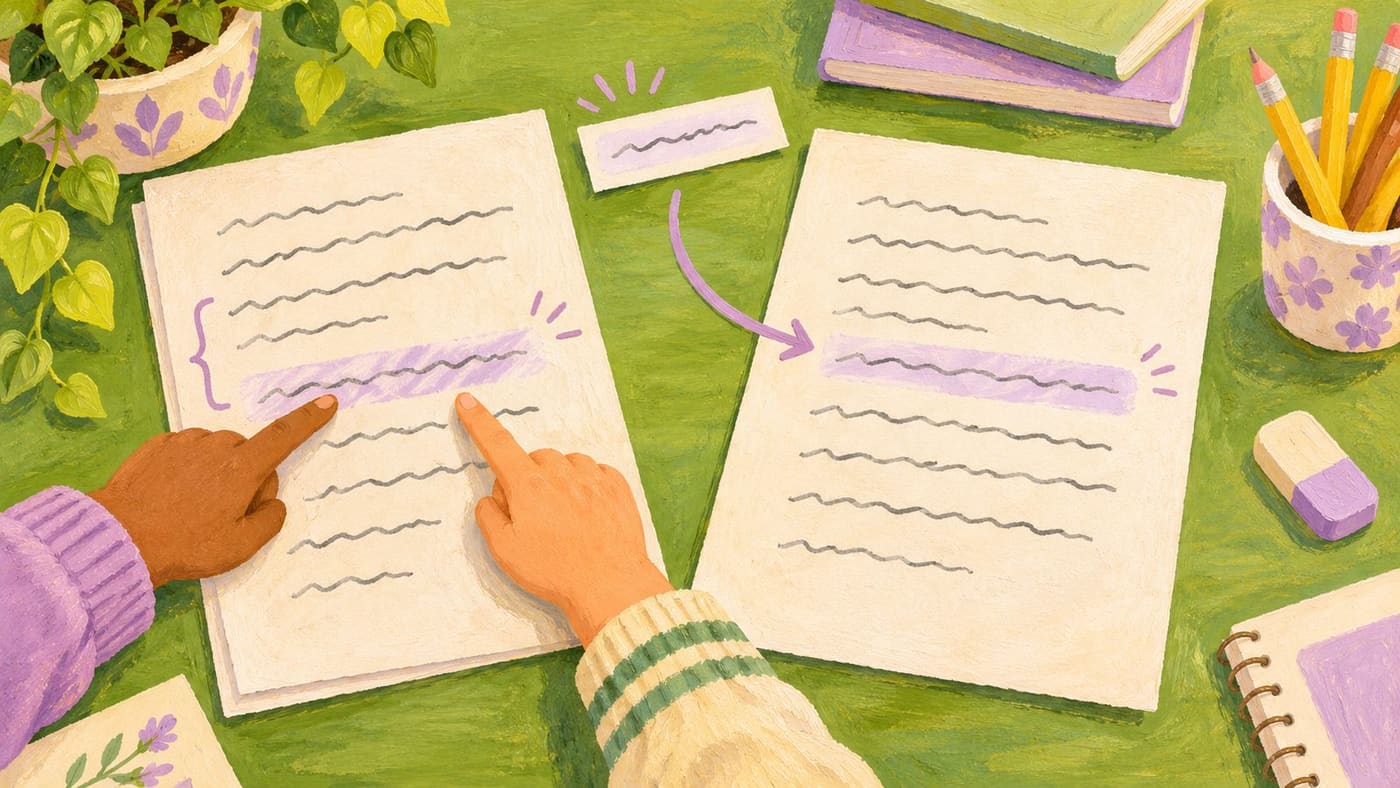
A student reads a draft aloud and then fixes two spellings. The spelling changes help, but a reader still cannot tell why the character went outside. The writer may know the reason and assume it is on the page. A short revision lesson can help the student hear that difference and decide what to change.
This lesson uses a small paragraph with one reader question. Students read it, find where a reader loses the thread and try a change that makes the meaning easier to follow. They can attend to spelling and punctuation afterward. The aim is to make revision a specific decision a young writer can explain and use again.
Give revision a job the writer can see
The What Works Clearinghouse practice guide on elementary writing recommends teaching students to use the writing process for different purposes. Its guidance is broader than the classroom exercise here. For this exercise, put the intended reader and purpose where students can see them. A note for a new pupil who wants to find a classroom needs different details from a story about a pupil getting lost.
Choose a task in which the difference is visible. Ask students to explain what happened in a short scene to someone who has not seen it. The first draft may say, “I left the room. I went back for it. We walked outside.” Readers can follow the order and still be unsure what the writer went back for. The teacher can model a question about meaning before looking for a punctuation error.
Make the assignment small enough to finish. A student working on a long story might revise just the point at which the character changes plans. A student writing an explanation might improve one link between a step and its result. Keep the rest of the draft available as context. Limiting the work makes it easier for students to reread the changed part and decide whether the change helped.
Model a decision out loud
Write a brief draft that you can change in front of the class. For example, “Mara put the tray by the door. She went back for it when she heard the bell. Her brother waited on the steps.” Read it once as the writer and a second time as a reader. The reader may wonder why the bell prompted Mara to go back. Say where you stopped and what you need to know.
Try two alternatives. In one, the bell signals the start of a plant sale and Mara remembers the seedlings on the tray. In another, it is the doorbell and Mara moves the tray so her brother will not trip. Each version makes a different story. Choose the one that matches the story you wanted to tell, and then read the surrounding sentences again. If the first version works, the revised paragraph might show Mara hearing the market bell and returning for the tray of seedlings before joining her brother. The exercise is about making a reason visible, not about making the paragraph longer.
Keep a copy of the first version on the board. Ask students to point to the information the revised version gives the reader. A student might say that the word “bell” has become clearer, or that the tray now has a purpose. Both are useful observations. If someone prefers the original because it leaves a mystery, ask which uncertainty the writer meant to leave and which one makes the action hard to follow.
Give the reader a question instead of a correction
After the demonstration, ask a partner to read a short paragraph and mark the place where a question arose. Offer a few sentence openings: “I could follow the action until…” or “I wondered who…” or “I wanted to know what happened between…” The partner can point to the words that prompted the question. A mark alone, especially an underline with no explanation, leaves the writer guessing what to do.
The question belongs to the reader, but the decision belongs to the writer. If a partner asks why Mara went back, Mara's writer might add a cause, move an existing sentence earlier, or decide that a later paragraph already supplies the answer at the right moment. Ask the writer to explain the choice. The reader does not have to compose a replacement sentence. That keeps the task manageable for both students and gives the writer practice making a decision.
Model the difference with a pair of responses. “Put in more details” gives the writer no place to start. “I know she turned back at the bell, but I don't know what she expected to find” identifies a place and a question. The second response is useful even if the writer ultimately keeps the reason hidden for another paragraph. Now the writer can decide whether that uncertainty serves the story.
Read the new paragraph without the old one
A revision can look better beside the original and still leave a fresh reader confused. Ask a student to read only the changed paragraph while the original is covered. If that reader can explain the action or the sequence in their own words, the writer has some evidence that the change helped. If their explanation still misses the intended point, identify the remaining gap and try a smaller or different change.
Use an example that shows why more words do not automatically help. An added sentence about the colour of the tray might make the scene easier to picture while leaving the bell unexplained. An added sentence saying that the market was about to open may resolve the timing. If the writer's goal is to explain Mara's decision, the second detail does more work. If the goal is to help a reader recognize the tray later, the colour may matter. Judge each change against the purpose of the paragraph.
There is room for a revision that removes words. “Mara, who was on the steps, thought about the tray by the door and went back to get it after she heard the market bell ring” could be split so the bell comes before her decision. The writer might also remove the first location phrase if the previous sentence already puts Mara on the steps. The test is whether the reader follows the sequence, not whether the student can count an addition.
Make it possible for more students to take part
Some students will find it easier to say a revised sentence before they write it. Offer a quiet rehearsal with a partner, or invite the writer to point to two sentences and explain what connects them. A student who uses dictation or an assistive writing tool can work on the same question. The evidence you are looking for is a choice about meaning and its effect on a reader. There is no need to make everyone demonstrate that choice in the same way.
For a learner who is still acquiring the language of instruction, distinguish a missing idea from difficulty expressing an idea. The student may be able to show the action with a drawing or describe it first in another language. If they already know why the character goes back, help them find a sentence that brings that reason onto the page. If they have not decided why, ask them to choose a cause before reaching for a sentence frame.
Use a shared example or a text invented for the lesson when students are reluctant to share personal work. A peer does not need to know who wrote a draft to ask where the action became difficult to follow. Give students a way to keep personal details out of a classroom exercise. A teacher can also listen as the reader when a partner is unavailable or when a student wants to check an early revision before sharing it more widely.
Try the same move in a different kind of paragraph
For an explanation, use a short piece about a classroom plant. The draft might read, “The class moved the plant. The leaves were turning towards the window. We put it there instead.” The writer may want to explain why the class chose another spot, but “there” leaves the destination unclear. One revision could name the new shelf and put the observation about the leaves before the decision. If the assignment asks for a claim about why plants respond to light, that is a different question and needs evidence. The sentence exercise can work without treating the fictional observation as a scientific experiment.
For directions, write, “Put it in the basket after you turn left.” The reader needs a reference point and the name of the thing to put away. Try replacing “it” and naming the turn. A classmate can trace the directions on a simple sketch. If they take a different turn from the one the writer intended, the writer has a concrete place to revise. The sketch tests whether a reader can follow the directions. It doesn't make every possible route correct.
Return to the same reader prompts in both tasks, but listen for different answers. A story reader may want to understand a decision. A reader following directions needs to know which action to take and in what order. A student who can say which question matters in each task has learned something more portable than a rule to add a sentence to every paragraph.
Keep revision and editing visible as separate passes
Once the meaning is clear enough for the task, reread for the conventions the class is practising. The punctuation of dialogue might matter in one paragraph and the spelling of place names in another. If students begin by circling misspelled words, thank them for noticing and mark those fixes for the editing pass. Then ask them to return to the reader question. Some spelling errors can make a word impossible to recognize, so the distinction is a way to focus attention, not a reason to ignore anything that prevents reading.
Save the original paragraph, the changed version and a short account of the decision. A student might write, “I moved the bell earlier so the reader would know what made Mara turn back.” Another might say, “I kept the question about the tray because the answer is in the next paragraph.” These explanations give the teacher something to discuss. They also reveal whether the student is making a choice or merely carrying out a classmate's instruction.
Keep the feedback small enough to use. If a paragraph has several problems, select the one that matters most to the assigned purpose. A student who can improve one confusing transition and explain the improvement has a clearer next step than a student who receives eight corrections at once. Save the other observations for another exercise or for the student to choose from later.
End with a check the writer can repeat
Ask students to point to one part they changed and say what a reader can now understand. A teacher can record whether the student identified a reader question, made a change that addresses it and checked the changed paragraph. If a student describes the problem accurately but cannot yet rewrite the sentence, the next lesson can focus on trying alternative sentence orders. If a student rewrites readily but cannot explain what improved, give them another chance to listen to a reader's account.
In the next writing task, bring back one familiar question without repeating the whole lesson. Where did a reader get lost? A student can ask it while rereading alone, or ask someone else to show them the point where meaning became unclear. Later, try the same check in an explanation or set of directions. The recurring habit is to decide what the reader needs, make a specific change and see whether it worked.
Start with a paragraph the class can finish. One reader question, one revision and one fresh reading make the result visible to the writer. The next time a draft goes silent at a crucial moment, the student has a way to find the gap and choose what belongs there.
For another example of looking for the exact moment that changes an interpretation, read how to follow a relay baton exchange.
Sources and research note
Sources checked November 3, 2026. The IES practice guide provides the background recommendation on the writing process. Mara, the classroom activities and the illustration are conceptual examples. The lesson is an original application and was not tested for this article.