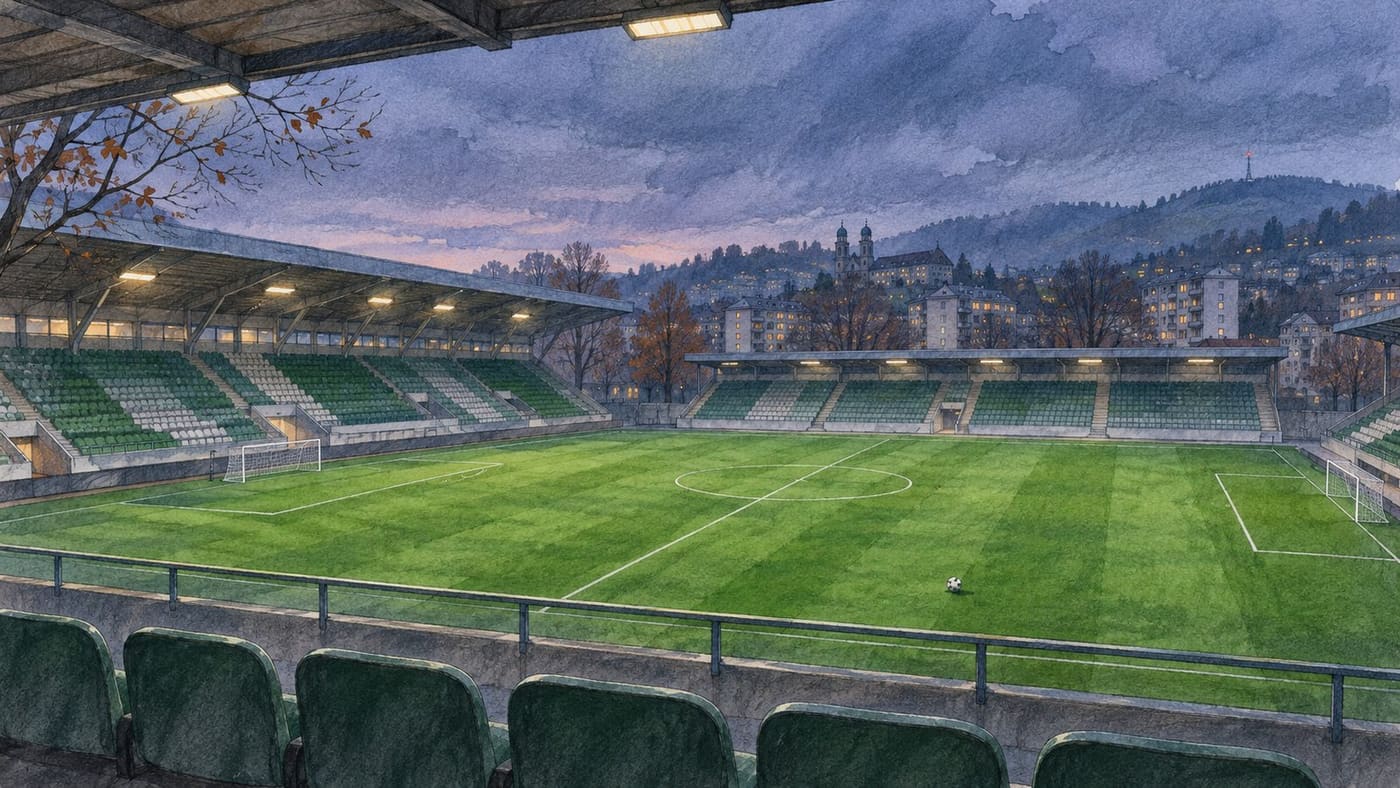
FC St. Gallen beat FC Lugano 5–0 at the Berit Sitterstadion on November 8, 2026. Lugano forward Albian Ajeti was sent off in the 11th minute, St. Gallen scored twice in quick succession after the half-hour and the hosts were three up at halftime. Andrin Hunziker scored twice, once in each half. Lugano’s unbeaten start to the Swiss Super League season ended, and the club reported that it still led Young Boys by six points after the match.
There are two league meetings to keep straight. Lugano won 4–1 at home in September. The November meeting was at St. Gallen and ended 5–0 in the other direction. Lugano had a player sent off in each game. The first time the dismissal came after Lugano had already built a four-goal lead. The second time the teams were level and had most of the match left to play. Comparing the two helps explain why the timing of a red card matters as much as the presence of one in the match record.
FC Lugano’s November match report
What changed in the 11th minute
Lugano’s account describes a cautious start with few clear chances. Ajeti challenged Hugo Vandermersch and referee Sven Wolfensberger showed him a red card. That left Lugano without the player listed as the central forward in its starting formation. The score was still 0–0. The visiting side now had to consider how to hold onto the ball when it came out of defence, as well as how to cover the spaces St. Gallen could use with the extra player.
A red card removes a player from several different phases at once. A forward can offer an outlet for a long clearance, occupy a defender when a teammate receives the ball, or help direct the opponent’s first pass in buildup. With that player gone, other players can share the work, but each adjustment creates choices elsewhere. If a midfielder moves up to offer an outlet, someone else has more ground to cover. If players stay closer together to defend, the first pass after they win the ball may have fewer safe destinations.
Lugano then had to make a separate change. Captain and goalkeeper David von Ballmoos went off injured in the 26th minute, with Felix Gebhardt coming on. The substitution filled the goalkeeping position. It did not restore the missing outfield player. By the time St. Gallen took the lead, Lugano had lost its starting striker and changed goalkeeper, and the game had moved well beyond the tentative opening described by the club.
The record establishes the order of those events. It does not give a way to isolate how much of each later chance came from the dismissal, how much came from the change in goal and how much came from St. Gallen’s execution. To see the home side’s contribution, look at how it created each of the first three goals. The opportunities came from different situations and needed different finishes.
How St. Gallen turned the advantage into a halftime lead
Chima Okoroji opened the scoring in the 33rd minute. According to Lugano’s report, he combined with Lukas Daschner near the edge of the area, moved inside and sent a left-footed shot across goal. The move asked Lugano to deal with a passing combination and then adjust to the receiver carrying the ball toward a shooting lane. It took St. Gallen more than 20 minutes after the red card to find this first goal. The extra player gave the hosts more options. Okoroji and Daschner still had to make one of those options count.
The second goal came in the 34th minute. This time St. Gallen pressed while Lugano tried to play out. Daschner won the ball and played it to Hunziker, who scored in front of Gebhardt. The circumstances changed within about a minute. While the first goal came from combining near the box, the second came from taking possession away from Lugano before the visitors could get out. A team that has just conceded usually wants a steady passage with the ball. Instead Lugano had to defend another chance almost immediately.
Lugano still had an opening before the break. The club reported that Yanis Cimignani had two efforts from close range in the 37th minute and Lawrence Ati-Zigi saved both. That passage is worth including because the result alone gives no hint that Lugano could have reduced the deficit while the gap was two. A goal at that point would have made it 2–1. St. Gallen’s goalkeeper kept that possibility from becoming the next scoreline.
Tom Gaal then made it 3–0 in the second minute of first-half stoppage time. He headed in at the far post after Lukas Görtler’s corner. Here the route to goal was a set piece, after the first two goals had come from a passing move and a recovery in open play. The corner gave St. Gallen time to position players before the delivery. The far-post finish shows where the final challenge occurred, but the club report does not establish how every defender was assigned to mark. The confirmed event is the header and the three-goal lead it gave St. Gallen at halftime.
Two second-half goals and the chance Lugano had at the post
Lugano brought on Kevin Behrens for Daniel Dos Santos at the break. The club’s account says the visitors tried to play farther forward to find a goal. That carries a different trade-off at 3–0 than it does at 0–0. Protecting space can slow the rate at which a side concedes chances, but at three down it also leaves less opportunity to recover. Moving higher gives players closer support when the team attacks and increases the amount of space they may need to cover when they lose possession.
One of Lugano’s chances came from a corner. Antonios Papadopoulos redirected the ball at the near post and Lars Lukas Bichsel struck it at the far post, where his effort hit the woodwork. It was a separate test from the chances Ati-Zigi had saved before halftime. The sequence is worth comparing with Gaal’s goal. Both used a delivery from a corner and ended with an attempt at the far side. In one case the ball went in and in the other it struck the frame. It is possible to recognise both as dangerous chances while keeping the outcomes clear.
St. Gallen’s fourth arrived in the 66th minute. Okoroji found Hunziker in the area, and the forward controlled the ball and finished at the near post. It was Hunziker’s second. For his first, Daschner had supplied the ball after winning it back. For his second, the pass came from the player who had scored the opener, and Hunziker had time to control it before shooting. The two goals show the same forward benefiting from different service.
Substitute Frokaj added the fifth in the 84th minute with a curling effort from near the edge of the area. The final record credits Okoroji, Hunziker, Gaal and Frokaj with the goals. It also keeps Ati-Zigi’s clean sheet intact, even though Lugano had attempts that required saves and an effort that hit the woodwork. The five-goal margin measures the difference in finished goals. The opportunities at both ends explain why it is still useful to watch how the teams played after the third.
Why September’s 4–1 result belongs beside this one
On September 16, Lugano had already scored four before halftime. Beckham Castro opened the scoring, Pihlström scored twice and Karimov added the fourth. Pihlström was sent off just after the restart. Hunziker pulled a goal back for St. Gallen, but Lugano still won 4–1. By the time it went down to ten in September, Lugano could defend a large advantage. In November it had to play short-handed for most of a match that was still goalless when the card was shown.
That distinction matters when comparing what an opponent can ask of ten players. With a four-goal cushion, the leading team can trade attacking volume for defensive coverage. The opponent still needs several goals and cannot recover the deficit through a single mistake. At 0–0, there is no cushion. If the opponent goes ahead, the short-handed side needs to create a goal while also limiting what the team with eleven can do. That was the problem Lugano faced after Okoroji’s strike, and Hunziker’s first goal made it harder almost immediately.
The venues changed too. The September match was Lugano’s home fixture at the AIL Arena. The November match was the return league fixture in St. Gallen. A search result that gives only the two club names can point to either, as well as to the separately scheduled Swiss Cup tie. Check the date and competition before using a score or lineup. The five goals discussed here belong to Matchday 13 of the league on November 8.
FC Lugano’s September match report
FC St. Gallen’s league fixture announcement
What the defeat changes at the top
Lugano entered the weekend with 34 points from 12 league matches, according to its preview. The club said it was nine points clear of Young Boys at that point. Its postmatch report put the advantage at six. Those figures belong to different snapshots. Lugano earned no points at St. Gallen, and the gap in a league table can change through matches elsewhere in the same round. The club’s first league defeat ends the unbeaten run while leaving it in first place in the postmatch account.
St. Gallen earned three points from the win. The size of the victory also matters for goal difference, which records the margin in each match rather than only the points awarded. A reader looking up the teams after the international break should use a current table for their positions. The lasting match facts are the three points for St. Gallen, the first league loss for Lugano and the five goals that went into the season’s goal totals.
Lugano’s published calendar lists Grasshopper Club Zürich as its next league opponent on November 21. It also lists a trip to Luzern later in November. That calendar is useful for separating the next Swiss Super League match from the cup and European fixtures that fill the same period. A team may play another competition between two league rounds. If the question is what happened to the league lead, compare league results and the league table rather than treating all the fixtures as points matches.
FC Lugano’s pre-match standings and form
For a snapshot of the round, read the match report first, then check whether the table includes the same number of matches for the clubs you are comparing. A lead can grow or shrink temporarily when one club plays earlier. For a longer comparison after the break, record both points and games played. That is the context in which a six-point lead should be read, especially in a period when cup and European matches can make a calendar look busier than the league schedule alone.
What the Swiss search snapshot showed
Google Trends listed “st. gallen – lugano” first in the Swiss Trending Now capture at 15:46 UTC on November 8. The saved view used the previous 24 hours, included all categories and trend statuses, and sorted by search volume in descending order. The row displayed 10K+ and was marked Active. Those settings make the position reproducible within the saved view. They give no attendance or viewing figure and do not identify which incident prompted someone to search.
For a quick reading of the result, the important times are the 11th minute for the red card, the 33rd and 34th for the opening goals, and first-half stoppage time for the third. The rest of the match still had meaningful chances, including Bichsel hitting the woodwork and Hunziker scoring again. The official record is the best place to distinguish that final 5–0 from a page captured while the game was still 3–0. For another example of why the score at the time of a dismissal matters, see our Hertha–Wolfsburg match analysis.
Sources consulted 8 November 2026, Bangladesh time.