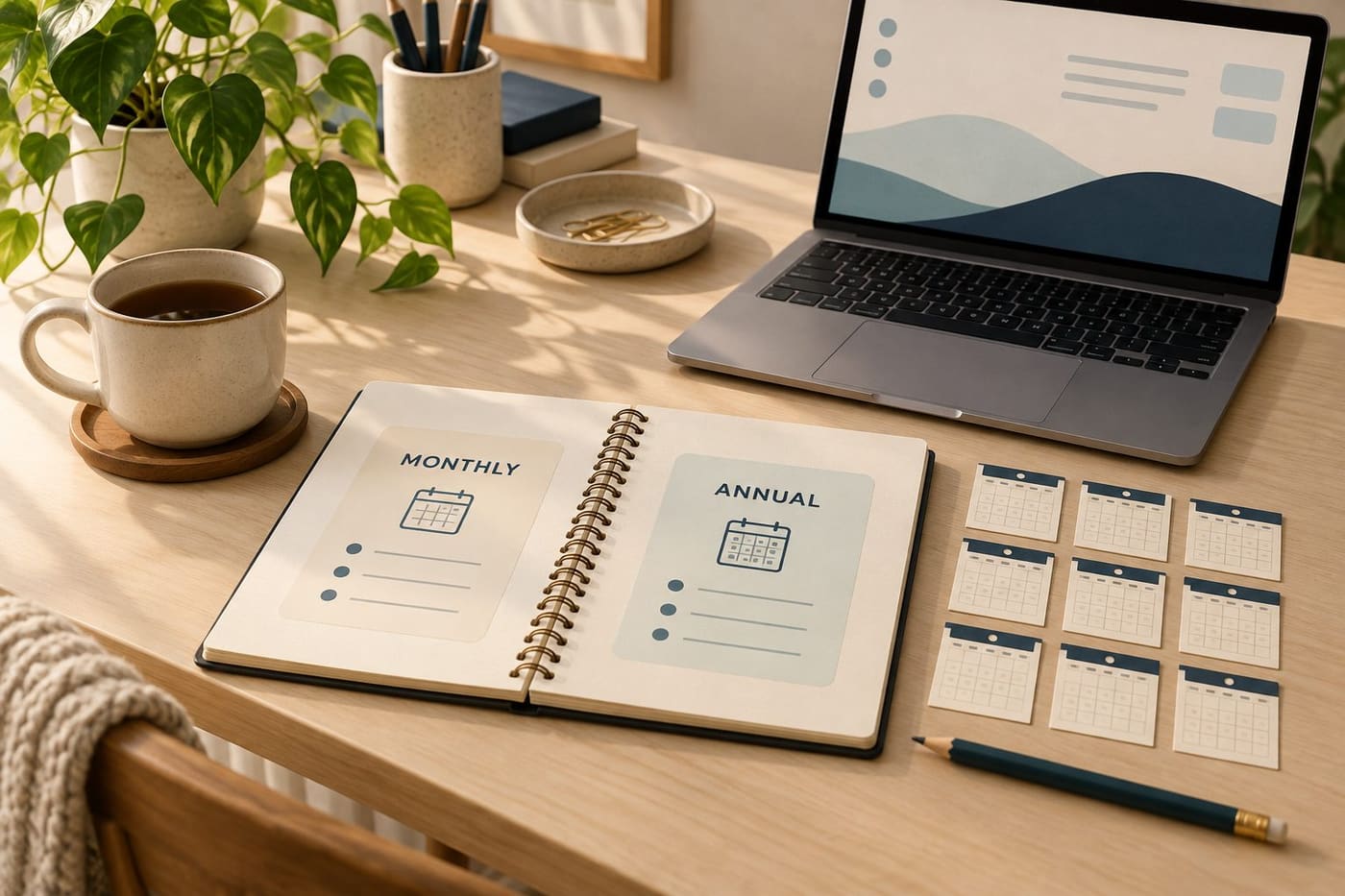
Two subscription cards show a monthly price. One says “monthly”; the other says “annual, paid monthly.” The amounts can be compared, but the agreements may be quite different. Before choosing the smaller number, establish how long you are committing to pay and what happens if your needs change.
A monthly charge is a payment interval, not a complete description of the agreement. A useful subscription comparison separates the payment schedule, the commitment period, the renewal arrangement and the cancellation conditions. It also asks whether the service includes what you actually need.
This guide explains a practical comparison method using original, fictional calculations and specific official examples checked on 31 October 2026. It does not recommend a provider, determine your contractual rights or guarantee a refund. Prices and rules in your own checkout and applicable local requirements need their own reading.
Put four different dates on the page
Start a comparison note with four questions: when does the first payment happen, how often do subsequent payments happen, when does the commitment end, and when might renewal occur? Those answers may not all point to the same date.
A plan can charge once for a full year. Another can spread an annual commitment across monthly payments. A genuinely month-to-month plan can have a different cancellation arrangement again. Do not infer the type from the size of the first charge or from a large “per month” figure in an advertisement.
For a concrete provider example, [Adobe's US subscription guidance](https://helpx.adobe.com/account/individual/terms-policies-and-regulations/adobe-subscription-terms.html) distinguishes an annual plan paid monthly from annual prepaid and month-to-month plans. Its published US guidance describes an early termination fee for the annual paid-monthly arrangement after the stated initial cancellation period. This example illustrates why the commitment matters; it is not a fee rule for every subscription or country.
In your own notes, write the full plan name. “Design app, annual plan paid monthly” preserves more information than “design app, monthly.” If an offer does not make the commitment clear, mark it unresolved rather than filling in the most convenient interpretation.
Compare the same service before comparing its price
Two amounts are not a useful comparison if they buy different things. List the features that matter for the intended task: access to a particular application, number of users, storage allowance, permitted use or another clearly described benefit. Use the actual offer's descriptions rather than assuming that similar plan names mean identical access.
Imagine a fictional language-learning service. Plan A includes one learner and downloadable lessons. Plan B allows a household group but does not include downloads. A solo learner who needs offline access cannot decide between them by multiplying each price by twelve. The feature mismatch needs to be resolved first.
Avoid treating every extra feature as money saved. An additional user slot has no budget value to a person who will never use it. Write “included but not required” beside such features. This keeps the comparison anchored to the purchase you intended to make rather than the largest bundle available.
Also record the billing route. A service bought directly from a provider may be managed differently from one bought through an app store. The application you use and the organisation that handles its payment are not necessarily the same thing.
Build a full-year comparison with explicit assumptions
Consider two invented offers for the same fictional service. Plan M costs 15 currency units per month and can be ended between monthly periods under its stated terms. Plan Y costs 120 units upfront for a year. For this arithmetic only, both include identical features, and taxes and other charges are excluded.
Twelve payments of 15 total 180 units. The annual offer therefore costs 60 units less for a full twelve months of identical access under those assumptions. Dividing 120 by twelve produces an equivalent monthly average of 10 units. It does not turn the upfront payment into twelve instalments.
Show both numbers in your note: “120 due upfront; equivalent average 10 per month.” Writing only “10 per month” obscures when the money leaves your account. A comparison can be mathematically correct and still be unhelpful if it hides the payment timing.
Then identify what the example leaves out. The real checkout may involve taxes, a different currency, introductory pricing or a different package. Do not copy the fictional 60-unit difference into a claim about an actual provider. Recalculate from the actual amounts and retain the conditions beside the result.
Add a shorter-use comparison
A full-year calculation answers what happens over a full year. It does not establish what you will spend if you need the service for only a short project. Build two comparisons before deciding which subscription costs less: the intended-use period and the longer commitment period.
Using the invented offers above, three monthly payments total 45 units. The upfront annual purchase still costs 120 units in this example, where no partial refund is assumed. Calling the annual option cheaper because its equivalent monthly average is lower would answer the wrong question for that three-month project.
The simple arithmetic reaches 120 units at eight monthly payments. At nine payments, Plan M totals 135 units. These are comparison points for this invented pair of offers, not a forecast of your usage or a recommendation to buy a year. A different price, refund condition or feature set would change the comparison.
If your likely usage is uncertain, write down several possibilities rather than giving uncertainty a false precision. For example, compare three, eight and twelve months, then explain why each period might be relevant. A clearly labelled range is more useful than a confident claim that you will certainly use a service all year.
Keep committed instalments separate from renewal
An annual arrangement paid in instalments needs a different worksheet from a month-to-month purchase. Record the total commitment and the remaining scheduled payments, as well as the next renewal date. Stopping a future renewal may not remove payments already agreed for the current term.
[Google Play's cancellation guidance](https://support.google.com/googleplay/answer/7018481?co=GENIE.Platform%3DDesktop&hl=en) explicitly separates ordinary subscription cancellation from stopping renewal on a payment plan. It says remaining committed payments on a current payment plan remain payable when renewal is stopped, subject to the stated policies. It also says uninstalling an app does not cancel its subscription.
Do not generalise that example into a claim that every cancellation everywhere leaves the same balance due. Instead, use it as a prompt to read the section applicable to your own plan. Look for terms covering commitment, early termination, renewal and any relevant exception.
In a household record, distinguish “renewal stopped” from “all payments ended.” If you have confirmation only of the first, do not record the second. That distinction helps prevent a later legitimate scheduled instalment from being misread as evidence that nothing changed.
Treat a trial as its own timed decision
A trial is not yet evidence that you want a long subscription. Before starting one, record its length, the amount and frequency of any subsequent charge, and the cancellation instructions. If you cannot establish those points, the advertised trial price does not give you a complete comparison.
The [US Federal Trade Commission's consumer guidance on trials and automatic renewals](https://consumer.ftc.gov/articles/getting-and-out-free-trials-auto-renewals-and-negative-option-subscriptions) advises reading the offer's terms, noting cancellation deadlines and checking statements. It also recommends retaining cancellation records. These practical steps do not require assuming that every trial has the same length or refund policy.
Set a review reminder before the relevant deadline, allowing enough time to understand the process. A reminder is a tool for your decision; it is not a cancellation request. If you decide to stop, complete the applicable cancellation process and retain the result rather than treating the reminder itself as the action.
An original trial note could read: “Test the required offline feature; confirm the next charge and cancellation method; decide before the stated deadline.” This makes the trial a purposeful test instead of a vague promise to remember later. No trial was purchased or tested for this article.
Find the organisation that actually billed you
When the service name and billing channel differ, cancellation can become confusing. Begin with the receipt or subscription record rather than repeatedly searching inside an application that may not manage the purchase. Check the account used as well as the route through which you subscribed.
[Microsoft's subscription refund policy](https://support.microsoft.com/en-us/accounts-billing/subscriptions/microsoft-subscription-refund-policy) distinguishes subscriptions bought directly from Microsoft from those purchased through Google Play or Apple's App Store. For the latter, it directs customers to the relevant store's support for cancellation or refunds. Its direct-purchase eligibility also depends on factors including timing, subscription type and country.
Create one record for each actual subscription. If a household uses several accounts, note enough to distinguish them without copying passwords, complete payment-card details or security codes into a shared worksheet. A neutral account label can help locate the purchase without exposing sensitive information.
If two similar charges appear, investigate before concluding they are duplicates. They might relate to different accounts, plans or billing periods. Retain the separate evidence until the relationship is clear. Conversely, do not assume the second charge is valid merely because the name looks familiar.
Cancellation, refund approval and returned funds are different events
Keep three questions separate: will another subscription period begin, has a refund request been approved, and has money actually returned? A message answering one question should not be recorded as proof of all three.
[Apple's refund-request guidance](https://support.apple.com/en-euro/118223) describes a request process for eligible purchases and separately links subscription cancellation. It says that, even after approval, money can take additional time to return to the payment method. A request being submitted is therefore not the same event as funds arriving.
For your own tracking, use plain status descriptions: “cancellation confirmed,” “refund requested,” “refund approved” or “credit received.” Record the date and supporting reference beside each relevant event. Leave an unresolved outcome unresolved instead of making the household balance look tidier by assuming it happened.
If a charge appears after you expected payments to stop, compare the confirmation, charge date and covered period. The FTC advises monitoring statements after cancellation and contacting the card issuer about disputed charges where appropriate. This article does not determine whether a particular charge is authorised or set a universal dispute deadline; use the relevant issuer's process promptly.
Put payment timing back into the household budget
After comparing total cost, place the actual payment on the dates when it is expected. An annual average is useful for comparison, while the upfront amount is relevant to that month's available cash. Both can be true without being interchangeable.
Our [cash-flow calendar guide](https://monetizearticle.com/article/build-a-cash-flow-calendar-see-the-gap-between-payday-and-bill-day-636f22) explains how timing can create a gap between income and bills. Add the subscription's actual payment schedule to that calendar, rather than twelve fictional monthly withdrawals for a plan paid once upfront.
When reviewing a statement, our [bank-reconciliation guide](https://monetizearticle.com/article/reconcile-a-bank-statement-without-counting-pending-payments-twice-13454c) also helps distinguish entries without counting the same payment twice. Keep a subscription's status record separate from the bank record until an actual transaction supplies the link.
Conclusion: compare the agreement you might actually use
Before accepting a subscription, write down the plan's scope, payment schedule, commitment, renewal and cancellation conditions. Compare both the full term and a realistic shorter-use scenario. Preserve any unresolved condition rather than turning it into a saving by assumption.
The strongest result is not necessarily the lowest equivalent monthly figure. It is a clear record of what you would receive, when you would pay and what the agreement says happens next. That record lets you make a deliberate choice and recognise later whether the billing matches it.
Sources and research note
Primary guidance checked 31 October 2026: FTC consumer subscription advice, Adobe's US-specific plan guidance dated January 2026, Google Play cancellation and payment-plan help, Microsoft's subscription refund policy and Apple's refund-request instructions. Each is linked at the relevant explanation. These examples do not establish identical terms or statutory rights in every country. Adobe's general legal URL returned Korea-specific sections during research; those regional fee terms were not applied to the US example. No current litigation outcome or nationwide click-to-cancel rule is asserted.
All prices, currency units, comparison periods and sample notes are original hypothetical examples, not live quotations or tested customer outcomes. The builtin AI-generated conceptual illustration uses generic plan cards and blank calendar boxes; it is not an actual invoice. Limited exact-title and phrase searches returned unrelated or partial material without an exact matching article observed; they are not an exhaustive similarity check, a plagiarism percentage or a human-authorship guarantee.