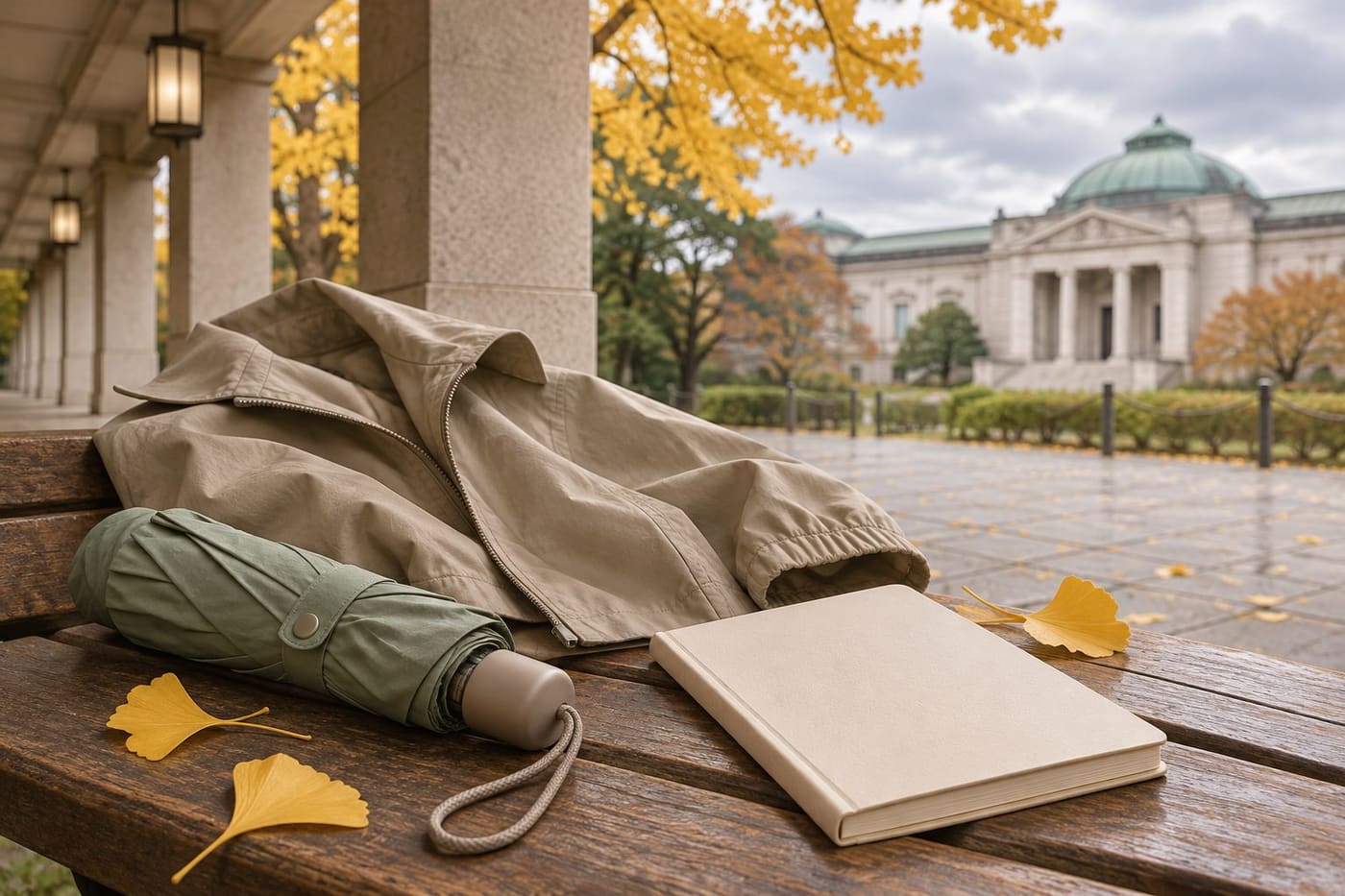
Japan's Culture Day falls on November 3. For someone planning a Tokyo outing, the useful weather question is local and time-specific: what does the latest Tokyo forecast say about the hours of the visit? A nationwide search for weather does not mean that one city forecast describes the whole country, and an appealing holiday photograph is not evidence of tomorrow's conditions.
At the research checkpoint on November 2, the Japan Meteorological Agency's 17:00 JST forecast described the Tokyo district as cloudy on November 3, with sunny spells until before noon. It is a dated forecast, not a promise of uninterrupted sunshine or a report of weather which has already happened. Reopen the current official forecast before leaving.
This guide combines that local snapshot with an explanation of the forecast fields and practical holiday planning. It does not assess every Japanese region, certify that a route is safe or confirm that a particular venue has space available. The planning examples are original and fictional unless a named official source is identified.
Fix the calendar date first
The Cabinet Office's 2026 public-holiday list identifies November 3 as Culture Day. In this guide, tomorrow means Tuesday, November 3, 2026, because the research date is November 2. Once that date passes, a search result retaining the word tomorrow should not be treated as a new forecast.
Write the full date in a group plan or calendar entry. Relative labels are convenient in conversation but become ambiguous when a message is forwarded, saved overnight or read in another time zone. An explicit date makes the intended day visible without requiring the reader to reconstruct when the message was written.
Keep the public holiday and the weather forecast as separate facts. The holiday establishes the date and context for an outing. It does not establish clear skies, open doors at every attraction or the operating timetable of every transport service.
Read the Tokyo district, not a national average
JMA's official Tokyo forecast data carries the November 2, 17:00 JST issue time. Its Tokyo-district entry for November 3 says cloudy with sunny spells until before noon. The dataset also has separate entries for the Izu and Ogasawara islands, which should not be silently substituted for the Tokyo district.
That geographic distinction matters when a page is headed Tokyo in a broad administrative sense. A region can contain several forecast areas with different conditions. Before copying a sentence into a travel plan, read the area label attached to it rather than relying only on the page title.
If your destination is outside the district covered here, choose its own current local forecast. A weather summary for central Tokyo is not an assessment of a mountain route, island crossing or another prefecture. The correct next step is changing the selected place, not extending the same sentence across a larger map.
Keep issue time and valid time separate
The issue time records when a forecast was published; the valid period records when its prediction applies. A forecast issued on November 2 can concern November 3. Confusing the two could make a reader think that today's observed rain is necessarily tomorrow's predicted weather.
JMA's explanation of its forecasting services distinguishes daily forecasts, one-week forecasts and shorter-range products. These serve different time horizons. Choosing a product which matches the decision is more useful than expecting one general weather icon to answer every question.
For an original example, someone deciding tonight whether to include an outdoor walk needs tomorrow's local forecast. Someone already at the venue deciding when to leave a covered area may also need a current short-range update. These are different checkpoints, and the earlier plan should allow room for the later information.
What the displayed rain probabilities mean
In the Tokyo snapshot, the November 3 six-hour probabilities are zero percent for midnight to 06:00 and 06:00 to noon, then ten percent for noon to 18:00 and 18:00 to midnight. These values belong to their stated local time blocks, not to every hour independently or to the whole country.
JMA's forecast FAQ explains precipitation probability as the chance of at least one millimetre during the specified period. It does not state how long any rain will last or how much will fall above that threshold. Probability and rainfall amount answer different questions.
Do not read a ten percent entry as ten percent of the afternoon spent raining. It is also not a forecast of ten millimetres. Keeping the percentage sign and period beside the value prevents a simple-looking number from changing meaning when copied into a short message.
Zero percent is not an absolute guarantee
JMA's forecast terminology explains that a displayed zero percent represents a probability below five percent and concerns the one-millimetre threshold. A zero display should therefore not be rewritten as a promise that no precipitation of any amount can occur.
For planning, distinguish the forecast from your tolerance for inconvenience. Someone carrying a notebook through a short uncovered walk may make a different practical choice from someone moving equipment which must remain dry. The forecast can be the same while the consequences of an unexpected shower differ.
That is a reason to make a flexible plan, not to replace the official probability with an invented one. Keep a modest fallback that fits the outing. If conditions or official information change, revise the activity rather than insisting that an earlier screenshot guaranteed the day.
Rainfall amount is another field
JMA's rainfall explanation describes precipitation amount as a depth of water, expressed in millimetres. It also explains that an observation covers a specified interval ending at the observation time. A recent measured amount and a future probability are not the same kind of information.
In an original fictional example, a station records two millimetres during the preceding hour. That observation does not establish a two percent chance of rain tomorrow, nor does it mean that the next hour must receive another two millimetres. The number needs its unit, place and time interval.
If you use observations to understand the current situation, keep them in a separate note from the forecast. This prevents an accurate measurement from becoming a prediction through an accidental change of label. It also makes later updates easier to compare with the correct earlier record.
The day can have more than one weather phase
Cloudy with sunny spells before noon is not the same description as sunny all day. A time-qualified phrase tells the reader when part of the forecast applies. Removing the qualification can make a summary sound more favourable while losing useful information.
For a fictional outing, the plan might include an outdoor approach in the morning and an indoor visit later. That is a proposed structure, not a recommendation that the morning is guaranteed dry or that every afternoon activity needs to move indoors. Recheck the actual destination and timing before adopting it.
Read the forecast sentence as a whole before selecting an icon or clothing image to represent it. A single symbol may be convenient, but a short plain-language note can preserve the timing better. Keep the distinction especially clear when several people are planning different parts of the same day.
Culture Day admission offers have boundaries
The education ministry's 2026 Education and Culture Week page lists November 3 free-admission arrangements at named national institutions. It specifies the regular exhibition at Tokyo National Museum, the collection exhibition at the National Museum of Modern Art, Tokyo, and the permanent exhibition at the National Museum of Western Art.
Those labels matter. A free collection or regular exhibition does not automatically mean that every special exhibition, screening, workshop or service at the venue is included. Check the named institution's current visitor information for the exact activity you want rather than expanding the ministry's wording.
The general planning questions also appear in our guide to preparing for a museum visit. That article concerns Frick's dinosaur museum, not Tokyo; its local opening and ticket details should not be transferred to a different institution.
Build a plan with an indoor alternative
An original fictional plan can start with one main destination, an optional outdoor section and a covered alternative. Put the essential activity first, then leave the optional portion easy to shorten or skip. A plan with fewer fixed commitments is easier to adjust if the forecast changes.
For example, a fictional group might choose a museum visit as its main activity and a nearby walk only if current conditions and access allow. The alternative could be spending longer inside the chosen exhibition rather than crossing the city to satisfy a rigid list.
This is a planning method, not a verified itinerary. The actual museum's entry arrangements, accessibility, opening times and last admission still need to be checked. A forecast which looks suitable does not create an available booking or override a venue's closure notice.
Plan the exposed parts, not just the destination
A day spent mainly indoors can still include uncovered station exits, a walk between buildings and a queue. Think through those transitions when deciding what to carry. The practical question is where the group would wait or regroup if the outdoor portion becomes unpleasant.
Keep the plan specific to the participants. Someone with limited walking tolerance may need a shorter approach or more time between activities, while a family may want a clear meeting point. These preferences do not change the forecast; they change how the plan should respond to it.
Avoid assuming that a photograph of a covered entrance proves the entire route is sheltered. Use current access information for the chosen venue and transport stop. Leave time to alter the approach rather than treating the shortest map line as a guarantee of the most suitable journey.
Check warnings and transport separately
A routine forecast is not a route-safety certificate. JMA's forecasting-services explanation treats warnings and advisories as distinct information. Before travel, check the current official notices for the destination and follow local authority guidance if hazardous conditions are reported.
This article does not claim that all areas are free of warnings. It also does not verify a particular rail line, road or ferry service. Transport operators can issue their own service information, and the fact that an activity is indoors does not settle the journey needed to reach it.
For an ordinary day plan, save the official weather and operator links you would use for a final check. If a relevant notice appears, review the plan before setting out. Do not treat a low probability in one forecast field as permission to ignore another source describing a different hazard or disruption.
A useful message for a group outing
Write the date, chosen place and intended arrival time before the forecast summary. Then state when the weather information was issued and which local area it covers. Add the actual venue arrangements and an alternative activity once those have been checked.
In a fictional message, the weather sentence might say that the local forecast will be checked again before departure, followed by a meeting place and a covered fallback. That is more useful than forwarding a national icon with no date and asking everyone to infer the same plan.
Keep later corrections in the same conversation so that an older screenshot does not remain the apparent final instruction. If the group changes the destination, change the forecast area as well. A carefully saved Tokyo entry should not continue guiding an outing which has moved somewhere else.
Conclusion: a local forecast and a flexible holiday plan
The November 2 JMA snapshot gives a specific Tokyo-district forecast for Culture Day, with timing qualifications and low displayed precipitation probabilities. Its value comes from preserving those labels and checking for updates, rather than turning it into an all-Japan promise of fine weather.
Choose the actual destination, confirm the scope of any admission offer and plan the exposed parts of the journey. Keep weather, venue and transport checks separate. That creates a practical November 3 plan while leaving room for the current information which matters on the day.
Sources and research note
Research checked November 2, 2026 using JMA's 17:00 JST Tokyo forecast, its services and terminology pages, the Cabinet Office holiday list and the education ministry's 2026 arrangements. The local dataset was saved with its retrieval time. No nationwide forecast, current all-clear, venue availability or completed journey is claimed. The Google Trends Japan past-24-hour descending-volume snapshot showed 天気, meaning weather, first displayed, 200K+, Lasted 1 hr, not Active. The article selects a clearly labeled Tokyo use case for that broad query; no higher topic was skipped. Examples are original. The image is conceptual artwork, not a record of the actual forecast weather or museum.