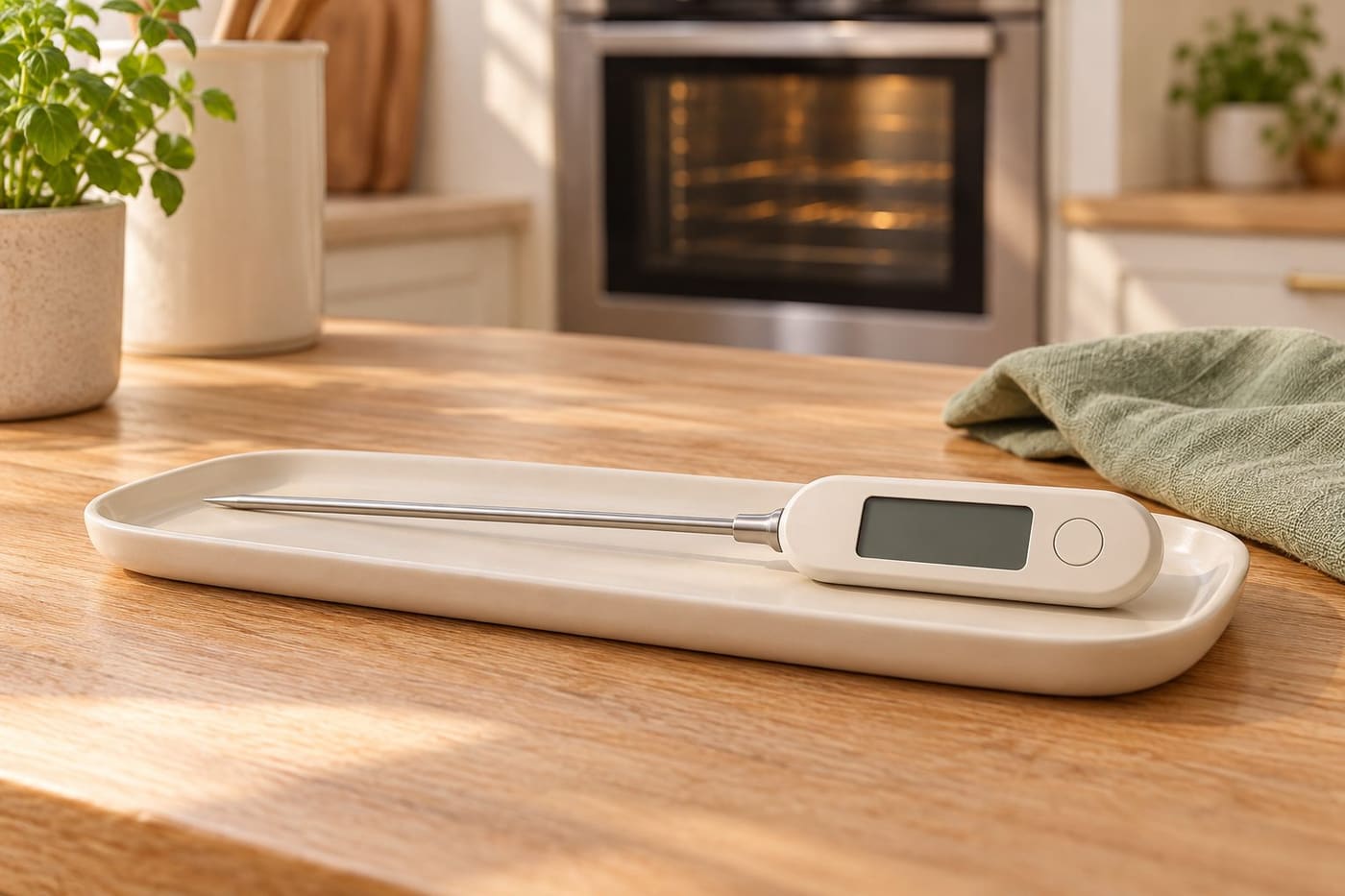
A dinner can look ready before the question that matters has been answered. The outside has browned, the timer has sounded, and everyone is waiting. A food thermometer gives the cook a different kind of information: a reading from the place where its sensor is actually measuring. That last detail matters. A precise-looking number from the wrong location can encourage a decision the food itself does not support.
Using a thermometer well involves more than buying a device. Choose the relevant guidance for the food, understand the instrument, take a useful measurement, and connect the reading to the next cooking decision. This guide explains that sequence for home cooks. It uses official sources checked on 1 November 2026 and identifies national guidance where numerical examples are given. It does not turn one country's table into a worldwide rule or replace the instructions supplied with a particular appliance or thermometer.
Decide what you need the reading to tell you
Before reaching for the probe, name the food and the decision. Are you checking whether poultry has finished cooking, whether a whole cut has reached its recommended cooking temperature, or whether a reheated dish is ready? Those questions belong to different entries in guidance. An answer remembered from a previous meal may belong to a different type of food.
Write the food category beside the relevant instruction if you are likely to forget it while cooking. Include any required rest or holding time. This is especially useful when several dishes are being prepared together: the information for a roast should not become an instruction for everything sharing its oven.
A reading is also different from a claim about the entire meal. It cannot establish whether a raw ingredient was stored properly, whether hands were washed, or whether a clean serving plate was used. Keep the measurement attached to the specific cooking question it can help answer. That makes the tool more useful without asking it to prove things it cannot measure.
Understand the instrument before the pan is hot
Find the manufacturer's instructions while the equipment is cool and the kitchen is quiet. Check which part senses temperature, how it should be positioned, how long a reading needs to settle, and whether the instrument is designed to remain in an oven. A handheld device and a leave-in model can require different handling. Do not infer oven suitability from the appearance of a metal probe.
The instructions should also explain the display, the temperature unit, and the cleaning limits. A waterproof claim for one component does not establish that the whole device can be immersed. Keep packaging or a saved manual somewhere accessible rather than relying on a product listing that might later change.
This preparation prevents a common kind of confusion: treating the moving number on the screen as a finished result before understanding what the device is doing. There is no single insertion depth or response time that this article can safely assign to every model. The instrument's own directions belong in the process, alongside food guidance.
Surface temperature and internal temperature answer different questions
Food Standards Australia New Zealand's thermometer guidance distinguishes probe readings from infrared surface checks and equipment gauges. Its page concerns food businesses, so its regulatory requirements should not be presented as universal rules for every home kitchen. The distinction between measurement types is nevertheless useful when selecting a tool.
An infrared reading describes a surface. The oven display concerns the appliance. Neither is automatically a measurement inside a piece of food. A bright digital display does not erase that difference. First ask what location the instrument measures; then ask whether that location answers your cooking question.
For a probe check, follow the device directions, measure a substantial part of the food, and allow the reading to stabilise. Keep cleaning and maintenance in the routine as well. These are measurement habits, not a promise that one instrument will suit every dish or kitchen.
Choose a useful location instead of the easiest location
The most convenient place to reach may not be the place that tells you what you need. A thin edge, an exposed surface, or an awkward angle can make it easy to obtain a number without obtaining a useful internal check. Pause before inserting the probe and think about where its sensing area will end up.
For an irregular piece of food, identify its thicker portion and consult the product instructions for an appropriate approach. If the shape makes placement difficult, do not quietly substitute a surface measurement and call it equivalent. Work out whether the thermometer is suitable for that food and how the manufacturer says it should be used.
You should be able to explain the placement in ordinary language: what was measured, where the sensor was positioned, and which cooking instruction the reading was compared with. That description need not become a formal kitchen record. It is simply a useful check against making a decision from an unexplained number.
Keep units and food categories together
For numerical examples, the United States safe minimum internal temperature chart, reviewed on 21 November 2024, gives poultry a minimum of 165°F, or 74°C. Its entry for whole beef steaks, roasts and chops is 145°F, or 63°C, followed by a three-minute rest. Ground meat is listed separately at 160°F, or 71°C.
These selected examples show why the food description matters. They are not interchangeable targets for all meat. The rest requirement belongs with the relevant entry, and the temperature unit must match the display. Consult the linked chart for the actual food rather than filling a gap with a similar-sounding example.
Avoid a note that says only a number. A better note identifies the food type, the unit and any time requirement together. The extra words take little space and prevent the instruction from losing its meaning when someone else helps with dinner. Do not shorten a specific rule until its important qualifications disappear.
Do not combine different guidance into an invented rule
Cooking recommendations can express the relationship between temperature and time in different ways. The UK government's cooking guidance, published on 18 December 2017 for England, Northern Ireland and Wales, includes time-and-temperature combinations. It also discusses avoiding contamination when checking food.
That is a reason to read a recommendation as a complete instruction. It is not a reason to select the temperature from one source and attach a different timing assumption from another. A statement about reaching a temperature and a statement about holding it for a specified period should not be treated as identical without their context.
Choose the appropriate official guidance for your location and food, then follow the whole instruction. If a packet gives particular preparation directions, read those too. When directions appear to conflict, seek clarification from the relevant source rather than constructing a compromise from unrelated numbers. A convenient simplified rule can be less useful than a clearly identified instruction.
Build cleaning into the measurement, not just the washing-up
A probe travels between a hand, a work surface, food and its storage place. Plan that journey. Know where the clean instrument will wait and how you will handle it after checking food. A clean serving plate should not become the resting place for equipment that has just contacted food still being cooked.
Follow the instrument's cleaning directions and applicable food-hygiene guidance. Pay attention to the probe and to surfaces or handles you touch during the check. Cleaning the metal while immediately picking up a contaminated handle does not make the whole sequence thoughtful.
This is easier when cleaning supplies and a suitable resting place are ready before cooking begins. You do not need an elaborate station. You need a practical arrangement that avoids moving a used probe across clean utensils while searching for somewhere to put it. If another person takes over, explain which items have been used and which are ready for serving.
A fictional meal shows how the steps fit together
Consider an invented home-cooking example. Leena is preparing poultry and vegetables for dinner. She has a digital probe thermometer but has not used this model before. Before starting, she checks its manual, confirms the display is in Celsius, and reads the relevant poultry instruction in the US chart she has chosen for this example.
When the meal appears ready, she does not regard the oven setting as the food's internal temperature. She positions the probe according to its instructions, waits for the reading to settle, and compares that result with the poultry guidance. If the cooking requirement has not been met, she continues cooking and checks again appropriately. She keeps the probe's cleaning step between checks and serving.
The example is a description of a decision sequence, not a reported cooking experiment. No actual appliance, meal or thermometer was tested for this article. Its useful feature is the order: identify the requirement, obtain the relevant measurement, and act on it. The display becomes part of a reasoned check rather than a decorative reassurance.
Notice what can make a reading hard to interpret
A changing display is not necessarily a settled result. An uncertain unit is not a minor formatting problem. A probe whose sensing area is not understood leaves the location of the measurement unclear. Each issue interrupts a different part of the connection between food and decision.
When a reading seems implausible, stop and revisit those basics. Check placement, units and the manufacturer's operating directions. Do not choose whichever number best matches the serving time you hoped for. If the instrument appears damaged or unreliable, follow its maintenance guidance and arrange appropriate replacement or checking rather than treating uncertainty as evidence that the food is ready.
There is also a limit to memory. If you cannot recall whether an instruction applied to a whole cut or ground meat, reopen the source. A short pause to identify the correct category is more useful than confidently repeating a number with its context missing. Keep a current link or clearly dated reference available for that purpose.
Make handovers clear when more than one person cooks
Kitchen confusion often arises between people rather than between numbers. One person checks a dish, another turns off the appliance, and a third assumes that serving can begin. A brief handover should explain what was checked and what remains to be done.
For example, say that a particular item still needs cooking or that the relevant rest period has not finished. Avoid a vague announcement that everything is done when only one item has been measured. If the next cook needs to recheck, make the thermometer's condition and cleaning status clear.
This is particularly useful in a shared household where people arrive at different times. Leave a meaningful instruction rather than an unexplained temperature on a scrap of paper. The goal is not to create paperwork around dinner. It is to prevent a precise observation from turning into a much broader claim as it passes from one person to another.
Keep the rest of food handling in view
The FDA's safe food handling guidance places cooking alongside cleaning, separation and chilling. It explains that appearance alone is an unreliable way to decide whether cooking has reached a safe internal temperature. A thermometer supports the cooking step; it does not replace the surrounding handling habits.
That distinction matters after the meal too. A successful cooking check does not establish how leftovers were subsequently stored. Keep later decisions attached to the relevant guidance rather than treating the earlier reading as a permanent safety certificate.
For planning beyond the cooking check, our related guide to planning refrigerator thawing offers a separate discussion of preparation and handling. Read the two tasks together without collapsing them into one test. A kitchen routine becomes clearer when each step has an identifiable purpose and an appropriate source.
Conclusion: make the number mean something
A useful thermometer check has a clear chain behind it. The food has been identified, the applicable instruction has been read, the correct kind of instrument has been chosen, and its sensor has been placed and read as directed. The result then informs the next cooking decision, including any relevant time requirement.
Keep that chain intact when sharing instructions or simplifying a routine. A bare number, an appliance display or an attractive browned surface cannot carry all the context on its own. Prepare the instrument before cooking, keep it clean, and return to the source when a food category or instruction is uncertain. Those habits make a small kitchen tool much easier to use with care.
Sources and research note
The four official sources linked above were checked on 1 November 2026. FoodSafety.gov supplies the identified US numerical examples; FDA supplies the wider handling context. FSANZ explains measurement types in a business setting, and the UK publication illustrates why time requirements belong with temperatures. The kitchen example is invented. The original conceptual illustration shows equipment at rest, not an actual food test.