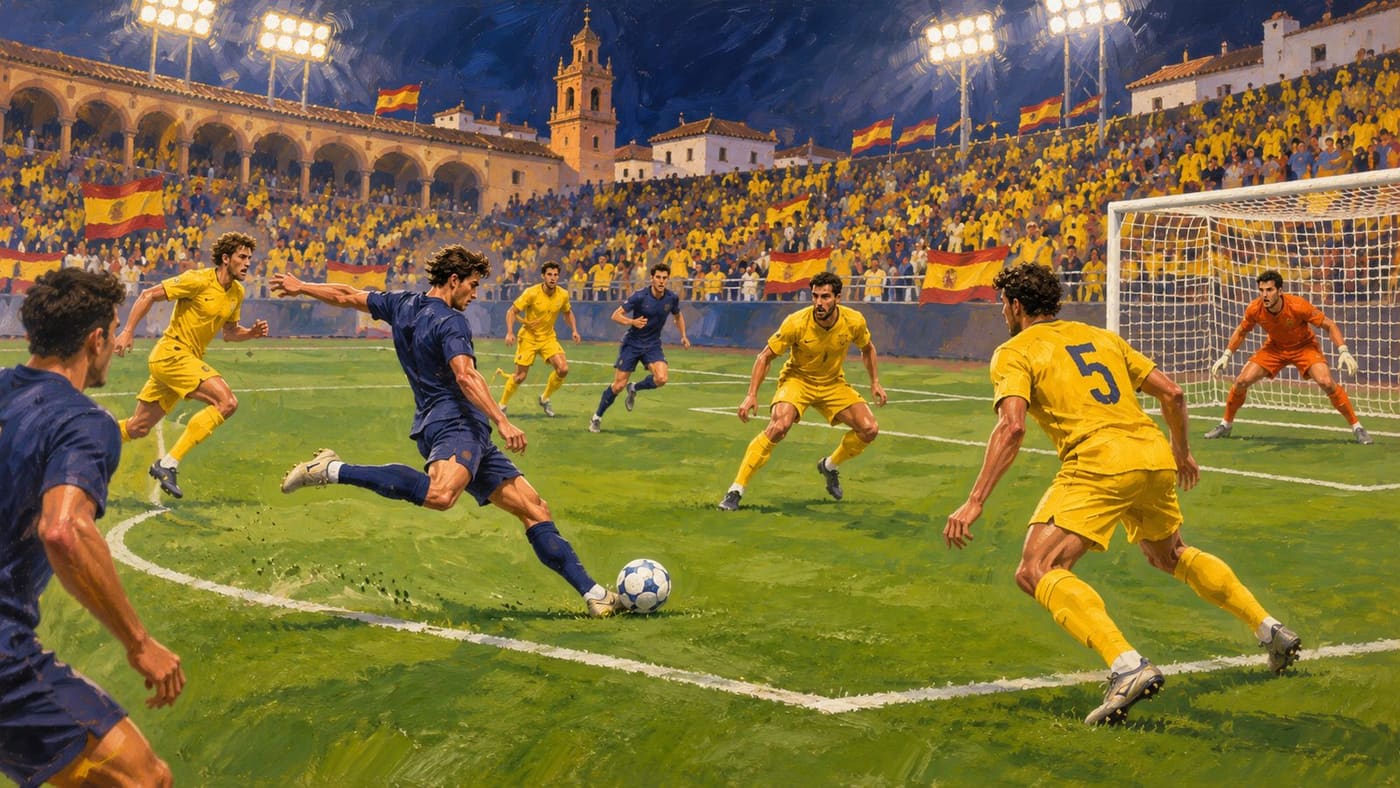
Paris Saint-Germain won 6–0 away to Villarreal on 3 November 2026 in the men's UEFA Champions League. Four goals in the first 17 minutes transformed the match before half-time. Fabián Ruiz scored again after the break, and David Boly marked his Champions League debut with the sixth. The official match centre records the score at the Estadio de la Cerámica.
The clubs also met that day in the UEFA Youth League. The results went in opposite directions. Villarreal won the youth fixture 3–0, while PSG won the senior match 6–0. If a search result seems to show a conflicting score, check the competition printed above the scoreline. The same clubs and date appear on both records, but the teams and competitions differ.
Follow the score through the opening 17 minutes
João Neves put Paris ahead in the ninth minute. Désiré Doué scored in the 12th, Senny Mayulu followed in the 13th and Fabián Ruiz added the fourth in the 17th. That sequence separates the opening goal from the two especially close together, and then from the goal that made the score 4–0. Reading the four timestamps explains the pace of the change more precisely than the final margin alone.
The PSG match report and the UEFA round-up supply complementary records. The club offers an account of the goals, while UEFA places the result alongside other games on matchday four. Use the match centre for the timeline and the UEFA round-up when comparing the result across the competition.
Four goals came from four different situations
The opening goal followed a corner. PSG's account credits Willian Pacho with diverting the ball before Neves finished from close range. For a reader following the sequence through a score app, the corner is the important context. It shows that the first change in the match came from a restart and a touch in the area. It does not require a claim that one team had already established lasting control of open play.
The second goal offers a different example. The club report describes Paris pressing together before Maghnes Akliouche found Doué, who finished from the edge of the area. The separation between the regain and the finish matters. A short highlights clip may start with the shot, while the report explains how Paris obtained the opening. The third goal followed a blocked Neves effort. Mayulu took the next chance before Villarreal could get the ball clear. Doué and Mayulu appear only a minute apart on the scorecard, but those two entries describe different possessions and different finishes.
The fourth arrived when Akliouche again supplied the ball, this time for Ruiz. In a run of four goals, it is easy to remember only the speed. The identity of the finishers is another useful detail. Four different players scored in that opening run. The record therefore tells a story about the number of players Paris brought into scoring situations, as well as the sudden change in the score. That observation is grounded in the scorer list and does not depend on extrapolating a full tactical model from highlights.
This opening also illustrates why a final score is an imperfect guide to the match a viewer would have seen at any particular minute. Before the first goal, a single Villarreal chance could have changed the next passage. By the time the fourth went in, the home team faced an entirely different task. Putting the early goals in chronological order helps a reader see when that change happened. The final six gives the size of the outcome, while the sequence explains when the result began to take shape.
Read the record claim with its scope attached
PSG's French-language report says its fourth goal arrived after 16 minutes and two seconds of elapsed play and describes the opening as the fastest four-goal start by a team in the competition. That is a club-reported record claim. The match centre gives Ruiz's goal as the 17th minute. The elapsed timestamp and the match-minute label can describe the same event. A goal just after 16:00 is recorded in the seventeenth minute.
There is a second historical claim in the club report. PSG calls the result its largest away win in the Champions League. The words “away” and “Champions League” define the comparison. They keep the claim distinct from a club record across all competitions, a league record or a record for all away teams. Someone quoting only “largest win” would omit information necessary to understand what PSG says it set.
The early scoring record and the away-margin record also describe different things. Imagine a side going four ahead quickly before conceding several goals. It could have a remarkably fast opening without setting a margin record. Conversely, a side could score six late goals without having a remarkable opening at all. At Villarreal the two claims arise from different parts of the same result. Keep them separate when using the report to explain the performance.
The score stayed at four until the interval
The four goals did not end the first-half action. PSG's report describes Péter Gulácsi turning away efforts from Doué in the 36th minute and Hakimi in added time. Neither attempt appears in a list limited to goals. If you use the goal list alone, the gap from the 17th minute to the interval may look empty. The match report adds evidence about two chances during that period and gives the goalkeeper a place in the chronology.
For a short account of the half, distinguish the score at the interval from the chances that did not change it. This is especially useful when comparing the fourth goal with Hakimi's later effort. Both came in the same half, but only one increased the lead. The goalkeeper's intervention explains why the score remained 4–0 in the report even though Paris continued to threaten.
That distinction also prevents a misleading inference from the 6–0 final score. Gulácsi could make important saves in an individual passage while Villarreal still conceded six overall. Likewise, a shot recorded in added time belongs to the first half even though the minute label contains a number beyond 45. The club report's two save entries make the account of the interval more precise without requiring a full count of every shot or save in the match.
Ruiz's second goal came after Villarreal had a chance
Paris led 4–0 at the interval. The club's account records a Sergi Cardona attempt that went wide soon after play resumed. Ruiz then scored his second in the 50th minute. PSG describes Vitinha finding him inside the area. The point is worth retaining because a scoreline with a zero can obscure the fact that the other team had attempts. A clean sheet means no goal was conceded. It does not show that no player threatened to score.
Ruiz had already finished one chance in the early sequence. His second made him the only player on the Paris scorer list to appear twice. That arithmetic reconciles the six goals with the five scorers. UEFA's matchday account names Ruiz as player of the match. The designation belongs to the senior competition record and is consistent with the match centre's two goals next to his name.
For a reader catching up from the result alone, the simplest timeline is therefore four before half-time, one soon after, and one late. That timeline is more useful than treating the second half as an afterthought. It tells the reader when Villarreal's opportunity came, when Paris extended the lead, and when the debutant added the final goal.
Boly's debut was a separate late development
PSG's team list shows David Boly replacing Achraf Hakimi in the 76th minute. The match centre records Boly's goal in the 78th. The club describes it as his first appearance and first goal in the competition. Those details explain why the last goal generated interest of its own even though the score was already 5–0. It was an individual milestone during an established team win.
The club's post-match reactions include Boly and Ruiz alongside Luis Enrique and Lucas Hernandez. That is a useful companion to the scorecard for readers who want to distinguish the participants' reaction from the event record. The match centre shows the substitution and goal. The reaction page shows how the people involved described the match afterward.
PSG puts Boly at 17 years and 285 days at the time of the goal and calls him its second-youngest scorer in the Champions League, behind Warren Zaïre-Emery. The qualifier is important. It is a ranking within PSG's Champions League history, not a ranking across every club in the tournament. It is also an age-at-scoring detail, which is a more specific statement than a ranking of young debutants. The club report supplies both the number and the comparison group.
Matchday four is a point in the schedule
UEFA's team-by-team fixture and results list records the match in the league phase. PSG describes it as its fourth win in four games. Four wins are twelve points under the ordinary three-points-for-a-win count. The six-goal margin contributes to goal difference, while the result contributes one win. Those are different columns of a table. A large margin can be significant for the first without changing the value of a win in the second.
The club report describes Paris as retaining the lead after the game. The time reference belongs with that statement. Other fixtures take place during the matchday, and a league table is updated as more results come in. Use the table with the time of the snapshot if the exact position is the question. If the question is whether Paris had four wins from its four completed games, the club and fixture records already identify the relevant sequence.
This is also how to compare the Villarreal result with Paris's earlier 4–2 win over Barcelona mentioned in the club report. Each fixture contributes a win. Their scorelines differ, and the home or away setting is part of the historical context. A reader looking up how Paris reached its points total should count the results. A reader looking up the away scoring record should keep the venue distinction.
Keep the two Villarreal fixtures in separate records
PSG's Youth League match report describes its development side losing 3–0. The senior match centre describes the men's first team winning 6–0. Both can appear under Villarreal and Paris Saint-Germain on the same date. A live score notification that omits the competition can make the two appear contradictory. The competition field resolves the ambiguity without requiring either score to be revised.
The safest way to cite one of the results is to include the competition alongside the score. When keeping notes, add the date and identify whether the source is the club's senior match centre or a development-team report. That way, if a different score appears later in a search, there are enough details to tell which game it describes. A scorer list is an additional cross-check when competition labels are abbreviated.
The France Google Trends capture for 4 November listed “villarreal – paris-sg” first by search volume over the previous 24 hours. It showed 500K+ searches and was marked Active at retrieval. The rank describes the captured France board. It is not a count of match viewers or a measure of interest in any one scorer. The senior result is established by PSG and UEFA, while the capture explains why the fixture was selected for coverage.
Conclusion
Paris won the senior Champions League fixture 6–0 by taking a four-goal lead in the opening 17 minutes, then adding Ruiz's second and Boly's debut goal after half-time. The early scoring sequence explains the shape of the match. The competition and team level explain why a separate Villarreal win by 3–0 also appears in the official records from the same day. Read the competition first, then follow the goal times and scorers for the match you meant to find.
For the separate development-team fixture, read the Villarreal–PSG Youth League match analysis.
Sources consulted 4 November 2026 include the PSG match centre, senior and Youth League club reports, PSG post-match reactions and UEFA's matchday and fixture records.