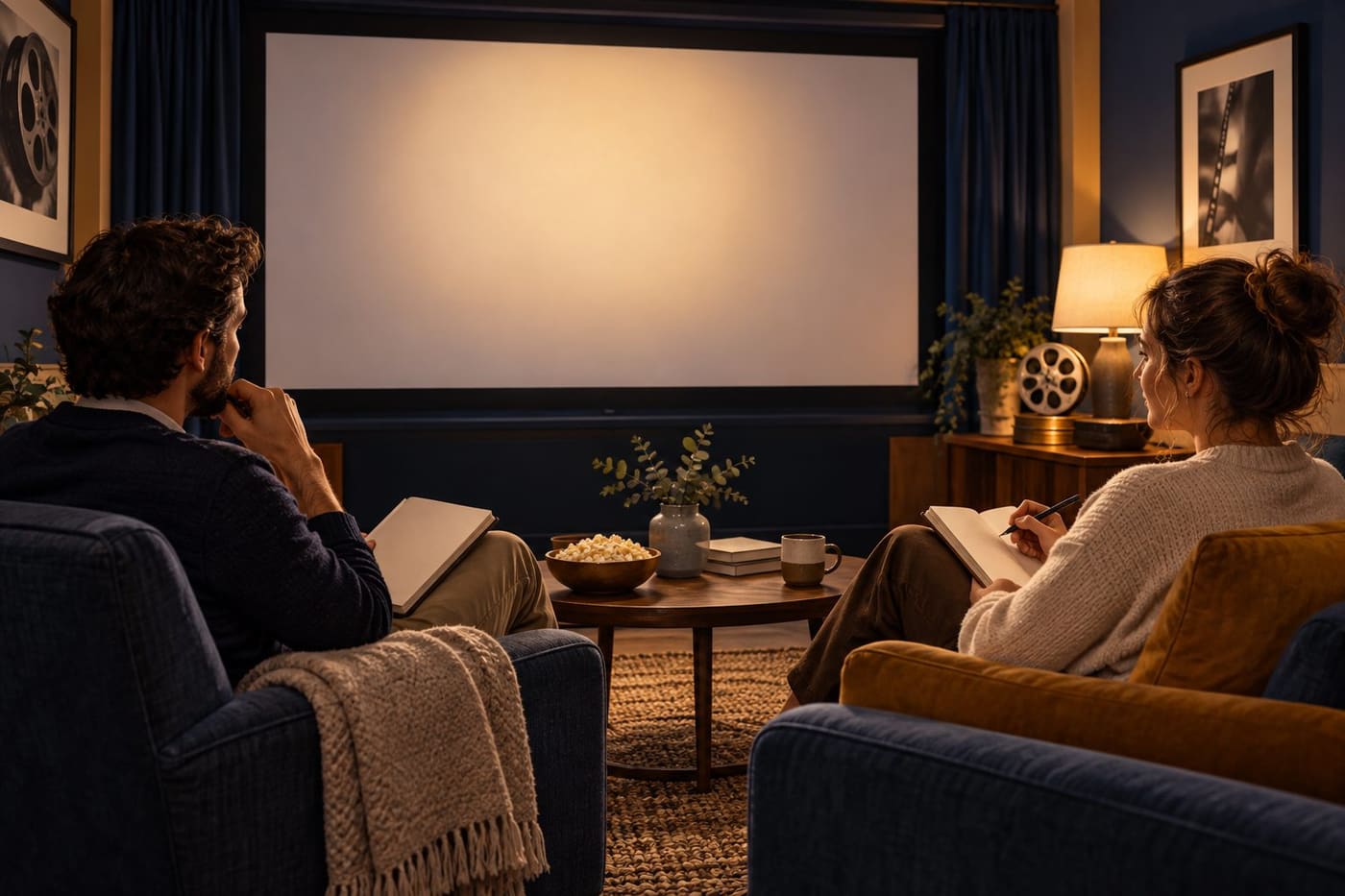
The credits finish, and someone asks whether you liked the film. You did, but the explanation comes out as a plot summary. Or you disliked it, yet cannot quite name what lost your attention. Returning to one short scene can give the conversation somewhere more concrete to begin.
You do not need to turn an evening's entertainment into an examination. Choose a moment you remember, describe what is actually on the screen and listen to how another viewer experienced it. The purpose is to find words for a response, not to prove that there is only one correct way to feel.
This guide uses an entirely invented scene to demonstrate close observation. It is not a review of a real film, a claim to have attended a screening or an account of a filmmaker's intentions. Three primary educational resources, read on 30 October 2026, provide a starting vocabulary. The viewing exercise and examples are original.
Start with a moment, not the whole plot
Pick a scene small enough to discuss without retelling the film. Perhaps a character hesitates at a door, an object changes hands or a room suddenly becomes quiet. Write a plain description before adding a judgment. A person waits beside a window is an observation; a person feels betrayed is an interpretation that needs support.
Our invented scene takes place in a closed railway waiting room. An adult named Lena sits beside a suitcase. Another adult, Dev, places an envelope on the bench and leaves without speaking. Lena looks at it, hears a train outside and puts the envelope in her coat. Nothing here belongs to an existing film or reported event.
That brief action gives two fictional viewers, Bea and Malik, enough to discuss. They do not invent the envelope's contents immediately. First they agree on the visible sequence. This keeps the conversation connected to the scene rather than to the different stories each viewer might like to write around it.
Notice what the frame includes
Film Education's terminology resource distinguishes shot sizes and describes how framing draws attention to people, objects and settings. It also groups elements within the frame, such as props, costume, expression, lighting and colour, under mise en scene: https://filmeducation.org.uk/resources/secondary/teaching_with_film/film_in_the_classroom/terminology/
Use that vocabulary lightly. In the imagined scene, suppose the first shot shows Lena and the empty room together, while a later image concentrates on her hand near the envelope. Bea can describe the change without claiming that every close view always means the same emotion. The surrounding action matters.
Ask what becomes easier to see and what disappears from view. Is Dev still visible when the envelope is placed down? Can we see Lena's face when she reaches for it? These questions locate the discussion in choices that can be described. They do not require a technical label for every image.
Separate a detail from its possible meaning
Bea reads Lena's pause as reluctance. Malik reads it as care. Neither response becomes a fact simply because it is expressed confidently. They look for the details behind their interpretations: the length of the pause, the movement of the hand and the sequence around the departure.
They may still disagree after describing the same moment. That can be the most interesting part of the conversation. A scene need not assign every gesture an unambiguous explanation. Say what supports your reading, then acknowledge what the scene leaves open.
Try completing two different sentences in your own words: what I noticed was, and what it suggested to me was. The gap between those statements is useful. It lets another person question an inference without denying that the observation occurred, and it makes room for a response you had not considered.
Listen to what changes
Filmmaker and educator Tom Barrance's Learn About Film guide treats pictures, sound and editing as connected storytelling tools. Its sound section identifies dialogue, voiceover, music and effects as possible elements, while its editing discussion asks how shots work together: https://learnaboutfilm.com/film-language/
In our invented scene, there is no spoken explanation of the envelope. A train sound arrives before Lena puts it away. Bea wonders whether it makes the decision feel urgent. Malik notices that it also places the quiet room beside a world that continues outside. These are interpretations of an imagined sound choice, not findings about an actual soundtrack.
When discussing a real scene, describe the sound you heard before naming its effect. If you cannot tell whether a sound belongs to the story world or a score, keep that uncertainty. A convincing interpretation does not require pretending to identify every instrument, recording technique or production decision.
Follow the order of information
Suppose the imagined scene shows the envelope before Dev's face. Now imagine the reverse: first his expression, then the object. The same basic action can invite a different sequence of questions. The exercise helps viewers discuss when information arrives, rather than simply listing what is in the scene.
Be clear that changing the sequence in your imagination is an analytical exercise. It is not evidence that an alternative edit exists. Do not describe deleted footage, a director's preferred version or production disputes unless reliable sources establish them.
Bea and Malik draw a simple sequence in their notebooks: waiting room, arrival, envelope, departure, pause, train sound, coat pocket. They use ordinary words. The list helps them identify where their reactions began to differ without needing to reconstruct the entire film or memorize specialist terminology.
Look for a pattern across the scene
One detail can matter, but a repeated relationship may be easier to discuss. Does the scene keep returning to an empty seat? Does a sound recur with a different effect? Does a character move from the edge of the frame toward the centre? Describe the pattern before turning it into a claim about the whole film.
In the invented example, imagine that the bench remains visible after Dev leaves. Malik thinks the empty space carries some of the scene's weight. Bea had focused on the envelope and overlooked the bench. Their discussion adds another observation without requiring either person to abandon the original response.
Avoid assigning a universal meaning to a colour, camera angle or prop. A visual choice can work differently across genres, scenes and cultural contexts. The interesting question is what it does here, alongside the other details the film actually presents.
Place technique in a longer history carefully
The BFI Replay collection Inventing Film Language introduces early film techniques, including close-ups, camera movement, editing and continuity. Its catalogue includes works such as Grandma's Reading Glass, dated 1900, and The Big Swallow, dated 1901: https://replay.bfi.org.uk/collection/419
That collection offers a route into further viewing, not proof that a single person invented every familiar technique. This article consulted the collection description and listings; it does not claim to have watched the linked films through the service or verified access for every reader.
For Bea and Malik, the useful connection is curiosity. They can explore an archive's own account and find another film to discuss. They do not need an unsupported historical first to explain why the envelope scene interested them. Specific observation can stand on its own while research supplies context where needed.
Ask a question another person can answer
A question such as why is this obviously a masterpiece leaves little room for a different response. Ask instead which moment changed the other viewer's expectation, or what detail they would revisit. A good opening can be answered without specialist knowledge and without agreeing with the host.
Bea asks Malik whether the train sound made the ending feel settled or interrupted. He explains his view and points to the pocketing of the envelope. Bea then describes why the same action felt like avoidance to her. They are discussing a choice in the scene rather than awarding points for a preferred interpretation.
For a small gathering, choose a few questions rather than working through a long checklist. Leave space for someone to say they simply enjoyed the performance or did not connect with the scene. Close viewing should offer another way into the film, not become a barrier to joining the conversation.
Keep spoilers and access in mind
Agree on what the group has seen before discussing an ending. A spoiler warning should come before the revealing detail, with enough context for someone to decide whether to continue. If a friend has not watched the film, choose a different topic or a scene they are comfortable discussing.
For a real viewing, check the actual edition's available access features. Captions, audio description and language options can affect how people participate. Our guide explains why those features should be checked for the particular release: https://monetizearticle.com/article/film-access-features-check-captions-audio-description-and-the-actual-edition-9d388b
Do not assume a service permits public or organized screenings merely because a title can be streamed at home. Check applicable permissions for the setting. This article is a discussion exercise, not a screening licence, an access guarantee or advice to bypass a platform's restrictions.
Make a short note that preserves uncertainty
A useful note can identify the scene, the detail and your response. Add a question if one remains. If a fact about production, history or an actor's contribution needs checking, keep it separate from what you observed. A remembered interview is not a source until you locate it and confirm what it says.
In the invented exercise, Bea writes that the envelope remains unopened and that the train sound precedes the final movement. She records her interpretation as one possible reading. She does not write that the director confirmed a meaning, because no real director or interview exists for this example.
For a real film, a time reference can help you find the moment again, but versions may differ. Describe the action as well as noting the time. That makes the note more useful to another viewer who is using a different authorized edition.
Rewatch without trying to catch the film out
A second look may correct a memory. Perhaps a pause was shorter than you thought, or a sound began earlier. Changing an interpretation after checking the scene is part of careful viewing. It does not mean the first response was dishonest or that enjoyment requires perfect recall.
Bea and Malik might discover, in a real discussion, that they had combined two moments. The practical response would be to locate them separately and adjust the account. They should not defend a mistaken description simply because it supports a clever argument.
Equally, an unresolved question need not be forced into an answer. Some conversations end with a more precise uncertainty: we understand the action, but read its significance differently. That is more informative than manufacturing a consensus or treating ambiguity as an automatic failure of the film.
Turn the conversation into a useful recommendation
If you recommend the film afterward, describe what kind of experience interested you without promising the same response from everyone. You might mention patient observation, a striking use of sound or a performance that rewards attention. Keep major revelations out unless the recipient has chosen to hear them.
Separate a personal recommendation from factual availability. Check a current official listing before telling someone where a film can be watched. A discussion of a scene cannot establish that the same title, language track or edition is available in another country today.
Bea's imagined recommendation would be modest: she would like to discuss a scene whose silence left room for several readings. She would not invent awards, reviews or audience statistics to make the recommendation more persuasive. The observed detail is already enough to explain her interest.
Conclusion: give your reaction somewhere to stand
Talking about film becomes more precise when a response is connected to a moment, a sound or a sequence of images. Start with what you noticed, explain what it suggested and listen to another reading. Specialist vocabulary can help, but it should clarify the exchange rather than dominate it.
One scene is enough for a worthwhile conversation. Return to it with curiosity, keep fact and interpretation distinguishable, and allow the film to remain open where the evidence does. The reward is a richer account of an evening's viewing, not a compulsory verdict.
Sources and research note
Three primary educational pages were read on 30 October 2026: Film Education's terminology resource, Tom Barrance's Film Language guide and the BFI Replay collection listing. The University of Florida page returned a redirect error and is not used. No linked video was claimed as watched. Lena, Dev, Bea, Malik and the entire scene are invented. The original AI-generated conceptual illustration is not a film still or a documentary screening photograph.