A bond is quoted at 98.50, yet the cash amount on the purchase confirmation is higher than 98.50 percent of its face value. One possible reason is accrued interest. The coupon payment belongs to a schedule, while the bond can change hands between the dates on that schedule. The settlement amount can therefore include an adjustment for interest that has accumulated before the buyer owns it.
To read that adjustment, keep the quoted price, face value, coupon and settlement calculation visible separately. The examples below use a fictional fixed-rate bond and an explicitly stated fraction of a coupon period. They illustrate the arithmetic without choosing a security, using a live market price or assuming that every bond follows the same calendar convention.
Begin with the coupon schedule
A bond’s coupon describes interest under its terms. For a simple fixed-rate bond with a face value of 1,000 currency units and an annual coupon rate of 6 percent, the annual coupon amount is 60. If the terms split that amount into two equal regular payments, each payment is 30. Those amounts come from the face value and coupon rate, rather than the current market quotation.
Interest can accumulate between scheduled payments before it is paid. Investor.gov defines accrued interest as interest that has been earned but has yet to be paid. That definition identifies a timing difference. It does not tell you the market value of the bond or what return a buyer will ultimately receive.
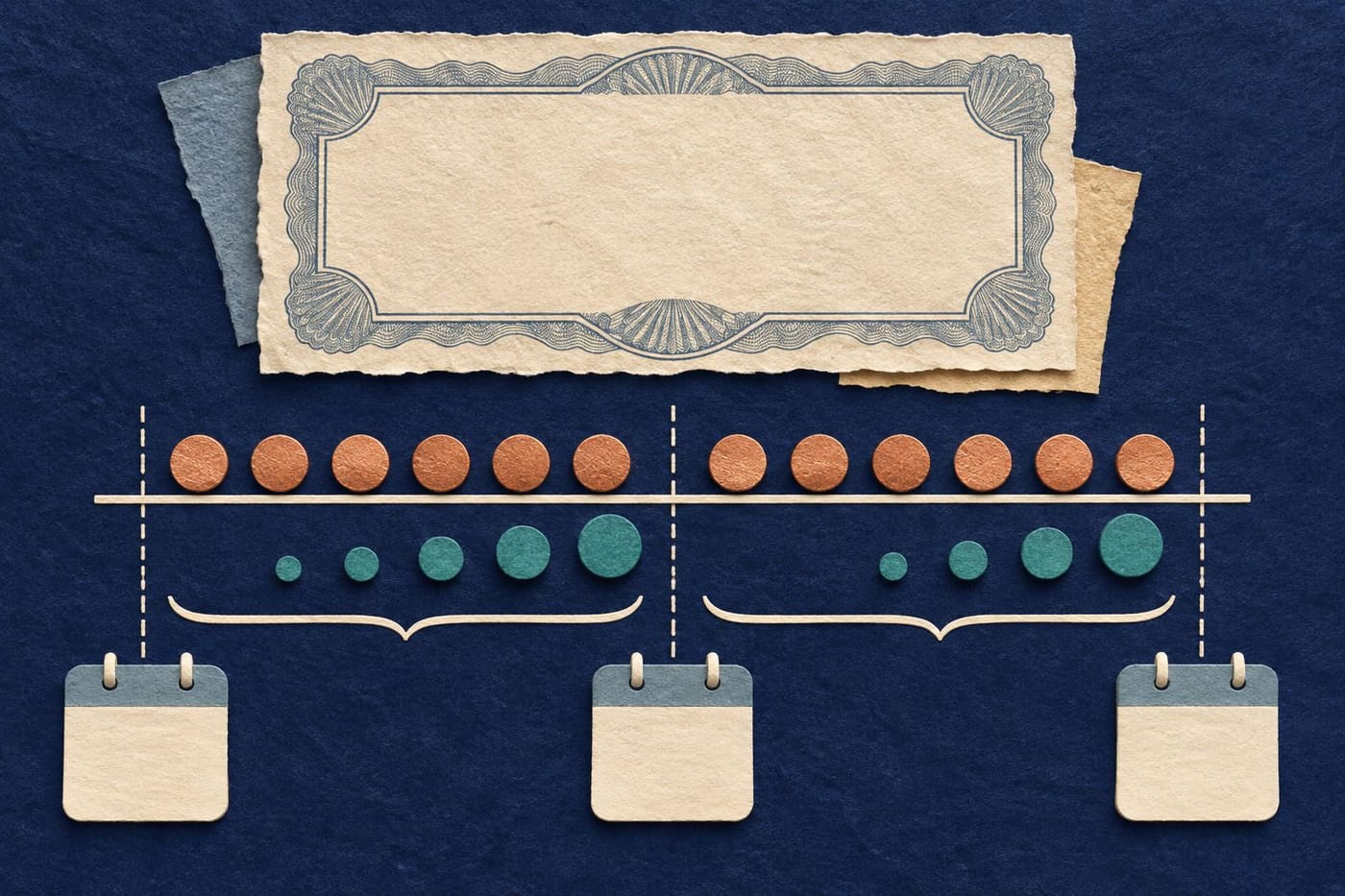
Draw a short timeline with the last coupon payment, settlement and the next coupon payment. Then write down the coupon amount for that period. This makes the question concrete: how much of the period’s interest is included in the settlement adjustment under the security’s terms?
For an actual confirmation, obtain the coupon dates from the security documentation and use the settlement date shown on the trade record. A trading-screen timestamp and a coupon date serve different purposes. If the calculation looks wrong, checking which dates were used is a better first step than changing the coupon rate to make the answer fit.
Convert the quotation into a cash price
Many bond quotations express a price as a percentage of face value. Under that convention, a price of 98.50 means 985 for a face amount of 1,000. For a face amount of 10,000, the same quotation means 9,850. Verify the quotation convention before doing the multiplication because the displayed number is not always a complete cash invoice.
In the fictional example, assume 98.50 is a quotation excluding accrued interest. That component is often called the clean price. Adding the accrued-interest amount gives a price including that adjustment, often called the dirty or full price. A purchase confirmation may use different labels, so read the line descriptions rather than relying only on the informal terms.
Fees, commissions or other separately disclosed amounts can also affect the cash total. A quoted price, accrued interest and a transaction charge are different inputs. If the amount due is higher than the quoted-price component, do not assume that the entire difference is accrued interest. Reconcile the actual confirmation line by line.
For example, write the calculation as face value multiplied by quoted percentage, then add the stated accrued-interest amount and any separately identified charge. This preserves the source of each component. It also lets you identify a disagreement about price without confusing it with a disagreement about the interest period.
Work through one coupon-period example
Return to the bond with face value 1,000 and a regular half-year coupon of 30. Suppose the applicable calculation assigns one third of that coupon period to accrued interest at settlement. The adjustment is 30 multiplied by one third, or 10. At a clean quotation of 98.50, the price component is 985 and the amount including accrued interest is 995, before any separate charges.
The one-third fraction is an assumption for this teaching example. It is not a claim that an arbitrary pair of calendar dates always produces that fraction. The actual bond’s day-count convention, coupon schedule and settlement details determine the fraction used on a real confirmation.
If the next scheduled coupon of 30 is paid in full to the buyer under the example’s terms, 10 of that cash corresponds to interest already compensated through the purchase adjustment. The remaining 20 corresponds to the rest of the coupon period in this simplified explanation. Receiving 30 in cash does not mean that all 30 was earned after settlement.
Now increase the face amount to 5,000 while preserving the same coupon, price and period fraction. The regular coupon becomes 150, accrued interest becomes 50 and the clean-price component becomes 4,925. The total including accrued interest is 4,975 before separate charges. Scaling every amount by five provides a useful arithmetic check.
Keep coupon and yield in their own places
The coupon rate and the quoted market yield answer different questions. Coupon terms determine the contractual interest calculation in this fixed-rate example. Yield measures relate price and expected cash flows under specified assumptions. Replacing the coupon with the yield in an accrued-interest calculation mixes the inputs.
FINRA’s accrued-interest calculator guidance explicitly asks for par value and the coupon rate, distinguishing those inputs from current price and yield. You can read that guidance to understand the fields without submitting a calculation. For a particular security, use the calculation convention stated in its documentation.
Suppose the fictional bond’s screen also displays a yield of 6.4 percent. That does not change the example’s annual coupon from 60 to 64. The contractual rate remains 6 percent on face value. The yield figure reflects a different calculation involving the price and the cash flows it is intended to summarize.
When copying figures into a worksheet, give each field a full name. “Rate” is ambiguous if one page contains coupon rate, current yield and yield to maturity. Recording “annual coupon rate, 6 percent” makes the input reviewable and reduces the chance that a later update will replace it with a different measure.
Check the day-count convention before using dates
Two bonds can accumulate interest using different day-count rules. A calculation may use an actual-day approach or a convention based on a 360-day year and specified treatment of months. The name of the method matters, and details can affect the fraction assigned to a period.
Do not infer the rule from the fact that the bond pays twice a year. A payment frequency tells you when regular coupons are scheduled. It does not fully describe how accrued interest is allocated between those payments. Leap years, short or long first coupon periods and special settlement circumstances can also make a casual calendar estimate unreliable.
FINRA’s public calculator presents bond-type choices and simplified descriptions of conventions. Treat that as an introduction to the inputs. Check the actual instrument’s terms when reconciling a trade, particularly where a generic description and a security-specific calculation seem different.
A useful query to the firm handling a trade is specific. Ask which coupon dates, settlement date, day-count convention, face amount and rate produced the accrued-interest figure. Those fields can be compared with the documentation. Asking only why the total is “too high” leaves several different components in dispute at once.
Understand why reopenings can include the adjustment
Accrued interest can also appear when additional amounts of a previously issued Treasury security are auctioned in a reopening. TreasuryDirect’s reopening explanation describes how reopened securities retain the original maturity date and coupon rate or spread, while price and issue details can differ. It notes that accrued interest may be payable and included with the first interest payment.
This is an issuance example, with TreasuryDirect’s own rules and records. It illustrates why the payment schedule and the buyer’s issue date can differ. Keep it distinct from a secondary-market purchase from another holder, even though both can involve interest that accumulated before the new holder owned the security.
The TreasuryDirect glossary for marketable securities explains the possible gap between the dated date and issue date. If your question concerns a TreasuryDirect purchase, those terms give you a route into the official explanation. Use the purchase record to identify the actual amounts and dates.
For a reader checking a headline about an auction, the practical lesson is to look beyond the coupon rate. Price, face amount and any accrued-interest adjustment together determine the purchase cash under the relevant arrangements. A coupon headline alone cannot reproduce that amount.
Distinguish the next payment from the total result
The first coupon received after a purchase is one cash flow. To understand the result over a holding period, you also need the original cash outlay, any sale or redemption proceeds, other payments and applicable costs. The accrued-interest adjustment belongs in that record so the first coupon is not counted as entirely new earnings.
In the teaching example, the buyer pays 995 including accrued interest and later receives a coupon of 30. The bond still has a market value, which may have changed. You cannot establish the buyer’s total return by subtracting 10 from the coupon and stopping there, because the holding-period result also depends on what happens to the investment’s value and other cash flows.
Investor.gov’s explanation of selling bonds before maturity describes why a sale price can differ from face value. Accrued interest does not remove that market-price uncertainty. The settlement adjustment and the investment’s price behavior belong to different parts of the analysis.
Our guide to reading duration on a bond-fund fact sheet examines another measure that can be confused with a payment schedule. For an individual bond confirmation, start by identifying the actual security and coupon terms before using a measure from a different product.
Recognize cases that need a different calculation
The fictional example uses a conventional fixed coupon with two equal regular payments. A floating-rate security, an inflation-linked principal adjustment or an unusual first coupon can require additional information. A security without regular coupons has a different cash-flow structure. Identify those features before applying the example’s arithmetic.
A bond with payment problems or a special market convention may also be quoted or settled differently. If the confirmation says that interest is treated differently, obtain the applicable explanation from the documentation and the firm. A familiar formula is useful only when its assumptions match the security.
Early redemption adds another set of terms. Investor.gov’s callable-bond explanation describes how call provisions can end future payments before the stated maturity. When reviewing an expected cash-flow schedule, check whether the schedule assumes that the bond remains outstanding.
These distinctions are reasons to keep a calculation’s scope on the page. A worksheet for one regular fixed-rate bond should identify that structure, the coupon period and the source of the day-count fraction. It should not silently become a template for every security carrying the word bond.
Reconcile the confirmation with a short checklist
Start with the identifier and face amount. Check that the quotation convention and price match the trade record. Then locate the coupon rate, previous and next coupon dates, settlement date and accrued-interest convention. Recalculate the stated components using those inputs, with charges shown separately.
If a discrepancy remains, preserve the confirmation and write down the exact line you cannot reconcile. A difference in accrued interest may come from a date or convention. A difference in the clean-price component may come from the quotation or face amount. Keeping the calculations separate helps the firm answer the actual question.
For your own record, retain both the original cash outlay and subsequent payments with their dates. That makes it possible to distinguish cash received from income attributed to a particular holding period. It also prevents a later summary from omitting the accrued interest that was paid at purchase.
A bond quotation becomes easier to read when you follow its components into settlement. The coupon schedule explains why interest can already have accumulated, the convention explains the fraction and the confirmation shows the amount actually charged. Together, those details account for the extra cash without turning the next coupon into a misleading measure of the investment’s result.
Sources consulted 5 November 2026. All prices, coupon amounts and period fractions are hypothetical, use an unspecified currency and exclude taxes and charges unless stated. No live quotation or individual investment choice is evaluated.