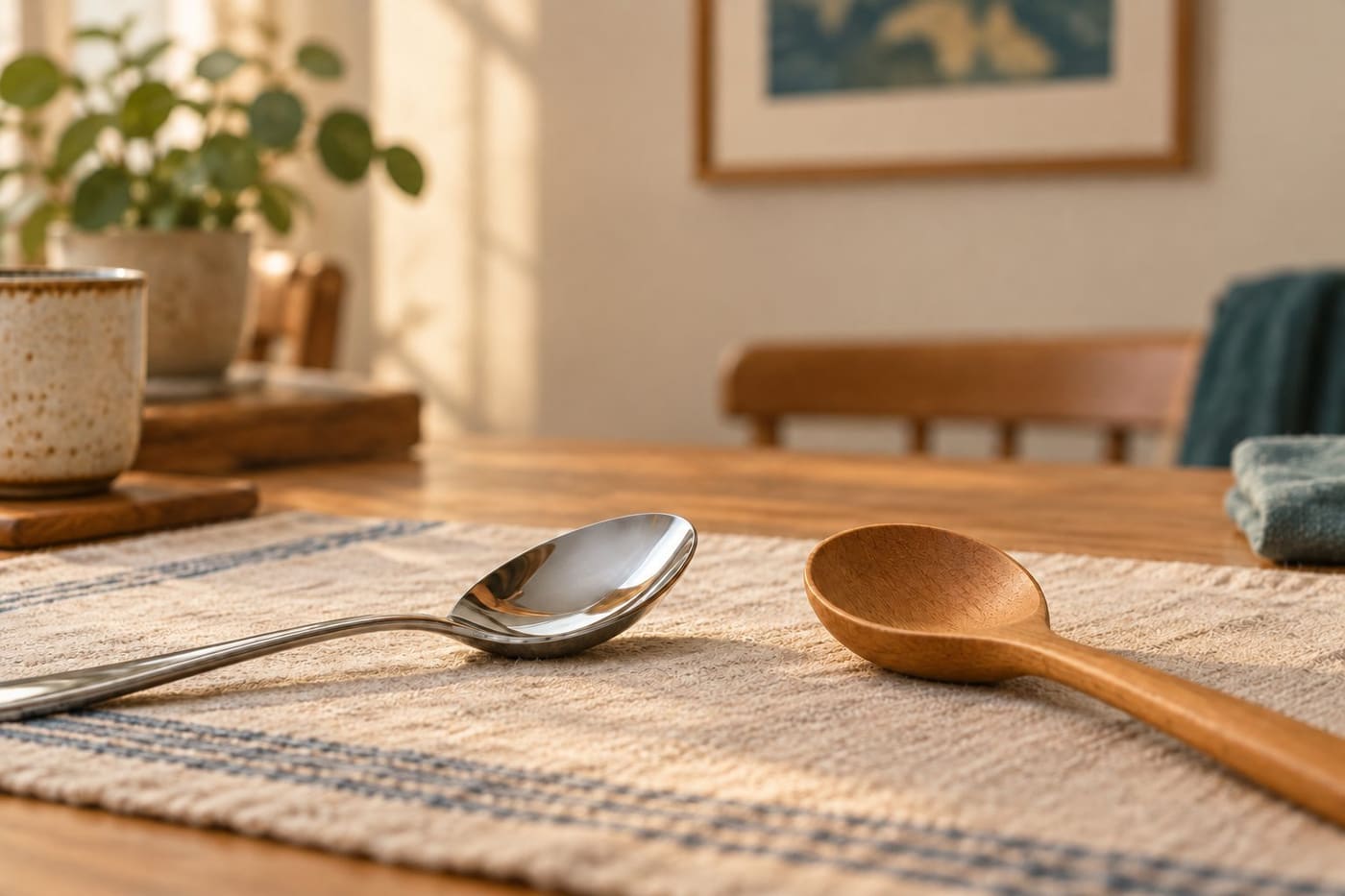
A metal handle can feel noticeably colder than the wooden surface beside it. The immediate explanation seems obvious: the metal must be at a lower temperature. That conclusion does not necessarily follow. If both objects have settled into the same ordinary indoor conditions, their temperatures can be similar while the experience of touching them differs. Your hand becomes part of the heat-transfer situation as soon as contact begins.
The distinction is useful far beyond a spoon or a door handle. It separates a sensation from a measurement and a material property from the circumstances of a particular object. This article explains the physics qualitatively, using institutional teaching sources checked on 31 October 2026. It does not report a newly performed experiment, recommend touching hot or cold surfaces, or offer a test for whether an unknown object is safe.
Begin with two different questions
What temperature is the object? What happens to my skin when I touch it? The questions are related, but they are not identical. Contact allows energy to pass between materials at different temperatures. The rate and course of that exchange help explain why two objects can feel different even when a suitable temperature measurement would put them close together. A sensation is information about an interaction, not a universal thermometer reading.
The American Physical Society uses metal and wood to explain this distinction in its [Getting Warmer/Getting Colder teacher guide](https://www.aps.org/learning-resources/getting-warmer-colder). When an ordinary room-temperature object is cooler than your hand, energy transfers from the warmer hand toward it. Metal generally carries that energy away from the contact region more readily than wood. That can make it feel colder without requiring the metal to have started colder.
Imagine an original fictional observation note by a reader named Sam: the spoon felt cooler than the wooden handle. That sentence records a perceived difference. Changing it to the spoon was ten degrees colder would add a measurement Sam did not make. The example is invented, but the editorial habit is broadly useful. Keep the description of what was experienced separate from the quantity that would require an appropriate instrument.
Heat flows; cold is not an ingredient
It is common to say that metal contains cold or gives cold to the hand. For this example, that wording points attention in the wrong direction. The useful account follows energy leaving the warmer hand. The University of Illinois Physics Van explains the comparison in its [answer about metals feeling hot or cold](https://van.physics.illinois.edu/ask/listing/44029), published in 2016. Its explanation concerns heat exchange and the skin's response, not an invisible supply of cold stored inside the material.
That change in language makes predictions clearer. If the surroundings and the object are cooler than the hand, consider energy flowing away from the hand. If an object is hotter than the hand, the direction can be reversed. This second situation belongs in a thought experiment, not a recommendation to touch heated metal. Neither an object's appearance nor its material name establishes that it is safe to handle.
For Sam's fictional note, an improved explanation might read: the metal felt cooler, consistent with faster energy transfer away from the hand under these conditions. The final words matter. They prevent a useful explanation from becoming the claim that all metal is always colder than all wood. Physics is describing a relationship among the hand, the object and their initial conditions, rather than assigning each material a permanent feeling.
Conduction describes one route for the energy
Conduction is heat transfer through matter in contact without requiring a bulk stream of that matter to carry the energy along. OpenStax's [University Physics discussion of heat-transfer mechanisms](https://openstax.org/books/university-physics-volume-2/pages/1-6-mechanisms-of-heat-transfer) explains the distinction among conduction, convection and radiation. In a metal, mobile electrons contribute to carrying energy. The material does not need to move from the handle into your hand for energy to pass through the contact.
Thermal conductivity describes how readily a material conducts heat under specified conditions. It is useful for comparing materials, but a material name alone does not calculate the full experience of contact. The size and shape of the object, what lies beneath its surface, its initial temperature and the duration of contact also matter. A thin metallic coating and a large block of the same metal need not behave identically in every situation.
Avoid turning a qualitative explanation into an unsupported numerical ranking. Saying that one object felt cooler does not measure its conductivity. Nor does a list of representative conductivity values establish the precise properties of an unknown household item. Coatings, composition and construction may differ. A general explanation can still be valuable without attaching a table of exact numbers that the actual objects have not been shown to match.
The contact changes as time passes
The instant of first contact and the situation after longer contact are not interchangeable. Energy exchange changes conditions near the contact region. In a detailed treatment of transient contact, conductivity is considered alongside density and heat capacity. A Purdue University [heat-transfer teaching page](https://web.ics.purdue.edu/~dchavas/teaching/interactive/heat-transfer.html) identifies their combination as thermal effusivity. That helps explain why conductivity alone is not a complete description of how a surface responds to contact.
You do not need to calculate effusivity to use the distinction responsibly. It is enough to recognize that a short touch is a changing process. The hand and the surface do not remain unaffected while the person makes a judgment. A previous touch may therefore change the next comparison. This is one reason a casual impression should not be presented as a carefully controlled material test.
In an invented discussion, Sam might compare a small spoon held for a while with a wooden handle that had not been touched. The two objects would no longer share the same recent history. If the experience changed, it would be premature to announce a contradiction in the original explanation. The first question would be whether the comparison still holds the relevant conditions alike, including what happened before the observation.
Same room does not always mean same temperature
The familiar explanation begins with an important assumption: objects have had a chance to settle into similar conditions. A room can contain sunlight, heating equipment, drafts and objects recently brought from elsewhere. Two items sitting near each other may therefore have different thermal histories. Before explaining a contrast entirely through material properties, consider whether the initial temperatures really are known to be similar.
For a fictional desk scene, imagine that one spoon has been in a drawer while another has just been washed. The wet spoon introduces another difference. Or imagine a metal object lying in a patch of sun while the wooden one remains shaded. Those situations are not clean examples of same temperature, different material. The lesson is to identify the assumptions rather than insist that every everyday contrast must have the same explanation.
An honest account can say that the initial temperatures were not measured. That does not make the observation worthless. It tells the reader what the observation can support and what remains open. A useful science explanation often starts by narrowing the claim. The goal is to understand the interaction, not to force a household scene into a demonstration whose conditions were never established.
Do not confuse an insulator with a source of warmth
Wood's comparatively low conductivity does not mean that it manufactures warmth for the hand. In the ordinary comparison, it is less effective at carrying energy away from the contact region. Calling it warm can be a convenient description of sensation, but the explanation should retain the direction of energy flow. The material is participating in the transfer, not providing an independent heater simply because it feels less cold.
The US Department of Energy's [building-science overview of heat flow](https://bsesc.energy.gov/energy-basics/heat-flow) distinguishes conduction, convection and radiation in buildings. It explains insulation as a way of resisting heat transfer. This is a broader application of the transfer idea; it is not a claim that a wooden handle is equivalent to a correctly designed building insulation system or that a material's pleasant touch predicts an energy-saving result.
For example, choosing a desk because its surface feels comfortable is a different decision from choosing a wall assembly for thermal performance. The first may involve an ordinary personal preference. The second depends on specifications, installation and the whole system. The hand-and-spoon example provides a concept, not a shortcut around building guidance, product testing or the requirements that apply to a particular construction project.
Keep the three transfer mechanisms distinct
Conduction is central to the direct-contact comparison, but it is not the only way energy moves in an ordinary room. Moving fluids can carry energy by convection; electromagnetic radiation can transfer energy without direct material contact. These mechanisms can act together. Identifying conduction at the hand does not mean that the object's prior temperature or the room's energy exchanges were determined by conduction alone.
Suppose Sam's fictional account says a spoon sat beside a sunny window and then felt warm. The account has introduced radiation and a different starting condition, not disproved the explanation for two cooler objects at comparable temperatures. Likewise, air movement can affect the surrounding situation. A good explanation names the part of the process being discussed instead of using one mechanism as an all-purpose explanation for every change.
When reading a diagram, ask what its arrows represent. Are they showing energy transfer, moving air or simply the order of a story? An unlabeled arrow can encourage the mistaken idea that cold is a substance travelling into the hand. This article's original conceptual illustration shows the two materials without arrows or temperature readings; it does not display measured temperatures, calculated transfer rates or the results of an actual comparison.
Build an observation note that preserves the uncertainty
An optional learning note can have three short parts: the sensation described, the relevant conditions known, and the explanation being considered. For an entirely invented entry, Sam might write that a metal spoon felt cooler than a wooden handle in an ordinary room, that their initial temperatures were not measured, and that differing rates of heat transfer could explain the contrast. This is an original explanatory example, not a supplied dataset.
Notice what the note avoids. It does not claim to have measured a ten-degree difference, calculated conductivity or proved that one material is a better choice for every use. It also does not conceal the missing information. Someone reading the note can see why a conclusion is tentative. Adding an honest limitation can make an explanation stronger because it shows exactly how the evidence and the interpretation fit together.
No heat, ice, hazardous sample or powered equipment is needed to understand the argument. Do not use touch to test unfamiliar surfaces, machinery, cookware, electrical devices or anything that may be hot, very cold, contaminated or otherwise unsafe. People need not perform a physical demonstration to follow this article. An appropriate educational or workplace procedure takes priority over a casual activity suggestion, and a conceptual explanation is not a handling-safety assessment.
What this everyday example does and does not show
The metal-and-wood comparison illustrates that a perceived temperature difference can arise from the rate of heat exchange. It does not mean that temperature differences never exist between neighbouring objects. It does not make touch useless, and it does not make every instrument reading automatically correct. Rather, it distinguishes the question being asked and the evidence needed to answer it. The scope of the conclusion should match the scope of the observation.
It also shows why materials cannot be judged by a single property in isolation. A conductivity comparison answers a different question from a transient contact model, a manufacturing specification or a comfort preference. When an explanation moves from one question to another, it should announce the move. Otherwise a true statement about the first setting may become a misleading claim about the second.
For a broader example of reading a physical record with its conditions in mind, see our [tree-ring and climate explainer](https://monetizearticle.com/article/narrow-rings-long-histories-how-trees-record-past-climate-e256ad). The subject differs, but the habit is the same: identify the observation, understand the mechanism and keep the limits attached. An everyday sensation can be a good starting point for science without being the final measurement.
Conclusion
Metal often feels colder than wood in the same ordinary indoor setting because it can draw energy away from a warmer hand more readily. The explanation concerns heat flow during contact, not a permanent supply of cold inside the material. Initial temperature, construction and contact history still matter. Keeping those conditions visible turns a familiar household contrast into a clear lesson about the difference between sensation, measurement and explanation.
Sources and research note
Institutional teaching sources linked beside the relevant sections were checked on 31 October 2026. The Illinois answer is dated 2016 and the APS resource identifies its PhysicsQuest 2019 origin; neither is described as a new discovery. Only the relevant qualitative contact and heat-transfer principles are used from the Purdue and OpenStax pages; no source experiment, numerical table, code or exercise is reproduced. All Sam scenarios and observation notes are original invented examples. No experimental measurements, materials certification, clinical assessment, building-performance prediction or universal touch-safety claim is made. The image is original AI-generated conceptual artwork.