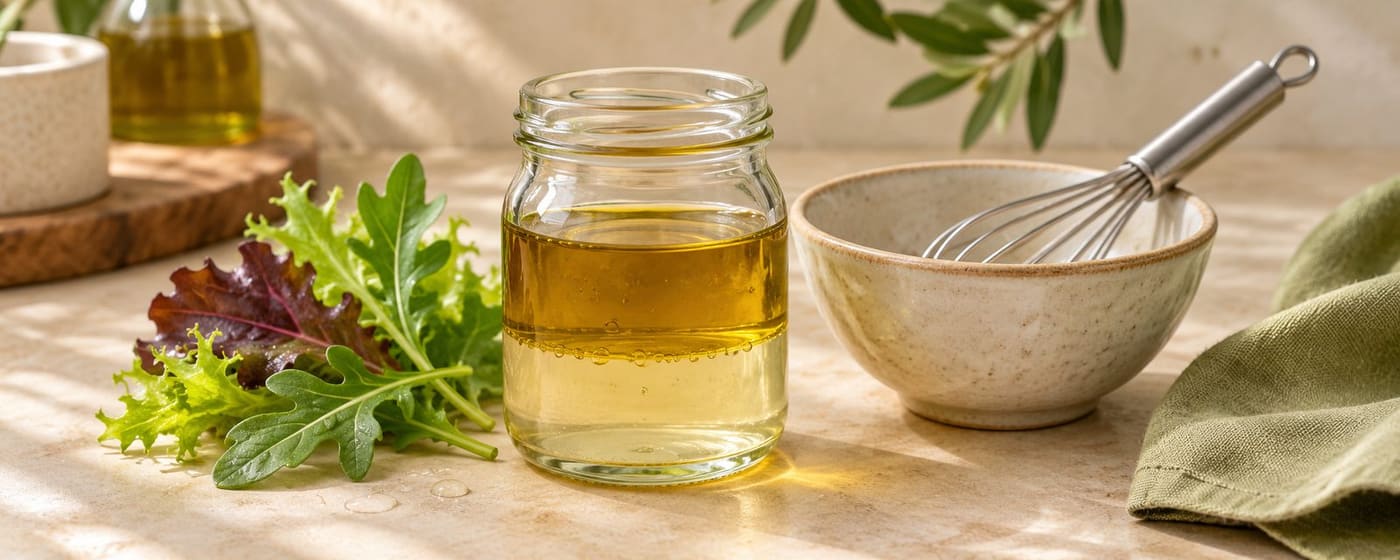
A jar of vinaigrette can look cloudy and even after a few shakes. Leave it on the counter while you set the table and two layers may start to reappear. The dressing has changed in a way you can see, but you have not necessarily done anything wrong. A simple vinaigrette is a mixture you can bring together briefly, then bring together again when you need it. The useful question is how long it needs to stay mixed for the dish you are about to serve.
The Professional Cooking chapter on emulsions describes plain oil-and-vinegar dressing as a temporary emulsion. Shaking or whisking breaks one liquid into droplets suspended through the other. Those droplets can join and form larger regions again. Understanding that change gives you a way to choose between shaking a jar at the last minute and whisking a dressing that stays together long enough to coat a bowl of greens evenly.
Watch what changes when you shake the jar
Put a small amount of oil and vinegar in a clear jar, leaving room above them. Before mixing, look at the boundary between the two liquids. Shake the jar briefly and set it down. The boundary is harder to see because the liquid has been broken into many droplets. The mixture may look cloudy because light scatters at their surfaces. As the droplets combine and layers form again, a clearer band may appear near the top or bottom.
The behaviour is easier to see when the jar is still. Watching it while you shake gives you little information about how long the mixture will stay even on a serving spoon. Wait a short interval and look at the jar against a light background. If the oil and vinegar are beginning to form layers, shake again just before pouring. You can use the same observation to decide whether to take the dressing straight to the table or mix it in a bowl closer to the time you will need it.
There is no need to assign the same internal structure to every dressing. Ingredient proportions, mixing and additions can affect which liquid forms the surrounding phase and how the droplets are distributed. For a cook deciding when to dress a salad, the visible behaviour is enough to start with. Is the mixture even when it leaves the spoon? Does a clear layer form before you finish tossing? Does it mix again easily? These checks concern the dressing you actually made.
Use a ratio to start, then taste it on the food
The Professional Cooking chapter on salad dressings gives three parts oil to one part vinegar as a basic starting point and discusses adjusting it to taste. For a small trial, three teaspoons of oil and one teaspoon of vinegar give you four teaspoons of base. This is enough to compare a few bites without committing a whole bowl of greens to the first version.
Mix the vinegar with a small pinch of salt and taste the finished dressing on a leaf or a piece of the food you are serving. If the dish includes an ingredient that is already salty, such as olives, the dressing may need less added salt than it seems to need on its own. A dressing that tastes assertive from a spoon can be milder once spread across vegetables. Tasting on the actual food gives you a better idea of the balance in the finished bite.
To explore the ratio, split the mixed dressing into two small portions. Add a little oil to one portion if you want to see whether the acidity becomes more comfortable. Add a few drops of vinegar to the other if you suspect the original is too mild. Mix each again, then taste them on similar pieces of the same vegetable. Keep the amounts small so you can tell which change you prefer. Adjusting a whole jar from memory makes it harder to compare the result with the starting point.
The kind of vinegar and oil matters as well as the ratio. A strongly flavoured oil may dominate even when you use the same proportion as a mild one. A vinegar with a different flavour or acidity can change the result without changing the volume. Write down which ingredients you used if you want to repeat the dressing. “Three to one” describes the amounts, while the ingredient names tell you what you were actually tasting.
Decide whether to shake or whisk
Shaking is convenient for a small, plain dressing that will be served right away. Use a clean jar with a secure lid and enough headspace to move the liquids around. Shake, open it and pour soon after the mixture comes together. If you are serving several plates individually, close and shake the jar again before the later portions if you can see it separating. The last plate should get roughly the same mixture as the first.
Whisking lets you watch the change more closely. Put the vinegar and any seasonings you want to disperse in it into a small bowl. Start whisking and add the oil gradually. If the bowl slides, set it on a stable surface before continuing. Watch whether the oil is being drawn into the moving mixture or collecting in a clear pool around the edge. Slow the addition if the whisk is no longer drawing it in. For a small batch, a narrow bowl can make it easier to keep the whisk in contact with the liquid.
Neither method has to produce a dressing that stays uniform for hours. If the dish is ready, the mixture can be useful even when it begins to separate a few minutes later. If you need to dress several plates over a longer interval, test whether a more vigorous mix, a stabilising ingredient or periodic remixing suits the job. The practical comparison is what happens during the time it takes to serve.
If you want to compare the two methods, use the same ingredients and volume in each batch. Pour a little of each into a clear glass immediately after mixing, then check again after the length of time it usually takes you to serve. Look at how much clear liquid has formed and how readily it disperses when stirred. Two different jars can exaggerate the appearance of a layer because the same amount of liquid will stand higher in a narrow container. Matching glasses make the comparison easier to read. You can then choose the method that fits the dish without trying to name a winner for every kitchen.
Try mustard as an optional ingredient
The culinary text discusses mustard as an ingredient that can help a vinaigrette stay mixed longer. It also changes the flavour. For a simple trial, whisk a small dab of prepared mustard into the vinegar before adding the oil. Taste before adding more. A sharp mustard can make the dressing more assertive even when the amount of vinegar has stayed the same.
The Culinary Institute of America’s hot mustard vinaigrette recipe is an example of a different balance. It uses more cider vinegar than oil by volume and adds the oil gradually while whisking into the seasoned mustard mixture. Its proportions serve a particular dish and flavour. The example shows why the conventional oil-heavy ratio is a starting point for one style, rather than a rule that every dressing follows.
For a kitchen comparison, prepare two small portions with the same oil and vinegar in the same amounts. Put a little mustard in one. Whisk each with a similar motion for roughly the same amount of time. Set them side by side and see when a clear layer begins to appear. Then taste each on food. You may prefer the plainer version even if it separates sooner, or find that the mustard improves both the coating and the flavour. The comparison is about those ingredients under your mixing conditions. It does not establish how every mustard or vinegar will behave.
Diagnose the bowl as well as the dressing
Suppose the dressing looks balanced on a spoon but tastes weak after tossing. Check whether the greens are carrying water from washing. Water at the bottom of the bowl can dilute the dressing and make it harder to tell what adjustment it needs. Drain and dry the greens, then try a small portion again before adding more salt or vinegar to the entire batch. A change to the food can solve what looked like a problem with the recipe.
If one bite is oily and the next sharp, look for uneven distribution. Dressing poured from a jar that had already separated may coat some leaves with mostly oil and others with a more acidic portion. Recombine the dressing before adding more. Toss a small test serving and taste two bites from different parts of the bowl. When those bites differ, adjusting the ratio may do less for the result than changing how you mix and distribute it.
If every bite is too sharp, test a small addition of oil in a separate spoonful, then mix and taste it on a leaf. If every bite feels heavy, try a little more vinegar in a test portion or use less dressing on the food. Adding more acid and using less dressing are different changes. The first changes the balance of each drop. The second reduces the amount of coating. Trying them separately helps you decide what you are responding to.
Dry leaves, sliced cucumbers and cooked grains also hold dressing differently. A small quantity can spread over light greens, while a bowl of grains offers many surfaces and may benefit from staged additions. Add enough to coat, toss and check the bottom of the bowl. If there is a puddle, serving more dressing with it may make later portions less balanced. The food is part of the test, not just a backdrop for the liquid.
Plan the last minute before serving
If dinner is ready at the same time for everyone, you can leave a plain dressing in its jar and give it a final shake as the salad goes out. If guests will serve themselves over a longer period, keep the dressing separate and provide a spoon or use a jar that can be closed and remixed. If you are preparing individual plates, arrange the plates before whisking so you do not spend the dressing’s most even moments looking for another dish.
Use a smaller portion for the first toss than you think the whole bowl needs. A little can be added after tasting, while removing an excess coating is harder. Taste a representative bite that contains the main ingredients. A bitter leaf, a sweet piece of fruit and a salty garnish can change how the same dressing reads. If the salad has several ingredients, checking a plain leaf alone may miss the way the whole dish works.
Keep a short note if you find a version you want to repeat. Record the amounts, the kind of oil and vinegar, whether you used mustard and the food you served it on. Add one observation about the method, such as “shake again before the second plate” or “whisked well while pouring the oil slowly.” This can be more helpful next time than a longer ingredient list with no information about timing. A dressing can be good because it suits the dish and the moment, even when it does not remain uniform in the jar.
The simplest vinaigrette needs only a brief, useful period of even mixing. Start with a small amount, check the flavour on the food and watch the dressing as you serve it. If it separates early, remix it or try a modest change in method or ingredients. Once the dressing coats the food evenly and tastes right in a bite, it has done the job you made it for.
For another kitchen guide to judging a mixture by observation, see how to tell when yeasted dough has risen.
Sources consulted 4 November 2026. The small-batch comparisons are illustrative.