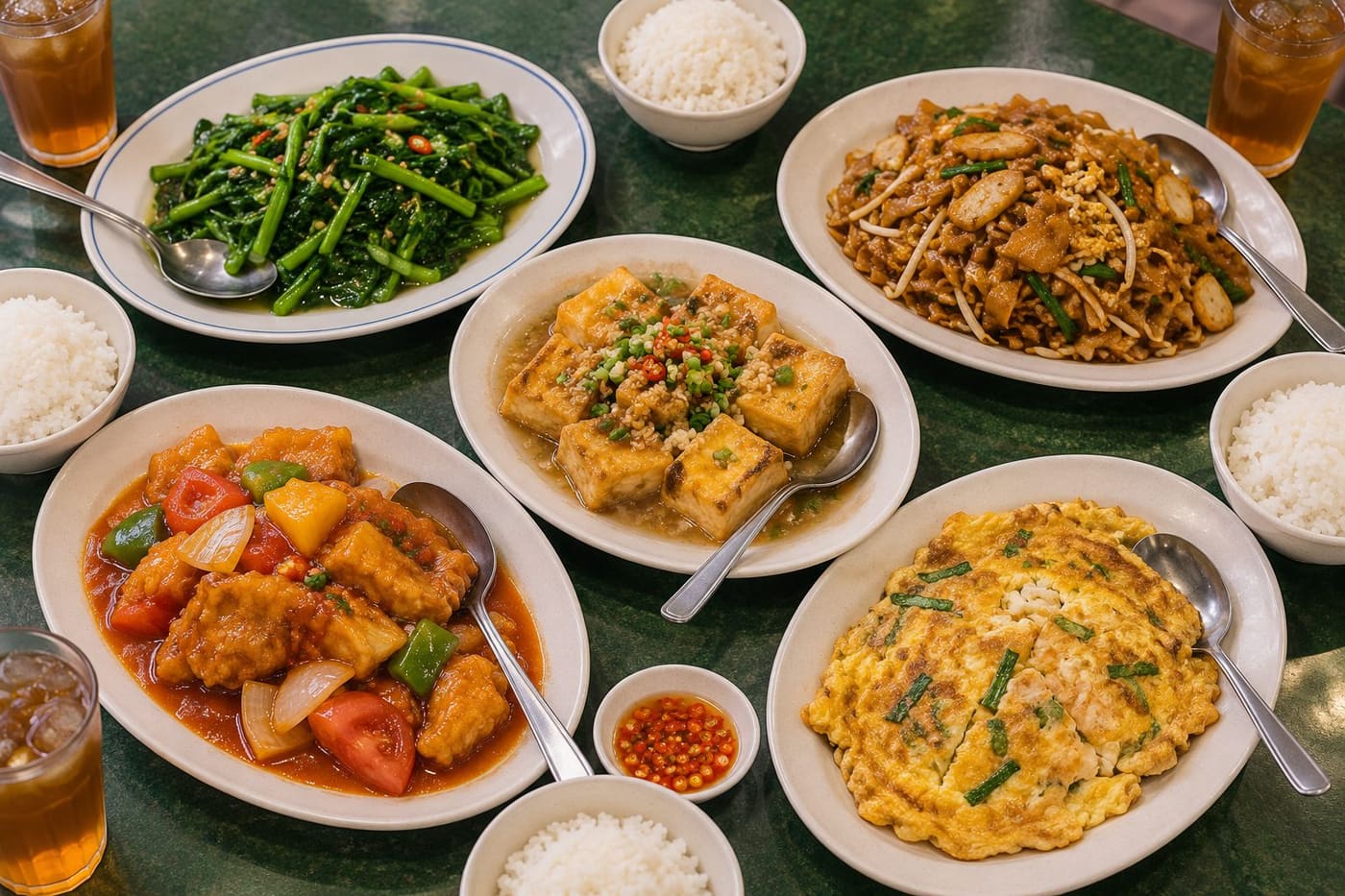
Zi char is a style of dining in Singapore in which a group can order several cooked dishes and share them around the table. A meal might begin with rice and two dishes for two people, or with several plates and a noodle dish for a larger group. The menu may call it tze char instead. Both spellings are useful when searching, because the name a restaurant uses on its sign may differ from the one in a tourism guide. The Singapore Tourism Board’s local dining guide places zi char within Singapore’s communal dining culture and describes its relationship to Chinese home cooking.
The query “tze char” appeared second in a Singapore Google Trends snapshot retrieved at 14:24 UTC on 7 November 2026. It displayed 5K+ and was marked Active in the past-24-hours view, with all categories and trends included and rows sorted by descending search volume. The first row was the Leeds–Spurs fixture, already covered in our Singapore match guide. The search snapshot gives the editorial context. It does not explain why people searched or identify which restaurants they were looking for.
What a shared order looks like
Think of the order as a meal assembled across plates. Some tables want plain rice and several dishes with contrasting flavours. Others choose a noodle dish that can do much of the work on its own, then add a vegetable or another plate to share. That decision comes first because it changes how many other dishes you need. A full serving of noodles as well as individual rice portions can make sense for a large group, but for a small table it can leave little room for anything else.
The tourism board describes dishes associated with communal dining and gives examples that include chilli crab and prawn paste chicken. Those examples illustrate the range of the style. A particular restaurant can have its own specialties, combinations and ways of presenting a dish. Read the current menu as the source for the individual order, even when a dish name looks familiar from a different kitchen.
A practical starting point for a group is to choose one dish that most diners want, a vegetable or tofu option if suitable, and a starch. Then decide whether there is a gap. If the anchor dish is already a large noodle plate, you may prefer to add a smaller side instead of a second starch. If the centre of the meal is seafood with sauce, ask whether rice or another accompaniment needs to be ordered separately. The right answer depends on what the menu includes and how your table wants to eat.
Read the menu by format before choosing flavours
Open the relevant menu for the location and service you intend to use. The FuLee Group menu page distinguishes zi char from its other offerings. George Town’s menu is a different operator’s example of a tze char menu, and its restaurant information explains the kitchen’s Malaysian stir-fry influence. The same broad dining format can contain different regional influences and different dishes.
Start by identifying whether an entry is an individual meal, a plate intended for sharing or a set. If a menu gives several sizes, check how the kitchen describes them. One restaurant’s medium portion need not match another’s. If a set lists a number of diners, read the included dishes and extras. A set may be useful for a group that agrees on the selection, while individual plates make it easier to vary the order.
Delivery and dine-in menus can also organise the same food differently. Keng Eng Kee’s ordering menu includes a set-menu section, and Kok Sen’s ordering page gives its own online options. These are examples of how operators present their offerings. Match the menu to the outlet and the way you are ordering, because an item or size offered through one service may have a different presentation through another.
When browsing, look past the main category and check the description under the dish. A noodle entry may already include a protein or egg. A vegetable dish can come with seafood ingredients or seasoning. A seafood title may identify an ingredient but leave preparation choices to another part of the menu. Read enough to know what is actually being added to the meal.
Choose dishes that work together
A shared meal has room for contrast. If the first dish is rich or heavily sauced, you could choose a simpler vegetable plate next. If the main attraction is a fried dish, a softer tofu dish or a plate of greens can vary the texture. This is a planning choice rather than a rule. The goal is to pick dishes that people around the table will actually share.
One way to make the decision easier is to ask each diner for a preference before ordering. One person may care about heat level, another may want vegetables and a third may want to try the house specialty. Start with the constraints the whole table needs to respect, then use the remaining choices for variety. Agreeing on a starch early prevents a table from ordering two versions of the same meal by accident.
For a two-person meal, consider a modest order of one main plate and one complementary dish, with rice if needed. For four people, you can use the same approach and add a distinct plate once you know the size of the main dish. A larger table may want duplicate servings of something everyone wants to try. It is easier to make that decision after asking how a portion is served than by counting menu items alone.
If someone suggests a famous dish and others are uncertain about it, agree on how it fits the meal. A small plate to try can be a different commitment from making it the centre of the order. A dish people have seen in a photograph may be available only in certain sizes. A quick question about the current serving format gives the table a better basis for choosing.
Ask about price in the same units the menu uses
A fixed-price plate is easy to compare with another fixed-price plate if you also understand the sizes. An item priced by weight, or described as market price, needs a different question. Ask for the expected total for the portion on offer before deciding. That makes it possible to compare the actual order with a set or with a smaller plate. The price per unit and the amount served are two separate parts of the calculation.
If a set is priced per person, multiply by the number the restaurant applies to that booking. If it is priced per set, check how many people it is designed to serve and whether the table will need to order anything alongside it. Neither format tells you on its own whether rice, drinks or other items are included. The description for that set supplies the answer.
When diners are splitting the bill, agree in advance whether an expensive item is for everyone. A group may decide to share the core dishes and let individuals order extra drinks or sides. The choice is simpler to make before the food arrives. A menu screenshot is helpful for discussing options, but confirm the current price and any conditions through the operator when they affect the decision.
Dietary questions belong with the exact dish
A dish name or photograph rarely tells you everything that went into the kitchen’s version. If a dietary restriction matters, identify the ingredient or requirement clearly and ask staff about the particular dish and preparation. Sauce, stock, seasoning and cooking methods can matter as much as the visible ingredients. An answer about one dish does not establish what is in another plate from the same kitchen.
For a group meal, decide whether a person needs a separate order and how it will be served. People may use the same serving spoon for several dishes without thinking about it. If someone needs to avoid contact with an ingredient, discuss that with the restaurant and the group before the dishes arrive. The kitchen is the relevant source for what it can prepare and how it handles shared equipment.
Treat menu descriptions as an aid to asking the question. A picture of greens can help identify the intended plate. The ingredient and preparation information is what matters for the decision. When a person has a serious requirement, let them review the answer directly, especially if the dish is being ordered through another member of the table.
Decide which parts of the order need to arrive together
When a shared dish is meant to be eaten with rice, tell the person taking the order if you want those plates together. If a group is waiting for someone, decide whether to order the whole meal at once or begin with a smaller dish. A set may already have its own serving sequence. When ordering individual plates, asking how the dishes normally arrive can help the table choose whether to start immediately or wait for an accompaniment.
Also consider the space on the table. Several large plates and individual bowls can crowd a small surface. If the table is tight, ask whether the kitchen can bring out a second dish later. This is a practical matter of serving rather than a general dining custom.
A worked example for a table of four
Imagine four people agree to share most of the meal. Two want noodles, one wants vegetables and one wants to try a seafood dish. Start by asking whether the noodle portion is sized as an individual meal or as a sharing plate. If it is large enough to act as the starch for the table, the group could choose it alongside vegetables and one seafood dish. If it is small, the group could add rice or choose another serving after checking portion sizes.
Then resolve the questions that can change the order. Ask about the seafood portion and price, and check whether the vegetables are prepared with an ingredient someone needs to avoid. If there is a choice of sauce or heat level, decide which version suits most people. This approach gives each person a role in the order while keeping the meal coherent.
A different table of four might want rice and several smaller plates instead. That is the same dining format with a different starch decision. The menu can support both approaches. The important check is whether you are comparing portions prepared for the same number of people, and whether the staff’s description of the dishes matches what the table expects.
Use the right source when planning a visit
The tourism board’s guide gives useful context about Singapore’s dining culture. Kok Sen’s own site is an example of a restaurant explaining its own style and menu. An operator’s current page is the closer source for whether a dish is available at a particular outlet. A guide written for visitors can help you recognise a name or a type of food, while a current menu tells you what can be ordered.
For a group visit, check the opening hours for the day you intend to go and confirm whether the service is walk-in or takes bookings. If the restaurant lists different outlets, use the right address and menu. Do the same when looking at pickup or delivery. A link that goes directly to an ordering page can look like a general menu, so check which location and service it is displaying.
At the table, one person can read the order back before it goes in. Confirm the main dishes, their sizes, the starch and any preparation questions. That quick check helps catch a mistaken portion or duplicate order before it becomes a plate on the table. Once the food arrives, keep any separate dishes identifiable and make it easy for everyone to serve themselves.
Zi char is easiest to navigate when you begin with the number of people and the way you want to share. Look for the current menu, choose a starch and a few complementary dishes, and ask about size, ingredients and price where those details matter. The meal can be small or elaborate. What matters is that the choices work together for the people eating it.
Sources consulted 8 November 2026, Asia/Dhaka. Menu references are examples from the operators. The image is an original conceptual illustration of a shared meal.