BOOK LIBRARY · Complete books · Purchases disabled
TrendWindow

← Book Library · Complete book

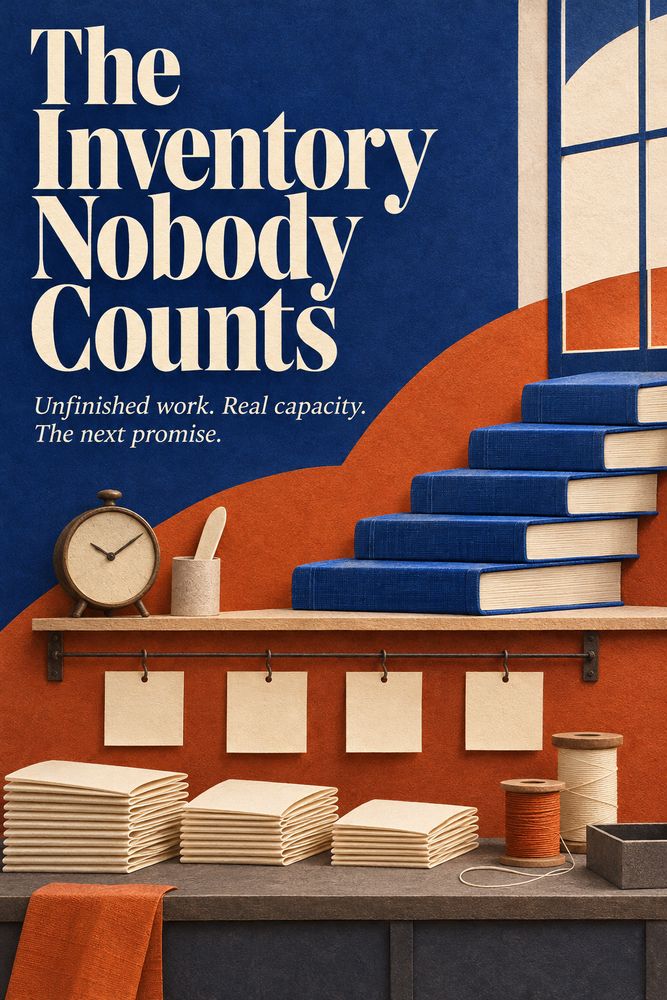
Front cover of The Inventory Nobody Counts

Business, Career & Money

The Inventory Nobody Counts

By TrendWindow Library

Twelve unfinished batches sit behind a bindery’s tidy window display. Through eight practical chapters, Inez, Ravi and Etta count existing commitments, examine available hours and test a smaller promise before expanding.

Read this complete edition, including its ending and notes. No purchase is required.

About this book

A short business book about unfinished work, real capacity and the next promise

North Window Bindery and everyone in this book are fictional. Its numbers are invented, internally checked examples, not evidence of a real firm's performance. The worksheets are original suggestions for operational thinking. They do not establish accounting values, employment rules, financing suitability or a guaranteed level of output.

Original focused short book prepared with AI assistance. North Window Bindery, its people, trial and figures are fictional. Operational worksheets are not accounting, employment or financing advice and guarantee no business outcome. Translation meaning reviewed with AI, not independently certified by native-language professionals.

1. The shelf behind the photograph

Inez photographed the finished notebooks in the front window. In the picture, their cloth covers made a clean blue staircase. Behind her, twelve unfinished batches occupied three shelves and part of the packing table.

A retailer wanted four additional batches every week. Inez imagined taking the room next door and buying a second printer. The retailer's interest was real within this fictional story; the capacity to serve it was not yet established.

“How much work do we already have?” she asked Ravi, who did the binding.

“Which kind of work?” he asked.

That was the first useful answer.

The bindery counted paper, cloth and completed notebooks. It did not have one reliable list of accepted work still needing attention. Etta kept proof approvals in email. Ravi kept binding jobs on cards. Inez kept several promises in her head, where they appeared smaller than they did on anyone else's calendar.

They chose one family of work to examine: batches of twenty identical cloth notebooks in their standard format. A batch, not an individual notebook, would be the counting unit. Large custom commissions would remain visible on a separate list, with their own estimates. They would not pretend that a two-hundred-page special edition required the same effort as a standard notebook.

For this exercise, an accepted batch entered the open-work list when the shop agreed to make it. It left as completed only after the final check passed and it was packed and ready for the agreed dispatch. Dispatch itself remained a separately recorded step. This operational definition did not decide when money was earned or when a sale belonged in the accounts.

Raw materials without an accepted order did not become an open batch merely because they occupied a shelf. A customer enquiry did not become a commitment merely because Inez hoped to win it.

Before counting, write your own start and finish conditions. State the unit and the work excluded. Ask the people doing the work whether another person could apply those definitions tomorrow and get the same answer.

The title's unnoticed inventory is unfinished commitment. Counting it is not an accusation that people are idle. It is a way to discover what the business has already promised before adding another promise.

2. Give each batch one present state

On Monday, the twelve batches had twelve identifiers. Three awaited approved proofs. Two awaited materials. Four were ready for binding. Two were being bound. One awaited the final check.

Three plus two plus four plus two plus one equalled twelve. It was a small achievement, but it meant the list could be reconciled with the shelves.

Etta wanted a separate column for urgent jobs. Ravi objected: a batch could be urgent and awaiting paper. Putting it in both columns would make one batch look like two. They kept one current state and added urgency as a separate note, with a reason and an agreed date.

Every row held an identifier, acceptance date, promised date, present state, next action and the person responsible for that action. Customer details stayed in the protected order record, not on a board visible through the shop window. A blocked job remained on the list. Moving it out of sight would not remove the promise.

At the end of the baseline week, they reconciled the count:

Movement — Batches

Open at the start: 12.

Newly accepted: +7.

Completed under the stated definition: -5.

Cancelled by recorded agreement: -1.

Open at the end: 13.

The cancelled batch was not called completed. Its agreement and relevant records remained. The cancellation's commercial terms belonged in the actual customer record, not in a convenient arithmetic shortcut.

Thirteen did not explain everything. One batch had been open for twenty-one days while awaiting proof approval. Another, accepted yesterday, was already at the binding bench. They added age in calendar days and the current reason for waiting. Age described elapsed time, not hours of labour.

If the totals fail to reconcile, investigate duplicate identifiers, missing arrivals and inconsistent completion rules. Do not alter the ending number just to make the board tidy. Keep an explanation for a genuine correction.

For your own count, begin with a small, clearly defined work family. Reconcile a real period, then inspect the oldest jobs individually. A clean total can hide an old promise, just as a crowded shelf can hide a nearly completed order.

3. Walk the route, including the messages

On that first Monday, Inez had drawn a straight line: print, bind, pack.

Etta put a pencil across it.

“Before print, somebody has to say which version.”

They followed one actual batch in their fictional shop. The route included confirming the specification, receiving approval, checking materials, preparing the print file, printing, binding, checking, packing and arranging dispatch. It also included a question sent back to the customer when two versions carried the same filename.

NIST describes value stream mapping as a way to show manufacturing processes and information flows. [Primary resource](https://www.nist.gov/mep/value-stream-mapping)

Their modest sketch used that distinction without pretending to be a complete professional assessment. The boxes showed what happened; the arrows showed what information or material allowed the next step to begin. They wrote waiting beside the places where nothing could proceed yet.

Ravi demonstrated why four batches labelled ready were not equally ready. One lacked a confirmed cover colour. Etta had marked the proof approved because the interior text was approved. Neither had invented the problem; their definitions had left a gap between them.

They corrected the state of that batch and kept a note explaining why. Then they defined ready for binding in their own shop: the agreed specification was confirmed, the required printed parts and covers were present, and the preceding checks were complete. Safety and quality steps stayed in the route. A step did not become expendable merely because a customer never saw it.

Observe with the people responsible. Ask what information is missing and what makes a job return. Do not use the map to announce that someone else's careful work is waste. If there is a technical, safety or compliance reason for a step, understand it before proposing a change.

The oldest batch needed one specific answer, not a faster machine. Etta contacted the fictional customer through the shop's usual process and agreed a clear response date. In your own exercise, record the next action and its owner; avoid an endless column labelled waiting with nobody responsible for finding out what happens next.

Inez left a space on the map for unknowns. An honest blank was more useful than an arrow claiming work flowed smoothly through a conversation nobody had checked.

4. Put capacity on a calendar

The second printer brochure said nothing about Ravi's Thursday.

For the coming week, he had thirty scheduled working hours. Six were already allocated to receiving, maintenance and other duties. That left twenty-four hours provisionally available for binding. Breaks and other required protections were respected in the actual work schedule; the calculation was not permission to erase them.

In this invented example, three hours per standard batch was a planning estimate that included the usual setup for that batch. The shop's recent observations ranged from two and a half to four hours. The estimate was not a promise that every batch took exactly three. Nor should setup be subtracted again elsewhere if it was already included.

The six standard batches already planned for binding would use eighteen estimated hours. Inez allowed three further hours for known rework and ordinary variation. Eighteen plus three made twenty-one. Against twenty-four available hours, the nominal remainder was three.

The proposed retailer's four extra batches would need twelve more estimated hours. Existing work, allowance and proposed work would therefore total thirty-three hours. Thirty-three did not fit into twenty-four. The shortfall was nine hours, before any additional unexpected problem.

The calculation did not establish that one extra batch was safe to promise. Other stages also needed time. A three-hour remainder built from uncertain estimates was not a three-hour guarantee.

They considered skills as well as hours. Inez could not add Etta's free afternoon to binding capacity as if training and experience were interchangeable. Learning time, supervision and the learner's existing work would need their own plan.

Make a capacity sheet for the relevant period and constrained resource. Show scheduled availability, other duties, the work already promised, the estimate behind each item and the allowance you chose. State what is unknown. Do not mix hours for one week with orders due across three weeks.

Ask what would change if the estimates were worse. Ten batches at four hours would mean forty hours before the separate three-hour allowance. That scenario was not a forecast; it exposed how sensitive the proposal was to the assumed batch time.

Inez put the brochure under the sheet. She had not proved expansion was wrong. She had proved that this week's argument for it was incomplete.

5. Run a trial that has edges

They chose a two-week operational trial before making a new recurring commitment. Existing promises remained visible. The trial was not a licence to discard difficult orders or quietly change customers' dates.

For standard batches, they would release only work meeting the agreed readiness conditions to the binding bench. Ravi would normally work on one batch at a time; a second could wait there only if the next step genuinely required it. This was a local trial rule, not a universal formula for every workshop.

Everything else remained on the open-work list with its state, age and next action. Limiting what entered the bench did not shrink the accepted backlog by magic. Inez had to distinguish accepting an order from starting physical work on it.

Etta reviewed incoming enquiries against the existing promises and the actual schedule. A requested date was not automatically an accepted date. If the shop could not meet it, she described available alternatives accurately. She did not describe an untested improvement as spare capacity already secured.

They also chose how to interrupt the trial. A safety concern, a quality problem or a credible risk to an existing promise required attention and a recorded decision. The rule should help the shop see problems, not compel anyone to hide them for the sake of compliance with the rule.

At a short daily check, they would ask which batch needed the next action, what was blocked and whether a promise had become doubtful. The check would end with decisions and named actions, not an hour of reporting about the same coloured cards.

Before beginning, write down the dates, the work family, the change being tried, the records to keep and the conditions for stopping or adapting it. Record what will remain unchanged, especially safety, quality and existing customer obligations.

In North Window, the test was small enough to reverse. No lease was signed, no equipment was ordered and no recurring wholesale date was promised. A trial can still require real effort; that effort belongs on the schedule rather than being donated invisibly by the people whose time you claim to measure.

6. Count what actually happened

The trial began with thirteen open batches.

In its first week, four batches were newly accepted and seven reached the stated completion condition. There were no cancellations. Thirteen plus four minus seven left ten.

In the second week, five entered and six completed. Again, none were cancelled. Ten plus five minus six left nine.

Trial week: One; Start: 13; Accepted: 4; Completed: 7; Cancelled: 0; End: 10.

Trial week: Two; Start: 10; Accepted: 5; Completed: 6; Cancelled: 0; End: 9.

Inez liked the downward line. Ravi asked her to read the notes beside it.

The first week included batches already near completion at the start. The team had accepted fewer batches than during the baseline week. Neither fact made the result false, but both mattered to its interpretation. Two weeks did not prove a permanent improvement or isolate the effect of the new bench rule.

The twenty-one-day batch received approval and was completed during the first trial week. Its record retained the original acceptance date. Etta did not reset its age when the customer finally answered. A different batch required a cover correction in the second week and stayed open until it passed its check.

They examined promised dates, unresolved age, rework and actual time as well as counts. A reduction in unfinished batches accompanied by hidden defects or unrecorded overtime would not be the result they wanted. The team recorded that the trial used its scheduled hours; it did not turn that fictional observation into a general promise about the method.

For your own review, preserve the definitions you started with. If you must change one, show the change and explain what comparisons it invalidates. Distinguish measured time from an estimate supplied from memory. Keep an inconvenient exception in view.

Write a conclusion with both a result and a limit: “Open standard batches fell from thirteen to nine in this trial. Lower intake and near-finished opening work also contributed; sustained capacity is still uncertain.”

That sentence was less exciting than “We increased capacity.” It was sufficiently accurate to support the next decision.

7. Ask what expansion would actually add

The empty room next door could hold another printer. It could not, by itself, approve a cover colour or add a trained person's hours at the binding bench.

Inez listed possible changes separately: a different schedule, additional skilled help, training, a machine, more space, a narrower product range, or a smaller new commitment. Each solved a different proposed problem and introduced different work.

For each option, she wrote the constraint it was intended to relieve, the evidence for that constraint, the resource it would add and the new demands it would create. A machine could need installation, maintenance, supervision and space. A person would need a fair role, appropriate terms and support. A room would carry obligations even during a quiet week.

The book does not supply current prices, financing terms, employment requirements or an accounting treatment for these choices. Those require current information and suitable professional advice for the actual business and jurisdiction. An operational count is one input to a decision, not permission to spend.

Their decision sheet had three scenarios: expected demand, less demand, and slower production than hoped. They did not label the optimistic case the truth and the other two pessimism. They wrote assumptions so another reader could challenge them.

Before assessing affordability, distinguish a customer expressing interest from a firm order and a firm order from money available to pay obligations. Inez would have the actual financial implications checked separately. Her operational list neither valued unfinished inventory nor settled revenue recognition.

The retailer still wanted four weekly batches. Inez explained that the shop had not established capacity for that standing commitment. She offered to discuss one isolated standard batch with a separately agreed date after checking the existing schedule. The offer did not reserve every future week.

Declining or reducing a proposal can lose an opportunity. This story does not pretend otherwise. The retailer might choose another supplier. That uncertainty belonged beside the risk of accepting work the bindery could not reliably finish.

An expansion decision becomes more useful when it says what evidence would change it. Inez chose to revisit the question after another ordinary operating period, with actual times, quality records and demand checked again. She was postponing a particular commitment, not declaring that the shop must remain small forever.

8. The order that fitted

The retailer accepted one pilot batch. Its dispatch date was agreed after the bindery checked the existing work and all the necessary stages. It was a new, specific order, not evidence that the four-batch weekly proposal had been accepted.

Etta gave it an identifier and recorded the specification and approval. Ravi received the printed parts only when they met the readiness conditions. The batch passed the final check and was packed for its agreed dispatch. Its card moved out of open work. The dispatch record was completed when it actually left.

Inez did not count that one success as proof that every future week would be the same. At the review, she asked what had been different, what still depended on one person's knowledge and which assumptions needed another observation.

For a first review in your own business, bring four things: a definition of the work unit and completion, a reconciled movement count, a list of aged or blocked work with next actions, and a capacity sheet tied to a real period. Add the people who understand the exceptions. Their explanation is part of the evidence.

Leave with one decision small enough to describe and specific enough to check. It might be correcting a readiness condition, obtaining one missing approval, changing a proposed date, or investigating whether a particular resource would address an observed constraint. It need not be a purchase.

Do not keep a measurement merely because it looks impressive. Keep it if it helps someone make a better-defined decision without hiding quality, safety, uncertainty or unpaid effort. A board that nobody maintains can become a second version of the promises in Inez's head.

The room next door was eventually let to a picture framer. Inez felt a brief sting when the new sign went up. She had lost that particular room, and there was no reason to call every lost opportunity a secret victory.

Then Etta brought her the next enquiry. Inez looked at the open-work list before answering.

In the front window, the finished notebooks still made their blue staircase. Behind the counter, every unfinished batch had a place, a next action and a promise the shop could see. The photograph had not changed much. The answer had.

### Source and scope

NIST MEP, “Value Stream Mapping,” created 24 February 2022 and updated 22 May 2024, was opened and reviewed on 9 November 2026. The linked statement in chapter three is deliberately narrow. The shop, trial, arithmetic, worksheets and ending are original invented material, not a NIST case study or an externally validated intervention. This is a complete focused short book, not an accounting manual or a full operational assessment.
Explore more books →