BOOK LIBRARY · Complete books · Purchases disabled
TrendWindow

← Book Library · Complete book

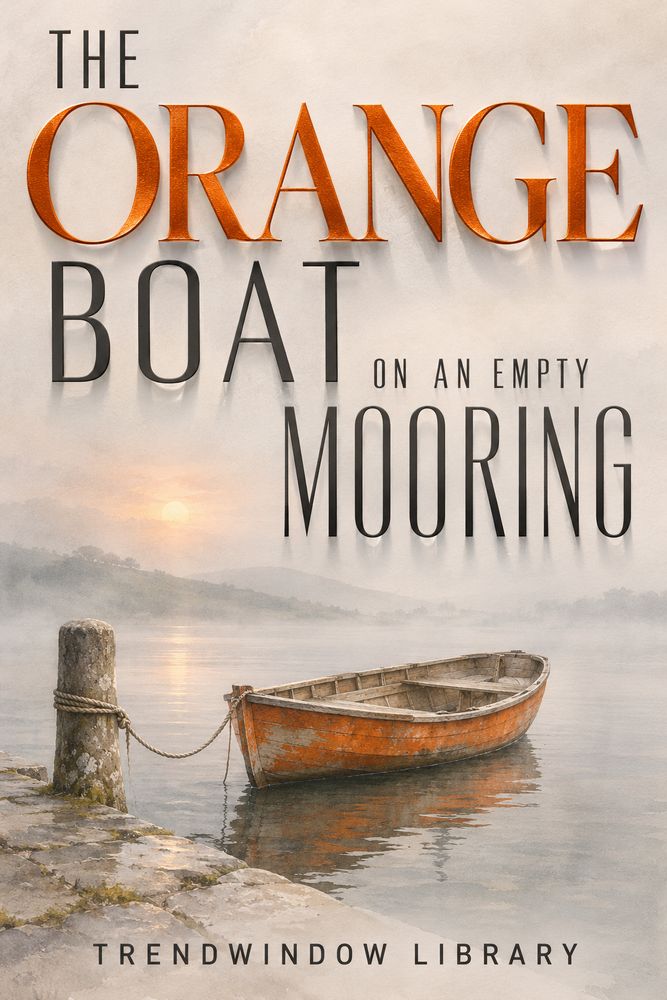
Front cover of The Orange Boat on an Empty Mooring

Mystery, Crime & Thriller

The Orange Boat on an Empty Mooring

By TrendWindow Library

An orange boat returns after nineteen years, bringing Ada Kerr a cousin and evidence that overturns a family accusation. A complete original short mystery.

Read this complete edition, including its ending and notes. No purchase is required.

Chapter 1 — Before Breakfast

The boat was there before my father opened his curtains.

I saw it from the kitchen window while the kettle was beginning its small argument with the stove: orange hull, grey water, a line drawn from its bow to the post at the end of our quay. For nineteen years that patch of water had contained nothing but reflections. Now it contained the Wren.

I knew the boat before I could read its name. As a child I had sat in its bow with a biscuit wrapped in a paper napkin, pretending the estuary was an ocean and the far bank another country. My mother had always made me keep the napkin. No grand expedition excused litter.

The boat had disappeared the summer I left for college. My uncle Ned had disappeared from our family at the same time.

Those two departures had become one sentence.

I went upstairs and knocked on my father's door. He was dressed, sitting on the edge of the bed with one shoe on. He had been living with me for six weeks while a leaking roof was repaired at his house. We had managed our arrangement through separate cups, different radio stations and a polite refusal to discuss the years between us.

'The Wren's outside,' I said.

He looked at the second shoe as though I had asked him to name it.

'Can't be.'

'Come and see.'

He did not stand. 'Lots of orange boats.'

I nearly accepted that. It was one of my father's gifts: making the easiest explanation feel like a duty.

Instead I put on my coat and went down to the quay. I stayed on the dry upper stones. A white card had been tied to the mooring post, above the reach of the water.

For Ada Kerr. I will come at eleven. Ruth Reeve.

Reeve was my mother's name before she married. It was also Ned's surname.

I had never heard of Ruth.

Chapter 2 — What We Called It

At breakfast my father asked whether I had called the harbour office.

'Not yet. Someone's coming at eleven.'

'Who?'

I told him the name. His knife stopped against the toast.

'Do you know her?'

'No.'

'You know something.'

'I'm eating breakfast, Ada.'

When I was nineteen, he had told me that Ned had taken my mother's boat without permission. He had said it in the kitchen while holding the empty hook where the shed key belonged. I remembered that hook with a clarity I could not give the conversation itself. The chipped green paint. The shape of his hand beside it. The certainty that I ought to be on his side.

Ned had been my mother's younger brother. He made terrible pancakes, knew the names of birds and never corrected me when I called every distant vessel a ship. He had promised to take me out once more before I left for college.

Instead the boat was gone. He did not come to my leaving supper. My father said some people took what they could and left others to clear up.

After Ned left, I had waited for him to write. When no letter came, I treated the silence as another piece of evidence against him. I did not ask whether he thought I knew about the sale. I did not write first. It was easier to be the person who had been abandoned than the person who might have misunderstood.

I had repeated that sentence in the sailing-club café two years later. I was old enough by then to understand what I was saying and young enough to enjoy the authority of saying it. Someone mentioned Ned, and I supplied the story: he had stolen our boat.

My mother had been sitting beside me. She lifted her cup. She did not correct me.

Now I watched my father butter toast he would not finish.

'What if she has brought it back because it was taken?'

'Then we can sort it out.'

'What if it wasn't?'

He put the knife down.

Outside, the orange shape moved gently against its line. It looked less like an answer than an interruption.

Chapter 3 — The Visitor

Ruth arrived at ten fifty-eight in a blue coat with a split cuff. She carried a canvas bag and knew exactly where the gate latch was. That, more than her surname, unsettled me.

'Your mother showed me,' she said when she saw me looking.

'When?'

'About six years ago.'

My mother had died eight months earlier. I had spent those months discovering ordinary things I should have asked while she could answer: who had taken a photograph, whether a chipped dish mattered, why she kept empty tins in the top cupboard. I had not expected to discover a cousin at the gate.

Ruth did not ask to see my father. She asked whether we could sit outside, where she could watch the boat.

'It's not safe to use yet,' she said. 'The yard brought it round with their people. They arranged this short stay with the office yesterday. It goes back onto land this afternoon.'

I had imagined someone arriving secretly in darkness. There had been a booking, a working crew and a perfectly ordinary transport arrangement. The previous afternoon I had approved a request from the office to use the empty berth for a short visit. I had read the arrival window and ignored the vessel name, assuming it belonged to someone else's uninteresting business. I had given permission for a boat, without imagining this one.

'Why bring it here?'

'My father kept a photograph of this quay. I wanted to see the boat against the place, once. And I wanted to meet you.'

'Your father is Ned?'

'Was. He died five months ago.'

I looked past her at the boat. There was a small grey repair near the stern. I remembered a damaged place there, though memory was not a certificate of identity. The name and the colour could both have been copied.

Ruth took a photograph from her bag. My mother stood beside a younger Ned in front of the Wren, holding a paintbrush like a conductor's baton. A streak of orange crossed his forehead. On the back was a date in my mother's handwriting: the week before I left for college.

'That's when she sold it to him,' Ruth said.

The word sold seemed too tidy for the years I had put around the boat.

Chapter 4 — The Paper in the Folder

I asked whether Ruth had anything besides the photograph.

She looked at me for a moment, and I heard my question as she must have heard it: you have brought your dead father's life to a stranger, and the stranger wants paperwork.

'I'm sorry,' I said. 'I don't know what I know any more.'

'I brought the folder because I thought that might happen.'

Inside were old maintenance notes, photographs and a signed record of the sale. It named Elsie Kerr as the seller and Ned Reeve as the buyer. The amount was written in words as well as figures. My father's name appeared as a witness.

I did not suddenly become an expert in documents. A name on a page needed checking. I asked permission to show the sale record to him. Ruth agreed, but kept the original in her hand. I could take a photograph for the conversation; I could not take her folder away.

'Of course,' I said.

'It isn't a test of whether you trust me.'

'I know.'

'I'm not sure you do yet.'

She said it without cruelty. I was grateful for that, although gratitude was not the feeling I wanted.

My father stood at the kitchen window when we went inside. He had seen us on the bench. He had seen the bag open and the paper come out.

Ruth introduced herself. He said her father's name once, quietly, then looked at the photograph I had taken of the sale record.

'Is that your signature?' I asked.

He did not ask to enlarge it.

'Yes.'

'Did Mum sell the boat to Ned?'

'Yes.'

There was a silence so complete that I heard the kitchen clock hesitate between two ticks. I knew it had not really hesitated. I had.

Chapter 5 — The Difference Between Gone and Stolen

My father asked Ruth to sit. She remained standing.

'Why did you tell me he stole it?' I asked.

'I said he took it.'

'You said without permission.'

He looked at the window. 'Your mother should have spoken to me first.'

'But you witnessed the sale.'

'By then she'd decided.'

The boat had belonged to my mother. She had bought it before they married, and for years my father had spoken of it as though it were his own unfinished project. He promised trips in it, postponed repairs to it and complained about the space it took. When I was leaving home, she sold it to her brother. Some of the money went towards my first term away.

My father knew this. He had been angry that she had made a decision he could not turn into his generosity.

'You thought I'd blame you for the boat going,' he said.

'I didn't have to blame anyone.'

'You were upset.'

'I was nineteen. You could have told me something true.'

Ruth put the photograph of my mother and Ned on the table, but she did not put down the original sale record.

'Dad told me they fell out,' she said. 'He didn't tell me you were calling him a thief.'

My father looked at her properly then.

'He knew what people thought.'

'How?' she asked.

I answered because the part I could answer belonged to me. I told her about the café, my mother's cup and the sentence I had enjoyed repeating. Ruth listened without helping me make it sound younger or less deliberate.

'He stopped visiting because of that?' I asked.

'I don't know every reason he had,' she said. 'You'd have had to ask him.'

I had wanted a complete account to arrive with the boat. Instead I had a fact that destroyed one account, and spaces where other people's answers should have been.

Chapter 6 — My Mother's Visits

Ruth had met my mother several times. They had tea in a garden, gone to a small exhibition and once spent an afternoon painting a room the wrong shade of yellow. There were photographs. My mother looked amused in them, impatient in one, tired in another. She did not look like a woman visiting a family from which she had been kept by an impossible distance.

'Why didn't she tell me about you?'

'What did she tell you about anything difficult?'

It was an unfair question from someone who barely knew me. It was also a good one.

My mother had specialised in making arrangements that allowed everyone else to continue being themselves. She could send a birthday card, move an uncomfortable conversation into another room and keep two versions of a Sunday without admitting that she was keeping them apart.

I had called that kindness. Looking at Ruth's photographs, I could see what it had cost other people.

'I'm angry with her,' I said.

'You can be.'

'She's dead.'

'So is my father. It hasn't made everything simple.'

We went back outside. My father stayed in the kitchen. He did not forbid us to leave, and I realised how much of my life I had spent waiting for permission he had not actually been asked to give.

Ruth showed me a picture of Ned beside the boat years later. He had repainted the grey repair instead of hiding it. Beside him stood a child in a life jacket, solemnly holding a packet of biscuits.

'You?' I asked.

She nodded.

The sight hurt. Not because the picture had taken anything from me. Because I had spent years imagining a man who stole a boat, while he had been taking his daughter out on the water and insisting that she keep the paper wrapper.

Chapter 7 — The Correction

I wanted my father to write a letter. I wanted him to sign his name beneath a clean paragraph that would travel through the town and repair everything I had helped break.

He would not.

'People will make more of it,' he said.

'They made something of the first story.'

'It was a long time ago.'

'Ruth has only just heard it.'

He sat with his hands folded. I could see the familiar temptation: if I found the right sentence, he would turn into the father who could say the next one. I had spent enough of my life searching for that sentence.

I told Ruth I would correct what I had said. She asked to see the words before they were sent anywhere. She did not want her father's private photographs, the sale amount or my college expenses made into a public spectacle.

We wrote a short note to the sailing club, where I had repeated the accusation. I said that I had described Ned Reeve as having taken the Wren without permission. I had now seen the sale record and heard my father's confirmation that Elsie had sold it to him. My earlier account was wrong. I apologised for repeating it as fact.

I did not say that the whole family had always loved him. I did not claim his forgiveness. I did not attach Ruth's photographs.

With her agreement, I sent the note to the club secretary and asked that the correction reach the people who had heard the old story as far as practicable. We could not guarantee who would read it. That was not a reason to leave the lie comfortably where it was.

The secretary replied while we were still on the bench. She could include the correction in the next members' message and send it to the committee. She could not tell us who had heard the accusation at the time or how far it had travelled afterwards.

I began typing a request to make the correction more prominent. Ruth touched the edge of my sleeve.

'You can ask,' she said. 'But don't make this another thing you need somebody else to finish for you.'

I put the phone down. There were people I could contact myself. I wrote their names on the back of a shopping list, then crossed out one who had died. The blank space after his name was a consequence, not a task waiting for a clever solution.

Ruth put her phone away. 'Thank you,' she said.

I had hoped the words would make me feel better. They made me feel responsible, which was different.

Chapter 8 — What Stayed on the Quay

The yard's crew came in the afternoon. Ruth had already explained that the boat belonged to her now, through her father's estate. She had not brought it to return it to us. There was no gift waiting behind the correction, and I was glad she had not allowed me to imagine one for long.

The practical arrangements and the old documents were hers to check with the people handling them. My father's admission settled the false story we had told; it did not turn me into the person entitled to direct the boat's future.

I watched from the upper quay while the crew dealt with moving it. No one asked me to climb aboard, tie a clever knot or prove that childhood memories made me competent on wet steps.

My father came outside wearing the coat he had worn for years. He stopped beside the bench, too far from Ruth to pretend he was joining her.

'I should have told Ada,' he said.

Ruth looked at him. 'You should have told people who asked.'

He nodded once. It was not the letter I wanted. It was not nothing.

She did not embrace him. Before leaving, she asked whether I would like to meet for tea the following month, somewhere neither of us had to host the other. I said yes. We chose a place and a date, then put them in our phones while we were still standing together.

After the boat had gone, the water looked ordinary again. My father remained by the bench.

'Your mother didn't want rows,' he said.

'I know.'

'She thought it would pass.'

'It did pass. It passed to me.'

He looked down at the stones. I left him there long enough to understand that I was not going to smooth the sentence for him.

That evening I found the old biscuit tin in a cupboard. Inside were photographs of boats, folded maps and a packet of unused paper napkins. I put the photographs back without deciding what every one of them meant.

On the back of a spare envelope I wrote Ruth's number. Then I changed my mind and put it in the address book, under her own name.

In the morning the mooring was empty. For the first time in nineteen years, I did not call it stolen space.

About this edition

This is an original short family mystery written for TrendWindow Library. Ada Kerr, Duncan, Elsie, Ned and Ruth Reeve, the Wren, the quay, the club and all events are fictional. The first-person voice is invented, not a claim of lived experience. This is not legal guidance on ownership, inheritance or evidence, nor boating or mooring instruction. The central false accusation is resolved; loss and family relationships are not presented as instantly repaired. The complete digital edition includes its ending. Fixed reading units are not printed pagination.

Explore more books →