BOOK LIBRARY · Complete books · Purchases disabled
TrendWindow

← Book Library · Complete book

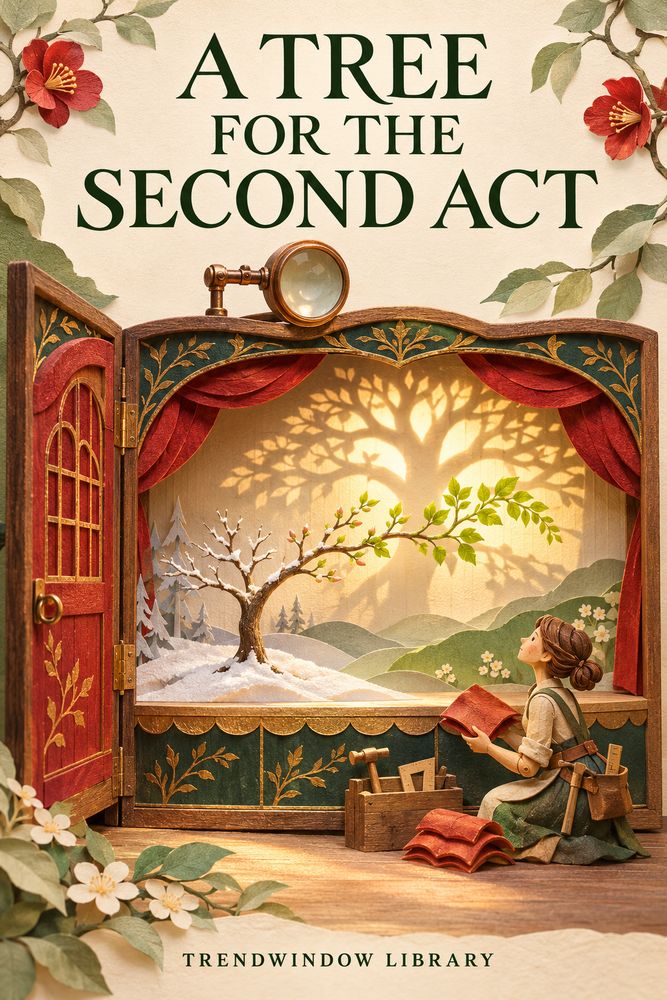
Front cover of A Tree for the Second Act

Fantasy & Science Fiction

A Tree for the Second Act

By TrendWindow Library

A complete original short fantasy. A new theatre prop keeper finds a living miniature tree made for a production thirty years ago. Its seasons return, but its branches keep growing—and the company must write a different second-act ending.

Read this complete edition, including its ending and notes. No purchase is required.

1. A Door the Size of a Book

Sena found the little theatre inside a cabinet of obsolete thunder. She was thirty-one, the new keeper of props at the Lantern House, and had been instructed to inventory everything that might still be useful. So far she had found three broken storms and a crown that insisted it belonged in a larger box.

The theatre model folded shut like a book. On its wooden front, someone had painted a red door. A copper viewing lens stood on top. The label said: WINTER TREE. ACT TWO. ADA.

Sena opened it on the workbench.

A bare tree stood inside, no taller than her finger. Its two main branches made an uneven fork. Snow lay between its roots. Through the lens, a tree-shaped light spread across the workshop wall, large enough to shade a person who was made of paper.

Sena touched the wall. There was no cold, no wet snow. The light was showing the little landscape, not bringing winter into the room.

Bram, the director, stopped in the doorway. At fifty-four, he wore his first Lantern House production like a favourite coat: he could still name every curtain that had failed to open.

“Ada’s tree,” he said. “I thought it was lost.”

Thirty years earlier, it had stood behind the puppet carpenter in The House at the Turn of the Road. The company was reviving that play next week. Bram had been its youngest stagehand. Sena had not yet been old enough to attend.

“That fork,” he said. “The snow in it. Exactly what we need.”

Sena left the model open while she searched for its old cue sheet. When she looked back, a green point had appeared on the left branch.

She shut the painted door. The light vanished from the wall.

2. The Maker’s Afternoon

Ada was seventy-three and no longer came to every rehearsal. Sena telephoned to ask whether she would accept one paid afternoon of consultation. Ada asked what was broken.

“Possibly nothing,” Sena said. “That may be the trouble.”

Ada arrived with a pencil and a square of cake wrapped in paper. She looked at the green point and smiled.

“Spring.”

“Bram needs winter.”

“Then Bram should have asked before you opened it.”

Sena explained that she had opened it first. Bram had only come in afterwards. Ada took another bite of cake and waited for the rest.

Sena had not timed the opening. She had left it running while she searched. The old cue sheet was still missing.

Ada drew a circle on fresh paper and divided it into four. The model’s year took one hour of open time: fifteen minutes each for winter, spring, summer and autumn. Shutting the door paused it. Opening resumed it. There was no reverse.

“After an hour, winter again?” Sena asked.

“The next winter. A tree a year older. The seasons come round. The branches do not go backwards.”

Ada had made the landscape, not stolen it from a forest. It held no people or animals. Its tree was alive by the particular magic she had built into it, and needed neither ordinary watering nor a gardener’s instructions. Its growth belonged to the model’s own seasons.

She had closed it after the old production. Thirty years on a shelf had passed outside it, not inside.

“Can you put it back to the old shape?” Sena asked.

“No. I never gave it that ability.”

Ada crossed out the word RESET that Sena had written beside the circle.

3. An Honest Cue Sheet

Bram brought a drawing from the original programme. The old fork curved over the puppet carpenter’s unfinished roof. The play ended when she fixed the last roof tile beneath the snow. Bram remembered an audience so quiet that he could hear the stagehand beside him breathing.

“People will come to see that again,” he said.

“Some will,” Ada agreed. “Some were not alive then.”

He asked if they could stop the model before the new bud became a leaf.

“You have already passed the end of winter,” Ada said. “Closing it cannot undo that.”

“Then keep going until winter comes round.”

They did. Sena set a clock beside the model and wrote down every opening and closing. The bud became a leaf. The leaves thickened, turned gold and fell. When snow returned, the fork was still recognisable, but a new twig reached beyond the old drawing.

Bram looked from drawing to tree.

“Could we hide that bit?”

“We can make scenery from a drawing,” Sena said. “But we cannot advertise the living tree and pretend it has not changed.”

Her voice shook a little. Bram was not the only one who had wanted her first production to work perfectly.

She showed him the cue sheet. At the top she had written: FIRST OPENING NOT TIMED. OPENED BY SENA DURING INVENTORY.

“It was not a mysterious fault,” she said. “I should have recorded it.”

Bram read the line twice. Then he wrote his own below it: DIRECTOR REQUESTED ORIGINAL WINTER WITHOUT CHECKING MODEL.

Ada pushed the cake towards both of them.

4. A Roof with Room

The puppet carpenter was called Tessa. Unlike the tree, she was not alive: two puppeteers gave her gestures, and a third performer spoke her lines. Her wooden hands were beautifully made, and she had spent thirty years with a roof tile tied to one wrist.

They untied it on Tuesday.

“The old ending is good,” Bram said. “We do not have to call it bad to write another.”

Sena put a paper roof beneath the enlarged light of the new branch. When Tessa lifted the last tile, the twig lay directly across her path.

The first idea was to cut the branch from the projected light with a black screen. It looked like a square hole in the sky. The second was to move the whole tree sideways. Then it appeared to grow through the house.

Finally, one puppeteer lifted Tessa’s head towards the twig instead of making her struggle past it.

“She could change the roof,” Sena said.

They built a small opening around the branch. In the new ending, Tessa did not restore every outline she remembered. She finished a house with room for something she had not planned.

Bram wrote new dialogue. Sena drew revised scenery. The puppeteers adjusted their movements. Ada explained the model’s timing but did not rewrite the play for them. Her agreed afternoon was over; she stayed for cake, not for another unpaid rehearsal.

The company changed the announcement. The revival would include a new second-act ending and Ada’s original living miniature, now grown beyond its old shape. Sena kept the old programme drawing on the table where everyone could see it.

They used eleven minutes of the new winter for one timed light test. Sena closed the model with four minutes of winter left. Their new scene would need six; the change to spring would become part of its ending.

On Wednesday they rehearsed with a paper tree. The model remained shut. They did not need to spend its seasons learning where to stand.

5. The Branch They Had Not Practised

On opening night, Sena wrote the model’s paused position at the top of her cue sheet: WINTER. FOUR MINUTES REMAINING.

The new scene needed six minutes. They had planned to let spring arrive before the last tile went into place. She checked the clock, the door and the copper lens. No one promised that every bud would appear in exactly the same place as in rehearsal.

Bram stood beside her.

“I still wish we had the old fork.”

“We have the drawing.”

“I know.”

He went to introduce the play. Sena heard him explain the changed ending. He named Ada and the present company. The audience had not been sold a secret replacement for something lost.

At Sena’s cue, the painted door opened. Snow light lay behind Tessa’s roof. The puppeteers moved her across the stage while the clock marked the model’s open time.

After four minutes, green appeared. A new shoot cast a thin shadow across the place where the puppet’s ladder was meant to rest.

For a breath, Sena thought she had ruined it again. Then the puppeteer moved the ladder one wooden step to the right. Tessa looked up. The performer gave her a small, exasperated sigh before speaking the new line.

“Well. You might have told me you were building too.”

The audience laughed. Sena kept the door open. The final tile settled beside the opening in the roof, with the branch rising through it.

When the curtain fell, she closed the model. Spring paused. The little tree had not been cut, restored or persuaded to apologise.

6. The Label Beneath the Door

After the performance, a woman asked Bram why he had changed the ending she remembered.

“Because we used the tree again,” he said. “And we found a different way to finish the house.”

She said she preferred the first ending. Bram thanked her for coming. He did not tell Sena that the conversation had spoiled the applause.

Ada came backstage with the old programme folded in her bag. She had liked the little sigh before Tessa’s line. She had not put it there; the performer had found it.

Sena showed her the new cue sheet. Every opening was recorded. The first untimed opening remained at the top, followed by the decisions made afterwards. She had not rewritten it to make the week's work appear inevitable.

“You can keep the drawing with the model,” Ada said. “Just do not use it as an instruction for the tree.”

Sena made a second label beneath WINTER TREE. ACT TWO. ADA. It read: PRESENT TREE RECORDED THIS WEEK. SEE CURRENT CUES. On the back she named the people who had built the new roof, written the dialogue and moved the ladder.

The company paid Ada the consultation fee they had agreed. For the next performance, they would use the paper tree to practise and open the living model only when they needed its light. There would be another winter eventually. It would belong to an older tree.

Before going home, Sena opened the red door for one deliberate minute. The new shoot held a leaf as small as a green comma. She wrote the minute down and closed it.

She put the old drawing beside the model. Both were worth keeping. Only one had promised to remain exactly as it was.

Edition Note

This complete short fantasy is original AI-assisted fiction with editorial review. Sena, Bram, Ada, the Lantern House, the puppet play and its living miniature are invented. The model’s four fifteen-minute seasons, paused growth and projected landscape are magic, not factual claims about botany, climate, optics or theatre history. No real tree-care or technical stage instructions are offered. The story ends with the performance completed, the maker paid, the new crew credited and the model’s changed state honestly recorded. The full story and this note are provided in English, Bengali, Hindi, Spanish, French and Arabic. Original English front and back cover illustrations were generated for this edition. No independent human-authorship, native-human translation, print-proof or ISBN certification is claimed.

Explore more books →