BOOK LIBRARY · Complete books · Purchases disabled
TrendWindow

← Book Library · Complete book

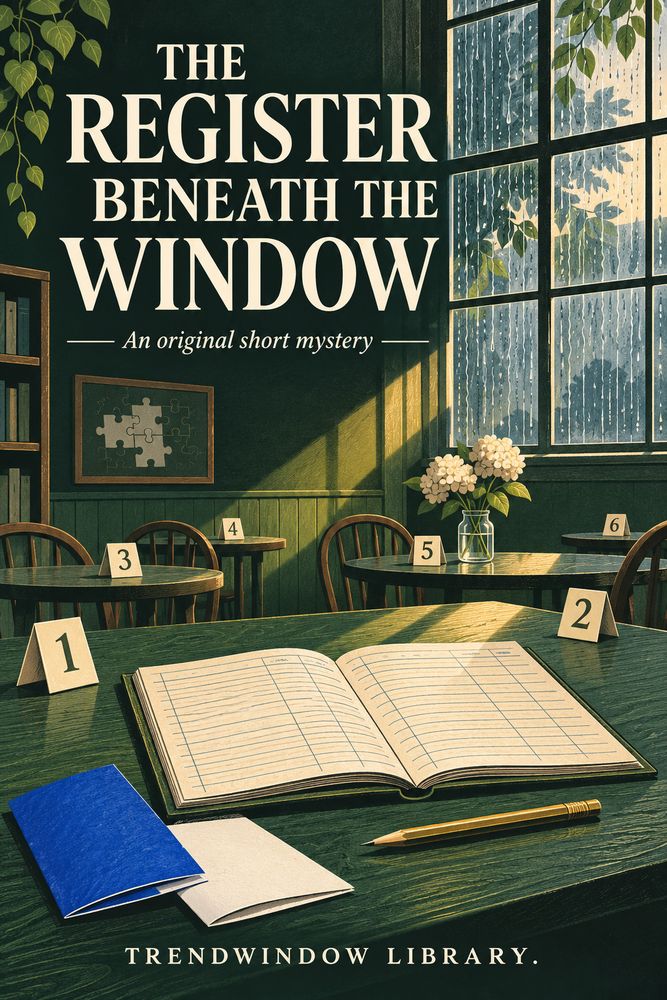
Front cover of The Register Beneath the Window

Mystery, Crime & Thriller

The Register Beneath the Window

By TrendWindow Library

A complete original short mystery. A perfect score belongs to a puzzle-club founder nobody remembers seeing. Iris Hume compares a register, two paper versions and an impossible total before a farewell becomes an undeserved victory.

Read this complete edition, including its ending and notes. No purchase is required.

1. The Name at the Top

At three o'clock Iris Hume found Ned Arden's name at the top of the results board. Seven answers out of seven. Beneath it, Amina Rahal had six.

The room smelled of damp coats and the orange peel someone had dropped into a wastepaper basket. The competition had finished half an hour earlier. Most of the players had gone home to change before the farewell tea at four. Ned, who had founded the puzzle club, was moving to live near his son the following week.

Iris had spent the competition folding programmes in the little office. She had not watched the door. Still, she was surprised.

“I didn't know Ned was playing.”

Leon Dale, the club secretary, put down his green marking pen. “One last attempt.”

“Where did he sit?”

“Eight. It's in the register.”

The register lay beneath the tall window, its cover held open by a chipped mug. Ned's name occupied the eighth row. In the column headed Table, someone had written 8. The last column, headed Present, contained a neat tick.

Iris did not recognise the handwriting well enough to name it. She knew something else, though. That morning she had helped Ruth, the competition director, arrange the tables. There had been six.

“Perhaps he used a chair at the side,” Leon said.

“You said eight.”

“A number, Iris. Not a sworn statement.”

He smiled, but she had already looked back at the board. Amina's six sat below Ned's seven like a smaller thing that had been put in its proper place.

“May I see the papers?”

Leon began gathering them. “Ruth checks any disputed mark.”

“Then we should ask Ruth.”

Outside, rain caught the window in slanting threads. Iris moved the mug away from the register before a drip from its base could touch the paper.

2. Six Tables

Ruth was in the kitchen counting teaspoons. She listened without putting down the handful she held.

“There were six tables today,” she said. “There were eight on Friday. The hall asked us to leave the far corner clear for repairs, so we changed the arrangement this morning.”

“Could Ned have sat elsewhere?” Iris asked.

“I was timing the competition. I didn't count heads. Amina handed in the papers.”

They found Amina in the corridor, looking for a glove. She had stayed to help with the tea rather than go home. When Ruth asked about the papers, she stopped searching.

“I collected six. One from each table. Leon said he'd put another with them.”

“Did he say whose?”

“No. I assumed somebody had finished early.”

Ruth set the spoons on a tray. Nobody had yet said Leon had invented a result. Iris was glad of that. An absent memory, a changed room and a late paper were questions, not an answer.

The old arrangement was still pinned behind the coat stand: eight numbered rectangles on a blue leaflet. On the noticeboard by the entrance, a white sheet showed six. Iris had made that replacement herself at eleven, before the players arrived for the two o'clock start.

On the sill they found the small table markers she had put away. Seven and eight were nested together, one cardboard tent inside the other.

“So the register might have been prepared on Friday,” Ruth said.

“Ned could have reserved a place,” Iris agreed. “That doesn't tell us when the tick was added.”

Ruth carried both plans back to the main room. Leon was arranging the answer sheets in a straight pile. At the top lay a blue paper. The others were white.

“We need to check the versions,” she told him.

3. The Wrong Total

The club had only seven questions that year. Six were short word and number puzzles. The last showed rows of chairs: one chair in the first row, two in the second, and so on. How many chairs altogether?

On the white competition paper there were five rows. Iris added them aloud: one, three, six, ten, fifteen.

“I wrote fifteen,” Amina said. “That's the one you marked wrong.”

Leon pointed to the answer key. Twenty.

Ruth turned the blue paper around. Its last question had six rows. The previous evening she had reduced it to five because the drawing would fit more clearly. The first six questions had stayed the same. She had printed the final competition papers on white paper that morning. Leon had kept the Friday blue copy and the answer key to prepare the marking.

“Six rows would be twenty-one,” Iris said.

She counted again, this time writing the addition on scrap paper. One plus two plus three plus four plus five plus six. Twenty-one.

The key was wrong for both versions.

“My mistake,” Leon said. “I must have missed a chair when I made the key.”

“We can correct it,” Ruth said. “But whose blue paper is this?”

Ned Arden's name was written at the top. All seven answers matched the key, including twenty.

Iris put her hands in her coat pockets. Matching a wrong answer was troubling. It was not a confession. A person could make the same mistake. A person could also have been given the wrong paper without knowing it.

“Did Ned receive the Friday version?” Ruth asked.

“It looks that way,” Leon said.

“Did you give it to him?”

“I handled the papers.”

His reply sat between them without quite answering the question. Ruth asked him to leave every paper where it was while she checked the other six scores.

4. A Place Reserved

At a quarter to four Ruth had finished the recount. Amina had seven correct answers on the white paper. None of the other five players had seven. The first six questions on Ned's blue sheet were correct, and its last answer was wrong. His score could not stand as the seven on the board.

What still needed explaining was how he had entered at all.

Leon said he had reserved Ned a place on Friday, when there had been eight tables on the plan. That explained the eighth row and the table number. It did not explain the tick in the Present column.

“You might have seen him when we didn't,” Ruth said. “Please tell us what happened.”

Leon looked at the register. “He wasn't staying long.”

“Before or after the start?”

Leon rubbed a small green stain beside his thumbnail. Iris would remember the stain afterwards, but it proved nothing about who had written a name in ordinary blue ink.

At ten to four the front door opened. Ned came in carrying a tin of ginger biscuits and a folded umbrella. He had not been expected until four; the rain, he said, had persuaded him to catch an earlier bus.

He saw his name on the board before he saw their faces.

“What's that doing there?”

Ruth explained that there was an answer sheet in his name. She did not tell him what she thought of it.

Ned read the blue sheet, then the register. “Leon put my name down on Friday. I said I might come. Yesterday evening I told him I'd only come for the tea.”

He looked at Leon.

“I haven't answered these.”

Nobody spoke for several seconds. In the kitchen, the kettle clicked off. It sounded unreasonably definite.

5. The Kind Result

“I wanted you to leave with it,” Leon said.

He meant the small wooden cup on the mantelpiece. Ned had carved it for the first competition. Since then its base had gained a narrow metal strip with the winners' names on it. Ned's name had never appeared there.

“You won plenty of things,” Leon told him. “You made this place.”

“That isn't one of the questions,” Ned said.

Leon sat down. He had filled in Ned's reserved row and added the tick that afternoon. After Amina brought the six white papers to him, he had written answers from his own key on the unused blue sheet. He had expected Ruth to announce the result at tea. He had imagined Ned smiling, surprised, without asking where his paper had come from.

“It was supposed to be kind.”

“To whom?” Amina asked.

Her voice was quiet enough that Leon had to look up to hear her.

“You marked my right answer wrong. You put his name above mine. You didn't ask either of us.”

Leon started to say that the cup was only a piece of wood. Then he stopped. He looked at Ned instead.

“I'm sorry.”

“Tell Amina,” Ned said.

He did. It was a longer apology this time, with the particular things in it: the copied paper, the false tick, the wrong mark and the result on the board. Amina listened. She did not tell him it was all right.

Ruth asked Iris to record what they had checked. The blue paper would be retained with the corrected results, clearly marked as an entry Leon had made without Ned's participation. The register would keep its original row, with an explanatory correction beside it. No one would erase it and leave the next person to solve the same mystery.

6. The Unnumbered Chair

By four twenty the room was full again. People shook water from their umbrellas and put their names on labels for the buffet dishes. Ruth asked for their attention before anyone lifted the cup.

She explained the error in the answer key and the false entry. She gave no speech about good intentions. Leon stood beside her and said that he had made the entry, that Ned had not participated, and that Amina had answered all seven final questions correctly.

Somebody asked whether Ned had known. Ruth said no. Ned added, “Please don't congratulate me for something I didn't do.”

The room went quiet in a different way.

Then Ruth handed the cup to Amina. Her name would be added to its base. She held it with both hands and said she wanted her paper back after the results were filed. Ruth promised her a copy and kept the original with the others.

The farewell continued. Ned received a card covered with remembered puzzles, jokes and awkwardly drawn maps. It had been prepared before the competition, and everyone knew what it was for. He took much longer reading it than he had spent looking at the cup.

Leon helped clear the plates. When he asked Ned to sit beside him, Ned said, “Not just now.” Leon left the chair empty. An apology had not made the afternoon disappear.

Before she went home, Iris closed the register. The corrected eighth row was dry. Ruth had written that future reserved places would be kept on a separate list; the Present column would be checked at the start by the person timing the room.

Iris put the book on a shelf, away from the damp window. Beneath the window now stood a plain chair without a number.

Ned sat there to read his card once more. Across the room, Amina was showing someone how five rows made fifteen. Iris heard the small burst of laughter when they reached the right answer. She left them to it and went to fetch her coat.

Edition note

This is an original complete short mystery. All people, the club, its competition, records and events are fictional. The arithmetic is explicit: one through five totals fifteen; one through six totals twenty-one. Matching an erroneous answer or not remembering somebody's arrival would not alone establish wrongdoing; the resolution includes checked versions, Ned's direct account and Leon's admission. The story is not legal or forensic guidance. AI-assisted writing, original conceptual cover illustrations and full translations receive editorial review; no independent human-authorship or native-human certification, ISBN or print proof is claimed.

Explore more books →