BOOK LIBRARY · Complete books · Purchases disabled
TrendWindow

← Book Library · Complete book

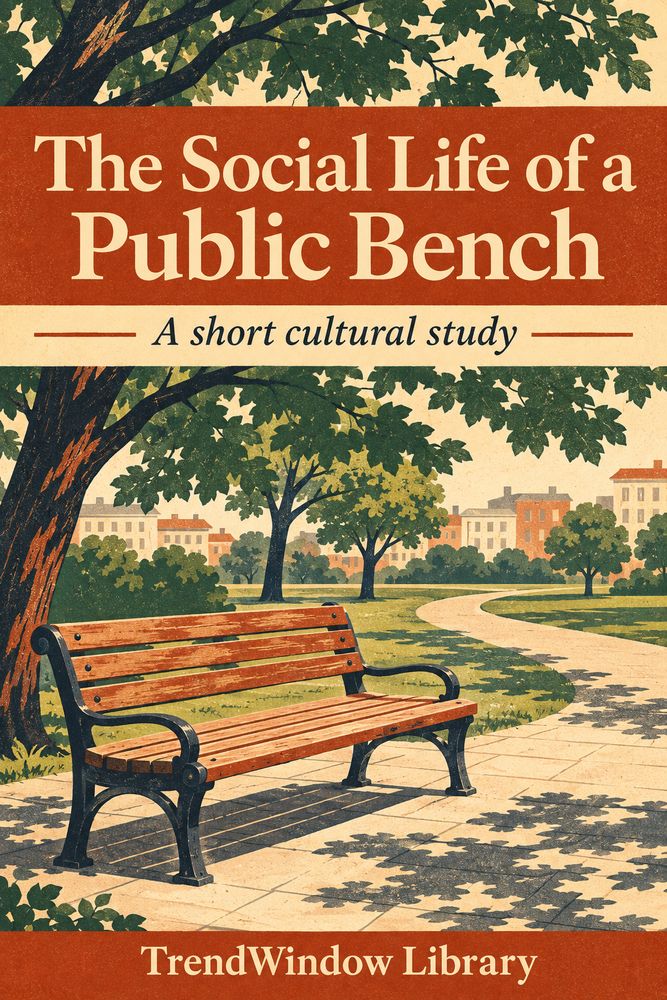
Front cover of The Social Life of a Public Bench

History & Culture

The Social Life of a Public Bench

By TrendWindow Library

A complete short cultural study in eight chapters. Selected institutional records and clearly imagined exercises explore public benches, designed views, resting routes, entry, commemoration, maintenance and the limits of evidence.

Read this complete edition, including its ending and notes. No purchase is required.

About this study

A complete short cultural study in eight chapters. Selected American park records and English access guidance support a method for looking at public seating. This is not a world history of benches, a legal opinion or a construction manual. All exercises and unnamed scenes are invented for explanation; no interviews or visits are claimed. Linked institutional sources were consulted on 17 November 2026, Bangladesh time. A source can establish a fact without proving every interpretation placed beside it.

© 2026 TrendWindow Library. Original AI-assisted study and translations, reviewed by an AI assistant. No independent human-editor or native-speaker certification is claimed.

1. Before Sitting Down

Imagine arriving at a square with a heavy bag and finding one empty bench. Before inspecting its maker’s mark, you may ask a simpler question: can I sit here? The surface, the route towards it and the rules around it all enter the answer. The object is easy to name. The opportunity it offers is more complicated.

This book follows three connected things: the seat, the place and the permission. The seat has a shape and materials. The place puts it beside something and at a distance from something else. Permission concerns who may approach, remain and use the space. These are questions for investigation, not a promise that every public bench welcomes everyone equally.

Start with a description that another person could check. A seat faces a path. It has a back, two end supports and no visible inscription. A tree stands behind it. These observations would not, by themselves, establish its age, ownership or intended users. Nor would an empty seat prove that nobody wants it. The missing person might be at work; the surface might be wet; the photograph might have been taken before opening time.

Consider two invented captions for the same imagined image. One says that residents have abandoned their square. The other says that a bench was unoccupied when the photograph was made. Only the second stays within the evidence supplied. The first needs more investigation, including whether the photograph actually shows the whole square.

Attention to such limits need not make a cultural history lifeless. It creates space for better questions. Why was this view chosen? Who requested the seat? What happened when it needed repair? A bench becomes socially interesting when we follow the decisions around it without pretending that wood or stone can answer for every person who passed.

2. A Designed View

Central Park contains cast-iron-and-wood settees and handcrafted rustic wooden benches, according to the Conservancy’s account. [Source: Central Park Conservancy, bench history](https://www.centralparknyc.org/articles/central-park-benches).

The contrast invites a question about how an object belongs in a landscape. A branching wooden support and a repeated metal frame can both hold a seat, yet they offer different things to notice. One may draw attention to an irregular outline; another may make its repeated pattern easy to recognise. That is an interpretation of form, not a claim that every visitor reacts alike.

A photograph can make a designed scene appear inevitable. Crop out a path junction and the bench seems devoted entirely to the view. Show the junction and it may also appear useful to someone deciding which way to go. Neither image necessarily lies. Each selects a relationship. A historian should ask what the frame leaves out before turning a pleasing picture into an explanation of purpose.

Distinguish the date of a design from the age of the particular object before you. An old pattern can be made again. A repaired seat can contain parts of different ages. An inscription might date a dedication rather than manufacture. Without records, appearance alone cannot settle these different chronologies.

For an invented exercise, put three cards beside a drawing: pattern introduced, present seat installed, wooden slats replaced. Leave their dates blank. What evidence would fill each card? A catalogue might support the first; an installation record the second; a record confirming completed maintenance the third. One document may connect them, but they should not be merged simply because the bench looks consistent.

This distinction changes what preservation can mean. Keeping a recognisable form and keeping every original component are different aims. Before praising or criticising a replacement, establish which aim was stated, what condition was recorded and what work occurred. A useful history can describe continuity without pretending that nothing changed.

3. Rest Along a Route

Active Travel England’s guidance prefers less than fifty metres between resting points and says seating should not obstruct routes. [Source: Active Travel England, benches and resting points](https://www.activetravelengland.gov.uk/planning-active-places/benches-and-resting-points).

This is guidance in an English planning context, not a universal legal distance or a finding that every route meets it. Its value for this study is the shift of attention from a single attractive seat to a sequence of places where a journey can pause.

Imagine an entirely hypothetical route from a bus stop to a library. One bench is near the stop; another is inside a garden reached by steps; a third stands beside the library door. Marking three dots on a map does not establish that all three are equally usable by someone following the direct route. The diversion, the entrance and the surface matter. A person who cannot use the steps should not disappear from the account because the map looks well supplied.

The same caution applies to armrests. An armrest may help a person sit or stand. A divider may also limit positions on a seat. You cannot infer a designer’s sole motive from a shape without further evidence. Nor should an argument about motive replace listening to the people affected. Ask separately what a feature permits, what it prevents, what the stated purpose was and whose experiences were recorded.

A useful description records a route rather than awarding a universal accessibility score. Note the observation date, the way to the seat and any obstruction visible then. Do not diagnose a stranger’s mobility from appearance or claim to represent disabled people through an imagined example. Those people’s own accounts require consent and faithful reporting.

A bench can therefore be part of a journey even when its occupant is motionless. In this sense, stopping and travelling are not competing uses of a street. A pause may be one condition that makes the next part of a particular trip possible.

4. Who Could Enter

The National Park Service records segregation at the then privately owned Glen Echo Amusement Park, protests in 1960 and an announcement of admission regardless of colour on 14 March 1961. [Source: National Park Service, Summer of Change](https://www.nps.gov/glec/learn/historyculture/summer-of-change.htm).

This example concerns access to an amusement park and a protest involving its carousel. It does not establish that any particular park bench bore a racial restriction. That boundary matters: a powerful history should not acquire a more convenient object merely because this book is about seating.

What the example changes is the question we ask of a welcoming landscape. Public enjoyment and public ownership are not interchangeable descriptions. A place can invite customers while excluding people. Its furniture may look generous in a photograph that reveals nothing about who could pass the entrance. Looking only at the seat would miss the decision that made sitting there possible for some and impossible for others.

An empty space in a photograph is especially weak evidence about equality. The people excluded from a place may leave no visible trace inside it. An admission policy, an account of protest or a contemporary recording can supply evidence that the image cannot. These sources must still be read for their date, authorship and particular claim; none gives us every visitor’s experience.

Do not turn changes in formal admission into an instant, complete account of social belonging. A dated announcement establishes an announced change. Evidence about implementation and later experience answers additional questions. It is equally misleading to erase a documented change because it did not answer every question at once.

The bench historian’s task here is modest and necessary. Ask who controlled the threshold. Identify the actual restriction and the people who challenged it when the sources permit. Preserve the distinction between the documented event and the object used to introduce it. A history of rest must leave room for people who were prevented from arriving.

5. Names on a Shared Seat

The Charles B. Stover memorial bench in Central Park’s Shakespeare Garden was dedicated in 1936. [Source: Central Park Conservancy, Charles B. Stover Bench](https://www.centralparknyc.org/locations/charles-b-stover-bench).

A named bench asks us to consider two uses together: remembering someone and providing a seat. A person can rest without knowing the commemorated life. Another can read the name without sitting. These uses can meet, but neither tells us automatically what every visitor feels.

An inscription is a chosen public statement. It does not contain an entire biography. Dates may identify a life, a donation or a ceremony; the wording and supporting records determine which. A short affectionate phrase should not be expanded into an invented family history. A public name is not permission to publish private details about relatives.

Imagine a different, wholly invented plaque: For Mira, who loved this view. We cannot know from that line whether Mira visited every day, whether the bench occupies the same position as before or whether the donor shares her name. We can describe the wording and then state what remains unknown. If we want to explore grief through an invented character, that would be fiction, clearly labelled, rather than research about the real plaque.

Commemoration also raises questions about selection. Whose names become legible, and whose work remains unnamed? The absence of a cleaner’s name does not prove that no cleaner worked there. The presence of a donor’s name does not establish that the donor owns the space. To make either claim, consult the relevant arrangements and records.

A good account can preserve the warmth of a memorial while acknowledging these limits. It need not reduce every dedication to a financial transaction or pretend every passer-by joins a shared memory. A name offers one invitation to attention. The empty part of the seat offers another. Our interpretation should not close the space between them.

6. The Work of Keeping a Bench

The Conservancy records the recreation of the Concert Ground benches in the 1990s; its restoration plan includes replacing wooden slats and repairing metal posts. [Source: Central Park Conservancy, Concert Ground Benches Restoration](https://www.centralparknyc.org/restoration/concert-ground-benches-restoration).

A plan describes intended work, not proof that every item has been completed. This book makes no claim about the project’s eventual completion date. The record is useful because it makes different kinds of work visible within an object that a visitor might simply call the old benches.

Maintenance complicates the dramatic story of opening day. Someone must notice a problem, record it, decide what to do, arrange the work and determine when the seat can return to use. Those steps need not belong to one person. A photograph of fresh paint does not identify who paid, who repaired a support or who checked the result.

Consider an invented archive containing a damage report, an approved estimate and a receipt. Together, they may establish a sequence from concern to expenditure. They do not necessarily prove that the bench was usable every day between those documents. A closure notice or an inspection record might answer a different part of the question. Keep those evidential jobs separate.

There is also a geography to repair. If several seats along a route are unavailable at once, a person’s options can differ from what the inventory suggests. This is a question to investigate for a particular place, not a claim that a named restoration caused such a problem. The history of care includes the temporary arrangements as well as the finished surface.

Avoid converting this discussion into do-it-yourself instructions. A public bench belongs within someone’s responsibility; inspecting a record is not authority to tighten, repaint or move it. The reader’s task is to recognise the work behind availability. When a familiar seat remains useful, its continued presence may be the outcome of decisions and labour, not the absence of change.
7. Reading an Absence

New York City’s Department of Transportation installs and maintains public seating and invites suggestions for new locations. [Source: NYC DOT, Seating](https://www.nyc.gov/html/dot/html/pedestrians/seating.shtml).

A suggestion mechanism is evidence of a way to ask. It does not prove that every request is accepted or that every resident can use the mechanism equally easily. Keep the invitation, the response and the completed installation as separate events in any local account.

Now imagine a hypothetical bench that disappears between two photographs. The first temptation is to supply a motive. Perhaps it was removed to discourage a particular group; perhaps it was broken; perhaps nearby works required temporary storage. Those are possible explanations, not interchangeable facts. Begin by confirming that the photographs show the same location and that their dates are reliable.

Next, distinguish removal from non-replacement. An instruction to take away an unsafe seat and a later decision not to replace it would be two decisions. They might have different authors and reasons. A story that combines them can hide accountability as easily as one that ignores them. If only the removal record survives, say where the available evidence ends.

A missing bench can matter even before its cause is known. A person may report that there is now nowhere suitable to rest. That account describes an effect and should not be dismissed merely because the administrative explanation is incomplete. Conversely, a sincere account of difficulty does not by itself identify who ordered a removal. Effects and decisions need different kinds of evidence.

For a desk-based exercise, make three columns: what is documented, what is reported, what remains untested. Put an observation date beside each entry. Record disagreements rather than quietly choosing the tidiest version. This method does not solve a shortage of seating. It produces a more useful description of the problem and a clearer question for whoever holds the missing record.

8. A Bench Worth Returning To

Return to the invented square from the opening chapter. We still have no right to invent its history. But we now have a better way of approaching it: describe the object, follow the route, identify the rules, read the names and look for the work that keeps the seat available. Each step asks for a different kind of evidence.

If you choose a local example, begin with a small question you can answer without intruding on anyone. You might compare the dates on two published maintenance records or examine a photograph’s caption. If observing a place, stay where you are permitted, do not obstruct others and do not record identifiable strangers merely to decorate an argument. Nobody owes a researcher a personal story because they are sitting in public.

Write a short account with three clearly separated layers. First describe the supported facts and link their sources. Then explain your interpretation. Finally identify an uncertainty that could change it. For example, a replacement invoice may show that new slats were paid for; the claim that the entire bench is new would require more evidence. A neat conclusion is less useful than an accurate distinction.

This book has used selected institutional records, not a comprehensive archive or a survey of users. Its examples do not represent every country, climate or tradition of public rest. Nor do they offer a ranking of good and bad benches. They demonstrate how apparently ordinary furniture can open questions about design, access, remembrance and responsibility.

The conclusion is not that every seat hides a secret drama. Some histories will be brief. An ordinary repair carried out when needed can be worth recording without turning it into a heroic story. The point is to keep the people and decisions in view while leaving unsupported claims unwritten.

When you leave the imagined bench, leave room for the next person. That small ending holds the larger question of the book: what makes a place available to someone whose reasons for being there we may never know?

Explore more books →