About this book
An original fictional short story. People, documents and events in this story are invented. AI-assisted writing and translations; no independent human-editor or native-speaker certification is claimed.
← Book Library · Complete book
Fantasy & Science Fiction
By TrendWindow Library
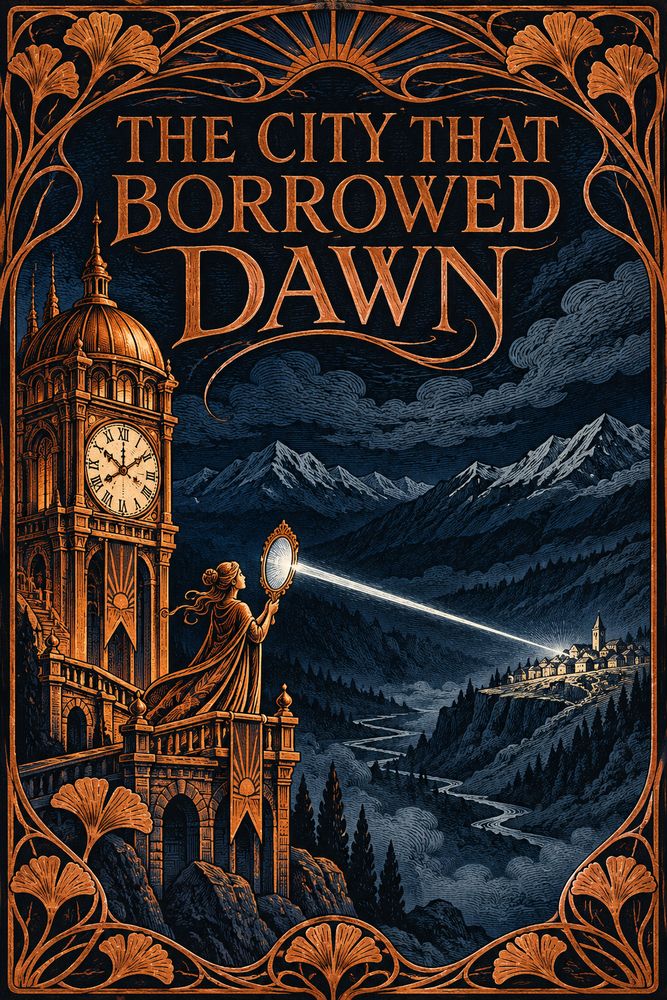
When borrowed dawn fails to arrive, clockkeeper Iven and sweeper Sena discover six winters of unpaid light. A bridge, a blocked mirror and an orchard force two communities to agree on what they can actually return.
Read this complete edition, including its ending and notes. No purchase is required.
An original fictional short story. People, documents and events in this story are invented. AI-assisted writing and translations; no independent human-editor or native-speaker certification is claimed.
The first person to complain that dawn was late was Sena, who swept the steps of the clock tower. She had worked there for twenty-eight years and judged the hour by when she could see the green in the copper handrail.
“I can see my broom,” she told Iven, the city clockkeeper. “I can't see what I'm sweeping.”
At the top of the tower the clock said six. In the glass chamber behind it, the daylight gauge trembled on zero. The small mirror normally caught a white line from Tern, the town on the ridge. That line opened the municipal shutters, and dawn worked its way down the streets. It arrived at the bridge last. People there liked to say they paid less rent because they got less morning.
There was no white line.
Iven checked the mirror with a candle. It was clean. He turned the receiving wheel half a notch and back. From the bridge he heard a bicycle bell and, a second later, a splash.
“Go down and ask whether somebody fell,” he told Sena.
“Someone always falls when you can't see the bridge.”
She put her broom against the wall and went anyway.
Iven opened the ledger. The city had signed to receive ninety minutes of ridge light each morning until its own east-facing shutters were rebuilt. The agreement was supposed to last one winter. There had been six winters. Beside the last delivery his predecessor had written *renewed orally*. Beside the one before it, in a smaller hand, someone had written *return pending*.
There was nothing in the current year's account under *return*. He went back through three volumes before he found what the city was meant to send. It wasn't money. It was the last half hour of afternoon, directed through a west-facing mirror toward Tern's shaded orchards.
He went to the west window. Down in the square the mayor's new glass roof covered the route from the tower to the old reflecting post. In the afternoon the whole roof shone. The city guide said that was a feature.
Sena came back up the steps.
“It was a basket,” she said. “The rider got off in time. Someone wants to know if they can have the oranges.”
“Let them ask the rider.”
“Will dawn come?”
Iven picked up the ledger. It was heavier than he had expected when he put both hands under it.
“I think we have to go and ask for it.”
The road up to Tern had white stones along one edge. Iven had thought they were for decoration until he tried to follow the road in darkness. He put a boot against each stone before taking the next step. Sena walked behind him with the tower candle in a jar. She had brought an orange the rider had given her.
At the top a woman in a wool cap was sitting on the wall, drinking from a tin cup. Behind her, the roofs of Tern were catching the first light. The orchards below were still dark. Iven could see their low walls because each one held a little snow.
“I'm looking for whoever closed the morning mirror,” he said.
“That's me,” said the woman. “I opened it too. Just not in your direction.”
She introduced herself as Lio, the keeper. She took them down into the orchard rather than up to the mirror. On the first terrace, a man and a child were moving blankets from one wall to another. The child folded hers very carefully. Frost cracked along the fold.
“We keep the blankets for the young trees,” Lio said. “The last light used to give us a little time to finish before the temperature fell. Now people leave work early to cover them. That's a debt your ledger won't show.”
Iven opened it anyway. He showed her the words *return pending*. Lio put one finger on the page, as if she could feel when the ink had gone down.
“We asked in writing,” she said. “They sent a man who stood in the square and told us the west mirror still worked. We knew it worked. We could see your roof shining from here.”
“What happens to the light you used to send us?”
“It goes down our north road now. The road crews haven't had a clear first hour in years. You'll have to give me a reason to take it away from them.”
Sena took the orange out of her pocket and rolled it between her hands to warm it. “Could we have enough to see the bridge while we work on the return?”
Lio looked at her for the first time since they'd arrived.
“Maybe. How much does your bridge need?”
Iven had come to ask for ninety minutes. He had no idea how many minutes a bridge needed.
Back in the city, Sena walked the bridge with the candle, stopping where two people couldn't pass without one stepping aside. There were three such places. She marked them in chalk. A lamp maker offered three lamps if somebody else would fill them. The rider with the oranges volunteered for the first week. By evening Iven had stopped thinking of the bridge as something that required dawn all at once.
At four he went to the square. A bar of light crossed the paving and climbed the glass roof, then broke into ribbons inside it. People at the market looked up. They did this every day. A little girl stood in a yellow ribbon with her eyes closed, letting it fall across her face.
The mayor stood beside Iven. “You see what we would lose,” she said.
“Yes,” he said. He did see it.
She had come to show him the roof hinges. For cleaning, one narrow panel could be opened without disturbing the rest. It was the panel nearest the old reflecting post. If they opened it at the right time, Iven thought, the mirror could send some of the light through. Most of the ribbons would stay.
“Why wasn't it tried when Tern wrote?” he asked.
The mayor watched the girl step out of the yellow ribbon and put her hand through it instead.
“Because I said we'd answer after the winter fair. After the fair we didn't answer.”
Iven wanted to ask her to say that again in front of the market, but the light was already moving. He fetched the key. The panel opened a finger's width and stopped. Grease had hardened on the hinge. When he forced it, the far corner of the glass made a sound like a spoon against a cup. He stopped pulling.
From Tern, no one would see a difference that evening.
The girl opened her eyes. “Is it broken?”
“The window?” Iven asked.
“The light.”
He looked along the paving, where the ribbon was nearly gone.
“It's still here,” he said. “It isn't going where it should.”
The next morning, Lio came down the hill with a canvas bag of tools and a red flag. Iven had invited her to inspect the west mirror before they tried again. She checked its pivot and asked him to show her the roof. After she looked at the hinge, she handed him a stiff brush. Together they worked the old grease loose a little at a time.
They tried the panel at noon. It opened all the way, but a draft made it slap against its stop. Sena took a length of cord from the lamp maker and ran it from the handle to a ring in the paving. Iven moved the reflecting post two handspans so the afternoon light could clear the frame. Lio watched him make the marks before tightening the bolts. She had seen people promise to move things and leave no mark of where they had been.
At four Lio waited on the ridge with the flag. Iven held the panel open. For a while there was nothing except the usual ribbons in the square. Then a white patch ran past the frame and caught the mirror. Iven turned it until the patch was no longer visible to him.
He waited.
A red flag appeared on the ridge and waved once. It disappeared. Then it waved twice more. Sena, who had carried the candle all the way up to Tern the day before, struck the tower rail with the back of her broom. People in the square looked up again. This time several looked toward the ridge.
The light lasted twenty minutes before the roof frame got in the way. Iven wrote twenty in the ledger. The mayor asked whether he would write that the mirror had been restored.
“Not yet,” he said. “Tomorrow we know whether it can do it twice.”
She took the pencil from him, added *test only* in the margin and gave it back.
At the next meeting Lio offered the city fifteen minutes of morning light while the bridge lamps were being installed. The rest would stay with the north road. In exchange, the city would send the twenty minutes they had proved it could deliver, then add the final ten when the mount had been extended. Neither side would count a delivery that the receiving keeper hadn't seen. They would write each week's totals on a board that anyone could read.
Iven asked what to do about the six winters already in the ledger.
“Send people for the orchard walls,” Lio said. “They need rebuilding. Ask who has the time before you put down any names.”
The mayor read aloud what she had told Iven about the winter fair. Then she wrote her own name on the first work day. Later, Sena told Iven that the mayor had never repaired a wall in her life. Lio said she'd put her at the end of one and teach her how to start.
On the last morning of the temporary agreement, Iven went down to the bridge before six. Three lamps showed the places Sena had marked. He could see the far parapet, the lip of the step and the shape of a basket on a bicycle. The rider stopped to adjust a strap. Iven held the basket steady for her. It was empty this time.
High above them, the borrowed line reached the tower. It went through the streets for a quarter of an hour. By the time it left, Iven could see a thinner light rising behind the city's own east shutters. The carpenters had opened the first repaired leaf the day before. The rest were still dark.
He walked back to the square. Sena was sweeping the steps. She said she could see the green in the handrail even after the borrowed light had gone.
“Is that enough?” he asked.
“For the steps,” she said. “Yes.”
At four, Iven opened the roof panel. He watched the light leave the square and waited for the flag. When it came, he entered the number in the ledger. Then he went downstairs to help Sena carry the day's sweepings out.