BOOK LIBRARY · Complete books · Purchases disabled
TrendWindow

← Book Library · Complete book

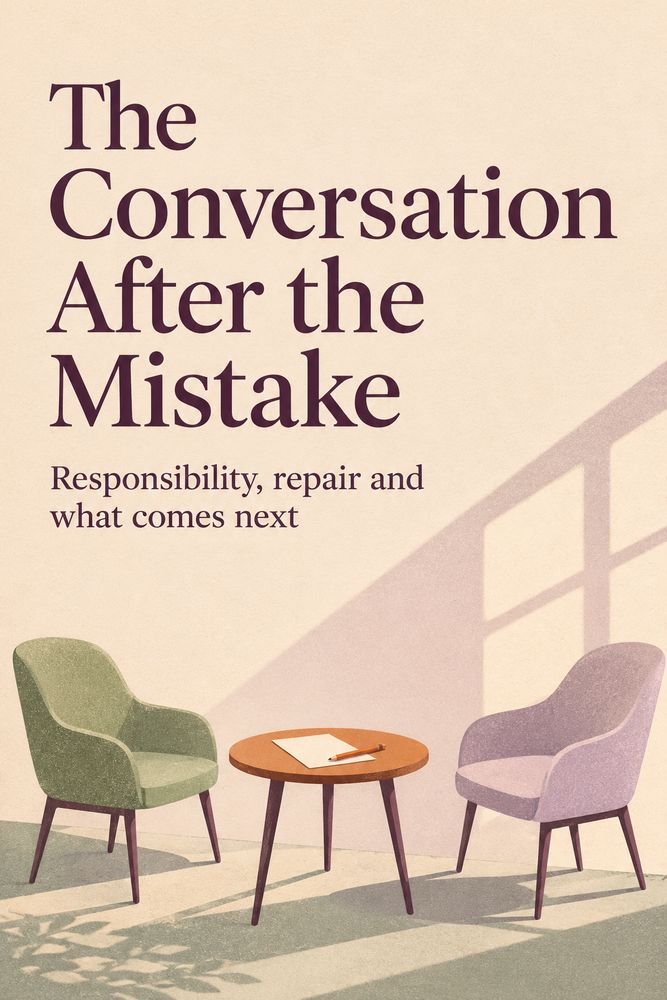
Front cover of The Conversation After the Mistake

Personal Growth & Psychology

The Conversation After the Mistake

By TrendWindow Library

When Nadia leaves Eli’s name off their workshop programme, a clear apology is only the beginning. Eight practical chapters follow one fictional case through facts, listening, a feasible correction and verified follow-through, without claiming forgiveness or renewed trust.

Read this complete edition, including its ending and notes. No purchase is required.

About this book

### A practical short book about responsibility, repair and what comes next

An original educational guide with a wholly fictional running example. These exercises are invitations to think, not a clinical treatment or a legal procedure. They do not require reconciliation, forgiveness or contact with someone who has asked to be left alone. Where there is immediate danger, a safeguarding concern or a required reporting process, address that through the appropriate channel first.

Original complete practical short book prepared with AI assistance. Nadia, Eli, the workshop and its outcomes are fictional teaching examples. General educational reflection, not clinical treatment, legal advice or a validated intervention. No obligation to reconcile, forgive or override contact boundaries. Translation meaning reviewed with AI, without independent native-language certification.

1. Name the event, not your entire character

Nadia opened the workshop programme on Monday morning and saw her name above a session she had developed with Eli. His name was missing. She had sent the file to the community centre on Friday. The centre had distributed it to the people attending. Eli's message contained one sentence: “We agreed that this was joint work.”

Her first draft of a reply was longer than the programme. She described a difficult week, the folder with confusing filenames and how much she valued collaboration. All of those things could be true. None yet said what she had done.

Begin closer to the event. “I sent the programme without your name, although we agreed to list us both.” This is a bounded statement. It identifies an action and an agreement. It does not ask the other person to judge whether you are, in general, good.

There is a difference between taking responsibility and performing self-disgust. “I'm a terrible person” can leave the recipient with a new task: reassure you before discussing the original problem. A specific sentence leaves space for what happened to them. You may feel ashamed. You do not have to make their response the only way you can bear that feeling.

Write three short lines privately: what I did; what I had agreed to do; what needs attention now. Use observable verbs. Sent, omitted, arrived, shared and charged tell a reader more than failed, disappointed or ruined. Those broader words may describe an impact, but they can obscure the action you need to change.

Nadia wrote: sent the old file; agreed on joint credit; correct the programme and speak to Eli. She did not yet know every consequence. Her note was a starting point, not a completed account of his experience.

Do not postpone an urgent correction until you have perfect words. If a wrong time is still bringing people to a closed venue, stop the misleading notice. If someone's information is exposed, use the proper response process. Conversation can accompany necessary action. It should not become a ceremonial obstacle placed in front of it.

2. Give facts, guesses and explanations separate places

On a second sheet, Nadia made three headings: known, uncertain and explanation. Known: the distributed programme omitted Eli. Uncertain: who had already downloaded it, and whether anyone had questioned his contribution. Explanation: she had selected an older file and approved it without checking the credit line.

This small separation prevents two kinds of overstatement. You need not invent harm to sound serious. You also cannot assume that because you have not seen harm, none occurred. “I don't yet know who saw the earlier version” is more accurate than “Nobody will have noticed.”

An explanation can help identify a preventable step. An excuse asks the recipient to treat that step as outside your responsibility when it was yours. The same detail may do either job. “The filenames were confusing, so it wasn't really my fault” transfers responsibility. “I chose the wrong file and did not check it; I will change how I approve final copies” keeps the relevant context and the action together.

Do not confess to things you did not do in order to appear agreeable. If the message says you deliberately removed a name and you did not, you can distinguish action from intention: “I sent a version without your name. I did not deliberately remove it. I understand that the result still denied you the credit we agreed.” That distinction should clarify the record, not erase the consequence.

Research offers a reason to attend to wording without turning wording into magic. Two studies by Lewicki, Polin and Lount examined apology components and found that they were rated differently. A study of judgments does not establish a universal script or guarantee forgiveness. The reference is at the end of this book.

Before a conversation, underline claims you could support with a record or direct observation. Put a question mark beside assumptions about the other person's motives, feelings or future decisions. “You must think I'm dishonest” is an invitation to discuss your imagined verdict. “What did the omission make harder for you?” leaves room for their account.

You may discover that an early assumption was wrong. Correcting it is part of responsibility. Consistency is useful when it means keeping an accurate record; it is harmful when it means defending your first story as the facts become clearer.

3. Ask for time that belongs to both people

Nadia wanted to call immediately. Eli was leading another session that morning. A surprise call might have relieved her discomfort while interrupting his work. Instead she sent a brief message acknowledging the omission and asking whether he preferred a short call later or a written exchange.

A request for a conversation should contain enough information to avoid becoming another burden. “Can we talk?” can leave someone wondering whether a new crisis is coming. “I want to acknowledge the missing credit and discuss correcting it. Would a short call this afternoon or a written reply work better?” gives the request a shape.

The recipient can decline. They can ask for another time, a support person or a different channel. They may want practical correction without a personal conversation. Do not turn the invitation into a test of their generosity. Repeated messages, unexpected visits and recruiting mutual friends are not better listening.

Choose conditions that make a real answer possible. If you supervise the person, a closed office and an urgent demand may make refusal difficult. Offer a genuine alternative and follow relevant workplace processes. If either person needs an interpreter, accessible text or extra time to process information, arrange that with consent rather than treating speed as proof of sincerity.

Preparation is useful when it supports attention. It becomes avoidance when every possible reaction must be rehearsed before you act. Choose a few notes: the event, the responsibility, a possible repair and a question. You do not need a speech long enough to fill the whole meeting.

If your body feels unsettled, take a brief ordinary pause: sit where you are supported, drink water if you want it, and read your opening once. This is preparation, not a promise to remove distress. You can speak responsibly while feeling uncomfortable.

Eli chose a written exchange that afternoon. Nadia put away the speech she had prepared for a call. Respecting his chosen format was the first part of following through. The conversation did not become less real because neither person could see the other's face.

Keep the exchange private unless there is an agreed reason to involve others. Public credit may need public correction. That does not make every private detail of the disagreement suitable for the audience that saw the original error.

4. Say the thing without a hidden defense

Nadia wrote: “I sent the programme without your name, despite our agreement to list us both. I'm sorry. I approved that version, and the omission was my responsibility. I would like to correct it with the centre. Before I do, is there anything about the wording or timing I should understand?”

The opening is not elegant. It is useful. It tells Eli which action she means, states responsibility and makes room for a response. It does not require him to accept her preferred description of his feelings.

Some phrases quietly withdraw the apology they appear to offer. “I'm sorry if you were upset” makes the problem depend on the recipient's reaction. “I'm sorry, but you know how busy I am” places a defense immediately after the acknowledgment. Replace them with the event and its known consequence. If an explanation matters, give it after ownership, briefly and without a demand for exemption.

Do not inflate your certainty. “I completely understand how you feel” may be untrue. “I can see that the programme did not acknowledge your work” is narrower and supportable. You can then ask about consequences you have not understood.

An apology is also not a contract for a favorable answer. Avoid attaching “so can we move on?” or asking whether they now feel warmly toward you. The other person may accept the apology and still change how they work with you. They may need evidence over time. They may not want further collaboration.

Read your draft for hidden requests. Are you asking them to reassure you? To keep the mistake secret for your benefit? To respond before your own discomfort grows? Remove what is not necessary to understand or repair the event. A request for confidentiality may sometimes have a legitimate purpose, but it should not conceal an error from people entitled to know about it.

Keep your voice recognizable. You do not have to borrow formal language you would never use in an ordinary message. Short, plain sentences are enough. The aim is not to sound like an expert in remorse. It is to make your position clear enough that the other person can answer the actual issue.

5. Listen without giving up accuracy

Eli replied that two participants had asked whether he was only helping with equipment. He had written half the exercises and developed the session with Nadia. He wanted the correction to name that contribution, not merely add him to a list of assistants.

Nadia had expected anger. Instead she received information about a precise misrepresentation. Her job was to read it. “Thank you for explaining” did not mean the matter was solved. It meant she had information she needed.

When listening, separate a correction to your account from an attack you have imagined. Repeat the practical point in your own words: “The correction needs to say we developed the session together, not that you provided support.” Then allow the person to correct your summary. Repeating words mechanically can sound like a technique used to manage them; showing what you understood is more useful.

If something is disputed, mark the boundary without turning the whole conversation into a trial. “I don't remember that earlier conversation in the same way. I do agree that I approved this programme without your name.” Check available records where appropriate. You can acknowledge a verified part while leaving another part unresolved.

Do not demand immediate evidence for every account of inconvenience. Equally, do not accept a false factual allegation simply to end an uncomfortable exchange. Ask a focused question when the answer affects repair. “Did the printed handout also omit the credit?” has a purpose. “Why didn't you complain sooner?” may merely put the burden back on them.

You are allowed to pause if the exchange becomes threatening or impossible to conduct safely. Responsibility does not require enduring intimidation. Use an appropriate intermediary or formal process when needed. This book's small example does not stand in for every power imbalance or serious harm.

Eli also wrote, “I don't want to spend tonight checking another long message.” Nadia shortened her proposed correction. She did not interpret his limit as a refusal to cooperate. A repair that consumes more of the affected person's time can become a second problem. Listening includes noticing the amount of work you are asking them to do.

6. Offer a repair within your control

A useful proposal says what you will do, by when, and what depends on someone else. Nadia could draft corrected wording and replace her own file. The centre controlled distribution. She could request a resend; she could not honestly promise that every participant would read it.

She offered: “I'll send the centre a short correction today, using our joint credit line. I'll ask them to replace the programme and send the corrected version to the original recipients. I'll tell you tomorrow whether they have confirmed that.” Eli asked her to include that they had developed the exercises together. She included it.

Public-service complaint guidance links apology with practical remedies. Its institutional setting is different from this fictional workshop. The everyday planning here is original, not a legal entitlement or a formula for deciding compensation. What matters in the example is that the proposed action addresses the actual omission.

Bring a considered option rather than asking the affected person to design everything. “What can I do?” can be sincere, but it may hand them another assignment. “Here is what I can correct; would this miss something important?” gives them a proposal to accept, alter or decline.

Match the repair to the event. A gift would not correct a programme that erased a contribution. A public declaration of friendship could expose a private disagreement. An expensive promise might be undeliverable. Choose an action that restores what can be restored without creating new obligations for the recipient.

If there was a direct cost, establish what happened and use the relevant reimbursement or complaint process. Do not improvise a payment arrangement you lack authority to make. If a record must be retained, correct it through the proper process rather than secretly removing evidence of the error.

A prevention step should also be specific. Nadia added a check of names and contributions before approving future programmes. She did not ask Eli to become the permanent proofreader of her work. That would turn her responsibility into his unpaid monitoring.

Write dependencies plainly. If a deadline slips, report that before the other person has to chase. “I have asked, but the centre has not confirmed” is incomplete progress described honestly. It is better than presenting your request as a completed repair.

7. Do the part that has no audience

The centre confirmed the corrected programme the next morning and sent it to the original recipients. Nadia checked the new file. Both names appeared, with the agreed contribution line. She sent Eli one short update with the corrected copy. She did not ask whether he was proud of how she had handled it.

Follow-through is often less dramatic than the conversation. It involves checking a file, returning an object, keeping a deadline or changing an approval step. Do it even if the response is brief. A repair is not a performance paid for with gratitude.

Keep a small private record of your own commitments: action, date, evidence of completion and any remaining dependency. Avoid turning it into a dossier about the other person's reactions. For Nadia, the evidence was the corrected programme and the centre's confirmation, not a measurement of Eli's warmth.

There may be a gap between repairing a record and restoring trust. Do not fill that gap with repeated requests for a verdict. “Are we okay now?” can make the recipient responsible for your uncertainty. If an agreed review is useful, ask once about a suitable time. Otherwise, let ordinary reliable behavior carry information.

Notice whether the same kind of mistake keeps recurring. Repeated apologies with unchanged practices create an unresolved practical problem. Examine where your process fails. Is responsibility unclear? Is the final check rushed? Are you repeatedly accepting work you cannot do? Choose a change you can observe rather than another declaration of good intentions.

A review can be modest. Later, at the next programme deadline, Nadia checked the current version, the names and the contribution line before sending. She kept that step on her own checklist. She did not tell Eli that her new checklist proved she had changed forever.

If you discover that the correction itself contains an error, correct that too. Do not protect the appearance of a successful apology at the expense of accuracy. The point is to leave a better record and a more reliable practice, not to finish with an immaculate story about yourself.

8. Close the task without claiming the relationship

A week later, Nadia and Eli taught the workshop. The exercises ran longer than expected. They shortened the final discussion together. Afterward, Eli said the corrected programme had helped. He also said he wanted to review any future shared publicity before it went out.

Nadia agreed to that arrangement for shared material. It did not replace her responsibility to check her own work. They packed the equipment. Neither announced that the mistake had made them closer. They had completed the session, corrected the record and established a clearer way to handle their next collaboration.

That is a sufficient ending for this example. It contains no guarantee that every apology will end with renewed work. Sometimes the repair is completed and the relationship ends. Sometimes contact remains limited. The recipient's decision is not another error for you to fix.

Before your own conversation, use one page. Write the action you can verify, the agreement or expectation involved, the impact you know and what remains uncertain. Add the responsibility that is yours, a repair you can actually offer, and a way to check completion. Leave space for information that changes the plan.

Afterward, write what was agreed, including any boundary on contact. Record what you did and what remains dependent on someone else. Do not write “resolved” simply because you sent an apology. Name the thing that is finished: corrected file, returned key, repaid agreed cost or changed procedure. Name what you cannot decide: forgiveness, trust and future closeness.

If no conversation is possible, you may still have practical responsibilities. Respect the boundary and use an appropriate permitted route for necessary corrections. Do not disguise a personal appeal as essential administration.

Nadia filed the corrected programme beside her checklist. The old version remained in the centre's appropriate record. On her own note she wrote: “Correction confirmed. Future shared publicity reviewed by both.” Then she closed the notebook and began preparing the next session's materials. There was work to do, and this time the first page had two names.

Sources and limits: [Lewicki, Polin and Lount, 2016, *An Exploration of the Structure of Effective Apologies*](https://ncmr.lps.library.cmu.edu/article/id/264/); [Public Service Ombudsman, *Putting things right*](https://www.ombudsman.org.uk/about-us/our-principles/principles-good-complaint-handling/putting-things-right). Consulted 9 November 2026. The case, exercises and dialogue are original fiction and educational reflection, not a tested intervention or individualized professional advice.
Explore more books →