BOOK LIBRARY · Complete books · Purchases disabled
TrendWindow

← Book Library · Complete book

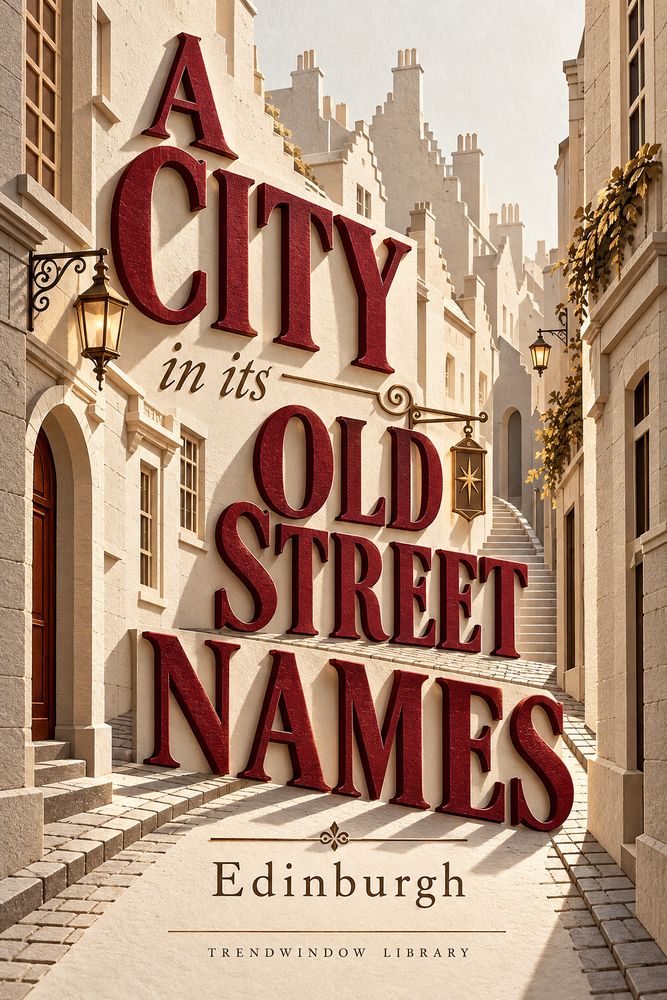
Front cover of A City in Its Old Street Names: Edinburgh

History & Culture

A City in Its Old Street Names: Edinburgh

By TrendWindow Library

Discover Edinburgh through the Canongate, Lady Stair’s House and Gladstone’s Land: a sourced short history of old names, ownership, rebuilding and civic memory.

Read this complete edition, including its ending and notes. No purchase is required.

1. A Route with More Than One Name

Royal Mile sounds like one street. The City of Edinburgh Council's conservation appraisal instead identifies a sequence of five historic streets: Castlehill, Lawnmarket, High Street, Canongate and Abbey Strand. Its description also notes later improvements laid across the older urban pattern. [1] A familiar collective name can therefore make a route easier to recognise while concealing distinctions within it.

This short history begins with that difference. Names help people find places, but they also select what becomes memorable. A word on a sign is neither the whole past nor an empty label. It can preserve a relationship whose explanation has become less familiar than the sound.

The book follows a limited group of Edinburgh examples: the Canongate, two named properties near the Royal Mile, a historical representation of the city and the council's continuing role in naming. The sequence moves from a name's meaning to the evidence needed to understand it. It is not a directory of every street or a current walking itinerary.

No resident from an earlier century steps out to guide an invented tour. No ghost story is presented as an event merely because it fits an old-looking passage. The narrative comes from documented names, ownership and changing descriptions, with original discussion connecting them.

A useful question accompanies us from the beginning: when a place carries an old name, which part of its history is that name actually carrying? The answer may be an institution, a purchaser or a later choice. It need not be the moment when every stone first appeared.

2. A Gate That Was a Way

Canongate offers a small trap for the modern English reader. Curious Edinburgh's historical account connects the name with the Augustinian canons of Holyrood Abbey and explains gait as a word for a way or street, rather than the modern English meaning of a gateway. [2] The name is not simply a statement that a barrier once stood there.

That does not mean gates and boundaries have no place in the area. It means the familiar spelling should not dictate an etymology without evidence. A word can look immediately understandable and still need a historical explanation.

The canons were members of a religious community, not cannon as a weapon. In translation, this distinction matters as much as the difference between a way and a gate. A place-name can retain its spelling while an explanatory sentence gives the reader the meaning.

Historic Environment Scotland's description of Canongate relates its development to Holyrood Abbey, long narrow land divisions and a burgh formally incorporated into Edinburgh in 1856. [3] The name therefore points beyond a strip of road to a history of settlement and administration.

The consulted institutional summaries assign different precise dates to the early grant establishing the burgh. This account does not settle that difference by selecting whichever date makes the smoothest sentence. It keeps the broader twelfth-century setting and avoids confusing the foundation of the abbey with every later act concerning the burgh.

The result is less tidy than a one-line legend, but more useful. A name may preserve a connection while the chronology of that connection requires further distinctions. Understanding the word begins the inquiry; it does not finish the institution's history.

3. The Space Behind the Street

The Canongate listing describes long narrow plots, or tofts, on either side of the main street, later divisions into forelands and backlands, and subsequent rebuilding. It also describes twentieth-century interventions, including retained frontages and others rebuilt in replica. [3]

These points complicate the idea of an untouched old street. A surviving name need not mean that every visible surface belongs to the same period. Nor does a rebuilt frontage make the earlier place imaginary. Names, property arrangements and building material can persist or change at different speeds.

The physical distinction between a frontage and the space behind it is useful even before we know every resident. An address on a main route may lead into a more complicated arrangement than a simple row of isolated houses. The history of a place does not end at its most public face.

That matters when we encounter a close, a court or a named property in a historical account. Before treating the name as a complete picture, we can ask what area the source means: a passage, a building, a plot or a district. Words that seem interchangeable in a casual story may refer to different scales.

This book is not supplying a survey of current access to those spaces. A historically interesting entrance is not automatically a public route, and a readable old name does not establish a right to enter a residence. The discussion concerns how to interpret evidence, not instructions for exploring private interiors.

We can now turn from a district name linked to a religious institution to names linked to owners. In both cases, the sign is a beginning. The dates tell us which connection it records.

4. A House Older Than Its Familiar Name

Lady Stair's House gives us a clear sequence. Historic Environment Scotland's historical article identifies 1622 as the building date and 1719 as the year the Countess of Stair bought the property. [4] The later owner's name cannot simply be made the date of the house's beginning.

The council museums' educational material adds a later layer: restoration in 1897. [5] Building, naming through ownership and restoration belong to different events. Combining them into one romantic origin would remove precisely the changes that make the example interesting.

A reader does not need to memorise every date to understand the point. Ask what action a date describes. Was something built, bought, named, restored or recorded? Two dates beside one place need not be competing claims about the same action.

A prominent owner's name also raises a different question: whose presence becomes easy to remember? Lisa Williams's historical article for Historic Environment Scotland discusses Edinburgh's connections with slavery and the presence of African and Indian people, drawing attention to histories that an admired façade may not immediately suggest. [4]

This short account does not turn that larger history into an invented household scene. It does not assign a securely established personal name where the consulted source itself expresses uncertainty. The point is to resist treating the name of a well-recorded owner as a complete list of the people whose lives belonged to a place.

One house can therefore teach two disciplines at once: separate the dates of different changes, and keep the limits of a commemorated name in view. A name may be genuine evidence while remaining selective evidence.

5. Gladstone Was a Purchaser, Not Every Resident

The National Trust for Scotland explains that Gladstone's Land takes its name from Thomas Gladstone, who bought the tenement in 1617 with the intention of renting apartments. It describes his extension of the property, painted wooden ceilings later concealed under plaster and their rediscovery during the Trust's twentieth-century work. [6]

The name points to a particular purchaser. It does not imply that all earlier construction began with that purchase, or that everyone associated with the building belonged to his family. The Trust's account places varied businesses and tradespeople within the property's history. [6]

Here the word Land can also mislead a reader who sees only an empty plot in the modern sense. The consulted account is about a tenement and the people who owned, rented and worked within it. The historical label deserves to remain attached to that context rather than being flattened by a present-day assumption.

A property's story becomes richer when ownership and occupation are not treated as the same thing. An owner may be preserved in the name, while tenants and commercial activity provide a different account of how the building was used. Recognising that difference does not require inventing a transaction or a daily routine.

The painted ceilings offer a further distinction between what once existed and what later viewers could see. Concealment and rediscovery are changes in visibility, not necessarily the creation and destruction of the object itself. A history of a building includes these changing relationships to its material.

This chapter does not promise the present condition of a room, a tour or an opening hour. It follows the institution's historical explanation to a simpler conclusion: an owner's name can be accurate without containing the whole life of a property.

6. A Picture of a City Is Not the City

The National Galleries of Scotland describes Frederick de Witt's double prospect of Edinburgh as an engraving made from a drawing by James Gordon of Rothiemay, associated with the picture plan completed in 1647. The two aspects present the city from different sides. [7]

That description identifies another kind of evidence. A historical representation is an object with makers and a date, not an unobstructed window through which we can inspect every former street. The consulted catalogue text helps place the work; this book does not reproduce the engraving or claim to have independently measured its depicted buildings.

The distinction matters when a name appears in an old map or view. One must ask what the document was intended to show and at what scale. A missing label is not automatically proof that a place did not exist. A label's presence does not give us the interior life of every household beside it.

The National Library of Scotland's map research guidance explains that local maps can assist with understanding areas and questions such as land tenure or ownership. [8] That is an invitation to use a type of source carefully, not a claim that this author has inspected every map or resolved a reader's family history.

Imagine two records using different spellings or numbers. Before inventing a vanished building, ask whether they describe the same time, area and sort of record. This is an original research habit offered here, not a report of a completed comparison of particular maps.

A city name lives in speech, on signs and in documents. These forms can illuminate one another, but they should not be collapsed into a single unchanging record. The representation has a history too.

7. Names Are Still Being Chosen

Old names can make naming seem like something that happened long ago and then stopped. The council's current public guidance says it names new streets, numbers properties and changes names or numbers when required. Its criteria include local history, cultural diversity, notable people and neighbourhood identity, with priority for a woman's name where possible in the relevant commemorative category. [9]

Those published responsibilities show naming as continuing work. They do not establish that every old street was selected under today's criteria, nor that a proposed name has already been assigned. A bank of possible names and an actual address are different things.

The distinction between remembering and administering is useful. A name may carry a cultural association while also helping identify a location unambiguously. Those purposes can meet in one sign without becoming identical. A historical argument about a name and an address needed for a service are not the same task.

This book does not request a renaming, contact the council or give instructions for changing an official address. It observes the published account of present responsibility to show that a city remains capable of making choices about what it commemorates.

That observation also changes the way we look backward. A name that now feels inevitable may once have been one choice among possible descriptions. Its familiarity is a fact about its later life, not proof that no other history could have been remembered.

The question from our opening chapter can now become more precise. What relationship does this name preserve, who is visible through it, and what other evidence is needed before we let it stand for an entire place?

8. Reading the Sign Without Ending the Story

We began with one route and several names. The Canongate introduced the distance between a familiar spelling and a historical meaning. Lady Stair's House separated construction from later ownership and restoration. Gladstone's Land separated a named purchaser from the many lives and uses of a tenement.

The representations and guidance then changed the scale. A city can be studied through documents without pretending that the document is the whole city. Present naming can be understood as an institutional activity without applying its rules backward to every earlier century.

None of this makes names unreliable by definition. It makes them particular. A name can be good evidence for one relationship and poor evidence for another. Knowing that difference is more useful than either believing every pleasing explanation or dismissing every sign as meaningless.

The short history ends with a practice of attention, not a complete directory. Read the name, identify what kind of place the source means, and separate the dates of different actions. Then ask who and what remain outside the wording. These steps can deepen an encounter without converting it into a claim of exhaustive research.

Edinburgh's old names do not need fictional witnesses to become interesting. Their documented layers already show institutions, owners, work, rebuilding and memory. A name may survive while its surroundings change; a familiar building may be older than the person remembered in its name. The sign can guide us to the past, provided we do not make it the point where the story must stop.

Sources and Edition Information

Research checked on 1 November 2026. Original AI-assisted short cultural history from TrendWindow Library. Eight chapters and these notes form nine fixed content units, not printed pagination. No site visit, archival manuscript inspection, private household scene, ghost event or current access assurance is invented. Original explanatory questions are distinct from sourced facts. English covers are original conceptual artwork, not site photographs, authentic street plans or historical maps. No third-party image reproduction, human-authorship claim or independent native-human proofreading certification.

[1] City of Edinburgh Council, Old Town Conservation Area Character Appraisal: https://www.edinburgh.gov.uk/downloads/file/23393/old-town-conservation-area-character-appraisal . Official indexed extract for the Streets section read for the five named streets and later interventions. Direct browser extraction failed because the PDF exceeded its content-length limit; no full-PDF or map-image review is claimed.

[2] Curious Edinburgh, The Canongate, Bill H. Jenkins, 29 January 2018: https://curiousedinburgh.org/2018/01/29/the-canongate/ . Main historical paragraph read for the canons and gait/way explanation. Brewing totals and every linguistic ancestor are not independently established here. Religious canons are not artillery; no invented route scene.

[3] Historic Environment Scotland, 126 Canongate, LB28443: https://portal.historicenvironment.scot/apex/f?p=1505:300:::::VIEWTYPE,VIEWREF:designation,LB28443 . Description and interest statement read for tofts, rebuilding and 1856 incorporation. Different precise twelfth-century grant dates in consulted institutional summaries are not harmonised into a claimed exact founding date. Informative listing text is not treated as an exhaustive history or current access advice.

[4] Lisa Williams, Edinburgh's part in the slave trade, Historic Environment Scotland, 15 November 2018: https://blog.historicenvironment.scot/2018/11/edinburghs-part-slave-trade/ . Selected passages read for the 1622 house, 1719 purchase and wider Black and colonial histories. A personal name marked uncertain in the source is not adopted as confirmed; no whole-household reconstruction or legal history claim.

[5] City of Edinburgh Council Museums and Galleries, Writers' Museum early and first level material: https://www.edinburghmuseums.org.uk/sites/default/files/attachments/WritersMuseum_1stLevel%20%28wecompress.com%29.pdf . Official indexed educational extract read for 1622 and 1897 as construction and restoration dates. No claim of full PDF visual inspection, copying activities or adopting every residence date.

[6] National Trust for Scotland, Gladstone's Land: The house: https://www.nts.org.uk/visit/places/gladstones-land/highlights/the-house . Main institutional history read for Thomas Gladstone's 1617 purchase, letting, varied trades and concealed ceilings rediscovered in the twentieth century. No current visit, opening-hour or room-condition promise.

[7] National Galleries of Scotland, The Prospect of the South Side of Edinburgh and The Prospect of the North Side of Edinburgh, P 8027: https://www.nationalgalleries.org/art-and-artists/63271 . Catalogue's explanation of de Witt, Gordon and the 1647 picture-plan context read. The image is not copied, surveyed or used as evidence for every building's position.

[8] National Library of Scotland, Maps, family-history research guidance, updated 23 January 2026: https://www.nls.uk/tools-for-research/family-history/maps/ . Main guidance read for maps as tools for local and ownership research. No complete map collection, individual ancestry case or every historical street spelling has been examined.

[9] City of Edinburgh Council, Street names and numbers: https://www.edinburgh.gov.uk/roads-pavements/street-names-numbers . Main responsibilities and naming criteria read. Present guidance is not imposed on all historical choices; no application, external contact or claim that a candidate name is already a statutory address.

Brief paraphrases support an original narrative rather than a copied route guide. A limited exact-title search found no matching book among returned results, not exhaustive clearance or a plagiarism percentage. Full translations preserve the chronology, distinctions, ending and source limitations. All covers remain in English.
Explore more books →