BOOK LIBRARY · Complete books · Purchases disabled
TrendWindow

← Book Library · Complete book

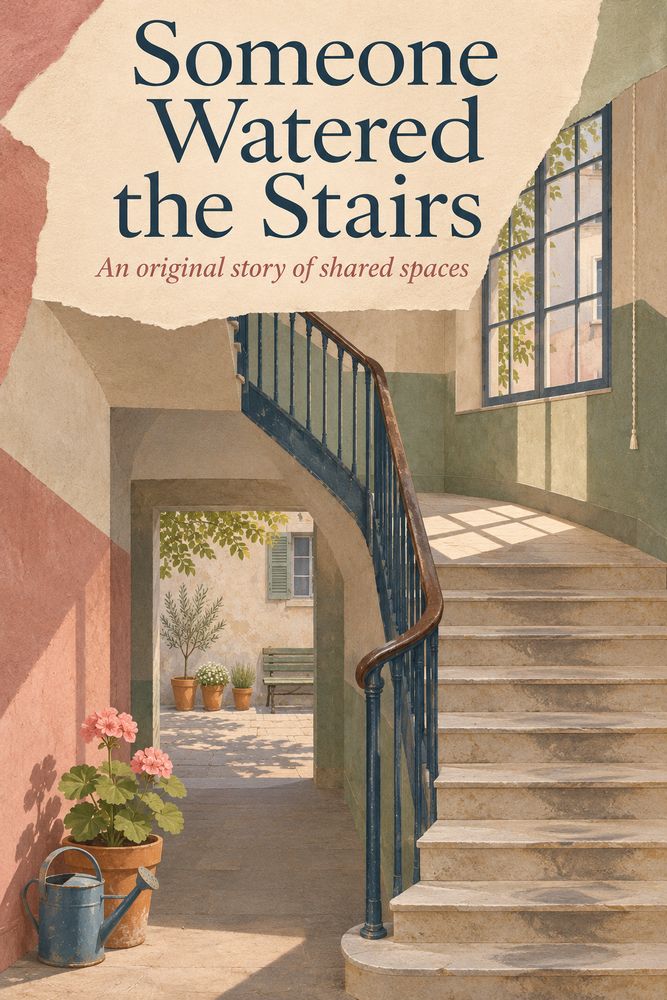
Front cover of Someone Watered the Stairs

Contemporary & Literary Fiction

Someone Watered the Stairs

By TrendWindow Library

A wet stair at Rose Court exposes a garden that has quietly grown from two pots to eleven. Caretaker Mara Sen must make room for her neighbours without pretending that grief can simply be replanted. A complete original literary story in eight chapters.

Read this complete edition, including its ending and notes. No purchase is required.

About this book

An original literary story in eight chapters

Rose Court and its residents are fictional. This complete short book concerns a particular imagined household community; it does not set rules for the management or safety of real buildings.

Original complete short literary story prepared with AI assistance. Rose Court, its residents, loss and resolution are fictional. Not a full-length novel or guidance on real building access, fire precautions, maintenance or plant care. Translation meaning reviewed with AI, without independent native-language certification.

1. The wet third step

Mara Sen found water on the third step at seven in the morning. It had gathered in the worn middle of the stone, where generations of shoes had made a shallow bowl. A green leaf floated in it like something travelling a long way.

She put out a warning, kept people away while she dried the step, and looked upward. The pipe above the landing was dry. So was the window. Beneath a terracotta pot, however, a dark ring spread beyond its saucer.

Mr Abid opened his door before she knocked. He was wearing a shirt buttoned incorrectly at the throat.

“Someone has watered them,” he said.

“I can see.”

“I hadn't yet.”

Mara did not accuse him. She had worked at Rose Court for eleven years and knew that a statement made too early could live in the building longer than its maker.

The garden had begun with two pots on a broad window ledge. Now there were eleven: under the window, against the railing, beside the turn where residents changed hands on their shopping. One plant had fastened itself to the curtain cord with a patient tendril.

Tess came down from the top floor carrying a folded shopping trolley. Her daughter Kavi followed with a school bag nearly as wide as her back.

“Again?” Tess asked, looking at Mara's cloth.

“It's dry now.”

“That isn't what I asked.”

Len waited on the landing above, both hands resting on his walking frame. No one had fallen. Mara would not turn the incident into an injury that had not happened. Still, she saw the space he needed and the pot occupying part of it.

She asked Abid to bring that pot inside while she contacted Iris, the building manager, about the wider arrangement. Abid lifted it without arguing. A pale square of clean floor appeared where it had stood.

“Salma liked the light here,” he said.

Mara knew. His wife had been dead for fourteen months. She also knew the light reached the stair whether or not a pot stood in it.
2. Eleven small claims

By midday, everyone seemed to have an opinion about a garden that nobody had formally agreed to keep.

Tess said the landing was a passage, not an extra room. Abid said he was not preventing anybody from passing. Len said nothing until they asked him directly.

“I can get through,” he said. “I would prefer not to negotiate the leaves as well.”

That silenced them more effectively than a complaint might have done.

Mara wrote to Iris with photographs and a description of the wet step and restricted space. She did not describe the plants as rubbish. Iris asked her to keep the route clear and identify who owned the pots before they considered another place. She would visit the following morning.

They began at one end of the ledge. The lemon cutting belonged to Tess, a gift she had not found room for upstairs. Two spider plants belonged to a student on the first floor. Abid claimed the fern, three geraniums, an ivy and a thick-leaved plant whose name he could never remember. Mara counted nine.

The tenth was a rosemary pot left by a former resident. A note in Mara's old handover book said it had been given to Abid when its owner moved away. He looked surprised, then said he remembered.

The eleventh stood in a blue bowl with a hairline crack. Mara recognised the bowl immediately. She had brought the cutting herself last winter, on a day when Abid had not come out for the post. She had said the plant might like company.

Now, while everyone considered who had made the trouble, she almost let him claim it.

“That one's mine,” she said.

Tess looked at her. “Then you knew it was growing.”

“I saw the separate pots. I stopped seeing the space.”

There was no useful way to make that sound better. Mara wrote her own name beside the blue bowl and took it to the small room where she kept her coat.

3. A pot with no name

Kavi found Mara rinsing the cloth at the utility sink after school. She watched the dirty water curl down the drain.

“If a plant bends, does that mean it's dying?”

“Sometimes it means it needs something. Sometimes it means it's a plant that bends.”

Kavi considered this unsatisfying answer. She was nine and had recently learned that adults used the word sometimes when they did not know what to do next.

“The pink one looked thirsty.”

Mara turned off the tap.

Kavi had used a large jug from her kitchen before breakfast. She had watered every pot because she did not know which belonged to the pink flowers. Some water had overflowed. She had wiped the ledge with her sleeve and gone upstairs without seeing where the rest went.

“I wasn't trying to make it slippery.”

“I know. The water still reached the step.”

Mara told Tess, with Kavi present. She did not make the child stand in the doorway while the whole stairwell listened. They agreed that Kavi would ask before watering anything in a shared space and that an adult would help decide where and how it could be done without a spill reaching the passage.

Tess apologised. Kavi stared at a loose thread on her bag.

Later Abid came down with the pink geranium. Its stems leaned heavily toward one side. He thanked Kavi for noticing it, then said he should have kept a closer eye on what the plant needed himself.

“It was Salma's,” he added.

“All of them?”

“No. That would make her responsible for a great deal of shopping after she died.”

Kavi looked up. Abid smiled, briefly, and the joke did what an apology could not: it allowed them to remain people in the same room.

The water had an explanation now. The crowded landing still needed one of a different kind. Mara hung the cloth where it could dry and took her list of eleven pots to the noticeboard.

4. The room behind the gate

Iris arrived with the building's existing plans and a ring of keys. She listened to Len describe the turn on the stairs, then walked the route with him. She did not ask him to demonstrate difficulty for a photograph.

The decision about the landing was straightforward: the shared stair route would remain clear. Choosing where the plants went was less so.

Behind the ground-floor gate lay a small paved courtyard. It held two empty delivery crates, a broken broom and an old bench that nobody sat on because a coil of hose occupied the seat. Mara had passed the gate daily and thought of the space as somewhere things waited to become a job.

Iris checked the building's arrangements for courtyard use, access and maintenance before agreeing that a small, defined area could hold pots. She marked its extent on a sketch. Doors and the usable passage were to stay clear; loose objects would not migrate into them. The old bench would be checked before anyone used it.

This was an arrangement for Rose Court, not a declaration that any courtyard was suitable for a garden. Mara wrote down what Iris had actually agreed, including the work still to be done.

Abid stood at the gate and watched the patch of sunlight move across the paving.

“It doesn't reach that corner.”

“No,” Mara said.

“Some of them won't like it.”

“Then those need another home.”

He had hoped the answer might be simply to move the old landing outside, unchanged. She understood the hope. She had hoped something similar whenever a tenant moved and left a room clean enough to suggest nobody had ever had to leave it.

Tess offered to take her lemon cutting upstairs. The student would collect the spider plants that evening. Mara would keep her blue bowl near her own window. Abid asked for time to decide which of his plants could come to the courtyard.

They agreed that remaining pots would stay inside their owners' flats until the new area was ready. Nobody would throw a plant away on somebody else's behalf.

5. What could not be carried

On Saturday, Mara helped Abid rearrange the pots he had brought inside after Iris visited. From his narrow hallway she carried the fern into the sitting room; he carried two geraniums separately, one hand under each heavy base. The third, with pink flowers, was already on his kitchen table. The ivy waited on a low shelf.

Inside, the room smelled faintly of toast. A calendar beside the refrigerator still held Salma's writing on a page Abid had folded behind the current month. Mara saw the loop of a letter and looked elsewhere.

“She used to complain about the stairs,” he said.

Mara waited.

“Everyone thinks she loved that landing. She liked the window. She hated carrying the watering jug up from the kitchen.”

He put a pot down too carefully, as if setting it down normally might break something that was not clay.

“I made it sound as though moving them would undo her.”

“You didn't have to convince me that she mattered.”

“I was trying to convince the building.”

They rested with the fern between them. Mara thought about the names she had removed from letterboxes. Small rectangular absences, quickly filled by someone else's mail. She had always done the work neatly. She had not always imagined what neatness looked like from inside a door.

Abid showed her a photograph on his phone. Salma stood beside the window holding a chipped mug. Behind her were only two pots. One had since died; the other was the pink geranium on the table.

He did not ask Mara to promise it would recover. She did not offer. He would ask for appropriate advice about the plant, then decide what he could manage.

Before Mara left, he put three labels beside the fern, rosemary and thick-leaved plant. Those would go to the courtyard when it was ready. The ivy and the two stronger geraniums would remain in his flat. The pink one stayed on the table, its name still unwritten.

6. A smaller garden

The courtyard did not become beautiful all at once. First it became less full of things nobody had agreed to keep there. Iris arranged removal of the broken broom and empty crates after checking they were not needed. The hose went to its proper storage. The bench was checked and made ready before the residents used it.

Then three of Abid's pots arrived in the agreed area. A fern, rosemary and the thick-leaved plant. Three was not eleven. From the kitchen window, Mara could see bare paving between them.

Tess called it spacious. Abid called it rather thin. Both descriptions were true.

They did not make Mara the gardener because she already possessed the keys. Abid would look after his plants, with a specific helping turn from Tess when he was away. Mara would report problems with the shared area during her ordinary work. She would not inherit every unclaimed watering day.

Kavi was given a small can for use with an adult who had agreed to help. The first time, Tess stayed beside her and they kept the water with the pots. When they finished, they checked that the path and gate area were dry and clear. Kavi seemed disappointed that there was so little water left to pour.

“The point isn't to empty the can,” Tess said.

“Then why fill it?”

Abid laughed from the bench. “A question for most of my cupboards.”

Len came through the gate the following afternoon. He could reach the seat without moving a leaf or asking somebody to lift a pot. He sat for ten minutes, then went back upstairs. He did not announce that the dispute had been worthwhile. Mara did not ask him to.

On the landing, the curtain cord hung loose. The window made an oblong of light on the floor. For the first time in months, Mara cleaned the whole shape without lifting anything out of it.

7. Rain on the empty landing

The pink geranium died the following week. Abid told Mara when she brought a misdelivered envelope to his door. He had tried to care for it and sought advice, but the plant had not recovered.

“There isn't another twist to it,” he said. “It's dead.”

She had been about to offer him one: a cutting, a replacement, a shop she knew. Instead she asked whether he wanted help carrying the pot.

“Tomorrow.”

They left it until tomorrow.

That night rain struck the stairwell window. Tess heard it from her doorway and came down to check that the sill was dry. Mara met her there on her last round. For a moment both looked at the empty places where the pots had stood.

“I wasn't asking him to forget her,” Tess said.

“I know.”

“I'm not sure he does.”

Mara could not promise what Abid understood. She could say that Tess's lemon cutting had new leaves upstairs, because Kavi had shown her. Tess smiled, then looked embarrassed by the change of subject. It was not entirely a change. Life had continued in several rooms without seeking a shared verdict.

Next morning, Abid chose to empty the dead plant from its pot. Mara helped with what he asked, not with a ceremony she invented for him. He cleaned the terracotta and put it on a high shelf inside his flat.

The photograph of Salma remained on his phone. The courtyard plants remained his to care for. Neither fact cancelled the other, and neither made the empty pot easy to look at.

On her way out, Mara noticed that the calendar had been turned fully to the current month. The folded old page was tucked into a drawer. She did not mention it.

8. The watering can

Six weeks after the wet step, someone left a new pot beside the courtyard gate. It contained a bright plant with no label and a note saying: FOR EVERYONE.

Mara did not place it among Abid's three. She asked the donor to contact her so they could discuss whether there was an agreed place and someone to care for it. The next day, a resident from the adjoining building collected it without offence. She had thought a garden meant unlimited welcome for plants.

“It's smaller than that,” Mara said.

“Most things are.”

The stair remained clear. Not every neighbour became friends. Tess and Abid sometimes exchanged only a nod; sometimes they discussed the weather for longer than either intended. Len sat in the courtyard when he wanted, not according to the garden's need for an appreciative audience.

One afternoon Kavi brought Mara the little watering can. Its handle had worked loose. There was no emergency and no reason to use it before it was repaired or replaced.

“I didn't fill it,” she said.

“Good.”

“I looked first.”

Mara put the can aside for attention and went with her to find Tess. Through Abid's open doorway she heard a radio and a teaspoon touching the rim of a cup. His two geraniums stood at his window. One was flowering; one was not.

At the stairwell turn, Kavi paused in the rectangle of sunlight. She stretched out her hand as though checking whether the light could be held. Then she went on, leaving the space empty behind her.

Mara followed. The third step was dry. That was not the whole measure of the building, but it was something she could know, something she had helped make true. Upstairs, a door opened before she needed to knock.

### Author's note

All people, plants and arrangements in this story belong to an invented setting. The loss and resolution are fictional. Decisions about real shared access, maintenance, fire precautions or plant care require the appropriate people and conditions for the actual building; this story does not certify any arrangement.

Explore more books →