BOOK LIBRARY · Complete books · Purchases disabled
TrendWindow

← Book Library · Complete book

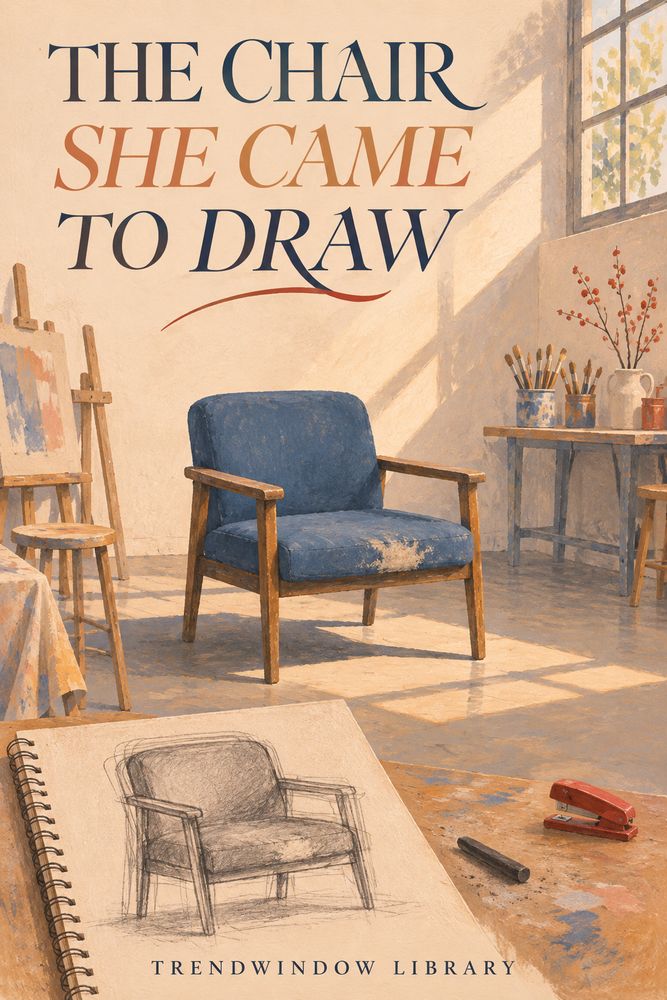
Front cover of The Chair She Came to Draw

Contemporary & Literary Fiction

The Chair She Came to Draw

By TrendWindow Library

A complete original work of first-person literary fiction. A workshop coordinator expects a cheerful photograph and an uplifting newsletter story. Marta brings a blue chair to draw, and an ordinary Saturday becomes harder to describe than Iris expected.

Read this complete edition, including its ending and notes. No purchase is required.

1. The Name I Did Not Ask

I wrote CHAIR WOMAN on the attendance sheet because she had not yet told me her name. This was not an adequate reason. It was merely the reason I had.

She arrived at the hall carrying one end of a blue upholstered chair. A taxi driver carried the other. The chair had four wooden legs, a low back and a pale mark near the front of the seat. It was neither beautiful enough to stop conversation nor ugly enough to become a joke. I made it remarkable by standing in its path.

“We have chairs,” I said.

“I saw them.”

She lowered her end carefully. The driver helped her put it beside the noticeboard and left. She had paid him before they came through the door. Nothing about the arrival required my management, except that I was blocking it.

My name was Iris. I was twenty-eight, and the centre paid me to coordinate the Saturday workshops, take attendance and prepare a short notice for its monthly newsletter. Those responsibilities had become a single ambition in my mind: every session should produce a cheerful photograph and a story that fitted beneath it.

That morning’s invitation said BRING ONE OBJECT YOU WOULD LIKE TO DRAW. I had supplied a teapot for anyone who forgot. Other people brought a lemon, a shoe and a chipped jug. The woman brought a chair.

“Will you be comfortable there?” I asked, pointing to it.

“I shall be over there,” she said, pointing to an ordinary hall chair. “This is what I came to draw.”

On my sheet, between two properly recorded names, CHAIR WOMAN suddenly looked larger than everything else.

2. Blue Cloth

She was Marta Venn, sixty-three. She told me these things when I finally asked. She did not tell me her age so that I could congratulate her on attending. I did that anyway, in the warm voice I used when I felt I was being kind.

“Have you drawn for long?” I asked.

“Not at all. That is why I booked.”

Eli, the tutor, gave her paper and charcoal. He was forty-eight and had a habit of answering questions with another question, which I found inefficient until someone asked him something interesting.

Marta chose a hall chair facing the blue one. She moved it, reconsidered, and moved it again. Eli let her. I offered to turn the blue chair towards the window for a better photograph.

“It is right for me here,” she said.

The pale mark on the seat was not a stain. It was where the blue cloth had faded. Marta had recovered the chair twenty-one years earlier, using an end of fabric too short for a customer's sofa. She had liked it enough to use the remainder on this chair for herself.

“You used to do upholstery?” I asked.

“I still do. Three days a week.”

I had already begun writing a sentence in my head about discovering a new interest in retirement. I discarded retirement, but kept the shape of the sentence. There was surely something about a new chapter. My newsletter notices were full of chapters, although I rarely asked what had happened on the pages before them.

Marta drew a line, stopped and rubbed it with her thumb. She was not secretly wonderful at drawing. I mention this because for several minutes I hoped she would be. A surprising talent would have rescued the story I was determined to find.

3. The Photograph I Had Arranged

Halfway through the morning, I asked Marta to sit in the blue chair. I held the camera low enough to include both her hands and the charcoal on the table behind her. The photograph existed very clearly in my head.

“For the newsletter,” I explained. “A little piece about you and the chair.”

“I came to draw it.”

“Of course. Just for a moment.”

She put down the charcoal. There was nothing theatrical about the movement. It was the small interruption needed to make me listen.

“I do not want a piece about me.”

I lowered the camera, but not quite far enough. I began explaining that the centre needed to show what happened in its workshops. She waited through my explanation. Then she said I could describe a drawing workshop without describing her life.

I wanted her to understand that I was not trying to be unpleasant. Instead, I heard myself ask whether I might photograph the chair alone. That was a better question, but it had arrived too quickly, as if the first refusal were a door I was trying to get around.

“Perhaps later,” she said. “I would like to get on.”

I put the camera in its bag. No photograph had been taken. There was no existing image to crop into permission.

At the table, I crossed out CHAIR WOMAN and wrote Marta Venn. I did not cover the first words so thoroughly that I could no longer read them. The sheet was for attendance, not for a record of my improved character.

4. Four Legs on Paper

The chair’s front leg sat on Marta’s page at a different angle from the one in the room. Its back was too broad. One arm seemed to belong to another chair entirely. I stood behind her with an idea about correcting the line, although I had not drawn anything myself since leaving school.

Eli came past. Marta asked him why she could not make the front and back seem to belong together. He pulled up a chair and talked quietly with her. I went to fill the water jug rather than join a conversation that had not asked for me.

When I returned, Marta had put a second line beside the first. The page looked less tidy, and she seemed more interested in it.

“Would you like a clean sheet?” I asked.

“In a bit. I want to see what happened here.”

I had enough experience of workshops to know that people came for different things. Yet I had made a private list of the proper outcomes: a finished object, a new friend, a photograph in which the room looked full. Marta was occupying the morning without providing any of them.

She looked up at me. “Are you drawing?”

“I am working.”

“So is Eli.”

Eli said I could take fifteen minutes if I wanted. He could answer the door. The notice did not need to be written before lunchtime.

I fetched a sheet and the red stapler from my desk. It was the nearest object I owned that I could think of drawing without inventing a meaning for it. On paper it promptly became a lopsided animal. Marta glanced at it, then returned to her chair. She did not offer me a better life in exchange for the fifteen minutes.

5. What Could Be Moved

Near the end of the session, someone came in with a pushchair and found the space by the noticeboard too narrow. The blue chair had drifted back towards the entrance while we rearranged the tables.

This was a practical problem. I was relieved to have one. I asked Marta if we could move her subject further into the room. She looked at her drawing, then stood to help. We moved the display table too. The entrance was clear, and the blue chair remained where she could see it.

She did not regard the request as an attack. I had spent so long defending things she had never accused me of that her straightforward agreement felt almost disorienting.

Eli asked whether anyone wanted to show their work. Some held up pages. Others kept them flat. Marta did the latter. Nobody turned it into a question about confidence.

I looked at my red stapler. A boy at the next table asked if it was a dog. I said it was a stapler. He considered this and said the front was quite good. It was the first useful review I had received all morning.

When people began packing, I asked Marta whether she wanted to come again. She said yes, if there was space. I checked the actual booking sheet before promising her a place.

Then I asked if she would like her drawing included in the newsletter. I asked because I liked the doubled line, not because it proved anything about being sixty-three. At least, I hoped that was why.

“No,” she said. “Not yet.”

I wrote the ordinary workshop notice instead. I named the tutor, gave the next date and explained that beginners could bring an object to draw. There was no small portrait of a stranger’s life beneath it.

6. The Following Saturday

Marta’s taxi arrived ten minutes before the next session. The driver helped her carry the blue chair inside. This time I asked where she would like to put it before deciding where she ought to sit.

She chose the corner near the window, beyond the display table. I helped with the last few steps. We left room at the entrance and put a hall chair at the angle she wanted.

“You could bring a smaller thing,” I said.

She looked at me. I nearly launched another explanation.

“I know,” she said. “I have not finished with this one.”

Her first drawing was in a folder under her arm. She put it beside a new sheet. She had not framed it, thrown it away or turned it into the first page of a story she wished to tell me. The two lines were still there.

At the desk I opened a fresh attendance sheet. I wrote Marta Venn without checking the week before. I could remember a name when I had stopped replacing it with an idea.

The camera stayed in its bag. That did not mean we would never use it again. It meant that this morning had begun before I decided what it would look like afterwards.

Eli handed Marta a stick of charcoal. She studied the chair, moved her hall seat a little to the left and held the charcoal above the page.

“Have you got everything?” I asked.

“Another sheet, please. I may need more than one.”

I brought two. Then I sat down with my stapler.

Edition Note

This complete short work of contemporary literary fiction is original AI-assisted writing with editorial review. Iris is an invented first-person narrator; the events are not an account of the creator’s experience. Marta, Eli, the centre, the workshop and its newsletter are fictional. The story offers no medical diagnosis, legal rule, art-technique guarantee or factual biography. It ends with Marta’s refusal to publish her first drawing respected, an ordinary workshop notice completed and her second visit begun on her own terms. The full story and this note are provided in English, Bengali, Hindi, Spanish, French and Arabic. Original English front and back cover illustrations were generated for this edition. No independent human-authorship, native-human translation, print-proof or ISBN certification is claimed.

Explore more books →