BOOK LIBRARY · Complete books · Purchases disabled
TrendWindow

← Book Library · Complete book

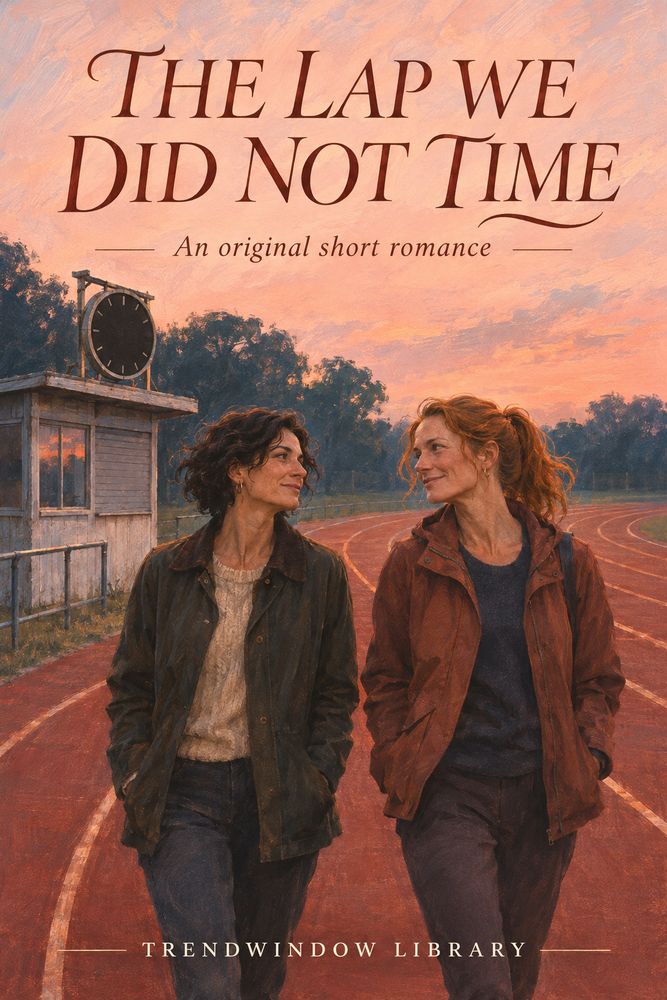
Front cover of The Lap We Did Not Time

Romance & Relationships

The Lap We Did Not Time

By TrendWindow Library

An original complete short romance. A cake brings Lina back to her old running club; an invitation from Rae asks for something different. A mistaken comeback and a missed meeting lead two adult women towards an honest date and an unmeasured walk.

Read this complete edition, including its ending and notes. No purchase is required.

1. The Blank Clock

At thirty-seven, Lina returned to Ash Lane track carrying a cake tin. This was not the return anyone had predicted. Nine years earlier, when she moved away for a job, people had said she would be back for the winter races. Instead she had acquired a different job, a flat with an unreliable shower, and the ability to make a lemon cake that travelled without collapsing. The tin had a better record of attendance than her running shoes.

The old club was holding an open afternoon on Saturday. Its invitation asked former members to bring a memory. Lina had brought something that could be divided into twelve slices. She was tired of the word former, but she did not want the word current badly enough to run for it.

Above the timing booth, the large clock was black. Its blank face made the place seem oddly private. No red digits were waiting to translate her body into a result.

“You finally found the only thing here nobody can put a time on,” a woman said.

Rae stood beside the booth, holding a paint roller over a tray. At thirty-nine she had silver at one temple and the same copper ponytail Lina remembered. There was a blue stripe of paint on her wrist. Lina had imagined their reunion often enough to be annoyed that she had never imagined this particular stripe.

“Cake?” Lina said, lifting the tin.

“That depends. Are you offering a slice or asking me to admire your packing?”

“Both, but the admiration can wait.”

They had been friends at the club, once: Lina twenty-eight, Rae thirty. They had never dated. Lina remembered a hundred shared warm-up conversations and one evening when she had almost asked Rae to stay for dinner. Almost had survived the intervening years with embarrassing clarity.

Rae put down the roller. “I've got fifteen minutes until this coat dries. Will you walk round with me?”

Lina looked at the track. “Walk?”

“Yes. I already know where it goes.”

2. The Outside Lane

They took the outside lane. On the grass, a volunteer was untangling bunting. At the far fence a child argued that the painted starting line ought to be called a stopping line if you approached it from the other side. Rae considered this a sound objection.

Lina had expected questions about races. Rae asked about her flat instead. Lina described the shower, which delivered either rain or regret, and Rae laughed so suddenly that Lina felt the old affection arrive before she could decide how much to show.

“I still run on Tuesdays,” Rae said when Lina asked about her week. “Some weeks on Thursday too. And I've started making very ugly pots.”

“I bake cakes I can't decorate.”

“We could open a shop. Nothing would look promising.”

By the second bend Lina had stopped planning her answers. She told Rae about the office window that opened onto a brick wall and the small cinema she went to alone. Rae told her about her sister's elderly terrier, who regarded every visitor as an inadequately briefed member of staff.

At the booth they did not discuss the distance or the minutes. Rae rested her elbows on the low rail.

“Tea next Saturday?” she asked. “There's a new place by the station. Three o'clock?”

“I'd like that.”

“Good. I'll meet you at the track gate first. You remember where that is.”

Lina remembered far too much. She took Rae's new number, then handed the cake to the volunteer at the table. When she returned, Rae was back at her painting. She looked up once and smiled, and Lina carried that small, deliberate smile all the way home.

On Sunday they exchanged messages about the cake. On Tuesday Rae sent a photograph of a pot with a handle too small for a finger. Lina replied that it could hold one carefully chosen grape. Nothing in the conversation required a stopwatch. She began looking forward to Saturday without telling anybody why.

3. A Name in a Programme

On Friday evening the club organiser, Ken, sent Lina a draft programme for the following month's reunion race. Beneath a photograph taken nine years ago were the words: WELCOME BACK, LINA. ONE TO WATCH IN THE COMEBACK LAP.

Her name was already in the list of runners. She had agreed to bring a cake to an open afternoon. She had not agreed to this.

For a moment the old picture seemed more authoritative than her present life. There she was, leaning forward at the finish, certain that the next result would settle something. She remembered how quickly people had asked about another race, even on days when she had wanted to talk about something else.

Rae had helped at the open afternoon. Rae had asked to meet at the track. Lina looked at their messages and saw an invitation she suddenly thought she had misread. Tea might simply be a friendly reward after practice. The pot photograph might have been the easy kindness of someone recruiting a former teammate.

She wrote to Ken: Please remove me from the runners and the comeback feature. I haven't entered. He replied that he had made an assumption and would change both. Then Lina wrote to Rae: I won't be joining the reunion race. I'm not coming back to running with the club.

Rae answered: Okay. I didn't know you were entered. Are we still on for tomorrow?

Lina read the question twice. Instead of answering it, she put down the phone and began washing a mug that was already clean. It was easier to be angry with a printed programme than to risk being mistaken about a woman.

By Saturday she had convinced herself that silence had cancelled the meeting. At three o'clock she was buying oranges in a supermarket. At three twenty her phone lit up: I'm leaving the gate now. I wish you'd told me.

Lina stood beside the fruit with the bag open in her hands. There was no useful way to blame Ken for the person she had left waiting.

4. What the Invitation Was

She called Rae that evening. Rae answered, but did not make the opening easy for her.

“I'm sorry I didn't come,” Lina said. “You asked a clear question. I didn't answer, and then I decided you'd somehow understand.”

“I didn't.”

“I know. May I explain what I thought? It isn't an excuse.”

Rae agreed. Lina described the programme and the panic of seeing a public version of herself revived without permission. Then, less fluently, she described the conclusion she had drawn about their tea.

“You thought I was organising a training session?” Rae asked.

“Or encouraging a comeback. I was trying to work out which role you wanted me in.”

“I wanted tea with you. I picked the gate because you knew it. That was the full extent of the planning.”

Lina closed her eyes. “I should have asked.”

“Yes. And you could have cancelled even if it had been a training session. I would still have wanted an answer.”

There was a silence in which Lina heard the small, ordinary sounds of Rae's kitchen. She had spent the week making Rae into an old memory, then an imagined recruiter. Neither version had left much space for the person on the phone.

“There was something else,” Lina said. “I wanted it to be more than two former teammates having tea. I was afraid of discovering that only after I'd made a fool of myself.”

Rae took a breath. “I wanted that too. I didn't say it because I wasn't sure. It seems we have been remarkably thorough about avoiding one conversation.”

Lina laughed, but did not use the laugh to skip the apology. “Would you consider another invitation? You don't have to decide now.”

“I will consider it,” Rae said. “And next time, choose somewhere we both actually want to meet. I don't mind the track, but it apparently carries a lot of unpaid dialogue.”

5. An Ordinary Date

On Monday Rae sent a message: Thursday, six thirty. The little cinema you mentioned. A date, if you still want one. No race afterwards.

Lina answered before she could turn the words into a puzzle. Yes. A date. I'll book my own ticket when you tell me the film.

The film was a comedy neither had seen. They chose neighbouring seats and agreed to meet in the foyer. On Thursday Lina arrived early, then waited outside until six twenty-five because she did not want to spend ten minutes staring at the door like a guard expecting trouble.

Rae arrived carrying a paper bag. Inside was the ugly pot from the photograph, with its tiny handle.

“I was going to give you flowers,” she said. “Then I remembered I own this excellent vase for one stalk of something extremely thin.”

“Is it for me?”

“If you'd like it. You can also decline. It has no practical defence.”

Lina accepted it. The small green pot was heavier than she expected, warm from Rae's hands. She wanted to kiss her then, in the foyer beside a cardboard spaceship, but the wish was new enough to hold carefully.

After the film they ate soup at a late-opening café. Rae said she still liked racing and did not want every mention of it to become something she had to hide. Lina said she did not need that. She wanted room for Rae's Tuesdays and for her own Saturday mornings, without either woman becoming the other's improvement project.

“I can't promise never to misunderstand you,” Lina said.

“That would be a very suspicious promise.”

“I can ask. And answer invitations.”

“That one I like.”

Outside the café, Rae asked if she could kiss her. Lina said yes. The kiss was brief, a little awkward, and completely unlike remembering one. On the bus home Lina held the pot inside her coat and thought about the next Thursday instead of the nine years they had missed.

6. Without a Result

Ken sent the revised programme on Friday. Lina checked it: her name was out of the runners' list, and the comeback feature had been removed. She thanked him for making the correction. She did not enter the race to prove that she was no longer afraid of it. Nor did she ask Rae to miss her own race as proof of affection.

They agreed on another walk at the track the next Saturday, followed by lunch. This time Lina asked directly whether Rae wanted to train first. Rae said she had already run on Tuesday and wanted the walk they had arranged. They met at noon, when they had said they would.

The clock above the booth was still black. A notice explained that a replacement part was on order. It was not a sign intended for them. Lina found that she preferred it that way. The world did not need to stage their relationship in order for it to matter.

On the outside lane Rae told her the terrier had stolen a sandwich. Lina described the improbable yellow flower she had found for the green pot. At the second bend Rae took her hand. Lina turned her palm to meet it.

“I nearly asked you to dinner nine years ago,” she said.

“I nearly asked you why you kept mentioning you had two plates.”

“I thought I was being subtle.”

“You were. Devastatingly.”

They laughed, then grew quiet without making the quiet a test. At the finish line they stopped because a groundskeeper was moving a hose, waited while he passed, and continued to the gate. Neither counted the minutes. The lap was complete. It had not made them younger or recovered the years. It had brought two women who were here now to the place where they had agreed to have lunch.

Rae asked whether the following Thursday was free. Lina checked her calendar before saying yes. Then they crossed the road together, hands still joined, and went to choose a table.

Edition Note

This complete short romance is original fiction. Lina, Rae, Ken, Ash Lane club, the track, programme and events are invented. Both romantic leads are adult women, aged thirty-seven and thirty-nine in the present story; their earlier friendship was nine years before, when they were twenty-eight and thirty. The book does not report real sporting results or provide exercise, coaching, medical or psychological advice. Affection does not remove either woman's independent interests or excuse a missed agreement. Original AI-assisted writing and translations with editorial review; no independent human-authorship or native-human certification is claimed. Conceptual English cover illustrations are original generated artwork, not documentary photographs. This is a digital edition, without an ISBN or print proof.

Explore more books →