BOOK LIBRARY · Complete books · Purchases disabled
TrendWindow

← Book Library · Complete book

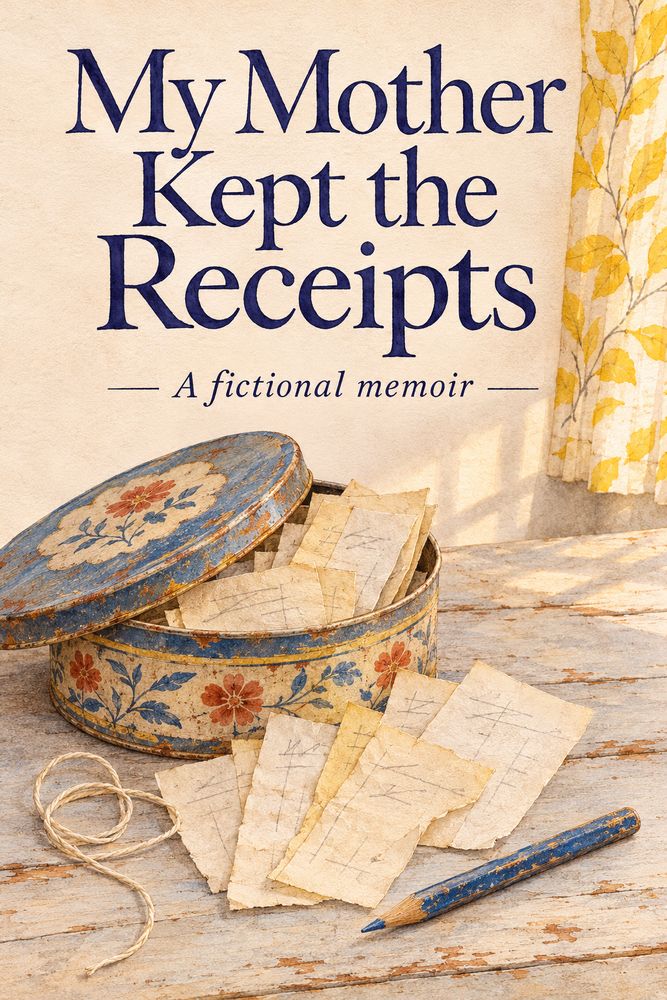
Front cover of My Mother Kept the Receipts

Biography & Memoir

My Mother Kept the Receipts

By TrendWindow Library

While helping her mother move, Rina finds receipts that unsettle the family story about who kept their shop running. Shared purchases, disputed memories and a private afternoon teach her to leave room for other people. A complete fictional memoir in eight chapters, ending with one ordinary purchase.

Read this complete edition, including its ending and notes. No purchase is required.

About this book

### A fictional memoir

This is an original work of fiction written in memoir form. Rina, Mara, Dev, Leo, Ada, the family shop and every receipt described here are invented. The narrator's memories, doubts and reconstructions belong to the story; they are not claims about real people or archival records.

Original complete short fictional memoir prepared with AI assistance. Rina, Mara, Dev, Leo, Ada, the shop, receipts and memories are invented. Not a real autobiography or archival account. Translation meaning reviewed with AI, without independent native-language certification.

1. The tin under the stairs

My mother handed me the biscuit tin as if she were returning something I had left in her house.

“Yours, if you want it,” she said. “Not the tin. The tin is useful.”

We were packing for her move to a smaller flat. She was alive, impatient with the number of mugs I thought she should keep, and perfectly capable of deciding which curtains she disliked. Yet I had begun treating the afternoon like the excavation of a vanished civilization. Every object seemed to require a story. She wanted the stairs clear before the man came for the bookcase.

Inside the tin lay receipts folded around receipts. Some were tied with thin string; others had been flattened under a rubber band that had gone brittle. My mother had written on the backs in blue pencil. Not long explanations. “Collected after closing.” “Ask for the second copy.” “This was mine.”

I recognized the name of the shop where my father had bought paper. In my memory, he stood behind the binding machine with his sleeves rolled up, making school projects and office reports into objects that could be carried without scattering. My mother sat at the counter taking money. That was the arrangement as I had understood it: he made things; she kept track.

The shop had paid our rent and bought our shoes. When people asked how we had managed, I said my father had worked with his hands. It was true enough to survive repetition and incomplete enough to become a family story.

My mother watched me open a pale yellow receipt.

“Don't start with that one,” she said.

“Why?”

“Because the bookcase man will be here in ten minutes.”

I had expected a secret. She was referring to time.

I put the papers back and carried the first box downstairs. On its side she had written KITCHEN, then crossed it out and written THINGS I USE. When I returned, the tin was waiting on a cleared chair. She had not forbidden me to read it. She had simply refused to let my curiosity reorganize her day.

That evening I took the papers home in a shopping bag. She kept the tin.

2. A machine with two owners

The yellow receipt was for a secondhand binding machine. I knew the machine: green paint worn smooth along its front edge, a handle that my father lowered with the solemn care of someone landing an aircraft. It had occupied the shop's back table for most of my childhood.

The receipt carried my mother's name.

I phoned her before I had finished reading.

“So you bought the machine?”

“Ada and I bought it.”

“But it was Dad's.”

“It was at the shop.”

I heard the distinction and, for a moment, refused it. The machine belonged to the picture of my father I had kept. Giving it another owner felt like removing a tool from his hand.

On the back, in blue pencil, my mother had written, “Half Ada. Her turn after six.” Ada made notebooks for a small stationery stall. She used the machine in the evening, when our customer work was finished. My father had helped move it upstairs and repaired a loose stop. None of those facts made the purchase his.

I remembered Ada as a woman who arrived with a basket and talked to my mother after closing. I had never thought to ask what was in the basket. It contained notebook covers. I had remembered a visitor, not someone arriving to do her own work.

My mother did not present this as a revelation about marriage. She wanted to know whether I had found the receipt for the replacement handle, because Ada might like the date. They had argued over how long the first one lasted.

“Was Dad annoyed that you shared it?”

“Why should he be? We needed it. Ada needed it. We could afford it together.”

There were disagreements, she added. Ada once left a pile of covers on the only clear chair. My father moved them and mixed two sizes. My mother had to sort them while everyone explained why it wasn't their fault.

That ordinary complaint helped me more than a grand declaration would have. The machine had not passed from one heroic owner to another. It had existed among three working people, their money, their skills and their irritation.

I wrote “shared purchase” in my notebook. Then I crossed out the sentence beneath it, which had begun, “My father never knew.”

He had known perfectly well.

3. The week without a wage

A bundle of seven receipts covered a week I remembered as the week my father was ill. I could not have named the month until I saw it written at the top. I remembered a bowl on the bedside table and the unusual silence of the binding machine. I had told myself that the shop had stopped.

The receipts said otherwise.

Paper. String. A small packet of fasteners. Two bus tickets. A delivery charge. On a folded scrap tucked between them, my mother had listed three completed orders. Beside one she had written, “Leo carried. Pay him.”

My brother was old enough then to regard family work as an insult unless someone noticed it. He remembered the delivery at once when I asked.

“I carried two bags in the rain.”

“You told me it was one.”

“It felt like two. Maybe it was two.”

The paper did not settle that dispute. It did show that our mother intended his work to count.

I asked her whether she had run the shop alone.

“Not alone. Ada helped with the covers. Your father answered a question from the bedroom and made it longer than it needed to be.”

She laughed, then said she had been tired. She did not say it proudly. On the back of the delivery receipt, the pencil note read, “Never book this much for one day again.”

I wanted to make that week evidence of her endurance. She had kept evidence of a limit.

The family accounts did not contain a wage for every hour she worked. Some money went straight from the counter to household spending; some remained for stock. I could not reconstruct a complete set of accounts from seven receipts, and she told me not to try to make them say more than they did.

“What did you pay Leo?” I asked.

“I don't remember.”

He remembered being paid. Neither of them remembered how much. I wrote down both facts.

When I retold the week later, I no longer said the shop had stopped. I said my father was ill, my mother kept the agreed work moving with help, and she decided that day's load was too much. It was a less graceful sentence than the one I used before. It had room for more people.

4. What the blue pencil meant

My mother's blue pencil had become, in my imagination, an instrument of perfect memory. I spread the receipts on my table and tried to sort their annotations into a code. A tick meant paid. A circle meant important. A line beneath a name meant someone had disappointed her.

Then I found a receipt with three circles and the note, “Bad pencil.”

The marks were not a private alphabet waiting for a clever daughter. Sometimes she tested the point. Sometimes the shopkeeper had made the mark. Sometimes a tick meant that the goods had arrived, not that the invoice had been paid. I had been turning an assortment of working habits into a system she had never promised to maintain.

There were two receipts for the same kind of paper on the same day. I thought I had found a duplicate charge. My mother remembered running out during a rush and sending my father back for more.

“Look at the quantities.”

They were different. I had read the date and stopped.

One receipt was torn down the middle and joined with old tape. Under the total, my father had written, “Returned the extra pack.” His handwriting leaned forward, as if every word had a train to catch. I had mistaken it for hers because I expected only her voice on the papers.

She had kept his writing too.

That mattered. I had begun correcting the old story by creating its reverse: a mother doing everything, a father occupying the photograph. The receipt would not support that either. He bought, returned, carried, repaired and sometimes forgot. She did those things too, with a different share of the work and a share I had failed to see.

I made three columns in my notebook: what the paper showed, what someone remembered, what I was guessing. The columns were not a scientific instrument. They were a way of slowing myself down.

Under the torn receipt I wrote, “Extra pack returned. Dev's handwriting, confirmed by Mara.” Under what I was guessing, I wrote nothing.

The empty space was difficult at first. I began to like it. It was the only place on the page that did not require my family to perform an explanation.

5. The receipt she would not explain

The bus ticket was folded into a receipt from a café across the river. Two cups of tea, a slice of cake and a penciled sentence on the back: “Not for the shop.”

I placed it in front of my mother at her new kitchen table.

“Who did you go with?”

“A friend.”

“Ada?”

“A friend.”

I waited for the name as if I had purchased it by carrying her boxes. She reached for the ticket and set it beside her own cup.

For a moment, I felt excluded from a history I had decided was mine. Then I noticed the new curtains. I had advised her to buy a practical brown pair. She had bought yellow ones with leaves on them. She was not making these decisions to illustrate a theme in my notebook.

“I don't want to explain every afternoon,” she said.

I started to say that I was only interested. That was true, but it did not make my interest an obligation for her.

She told me something else instead. When the shop was busy, people assumed she could leave it whenever she liked because my father was there. When the household needed something, they assumed she could leave it because she worked with him. Her hours became flexible in everyone's imagination except her own.

The café receipt was not evidence of an escape I was entitled to narrate. It recorded an afternoon she had wanted to remember without submitting it for approval.

“Can I keep a copy?”

“No.”

I gave her the receipt and the ticket. I did not photograph them first.

Later, at home, I removed the scene I had begun drafting about her secret sadness. I did not know whether she had been sad. She might have been laughing over a terrible slice of cake. The unknown was not an invitation to fill the space with the most moving possibility.

I kept one sentence: “My mother had afternoons that did not belong to the shop or to us.”

When I read that sentence to her, she nodded. Then she asked whether I could move the kitchen chair away from the heater. Even in a meaningful moment, something ordinary needed doing.

6. A photograph with a new caption

The photograph showed my father at the binding machine. I stood beside him holding a school project with a crooked title. My mother appeared at the edge, reaching for a paper bag. Half her face was outside the frame.

For years I had captioned it, in albums and in conversation, “Dad in the shop that supported us.” The words were affectionate, not deliberately false. Affection can still arrange the furniture so that someone else is always standing behind it.

I took the photograph to my mother.

“What were you doing?”

“Giving that customer her copies.”

“Were you always at the counter?”

“No. Your father took the counter when I bound things. He was slower with the change.”

She considered the picture.

“I was probably annoyed with whoever took it. There was a queue.”

The photograph had looked peaceful to me. My father smiled; I held the project; a rectangle of light lay across the machine. Outside the frame, someone was waiting for their copies. My mother had been working while we made ourselves into an image.

I did not want to remove my father's smile to improve the caption. He had been kind to me that day. He had helped me straighten the pages after I cut one badly. The correction did not require reducing him.

I wrote, “At our family's copying and binding shop. Dev and Rina pose by the machine Mara and Ada bought together. Mara serves a customer just outside the frame.”

My mother read it.

“Don't say I was always outside the frame.”

“I didn't.”

“You were thinking it.”

She was right. I had a tendency to make one picture carry a whole life. There were others in which she stood in the middle, wearing a ridiculous paper crown we had made for her birthday. She liked those less, but not because she was absent.

We chose a second photograph for the album: my mother at the worktable, my father sweeping beneath it, Ada in the doorway looking impatient. No one was smiling.

“That was a proper day,” my mother said.

I placed the photographs side by side. Neither explained everything. Together they made it harder for me to pretend one person had done it all.
7. The papers we did not keep

We sorted the receipts on a Saturday morning after my mother's move. She had brought the biscuit tin, now holding sewing thread, to demonstrate that it had found better employment.

I had expected to preserve every slip. She asked why.

“Because they're our history.”

“So is the broken mop.”

We did not throw things away in a dramatic gesture. We first checked what she still needed for practical purposes and kept those papers apart. For the rest, she chose what she wanted to retain, what she was comfortable letting me copy, and what she wanted kept private. I did not put customers' names or addresses into the little family booklet I was making.

Ada came over with buns. She looked at the machine receipt and corrected one of our memories: they had not bought it on the day they collected it. They paid first and fetched it the following evening. The written date had compressed two visits into one in both my mother's recollection and mine.

My mother accepted the correction without surrendering the right to remember other things differently. Ada said the original handle lasted four years. My mother said three. Neither wanted to spend the morning proving it.

We kept the purchase receipt and the replacement-handle receipt together. I wrote down their disagreement instead of choosing the more confident speaker.

Some papers carried no story anyone wanted to tell. A delivery fee remained a delivery fee. My mother put several ordinary scraps in a pile to discard after checking them. I let her. Preserving her life could not mean denying her the ordinary power to clear a drawer.

There were moments I still wanted to rescue: a faint sum, the pressure of her pencil, my father's sloping words. I copied a few with permission. The booklet became smaller than my first outline.

At the end, my mother asked to see its opening. I had written that she had quietly held the family together.

“Quietly?” she said. “Ask your brother.”

We laughed. I crossed out the word.

She had not been quiet. I had simply become accustomed to hearing her.

8. One ordinary purchase

The booklet was twelve pages, with two photographs and a few receipt details my mother had agreed to share. It was not a complete account of the shop. It said so on the first page. I gave copies only to the family members she had approved.

Leo called to complain that I had not included his opinion about the rainy delivery.

“I did. You thought there were two bags.”

“There were two.”

“You said maybe.”

He laughed and asked whether Mum still had the tin. He remembered keeping biscuits in it before it became a filing cabinet. For a few minutes we talked about the biscuits rather than what they represented.

My father was still in the booklet. He had not been removed from his own life. There was his repaired machine stop, his hurried handwriting, the photograph of him sweeping. My mother was there as a worker with skills, a purchaser, a colleague, a parent and a person whose café afternoon remained hers.

The papers had not given me access to everything. They had taught me how confidently I could misunderstand what was in front of me, especially when the misunderstanding made a pleasing sentence.

On my next visit, my mother asked me to walk with her to buy a small saucepan. The old one had an awkward handle. We compared two sizes, disagreed about the lid and chose the smaller pan. At the counter, the shopkeeper handed her a receipt.

I watched her put it in her purse.

“For the tin?” I asked.

“For the pan, if I need to bring it back.”

Outside, she stopped to check the time. She had somewhere to go that afternoon. I knew I could ask whether she wanted company. I also knew that a no would be a complete answer.

She said she was meeting a friend. I kissed her cheek and took the saucepan back to her flat.

When I unpacked it, there was no note tucked inside, no blue-pencil message waiting to become the final line of a story. There was a pan she had chosen, with a lid that fit. I washed it and left it on her stove.

Explore more books →