BOOK LIBRARY · Complete books · Purchases disabled
TrendWindow

← Book Library · Complete book

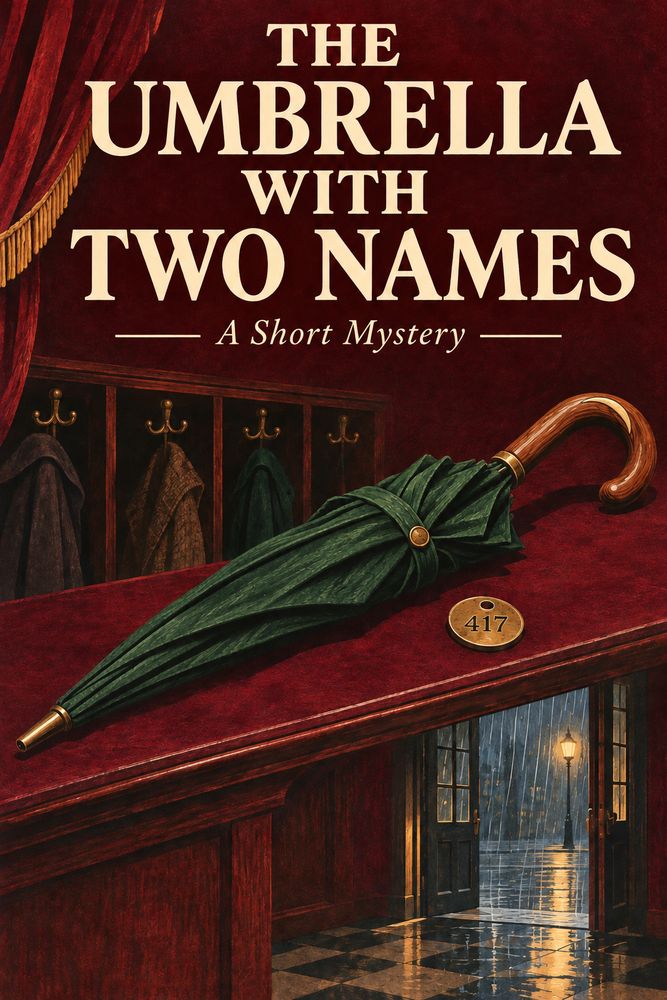
Front cover of The Umbrella with Two Names

Mystery, Crime & Thriller

The Umbrella with Two Names

By TrendWindow Library

A buyer rejects the green umbrella waiting at a theatre cloakroom. Mara Vale follows a repaired handle, a changed string and two competing sales to uncover a deliberate substitution. A complete mystery in eight chapters about evidence, ownership and returning what belongs to someone else.

Read this complete edition, including its ending and notes. No purchase is required.

About this book

A complete short mystery. This is fiction: the people, theatre and events are invented.

Original complete short mystery prepared with AI assistance. All characters, the theatre, sales and events are fictional. Not a real investigation or legal guidance. Translation meaning reviewed with AI, without independent native-language certification.

1. The name on the handle

By the time the last bidder left the Oriole Theatre, rain had turned the steps into shallow silver trays. Mara Vale stood behind the cloakroom counter, matching brass tokens to coats. Someone had brought a wet bicycle helmet. Someone else had entrusted her with a bag of pears. Only one umbrella remained when the foyer clock struck ten.

It was dark green, with a wooden handle worn smooth on one side. A paper label tied to it said LOT 17. Below the number, in blue ink, someone had written E. ROWAN.

The auction was raising money for repairs to the rehearsal-room roof. Mara had spent the evening taking coats, not following bids, but she remembered the umbrella on the display table. An elderly actor named Emil Rowan had donated it as a prop from his last touring production. The programme called it “the green umbrella carried in the final scene.”

A young woman returned through the doors without opening her own umbrella. Water ran from her fringe onto her glasses.

“I bought lot seventeen,” she said. “But that isn't the one I bid for.”

Mara checked the collection sheet. June Hale. Paid. The signatures appeared in their proper columns.

“What makes you certain?”

June held out her phone. In her photograph of the display, a pale crescent crossed the umbrella's handle. The handle on Mara's counter was plain.

“My father made the crescent repair,” June said. “He was the company's carpenter. I wanted something he'd touched.”

Mara did not hand over the umbrella. She wrote the time beside the collection entry and asked June to wait in the foyer. Before calling the auction organiser, she looked under the handle. Two letters had been scratched into the wood: N. B.

2. A reasonable mistake

The organiser, Celia Moss, arrived carrying the cash tin and a plate with one untouched sandwich. She was the theatre's administrator and had been awake since six. When Mara showed her the photograph, she set both objects on the counter with extraordinary care.

“We borrowed another green umbrella for the entrance display,” Celia said. “Perhaps the labels were mixed up.”

That was reasonable. The entrance display recreated a scene from the production, complete with a painted railway sign. The prop table and the auction table had stood three paces apart. Volunteer Nico Bell had helped carry everything in.

Nico was waiting for a lift beside the stage door. He came back with his sleeves rolled over his hands.

“The umbrella with my initials belongs to me,” he said. “I brought it because Celia asked for something green. Mine was only scenery.”

He recognised the loose thread at its strap. He also recognised the lot label, but said he had last seen that label on Emil's umbrella before the interval.

Celia offered June a refund. June declined for the moment.

“I'd rather find it.”

They searched the prop cupboard, the empty display and the corridor beside the auditorium. Mara asked everyone to leave the label attached to Nico's umbrella. A mistake was easier to understand if they did not tidy away its evidence.

In the prop cupboard they found a cardboard sleeve, open at both ends. “Green umbrella — Rowan” was written on it in Celia's broad handwriting. A fresh strip of paper covered an older address. Beneath it, just visible at one corner, was the word Dispatch.

3. The photograph before the interval

Nico began apologising before anyone accused him. He had taken a photograph for the theatre's social page, carried a stool upstairs and helped a visitor find the toilets. He could no longer remember the order.

“Let's use what you kept,” Mara said.

His photograph showed the auction table at seven forty-two. Emil's umbrella lay beside a silver-backed brush. The pale crescent was clear. Beside the handle, the lot label hung from a short red string. In June's photograph, taken later, the same red string remained.

The label now on Nico's umbrella hung from white cotton.

“That doesn't prove who moved it,” Mara said, before June could speak. “It tells us somebody retied it.”

Celia said the red string might have snapped. She had a sewing kit in her office. Nico said nothing. Mara could see him trying to remember whether he had ever borrowed white cotton.

She asked to see the object list. Each donated item had a description, a donor and a storage location. Lot seventeen had one extra instruction: KEEP IN SLEEVE AFTER DISPLAY. The sleeve was supposed to protect the repaired handle.

“Who collected the display after the interval?”

“I did,” Celia said. “Nico was upstairs.”

“And where did you put the sleeved umbrella?”

“On my office table. I thought it was the spare.”

It was the first account that explained where the missing object had gone. It also contradicted the words written on the sleeve. Mara did not call it a lie. She asked whether they could look at the office table together.

4. The empty rectangle

The table was crowded with programmes, tape and used cups. An empty rectangle remained between two stacks of paper, the size of the cardboard sleeve. On top of the nearest stack lay a printed collection receipt.

Celia reached for it, then stopped.

“That is a private sale,” she said.

“Of what?” June asked.

“Another donation.”

Mara read only the object description Celia turned towards them: green theatrical umbrella, repaired wooden handle. The buyer was a costume collector, Len Ward. The collection time was nine fifteen, during the auction's final break. A note said cash received.

Celia sat down. “He offered more than anyone was likely to bid.”

June's expression changed. Anger was arriving, but slowly, as if it needed directions.

“Then why did you let us bid?”

“I intended to withdraw the lot. Everything ran late. I thought a replacement would be enough. They're both old green umbrellas.”

The explanation did not make the exchange an accident. Nico's initials were still beneath the handle. The catalogue described Emil's prop, and June's money had bought that particular object.

Mara asked Celia to telephone the collector on speaker, with his agreement. Celia did. Len was surprised to hear there had been an auction claim. He had paid for an authorised private sale, he said, and still had the umbrella in his car. He agreed not to take it elsewhere while they established who could properly sell it.

For the first time that evening, the missing umbrella had an address they could actually reach.
5. What the donor had given

Finding the object did not settle the matter. Celia kept saying the private payment would help the roof. June kept looking at the photograph of the repaired handle. Nico had retreated to the doorway.

Mara rang Emil Rowan. She described the two sales without asking him to choose a favourite buyer. Emil listened, then asked her to read his donation note from the folder.

“For the advertised public auction,” it said. “Please retain the carpenter's repair. It belongs to the object's history.”

Emil had written nothing about a private arrangement. Celia admitted that she had not asked him before accepting Len's offer.

“I was afraid the roof fund would fall short,” she said.

Mara looked at the photographs, the two strings and the collection receipt. They had begun with a disputed umbrella. They now had a sequence: the genuine object on display, Celia removing it in its marked sleeve, a private collection, a borrowed replacement tied with a different string.

There was one question left.

“Why put Nico's umbrella in my cloakroom instead of leaving it on the display?”

Celia folded her hands. “I thought it would look as though he had carried the wrong one over.”

Nico stared at her. The confession was quieter than his repeated apologies had been.

Mara wrote Celia's words down and read them back. Celia confirmed them. The roof might explain her fear; it could not carry the blame she had tried to place on someone else.

6. Returning more than money

The theatre's chair, Sana Reed, came from her flat above the bakery. She took photographs of the objects and paperwork with permission, then recorded separate accounts. Mara showed her the cloakroom sheet, her timed notes and the label still attached to Nico's umbrella.

Sana did not announce a punishment in the foyer. She secured the two payments, stopped further collections and arranged a committee review. Whether any further formal action was needed would be considered from the records, not decided by an audience of tired volunteers.

Len returned the genuine umbrella that night after receiving his money back. He checked the refund and signed a return receipt. June could now choose either a refund or the lot she had actually won. She asked to inspect the handle first.

The pale crescent was not ivory or silver. It was a sliver of light wood, fitted where the handle had split. Under it, almost hidden, were her father's initials: T. H.

“He always put them where nobody would look,” June said.

She accepted the umbrella. Sana recorded the original auction payment against the correct lot, and June signed for the object after checking it. Emil confirmed that this followed his donation instruction.

Nico took his own umbrella back only after Mara removed the label and placed it with the records. He asked Celia whether she had meant to let him pay for the loss if the genuine umbrella never returned.

“I hadn't thought that far,” she said.

“I had,” he replied.

7. The correction on the door

Three days later, the Oriole reopened for rehearsal. A notice beside the box office corrected the auction record and stated that Nico had not exchanged or lost the donated umbrella. The committee had obtained his agreement to name him. It did not publish June's payment details or Len's address.

Celia had stepped away from handling donations while the review continued. She sent Nico an apology that named what she had done. He accepted the letter, not an invitation to declare the matter finished.

The roof fund was smaller than Celia had hoped. Sana put the actual total on the noticeboard. A contractor would assess which work could proceed; no one promised that good intentions would pay an invoice.

Mara replaced the auction collection sheet with a new form. It had space for an item photograph, an identifying feature and the collector's confirmation. More importantly, two people would check any proposed change to a donated lot before it happened. A better form would not make everyone honest, but it could make a quiet substitution harder to hide.

Nico came in to paint the railway sign for the next production. He left his umbrella open near the stage door, where its torn strap could dry. When Mara asked whether he wanted a fresh cloakroom token, he smiled for the first time that week.

“Only if you promise to give me the same umbrella back.”

“That,” she said, “is the whole service.”

8. The repair that remained

June returned on Saturday with a small photograph in a cardboard frame. It showed her father at a workbench, holding the unfinished handle while Emil watched from a chair. There was no inscription calling either man a genius. On the back June had written their names and the approximate year.

She gave a copy to the theatre, keeping the original. Mara placed it in the archive folder beside Emil's donation note. The umbrella itself belonged to June now; its history did not need to be trapped inside a display case to survive.

Outside, the rain had begun again. June paused under the theatre awning and pressed the runner upwards. The green cloth spread into a small, uneven circle. One panel was a little faded. The pale repair rested beneath her thumb.

“People keep telling me I paid too much for an umbrella,” she said.

“Did you buy it to stay dry?” Mara asked.

“Not only.”

June stepped into the rain. Mara watched until the green circle disappeared behind a bus. Then she went back inside and hung the brass cloakroom tokens on their hooks, one by one. Most evenings the work was ordinary: a coat, a bag, a familiar claim of ownership. Tonight she did not wish it were grander.

There had been two names on one umbrella and a third hidden beneath a repair. The names had mattered. So had the small, stubborn act of returning each thing to the person entitled to carry it away.

The end.

Explore more books →