BOOK LIBRARY · Complete books · Purchases disabled
TrendWindow

← Book Library · Complete book

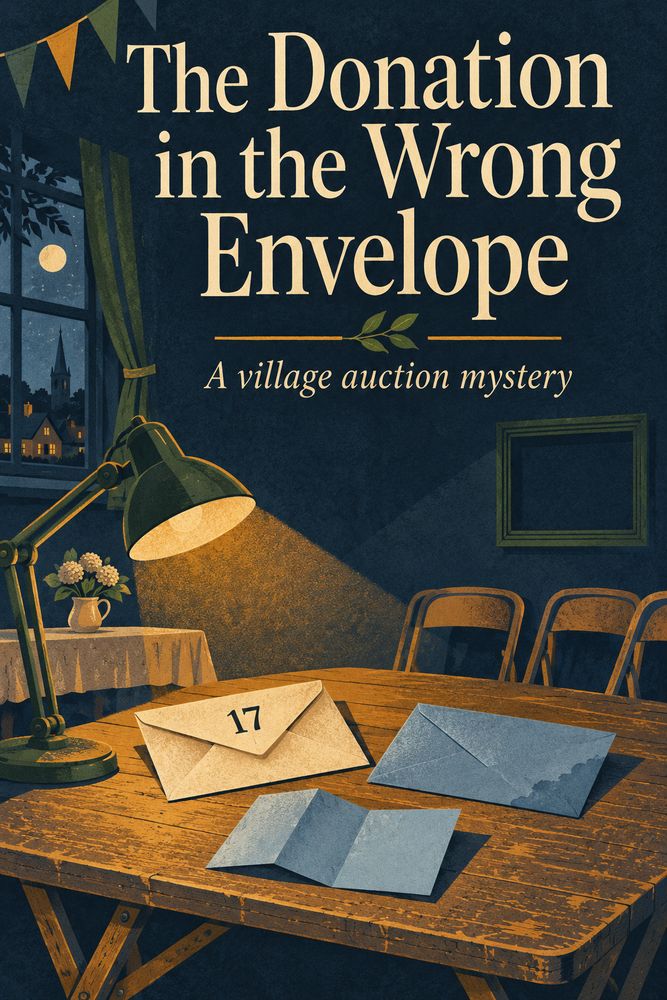
Front cover of The Donation in the Wrong Envelope

Mystery, Crime & Thriller

The Donation in the Wrong Envelope

By TrendWindow Library

After a village auction, Mira finds forty in an envelope marked 17, but the matching picture has no buyer and is listed as returned. In eight chapters, a spilled cup and an earlier false entry reveal two different mistakes that must be kept apart.

Read this complete edition, including its ending and notes. No purchase is required.

About this book

A short mystery of a village auction and two different mistakes

This is a complete work of fiction. The people, hall, auction, artwork and events are invented. It is not an account of a real organisation or an accounting procedure.

Original complete short mystery prepared with AI assistance. All people, the hall, auction, artwork and events are fictional. Not a real organisation report or an accounting procedure. Original conceptual cover illustrations. Translation meaning reviewed with AI, without independent native-language certification.

1. Forty, without a buyer

At a quarter past eight, the folding tables in Wren Hall looked longer than they had during the auction. Without bowls, plants and framed pictures, their scratched surfaces were exposed. Mira counted the last four notes while Len held the list flat beneath a mug that had gone cold.

“Forty,” she said. “But no buyer.”

The cream envelope carried a printed number: 17. Inside, beside the money, lay a blue sheet folded once. It read, “For the hall. Please leave my name off the thanks.” There was no name to leave off. Mira put the notes and message back together without adding a donor to the list from memory.

Seventeen was Winter Market, a linocut Edith Vale had donated from her own work. Its frame had a narrow green edge. The picture had been on the table when Mira arrived, a sweep of dark coats beneath three white awnings. Now the wall list showed a line through the title and the word RETURNED.

“Edith must have bought it back,” Len said.

“That is a story,” Mira replied. “We have an envelope and a different story on the wall.”

She was the volunteer treasurer, not a detective. Most evenings that distinction meant she spent longer looking for missing teaspoons than missing money. Tonight, however, the amount had not gone missing. Something else had.

From the stage, Owen called that he would take the remaining display boards to the store. He had organised the auction tables all afternoon, and his jacket still carried a square of masking tape on one sleeve.

Mira asked him to leave the wall list where it was. “I need to finish one entry.”

He looked at the envelope before he looked at the list.
2. A word written too confidently

The auctioneer's running sheet gave Mira one useful fact. Lot seventeen had not been called. Beside its number was WITHDRAWN, written in the auctioneer's hurried capitals. There was no winning bidder or price. Mira did not turn forty in an envelope into a sale simply because forty was a plausible amount.

“Owen told me before we started,” the auctioneer said, putting his coat back over his arm. “The donor wanted it returned. I assumed they had sorted that out.”

Owen was stacking chairs near the kitchen. When Mira asked, he said Edith had changed her mind. He had not wanted to embarrass her in front of everyone.

“Did she take the picture herself?”

“It was dealt with.”

Len began to say that Edith could be particular about frames. Mira stopped him with a small movement of the list. They had an answer about embarrassment and no answer about a handover.

Jo, who had helped at the payment table, said she remembered someone leaving money for the hall. Not a buyer, she thought. The table had been crowded, and she had moved several papers after a cup tipped over.

“Then the envelope might be my fault,” she said.

Owen straightened. “There we are. Just a mix-up.”

“Perhaps the envelope,” Mira said. “The picture is still another question.”

She wrote two headings on the reverse of a spare programme: MONEY and PICTURE. Under the first she noted forty and a blue message. Under the second she noted three white awnings, a green frame, and two different words used by two people. Neither heading contained the word theft.

3. The woman who wanted no applause

Anika returned for the umbrella she had left behind the kitchen door. Jo recognised her at once, then glanced at Mira without calling across the room. Mira took the blue message to a quiet end of the table and asked Anika privately whether it was hers.

“Yes. Forty. I gave it to Jo in the blue envelope.”

Mira showed her the cream one without displaying the money to the room. Anika shook her head. She had not bid on anything. She liked Edith's print, but liking something did not mean she had bought it.

“I only wanted to help with the hall,” she said. “No announcement. Last time they asked me to stand up.”

Mira said her preference would be respected. Anika confirmed the wording of the note and the amount, then took her umbrella. There was no reason to tell the room her name merely because the room had produced a puzzle.

Jo found the original blue envelope among the papers set aside after the spill. One corner was damp; the opening had torn when she tried to free it from a wet leaflet. She had transferred the dry contents to a spare cream envelope within reach. Its numbered side had been underneath.

“I meant to come back and write it properly,” Jo said. “Then someone needed change.”

They kept the original and replacement together and recorded what Jo and Anika had explained. The forty remained an anonymous donation in the public thanks. It did not become payment for Winter Market, and it was not counted twice because it had travelled through two envelopes.

Len looked relieved. Mira was relieved too. She drew a line beneath MONEY, leaving PICTURE exactly as it was.

4. Before the spill

Owen saw the line and reached for the wall list. Mira asked him to wait.

“The mix-up is settled,” he said.

“One of them is.”

Freya, the youngest volunteer, was rolling the paper tablecloth from the refreshment stand. She said she had noticed RETURNED before the doors opened. She remembered because she had asked whether the empty space could hold the raffle basket. Owen had told her to leave it clear.

Mira asked whether Freya was sure of the order, not the minute. Freya was. She had moved the basket only after the first visitors came in. Jo's spill had happened later, while payments were being taken after the auction.

That mattered. The wrong envelope could not have caused a withdrawal already announced or a return already written on the wall. Mira crossed out the sentence she had begun—“Envelope caused confusion”—and replaced it with “Envelope brought earlier confusion to notice.”

Freya also remembered accompanying Owen towards the store while he carried something wrapped in green cloth. She had held the door while he carried it. She could not say it was the print; she had not seen beneath the cloth.

“A frame-shaped thing isn't an identification,” Mira told Len when he lifted his eyebrows.

But it was a reason to ask a narrower question.

Owen said the bundle had been spare display material. He had been moving equipment all afternoon. That part was true: the hall was full of evidence of his work, from straightened table legs to the labels he had cut before lunch. Mira did not think useful work made every later statement true. Nor did one doubtful statement erase all the work.

5. Edith had not asked

Edith arrived at the side door with a flat cardboard folder. She had promised Len two spare event posters for the noticeboard and had forgotten them earlier. Mira was glad she did not have to build another theory about what Edith might say.

“Did you ask for Winter Market to be withdrawn?”

“No. Was there no bid?”

“It wasn't offered.”

Edith put the folder down. She did not look offended at the idea of a low price. She looked puzzled that somebody else had apparently spoken in her name.

She had left the print with Owen that afternoon. Her only request had been that the paper description stay beside it. She had not taken it away, asked for it back or authorised anyone else to collect it. The description named the work and said she had made it. It did not establish a reserve price or a condition that the frame must never be touched.

Len started to explain that perhaps Owen had misunderstood. Edith turned towards him.

“What sentence did he misunderstand?”

No one supplied one.

Mira showed her the two records: WITHDRAWN on the running sheet and RETURNED on the wall. She explained that the forty belonged to an unrelated donor whose identity would stay private. Edith did not ask for the name. She asked where her picture was.

Owen had stopped stacking chairs. For the first time that evening, he did not offer a practical task that would move him somewhere else.

“I was going to put it right,” he said.

Edith's hand remained on the cardboard folder. “Then tell me what is wrong.”

6. The green cloth

The store was opened with Len present. Mira did not rummage through volunteers' coats or treat every cupboard as hers to search. Owen took them to the bundle he had called spare display material. It rested on a low shelf, clear of the stacked chairs.

He unfolded only enough of the cloth to show the green frame and the lower edge of the print. The frame had a broken corner. The damaged glazing remained contained; nobody began handling loose pieces or attempting a repair in the crowded store. Edith recognised her work. They could see damage to the frame, but they did not declare the paper undamaged from a partial look.

Owen said he had knocked the picture over while rearranging the table before opening. At first he had thought he could make the corner look right. Then he had realised it required proper attention. He had told the auctioneer the donor wanted it withdrawn and written RETURNED so nobody would ask why it was absent.

“I thought I could get it repaired on Monday and explain after.”

“After what?” Edith asked.

He looked at the shelf. “After it wasn't broken.”

That was the answer beneath his other answers. He had wanted the consequence to disappear before admitting the action. There had been no buyer, no forty-pound sale and no return to Edith. There had been an accident followed by a deliberate false explanation.

Mira asked him whether he had touched the cash in the numbered envelope. She used no donor name aloud. Owen said he had not. Jo's account of the transfer already explained it. They had no evidence that he had taken or redirected the donation, and they did not add that allegation to make the evening feel complete.

7. What could be corrected tonight

They returned to the table with the print left safely contained in the store until an appropriate collection could be arranged. Edith asked that no repair be commissioned without speaking to her. It was her work, and she wanted its condition assessed before anyone promised an invisible mend.

Owen agreed. He offered to pay for what he had damaged, but Mira would not turn an apology into a settled amount before there was an actual assessment and agreement. Len said they would document the damage and arrange the next conversation with Edith. Nobody could repair the paper or the trust by writing a convenient number.

The auction records were corrected to show that lot seventeen had been withdrawn after accidental damage, not sold or returned. The original entries remained readable with the correction beside them. Jo's envelope mistake was described separately. So was the anonymous donation. They did not compress everything into “admin error”, a phrase large enough to hide the choice that followed the accident.

Owen would not handle the follow-up alone. Len and Edith would be involved in the decisions, and the committee would be told what had happened. That was not a dramatic punishment announced from the stage. It was a change in who could make the next claim without somebody else seeing the evidence.

Jo asked if she should apologise to Edith as well.

“For putting the money in a different envelope?” Edith said. “You told us when you knew. That isn't why my picture disappeared.”

Mira saw Jo's shoulders lower. Distinguishing two mistakes had not made either person perfect. It had stopped a small, admitted error from becoming shelter for a larger, concealed one.

8. The remaining entry

By the time they finished, the cold tea had acquired a skin. Len took the mug away, leaving a clean circle on the paper. Mira checked the total once more. The forty was included once, under donations. Lot seventeen had no sale proceeds. The record of its withdrawal pointed to the separate damage note and the agreed follow-up, not to a fictional buyer.

The hall had still raised money. The evening had still involved people who gave their time freely. Neither fact required them to pretend that everything had been done well. Mira packed the records before folding the table, with the blue envelope attached to the cream one so the explanation would not depend on who remembered the spill next month.

Edith carried her posters to the noticeboard. Before leaving, she looked back towards Owen.

“You could have told me when it fell.”

“I know.”

“I don't think you knew then. I hope you do now.”

She did not promise to donate another print. He did not ask her to.

Freya placed the raffle basket in the space where Winter Market had stood, then stopped and asked whether that was all right now. Mira said yes. The empty space no longer needed to hide behind a false explanation.

At the door, Jo handed Mira the spare teaspoons she had found behind the urn. Mira laughed for the first time that evening and put them in the kitchen drawer.

The last thing she switched off was the light above the noticeboard. On the corrected list, the title was still visible. The picture had not been returned, and the problem was not yet repaired. But the record finally said what had happened. That was enough to close the hall, and a necessary place to begin again.

Explore more books →