BOOK LIBRARY · Complete books · Purchases disabled
TrendWindow

← Book Library · Complete book

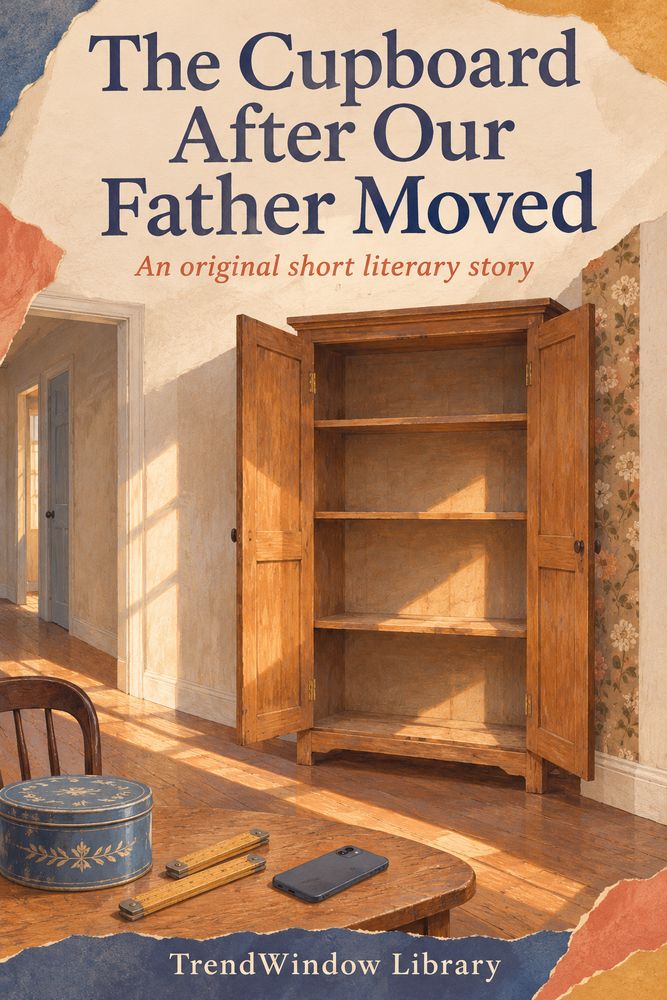
Front cover of The Cupboard After Our Father Moved

Contemporary & Literary Fiction

The Cupboard After Our Father Moved

By TrendWindow Library

A complete original short literary story in eight chapters. June arrives to clear her living father’s cupboard with a recording plan. An old ruler, an unsent letter and her brother’s account of their family challenge the life she thought she could preserve.

Read this complete edition, including its ending and notes. No purchase is required.

About this story

A complete original short work of literary fiction in eight chapters. June, Eli, Arthur, Ruth and Mina are invented characters; their family and the events described are fictional.

© 2026 TrendWindow Library. Original AI-assisted fiction and translations, reviewed by an AI assistant. No independent human-editor or native-speaker certification is claimed.

1. The Voice I Had Prepared

By ten on Saturday I had put three objects on the kitchen table and given each of them a number. My brother Eli watched me stick a label beneath a blue biscuit tin.

"Are we clearing his cupboard or opening a museum?"

"Neither. I'm making a record."

Our father had moved to a smaller flat on Thursday. He was seventy-one, alive, capable of choosing a flat, and annoyed that everyone described the move as a brave new chapter. He had chosen it because he could walk to the shops without crossing the steep road. The old house was sold; the keys were due to change hands on Monday. We had one cupboard left.

I had brought my phone, a small stand and a list of questions. In the car I had practised an introduction: These are the things our father kept. It sounded affectionate without being sugary. I thought my children would want to hear his voice one day. I had not asked whether he wanted to provide it this weekend.

Eli took a folding ruler from the bottom shelf. "This can go."

"He used that to make the cupboard."

"Did he?"

I could see him doing it: our father kneeling in the hall, a pencil behind his ear, us waiting to be allowed to hold something. Eli said the cupboard had always been there. He was five years younger; I excused him his missing memory.

The room sounded unusually sharp without the curtains. Every cup we put down made a small announcement. On the wall behind the cupboard was a strip of older wallpaper, brown flowers whose stems disappeared into white paint.

I took a photograph before we moved anything. Already I knew the caption. A lifetime of making do. I did not write it down because it seemed too obvious to forget.

2. What the Tin Was For

Inside the blue tin were four batteries, two door handles, a bag of screws and a single earring. I remembered our mother wearing a pair like it before she and Dad separated twelve years ago. I set it beside the ruler.

Eli called him about the handles. Dad said they belonged to a wardrobe we no longer owned and could go. Then Eli asked about the cupboard.

"Dennis brought it round when he closed his office," Dad said. "I gave him thirty pounds and an old mower. Why?"

I said I remembered him making something in the hall.

"A rabbit hutch. You'd gone off rabbits by the time it was finished."

Eli put his hand over his mouth. I was offended on behalf of the girl I had been. I had not gone off rabbits. Our mother had said we could not keep one because no one would clean it when I went back to school.

"Could have been that," Dad said. "Is my round cake tin there?"

It was not the answer I had prepared a place for. I asked about the earring instead. He had found it under the fridge years after Mum moved out. He had intended to give it back and kept forgetting.

I rang her. Ruth laughed when I described it. She had bought the pair for a costume party. Yes, I could throw it away. No, she did not need a photograph. She was going out and asked whether I had booked my car service.

For a moment I disliked them both. I had arrived ready to preserve their lives, and they kept giving me errands.

Eli folded the ruler into its short wooden parcel. "Perhaps keep it because you like it."

That sounded less generous than making it stand for someone else. I put it in my bag without a label.

3. The Letter in the Manual

A thick envelope fell from a washing-machine manual. It had my name on it in Dad's square handwriting. There was no stamp. I opened it while Eli was carrying mugs into the kitchen.

June, it began, if you leave in this way, do not expect me to pretend you have made a sensible decision.

I knew which way. At nineteen I had moved to another city with a boyfriend and a job that lasted six weeks. The relationship lasted eight months. The letter described my certainty as selfishness and said Mum had been too soft. It ended with a sentence I read three times: I cannot keep arranging a landing for someone determined to jump.

I had come home that winter. Dad had met my train, carried my case and asked whether I wanted chips. For years I had told that story as evidence that, when it mattered, he had known what not to say.

Now the unsaid things lay on the floor in his handwriting.

Eli found me sitting beside the cupboard. I held out the first page. He read the opening, saw the second sheet in my hand and stopped.

"Did he send this?"

"Obviously not."

"Then I don't know if we should—"

"It has my name on it."

I wanted him to read it because I did not want to be the only person changed by it. He put the page down. His refusal felt like taking a side, though he said he was going to make tea.

I photographed both sheets. Then I opened our family message group and looked at the small row of faces above the empty message box. My own children were in that group. I closed it without sending anything.

I had returned the phone to its stand after taking the photographs. Its blank screen reflected the cupboard and my knees. For the first time that morning, I lifted it out and laid it face down.

4. Someone Still Present

Dad arrived just after one, carrying sandwiches and complaining that the new flat's front door caught on the mat. He saw the letter before he had taken off his coat.

"Where did you get that?"

"From the cupboard."

"I thought I'd thrown it away."

I asked whether he had meant it. He sat in the chair Eli had brought back from the kitchen.

"When I wrote it, yes."

I had expected a correction: a misunderstanding, a bad draft, someone else's words. The simple answer left me with nowhere to put my anger except in front of him.

"You met me at the station."

"You needed picking up."

"And you thought I was selfish."

"I was angry. I was worried. I thought those were the same thing."

He reached for the letter. I held it back. His hand remained there for a moment, empty and absurd between us.

"I didn't send it," he said.

"That doesn't make it pleasant to read."

"No."

He looked towards the cupboard. "It also doesn't make the chips false."

Eli opened the sandwiches too loudly. I hated that he could make ordinary noises in this room.

Dad said he should not have written about Mum like that. He did not say he had never thought it. He had wanted me to return; he had also wanted to be right. By the time I did return, being right had seemed a mean thing to offer at a railway station.

"You were allowed to leave," he said. "You didn't need my good opinion to make it allowed. I knew that eventually."

He asked whether I had shown anyone. I told him about Eli and the photographs. He asked me to delete the photographs. I said I would, but not while he watched. It was the smallest authority I could find to keep.
5. The Accounts We Had Kept

While we ate, Eli found a bundle of old bank envelopes. I told him to leave them alone. I could hear the sharpness of my own voice and did not soften it.

He said, "I know what's in some of those. Dad helped with my rent."

It had been six months, after his business closed. I had known about two. Dad said Eli had asked him not to tell everyone. I heard everyone as my name.

For the last year I had ordered Dad's shopping, arranged the house viewings and taken three afternoons off work. Eli lived farther away. There were reasonable explanations for each separate occasion. Together they had become a story in which I was the reliable one and he was the person reliability supported.

I said all of this badly, including the three afternoons twice.

"I didn't know you were keeping count," Dad said.

"Neither did I. Until I needed the numbers."

Eli began to explain the business, then stopped. "I can do the keys on Monday. And the last meter photographs. You don't have to take another afternoon."

I told him Monday was not six months of rent.

"I know. It's Monday."

Dad had given him money I had not received. There was no discovery that made the amounts equal. Nor had Eli asked me to lose those afternoons. I had volunteered before anyone could suggest something slower or less tidy.

Dad said he could thank me for the work without making me responsible for all the work that came next. He asked which shopping order still needed cancelling. I found it on my phone and wrote down the number for him.

Then he held up the blue tin. "And these are broken batteries. I didn't collect them. I failed to take them anywhere."

Eli laughed first. I laughed unwillingly. The sound did not settle our accounts, but it let us finish the sandwiches.

6. A Cupboard for Papers

Mina came at three to see the cupboard. She had answered the notice Dad placed before moving. I had forgotten he had already made an arrangement that did not require my administration.

She wanted it for papers in her rented room. She checked the shelves, opened each door and asked about the dark ring on top. I said it was where our mother had kept a fern.

Dad said it had been a leaking bottle of furniture polish. I looked at him, waiting for the pleasure of correction. He shrugged. "There was a fern somewhere."

Mina did not mind the ring. She cared that the lower hinge was loose. Eli tightened it with a screwdriver from his car. They agreed she would collect it with a friend on Sunday afternoon, before the keys went on Monday. Dad accepted the price he had put in the notice.

When she left, I asked if he was sure.

"I've sold a cupboard, June."

"I know."

"Do you?"

He emptied the last shelf himself. A cracked jug went in the waste box. A little wooden boat went into a carrier bag for his flat. I had never seen him take an interest in it.

"Your mother bought me that when we went away," he said.

"I thought you didn't want reminders."

"I didn't say that. I don't want every reminder."

He kept the round cake tin, which we finally found behind a stack of envelopes. He gave Eli a spare screwdriver and asked me whether I wanted the ruler. I said I had already taken it. He nodded.

He put the unsent letter in his coat pocket. I almost asked what he would do with it. Instead, I lifted the manual from the floor. The washing machine had gone with the house. We left its instructions in a kitchen drawer for people who would need them for something other than remembering us.

7. Without the Stand

Eli took the waste boxes to the car. I stayed with Dad in the hall. The cupboard stood open, less solemn now that it contained air.

"I wasn't trying to catch you out," I said. "With the recording."

"You hadn't asked me to be recorded."

I had told him I would bring the phone. I had mistaken telling him about my plan for asking him to join it.

I deleted the photographs of the letter, including the copies in the recently deleted folder. Then I told him. He thanked me without reaching for the phone to check.

"I still read it," I said.

"I know."

I asked whether he remembered the station, apart from the chips. He remembered losing the car park ticket and asking me to stay with the bags while he looked. I remembered being furious because he had left me alone immediately after collecting me. He remembered being afraid I would start crying if he asked a question.

We sat with both versions. Neither was a secret that explained the other away.

At last he said, "I should have asked what happened. Later, when you were ready. I was pleased enough to have you back that I pretended there was nothing to ask."

I told him the job had hurt more than the boyfriend. It was strange to say that after so many years. He had assumed the reverse.

We did not open the whole winter. Eli came back, and Dad wanted to get home before it grew dark. At the door, he asked if I would come for supper the next evening. No sorting, he said. There was nothing left in the flat that needed my approval.

"What about the mat?"

"I've moved the mat."

I laughed. I said I would bring bread, and asked him to tell me if he wanted anything else.

8. A Voice in the New Room

On Sunday Mina and her friend collected the cupboard. Eli sent a photograph of the empty patch of wall and said he would be there for the keys on Monday. I thanked him without checking which hour he had arranged. Then I put my phone away.

At Dad's flat, the wooden boat stood on the windowsill. The cake tin held cake. He had bought it from the shop and disliked its icing. We ate it after soup anyway.

There were two chairs at the table and a third folded against the wall. The room was smaller than the one he had left, but from his chair he could see people coming out of the bakery. He knew the time they put tomorrow's loaves in the window. I had known none of this when I decided he needed a record of his old life.

After supper he asked whether I still wanted to use the phone.

"Only if you want to."

"I could tell you about that rabbit hutch."

I told him I did not believe his account of the rabbit. He said that would give me something to say on the recording.

I asked if he minded me keeping it for myself and the children. He said that was fine, but he wanted to hear it first. We agreed I would not post it anywhere. I set the phone on the table without the stand.

Before I pressed the red circle, he said, "Wait."

He reached for the cake tin and moved it out of the way. I felt the old urge to ask why this particular tin mattered. Perhaps it did. Perhaps he simply wanted more room for his elbow.

"Now," he said.

I pressed record. From the street came the sound of the bakery shutter coming down. Dad began with a piece of wood he had cut too short, and I interrupted him almost at once.

Explore more books →