BOOK LIBRARY · Complete books · Purchases disabled
TrendWindow

← Book Library · Complete book

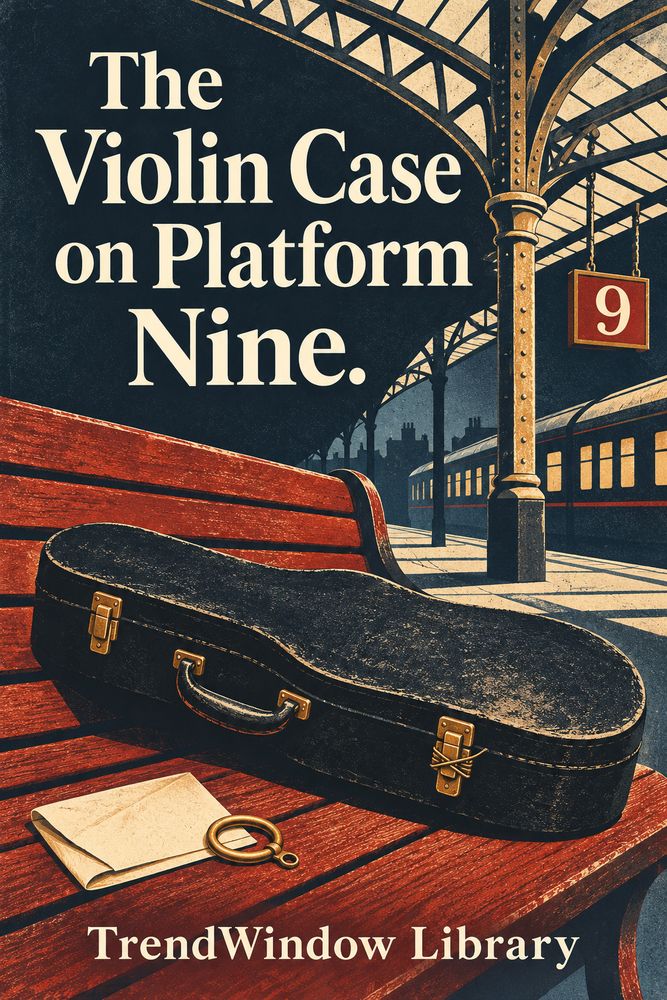
Front cover of The Violin Case on Platform Nine

Mystery, Crime & Thriller

The Violin Case on Platform Nine

By TrendWindow Library

A complete short mystery in eight chapters. When a student opens the wrong violin case, station cleaner Mara follows a brass ring and a folded wrapper through a theft hidden in an ordinary morning. Original fiction with a resolved ending.

Read this complete edition, including its ending and notes. No purchase is required.

About this story

A complete short mystery in eight chapters. Alder station, its railway, the people and every event in this story are invented. The station's arrangements are fictional, not a description of real railway security or investigative procedure. The mystery is resolved within this book.

© 2026 TrendWindow Library. Original AI-assisted fiction and translations, reviewed by an AI assistant. No independent human-editor or native-speaker certification is claimed.

1. The noise in the wrong case

Mara found the brass ring while looking for a spoon. It lay in a red hollow shaped for a violin, beside a folded piece of cream paper. The violin case stood open on the floor of the disused kiosk on platform nine. There was no violin, and no spoon. Behind Mara, Nell kept the kiosk door open with her shoe.

Ten minutes earlier, a student had opened a very similar black case on the platform bench and discovered blue lining and nothing else. She had said, quite quietly, “This isn't mine.” It was the quietness that made Mara leave her cleaning trolley. People often announced lost objects as though an announcement could reverse their loss. This girl had already understood that something more difficult had happened.

Her name was Iris. Her own case had red lining and a lower latch repaired with brass wire. She had set it on the bench while helping an elderly man whose tea had spilled over his hand. When she returned, perhaps a minute later, a black case was still there. She had picked it up without opening it. Only when she went to put away her music did she notice the blue inside. Her mother's violin, she said, had been in the other one.

Mara had seen the spill. She had also seen a man in a green coat set a case on the trolley beside the concert posters. At first she thought she knew the answer. Two travellers, two matching cases, an ordinary mistake. Then the man in the green coat came back from washing his hand. He looked at the blue lining and said that case was his. He had brought it empty to show a buyer its size. He did not have Iris's case. Nor had he taken anything from the bench.

Nell, the station supervisor, asked everyone to remain nearby if they could. She made no accusations and promised no departing train would be held. Iris's concert agent, Vale, suggested that the missing case might have been put into the kiosk when the platform was being cleared. He had used the kiosk earlier to store event materials. Nell fetched the station's key and asked Mara to come with her. That was how Mara found the empty red case and the two things inside it.

She stopped herself from picking up the ring. Her work usually began by deciding what could be thrown away. This morning it began by deciding what must stay exactly where it was.

2. A minute with too much in it

The elderly man was called Ansel. His tea had cooled enough that his hand was sore rather than badly hurt, but Nell brought water and asked whether he wanted further help. He said he wanted to understand why his old case had become part of somebody else's trouble. Mara understood that wish. Whenever an expensive-looking object disappeared, the person with the mop was suddenly expected to remember every passing shoe.

They stood together by the bench. Vale was a neat man with a folded poster under one arm. A broad, rigid carrying tube rested on his wheeled event cart. It was much wider than an ordinary poster tube, long enough for the rolled fabric backdrop used at the station's small concert display. He wore his visitor badge outward. When he spoke, he included Iris in his sentences but rarely looked at her.

“We have the car coming at twelve,” he said. “If the station can take the details, I can get her a replacement instrument.” Iris said she did not want a replacement. Mara asked which case had stood where before the spill. Ansel pointed at the poster trolley. Iris pointed at the bench. The two places were only a few steps apart, with a folding display board between them. From Mara's cleaning station, that board hid the lower part of the trolley.

Vale said he had been helping to tidy the display. A corner of his folded poster had caught Ansel's cup. He called it a clumsy accident and apologized. Iris had taken Ansel's cup while Vale fetched paper towels. Mara remembered the towels arriving. She did not remember where Vale had obtained them. Nell wrote “approximately eleven forty” against the spill. Mara asked her to keep the word approximately. She had looked at the clock after fetching her mop, not as the tea fell.

Ansel inspected the empty blue case without lifting it. “There should have been a little packet in there,” he said. “A curtain ring. And the paper I wrapped it in.” He had been helping repair a puppet theatre's curtain that morning. He had put the spare hardware in the case because his coat pocket had a hole. There was another ring in the sound pocket on the other side.

Mara looked towards the kiosk. The objects in the red case were beginning to explain something, but not yet a person. Nell asked the others not to open or move either case until she had recorded where everything had been found.

3. The things that travelled together

With Nell watching, Ansel turned out his sound pocket onto a clean sheet of paper. A brass ring appeared, followed by a pencil stub and two buttons. He looked embarrassed by the buttons. Mara liked him better for that, then reminded herself that liking someone did not settle anything. Nell photographed the ring where it lay. They compared it with the one in the kiosk without moving the latter. They looked alike, but nobody pretended that made them unique.

Ansel described the wrapper before Nell unfolded it: cream paper, folded twice, with a semicircle of brown grease near one edge. It had wrapped a cheese pastry. He had wiped the inside before wrapping the ring in it. The paper in the red case had those features. A shallow circular mark crossed its central fold. Mara could see why Ansel recognized it. She could not say when the mark had been made, or by whom.

Iris said she had never seen the paper or ring. Before leaving home she had checked the bow, the violin and the little cloth she kept beneath its chin rest. Her mother had written the first four bars of a tune on that cloth in permanent ink. The handwriting mattered to her more than the maker's label. The instrument had belonged to Tessa Rowan, whose voice and violin appeared on a few old local recordings. Vale had helped arrange a small concert around those recordings. Iris was supposed to play her mother's final, unfinished tune.

Mara's first theory failed in a useful way. If Ansel had simply taken the wrong closed case, his packet would not have moved from the blue one into the red one. Somebody had opened both. Somebody had cleared the blue case and used it to stand in for the red one. The violin had been taken from its fitted bed, leaving a convenient space for the discarded packet. It was a possible sequence, not proof that Ansel had been absent from it.

“Why empty my case?” he asked. Mara tapped the air above its blue lining. “So it would look and feel like an ordinary closed case. So there wouldn't be something loose rattling when she picked it up.” Iris remembered no rattle. Vale said an argument could be made from almost anything if you wanted one badly enough. Mara agreed. That was why they needed something besides an argument.

Nell checked the corridor camera list on her own device. The kiosk doorway was outside the available view. Mara felt disappointed, then oddly relieved: there would be no sudden perfect picture to make her guesses correct. They would have to keep the guesses separate from the facts.

4. The white mark underneath

Ansel's case had a smear of white paint underneath, where he had once set it on a freshly painted sill. He showed Nell the mark after she asked him to turn it over. Iris's had the brass repair on its lower latch. Both differences had been there before that morning. Nell recorded them. Mara thought of all the hundreds of black shapes she passed every week, their private distinctions facing the floor.

A young woman selling programmes approached them. Her name was Beth. She had seen Vale lift a black case from behind the display board after the spill. She had thought it was one of the performers' things and had moved aside. Asked which case, she could not say. Asked whether it was before or after the towels, she shook her head. She had been counting change. Nell wrote down exactly that uncertainty.

Vale said he had moved a case to the kiosk for safekeeping. He had already mentioned that possibility, he pointed out. Iris asked why he had not told her directly that he had done it. “I move dozens of things,” he said. “I didn't know it was yours.” His answer was not a confession. Mara could imagine a busy person moving something without looking closely. She could also imagine someone using busyness as a place to hide.

Nell's event sheet showed that Vale had signed out the temporary kiosk key at eleven twenty and returned it at eleven forty-six. Only he had signed for that copy that morning. The station retained its own key, and Nell was careful to say that a signature did not prove nobody else had touched the temporary one. Vale said he had kept it in his pocket throughout. When Nell asked whether he had opened the case he moved, he said no.

Iris looked at the ring again. “Then somebody else had to open it before you moved it.” Vale shrugged. Ansel asked where his case had been while he washed his hand. No one could give him a complete answer. The board had concealed too much, and everyone had been attending to the tea. Mara realized the spill had provided a task for each of them: Iris had the cup, Ansel his hand, Mara the floor. Vale had had the part of the platform they could not see.

It was enough to ask another question. It was not enough to call an accident deliberate. Mara asked Nell if the event materials were still on the platform. The supervisor looked towards Vale's wheeled cart. The broad carrying tube was strapped to it with two clean grey belts.

5. An offer made too early

Vale glanced at his phone. “The driver can't wait all day.” Nell said he was free to speak to the driver. She asked whether he would leave the event materials in place while she checked what belonged to the station. He stayed. Iris had gone very still beside the bench. Mara recognized the effort it cost her to remain polite to someone who kept offering a different version of her loss.

“Yesterday,” Iris said, “you told me a collector would give a good price for it.” Vale said he had merely passed on an enquiry. The violin was not particularly valuable as an instrument, he explained; its connection to Tessa was what interested the buyer. Iris had refused. Vale had said they should at least have it photographed. Now, in front of Nell, Iris repeated the refusal without softening it. “I didn't ask you to sell it. I said no.”

Vale took an envelope from his document wallet. He said he could demonstrate how preliminary the conversation had been. Inside was a reservation sheet, not a receipt for completed payment. Nell read it with his permission. It described “Tessa Rowan violin with marked practice cloth” and named Vale as the person arranging delivery. The collection date was that day. A line for the owner's authorization was blank. Nobody had paid through the station, and the sheet did not show that Iris had agreed to anything.

Mara did not need to know whether any contract existed. That was for people qualified to decide such things. She wanted to know why the practice cloth was listed. Iris said Vale had seen it at rehearsal. Ansel said nothing. Vale put the sheet flat on the bench, too carefully. His offered replacement suddenly looked less like kindness and more like an attempt to finish an inconvenience before the car arrived.

Nell asked what was in the broad tube. “Backdrop,” he said. “The blue one.” Mara had folded the blue backdrop herself after the morning rehearsal. It was on the shelf of the event cupboard, where Nell had asked her to put it. She said so. Vale answered that there were several blue cloths. There might have been. Nell did not argue. She asked him to open the tube and show her the event materials he had brought.

For a few seconds the loudest sound was the station announcement from another platform. Then Vale unfastened one belt. He stopped, with his fingers on the buckle of the other. “You won't understand,” he said. Iris replied, “Open it first.”

6. What the tube held

Vale opened the tube himself. Nell stood close enough to see inside; Mara and Iris remained by the bench. He withdrew a roll of grey padding, laid it down and unwrapped it. A bow appeared first. Then came a violin with a dark patch beside the bridge and a small folded cloth tucked against its chin rest. Iris took one step forward and stopped when Nell raised a hand. Nobody needed to tell her what it was. Still, Nell asked her to describe its familiar marks before touching it.

Iris described an old repaired seam near the lower edge, the dark patch, and the four handwritten bars on the cloth. Nell could compare those things with what lay before them. That was identification by its owner, not a valuation or an expert certificate. Iris did not pretend the instrument was ancient or rare. She said her mother had bought it second-hand when she was twenty-three and had never liked its varnish. Her voice shook on the word varnish.

Vale sat on the end of the bench. He said the collector would have taken better care of it. He said Iris could have had a better violin and enough money left for lessons. Iris asked whose choice that was. He did not answer. Nell called the station’s railway security team, gave the location and asked for someone to attend. She kept the objects together and wrote down who had opened the tube. She left decisions about offences and formal statements to the people who would take over.

While they waited, Vale spoke in broken pieces. He had noticed Ansel's case and had seen that it was nearly empty when Ansel put the packet inside. Behind the display board, he had opened both cases, tipped the packet into the red one and moved Iris's violin into the padded tube. He had set the blue case on the bench and locked the red one in the kiosk. The tea had bought him the interval. The poster had not caught the cup by chance.

Mara did not interrupt to claim she had known all of it. She had not. Vale's account supplied details she could only have guessed, and it would need to be recorded and checked. He had hoped Iris would discover the switch only after he had driven away with the event materials. The ring had been a nuisance he cleared out of his way. He had not expected anyone to ask where a nuisance came from.

Iris asked him once more about the cloth. This time he said nothing at all. Nell offered her a chair away from him. She took it.

7. The part Mara could promise

Two railway security staff arrived. Nell handed over her notes, the key sheet and the reservation sheet Vale had shown her. Mara told them what she had actually seen: the spilled tea, the towels arriving, the two objects in the red case, and the backdrop she had put away. When she described the exchange behind the board, she made clear that she had not witnessed it. Beth gave her own limited account. The gaps stayed gaps.

Ansel apologized to Iris for bringing his case. She looked surprised. “You brought a case,” she said. “You didn't choose what he did.” He nodded, but his fingers kept finding the hole in his pocket. Mara offered to get his buttons from the clean paper before they were lost. He laughed once, without much amusement, and said he might finally mend the lining when he got home.

The staff asked Vale to come with them to the station office. The story on the platform was over; whatever official process followed belonged elsewhere. Nell confirmed which items they needed to retain and, after the staff had recorded the instrument and its identifying marks, told Iris she could put her violin back into its red case. Iris did it slowly. She laid the bow in place, smoothed the cloth and closed the repaired latch. Her hands were steadier with a task than without one.

The concert had been due to begin at one. Iris asked whether cancelling it would mean letting everyone down. Nell said she could tell the audience there had been a serious disruption. Mara could not promise Iris that playing would feel good, or that going home would feel better. She could promise to bring her water and to keep the little waiting room clear for ten minutes. Iris accepted those smaller promises.

Mara found the missing spoon beneath the bench while clearing the last of the tea. It was sticky, ordinary and exactly where a dropped spoon might be. She was absurdly pleased. Not every object had to explain a crime. Some only needed washing. She carried it to the staff sink and found Ansel there, buying a fresh cup from the machine with coins he counted twice.

He bought Iris a tea as well, then asked whether she drank it. Mara told him to ask her. He went to the waiting room and knocked. For the first time that morning, someone waited for Iris's answer before arranging something on her behalf.

8. A tune allowed to stop

At twenty past one, Iris came back to platform nine. She had decided to play one piece, not the whole programme. Nell had moved the folding board so that it no longer made a hidden corner. There were fewer people than expected: a handful of travellers, Beth with her programmes, Ansel, and a child eating a sandwich beside his father. Mara stood near her trolley. Her shift still had an hour to run.

Iris told them the tune had no finished ending. Her mother had left it that way, and she had spent months feeling she ought to provide one before playing it in public. Today she would play what there was. She did not mention Vale. She did not turn the theft into an introduction designed to make the audience grateful. She tucked the violin beneath her chin, checked the first note and began.

Mara knew little about music. She heard a phrase return with one note changed, then return again more softly. A train opened its doors on the next platform. Someone wheeled a suitcase over the ridged paving. Iris waited through the loudest part, then continued. When she reached the place where the tune stopped, she let it stop. The silence was brief and unembarrassed. Ansel put his hands together first.

Afterwards Iris asked Nell for Mara's name. She wanted it included in the account she would send to the concert organizers. Mara said Beth and Ansel should be named too, if they agreed. Nell promised to describe what each had done. There would be no claim that one cleaner had solved everything alone, and no photograph taken without asking. Iris wrote the names on the back of an unused programme.

Before leaving, she showed Mara the repaired latch. “He said this made it look shabby.” Mara looked at the brass wire, twisted neatly through the metal. “Does it close?” Iris fastened it. The catch held. She smiled, not as though the morning had been repaired, but as though the answer to this one question was enough. Ansel carried his blue-lined case with the packet returned to it. He had tucked his buttons safely into the pocket without a hole.

The platform emptied. Mara wiped the bench and wheeled her trolley towards the stairs. On its handle Iris had left a folded programme, after asking whether she could. Inside was a short note: Thank you for noticing what did not belong. Mara put it in her coat, away from the damp cloths. Then she returned the clean spoon to the staff drawer and went to finish her work.
Explore more books →