BOOK LIBRARY · Complete books · Purchases disabled
TrendWindow

← Book Library · Complete book

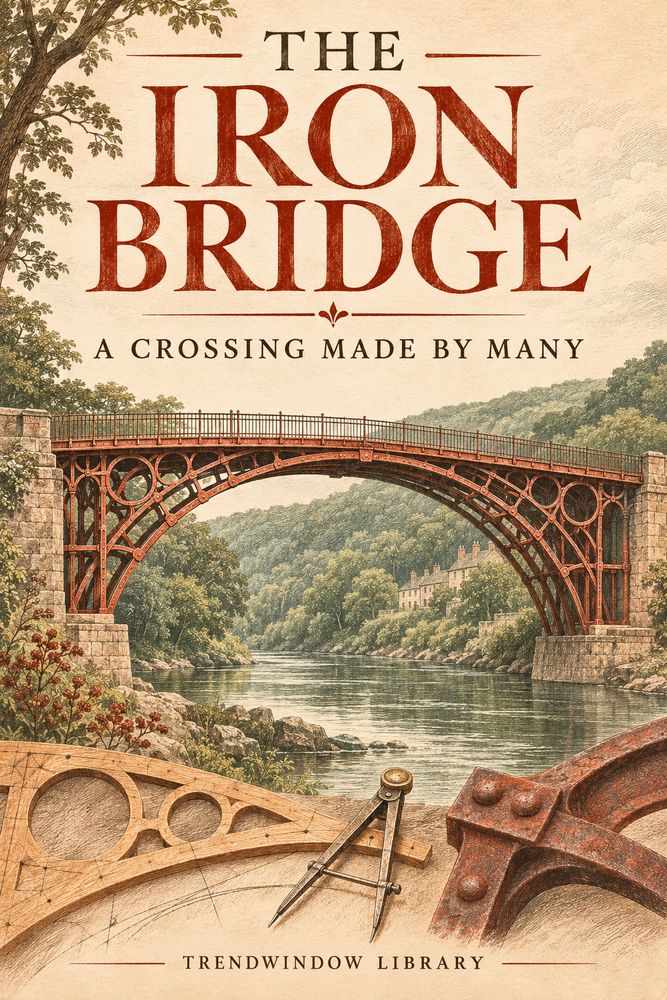
Front cover of The Iron Bridge: A Crossing Made by Many

History & Culture

The Iron Bridge: A Crossing Made by Many

By TrendWindow Library

Follow the Iron Bridge from a proposed crossing to fitted castings, public opening and later conservation. A short cultural history of named responsibilities, skilled work, surviving evidence and the wider industrial landscape.

Read this complete edition, including its ending and notes. No purchase is required.

1. Begin with the River, Not the Hero

A bridge can become so familiar in a picture that the river beneath it seems like background. At Ironbridge, that order needs reversing. The River Severn was a route through an industrial landscape, but crossing the gorge presented a different problem from travelling along it. A history that begins only with an inventor risks losing the people and activities that made a crossing worth building.

The UNESCO description of Ironbridge Gorge places mines, furnaces, workshops, manufacturing, workers' housing and transport within one connected property. It identifies five areas: Coalbrookdale, Ironbridge, Hay Brook Valley with Madeley, Jackfield and Coalport. The bridge is a focal point in that larger ensemble, not the whole World Heritage property by itself. Those relationships make a useful starting map for this short history.

Imagine a blank sheet with a river drawn down its centre. On it, put the words production, movement, settlement and crossing. This is an original reading exercise, not a reconstruction of an eighteenth-century map. Ask which relationships would remain invisible if you drew only the arch. A handsome structure may connect activities that do not fit into the same photograph.

That does not mean every community welcomed the same change or benefited equally. The selected institutional sources do not supply a complete account of every resident's experience. We should not fill that absence with invented testimony from a worker, ferryman or family. The fact that such people matter does not give a writer permission to give them undocumented words.

The chapters that follow therefore separate three things: documented dates and roles, interpretation of why those details matter, and questions the selected evidence leaves open. This is a cultural history built from identified records and institutional research, not a personal site visit or an engineering manual. The crossing becomes more interesting when a familiar silhouette is allowed to have a complicated history.

2. Three Names Do Not Describe One Job

The Darby name appears in more than one part of the story. English Heritage places Abraham Darby I's use of coke rather than charcoal for iron smelting at Coalbrookdale in 1709. The bridge project belongs to a later generation. Confusing the first Darby with his grandson would turn a sequence of developments into a single impossible career.

Thomas Farnolls Pritchard proposed an iron bridge in 1773. Historic England's official monument entry records the proposal to ironmaster John Wilkinson, the successful parliamentary petition in 1776 and work beginning in 1777. Pritchard died in 1777. Abraham Darby III oversaw the construction, with iron cast by the Coalbrookdale Company. The dates give us a succession of responsibilities rather than a photograph of one man doing everything.

The Institution of Civil Engineers adds another named contribution: patternmaker Thomas Gregory detailed the bridge's joints. Its account distinguishes Pritchard's design, Darby's oversight and Gregory's decisions about connections. These are related tasks, but the words are not interchangeable. Proposing a crossing is not the same as raising money, making a pattern, casting a component or assembling the work.

An original way to read this evidence is to write a verb beside each name. Then add a second column for work whose individual practitioners are not named in this selection. Do not turn that column into an invented roll call. Its purpose is to make the limits of a short account visible. A source that preserves an owner or designer's name more readily than a labourer's tells us something about the record as well as the project.

The title of this book, a crossing made by many, is an interpretation grounded in those different responsibilities. It does not claim a newly discovered workforce list. Recognising collective work is strongest when it stays precise about what is known and honest about whose details have not been recovered here.

3. A New Material with Familiar Connections

The bridge's significance does not require pretending that no earlier bridge ever contained iron. Historic England explicitly notes a long history of iron as a component in bridge construction before the Iron Bridge used it as its principal material. The more careful question concerns the scale and structural use of cast iron at this crossing, rather than an unqualified claim about the first use of any iron anywhere.

ICE describes almost 1,700 components cast locally and assembled at the site. It attributes the joint details to Gregory and identifies dovetails, wedges and tenons adapted from carpentry. It reports that around seventy percent of the components, including larger castings, were individually fitted and consequently differed slightly. These are descriptions of this structure, not instructions for designing a bridge today.

Familiar joinery in an unfamiliar material complicates a simple tale of invention. A new application can draw on skills already held by workers. That does not make the application unimportant. It changes the story from a clean break with everything before it into a translation of existing knowledge into another material and scale.

Consider two labels for a component: cast and fitted. The first directs attention to making its shape; the second to its relation with another piece. Neither word alone explains an assembled structure. This is an interpretive exercise about the account, not a claim that the reader can infer a safe connection from a cover illustration.

It also changes what mass production should mean in this particular discussion. A large undertaking assembled from many cast pieces need not imply that every piece was interchangeable. The reported individual fitting is a reason to look more carefully at that assumption. It is not a reason to dismiss the project for failing a later ideal.

The original cover art uses a bridge, a pattern and a joint to suggest these relationships. It is conceptual illustration, not an archival photograph, a measured drawing or a certified reconstruction. A source-based history should be as clear about its new images as about its old evidence.

4. Completion, Opening and the Evidence Between

English Heritage distinguishes completion in 1779 from the formal opening to traffic on 1 January 1781. Historic England records an inscription on the outer ribs identifying casting at Coalbrookdale and erection in 1779. Those statements answer related but different questions. The year associated with making a structure need not be the date when a public service formally begins.

A useful timeline therefore needs verbs as well as numbers. Proposed, authorised, begun, erected and opened are not synonyms. Flattening them into a single date would remove the very process a history is trying to explain. This distinction also helps a reader understand why institutional pages can prominently display different years without necessarily contradicting one another about the same event.

Evidence of assembly has its own later chronology. English Heritage reports that an Elias Martin watercolour showing construction came to light in a Stockholm museum in 1997. It discusses the image alongside Darby's accounts, with their references to scaffold poles, timber and rope. This book uses the institution's account of that research; it does not claim to have independently examined every original account or authenticated the watercolour.

The distinction matters because one evocative image can tempt a reader to treat every visible detail as a complete record of an operation. A picture has a viewpoint and a purpose. An account records some transactions more readily than others. Bringing different kinds of evidence together can improve an interpretation without turning it into an eyewitness certainty.

ICE also records that Darby paid William Williams for a drawing in 1780. An image of a completed bridge and an image showing construction need not do the same historical work. One might help establish how an undertaking was represented, while another contributes to a question about assembly. Here that difference is a reading principle, not a newly proven intention attributed to either artist.

For your own evidence note, record the event date, the date of the surviving evidence if known, and the date a modern institution examined or described it. Leaving one unknown is better than giving all three the same convenient year.

5. Keeping a Bridge Is Further Work

An old bridge that remains standing has not necessarily remained unchanged. Historic England describes movement affecting the stone abutments, alteration of the southern approach and its replacement first with a wooden arrangement and later iron arches in the nineteenth century. The official entry and English Heritage both place closure to vehicles in 1934. Their histories also describe later bracing of the abutments.

These changes belong to the object's history. They should not be treated merely as distractions from an untouched original moment. A crossing carries the consequences of material, ground and use over time. A short book cannot inspect its condition, but it can avoid implying that longevity means the absence of maintenance.

English Heritage's account of its conservation project describes work beginning in autumn 2017: scaffolding and protective covering, repairs to cast iron, masonry conservation, deck resurfacing, cleaning and repainting in red-brown. Its history page records completion in 2018. The project page also describes a temporary walkway through which visitors could see the work. These are the project participant's descriptions, not a present-day structural safety certificate supplied by this book.

Look at the verbs again. Repairing, recording, supporting and repainting involve decisions as surely as casting and assembling. They can make a structure available to later generations while also producing evidence about what earlier generations made. Conservation does not have to be presented as either erasing history or freezing everything in place; those are conclusions to examine, not assumptions to import.

An original observation exercise is to choose one historical description and ask which parts refer to material, which to use and which to later intervention. Do not attempt a physical inspection, remove material or touch a monument to complete it. The exercise can be done from the identified texts. Its result is a more careful question, not a diagnosis of a crack or a maintenance prescription.

The many in the title now includes later surveyors, conservators and other people responsible for continued care. That expands the history beyond a first opening while keeping the different periods distinct. The work of keeping is part of why there remains something to study.

6. Return the Arch to the Gorge

UNESCO's original decision record identifies Ironbridge Gorge's inscription in 1986. Its property description asks readers to understand the connected industrial landscape rather than treating the bridge as an isolated exhibit. That is where this short account returns: an arch, its making and its care belong among other places of work, movement and daily life.

The wider frame does not diminish the bridge's specific achievement. It helps explain why a single object can carry an account larger than itself without becoming a substitute for that account. A view of iron above water can be an invitation to investigate a landscape; it cannot contain all the people, exchanges and consequences in one glance.

There are also limits to the sources assembled here. Modern official pages are valuable records of institutional interpretation, but they are not identical to the eighteenth-century documents they discuss. This book identifies those layers rather than pretending that opening a modern page amounts to reading an entire archive. Where selected sources give inconsistent figures or dates, the notes explain the choice or omit unnecessary precision.

Try writing a final three-sentence account of the crossing. In one sentence identify a documented event with its date. In another name a different kind of work involved. In the third state a question you cannot answer from the selected evidence. This original exercise makes room for both knowledge and limitation; it does not ask the reader to invent the missing fact to make a tidier ending.

The story is complete without an imagined speech from Darby or a fictional memory assigned to a worker. We can follow a proposal, the organisation of making, the difference between erection and opening, the reinterpretation of evidence and the work of conservation. Each step changes what it means to say that a bridge was built.

The Iron Bridge remains the centre of this account, but no longer stands alone in it. Around the arch are named responsibilities, skilled work partly preserved in connections, later interventions and a wider landscape. That is a fuller ending than a single heroic name beneath a picture: a crossing made, understood and kept through the work of many.

Sources and Edition Note

Research checked on 5 November 2026. This is an original short cultural history and set of evidence-reading exercises. No invented historical dialogue, first-person site visit, independent engineering survey or complete archival examination is claimed.

English Heritage, History of Iron Bridge: https://www.english-heritage.org.uk/visit/places/iron-bridge/history/ . Selected Darby chronology, 1779 erection versus 1781 opening, later assembly research and conservation dates.

Historic England, The Iron Bridge, scheduled monument entry 1015325, first listed 18 January 1934 and amended 7 February 1997: https://historicengland.org.uk/listing/the-list/list-entry/1015325 . Design sequence, inscription, material context and later alterations. This older entry gives 1987 for World Heritage status; the original UNESCO decision below establishes 1986. Differing tonnage figures in selected institutional accounts are not resolved or used here.

Institution of Civil Engineers, Iron Bridge: https://ice.org.uk/what-is-civil-engineering/infrastructure-projects/iron-bridge . Selected roles, Gregory's joint detail, approximate component and fitting figures, and the 1780 Williams drawing. Its converted modern cost and project forecast are not presented as final expenditure.

UNESCO World Heritage Centre, Ironbridge Gorge: https://whc.unesco.org/en/list/371/ . Connected property and landscape. Historical visitor totals and old management-plan forecasts on the page are not reported as current 2026 conditions.

UNESCO, Decision 10 COM VIII, 1986: https://whc.unesco.org/en/decisions/3803/ . Original inscription record; no claim to have read every attached committee document.

English Heritage, Project Iron Bridge: https://www.english-heritage.org.uk/visit/places/iron-bridge/project-iron-bridge/ . Participant account of conservation methods and public viewing. No current access, opening, price or structural guarantee follows from this historical account.

Original conceptual English cover illustrations were generated for this edition; they are not downloaded archival images or technical drawings. Writing and full translations use AI assistance with editorial review. No independent native-human, human-authorship or print-proof certification is claimed.

Explore more books →