BOOK LIBRARY · Complete books · Purchases disabled
TrendWindow

← Book Library · Complete book

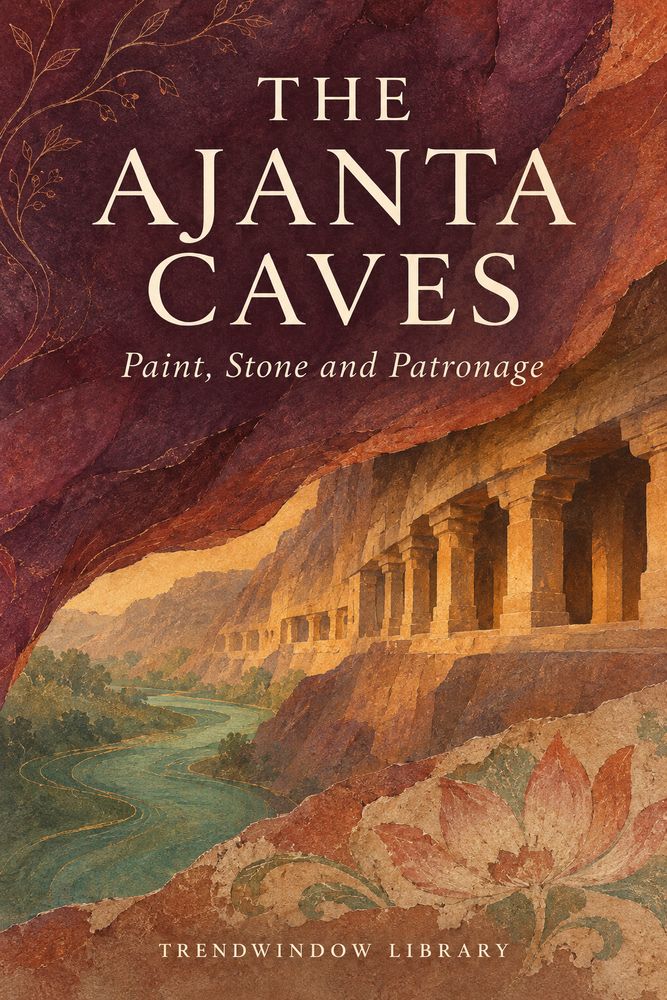
Front cover of The Ajanta Caves: Paint, Stone and Patronage

History & Culture

The Ajanta Caves: Paint, Stone and Patronage

By TrendWindow Library

Explore Ajanta through its rock-cut rooms, painted surfaces, named patronage and later copies: an original short cultural history that keeps evidence and interpretation distinct.

Read this complete edition, including its ending and notes. No purchase is required.

1. A Cliff with More Than One Time

Ajanta begins with a relationship between a cliff and the spaces people made within it. Above the Waghora River in Maharashtra, Buddhist halls and monasteries were cut into rock. The surviving ensemble joins architecture, sculpture, painting and inscriptions. Looking at only one celebrated painted figure would leave much of that history outside the frame.

UNESCO's account counts thirty caves, including unfinished excavations, and distinguishes two broad periods of work. Early monuments belong to the second and first centuries BCE; a later phase is associated with the Vakatakas in the fifth and sixth centuries CE. These are broad historical groupings, not construction dates for every doorway, image and layer of paint. The numbers assigned to caves identify places in the modern site description; they should not be mistaken for a simple calendar of completion. [S1]

The difference matters because an ensemble can be seen together without having been made together. A new excavation could stand near an older hall. Later work could reuse an existing space. An unfinished surface might preserve a stage of making rather than represent the ruin of a once completed room. Before imagining a single great building campaign, a reader needs room for interruptions, returns and changes of purpose.

A useful mental journey moves from the landscape toward the surface: river, cliff, excavated space, prepared wall, painted image. Each scale adds something the next cannot replace. The river does not explain a painted gesture; the gesture does not explain how a hall was removed from the rock. Together they prevent Ajanta from becoming either scenery without people or an isolated gallery without a setting.

This book follows those connections. It does not invent a monk's diary, a painter's conversation or a visitor's eyewitness experience. Its subject is what selected surviving structures and records allow us to discuss, and what remains uncertain. The aim is a cultural history of making and remembering, rather than a claim to recover every moment of the caves' working lives.

2. Making a Room by Removing Stone

A rock-cut building reverses an ordinary expectation. Instead of carrying separate walls into place, workers create space by taking material away. The cliff is therefore more than a support behind the architecture: it is the material from which much of the architecture emerges. Decisions about a pillar or a ceiling concern what will remain as well as what will be removed.

UNESCO distinguishes worship halls, or chaityagrihas, from monasteries, often called viharas. Its description of the former includes a central space, side aisles and a stupa toward the rounded end. The monastic arrangement includes a hall and cells. These descriptions concern patterns visible across the ensemble; they are not evidence that every cave had an identical plan or that every space retained one use throughout its history. [S1]

The distinction encourages attention to movement. A room is not just an outline on a plan. Entrances, pillars and the relation between a central feature and surrounding space shape how someone might approach, gather or pass through. That is an architectural reading, rather than a reconstruction of an undocumented ceremony. The possible movement should not be described as a witnessed ancient event.

The unfinished excavations are especially valuable to the question of work. A finished surface can make difficult production disappear from view; an incomplete one can leave the process more apparent. It is tempting to treat incompletion only as failure. A historical reader can instead ask what it reveals about sequence, choices and the different stages required to make a usable space.

We cannot restore the names of all the people involved by admiring the result. Patronage records and surviving monuments are uneven sources for labour. Yet that absence is not a reason to imagine the rooms as effortless. The remaining stone gives the book its first principle: a polished appearance should not erase the work that made it possible.

3. The Wall Beneath the Painting

Paint is the most immediately compelling part of many encounters with Ajanta, but the visible colour is only one part of a material system. Shrikant Dabhade's technical account, published through the Indira Gandhi National Centre for the Arts, separates the rock support, the prepared ground, pigments and binding medium. The distinction makes the wall's hidden preparation part of the artwork's history. [S2]

The account describes roughened rock, layers prepared to receive painting and variation in materials and surfaces. It also discusses moisture and the loss of adhesion between layers. These are selected observations from a historical technical study, not fresh tests performed for this book. They should not be turned into one universal recipe used by every painter in every cave. [S2]

Calling the paintings “frescoes” in a broad description can conceal a further distinction. True wet-lime fresco and painting involving a binding medium describe different processes. UNESCO uses the term tempera for Ajanta's murals; the technical literature discusses terminology and the material evidence in more detail. The useful point here is to keep support, ground and paint separate, rather than assume that a familiar label settles every technical question. [S1, S2]

This material reading changes what a missing patch means. A gap may concern the painted layer, the prepared surface beneath it or a larger failure involving the support. A photograph can show an absence without establishing its cause. Understanding that limitation protects a reader from diagnosing a wall simply because the damage has a recognisable shape.

It also gives colour a different kind of importance. A painting is not only a design that could be transferred unchanged to any convenient surface. Its survival depends on relations between materials and conditions. To remember the layer underneath is to recognise both skill and vulnerability. Nothing in that recognition authorises an amateur to clean, wet, coat or repair an ancient surface; interpretation is not permission to intervene.

4. A Patron's Name and an Unnamed Workforce

An inscription can bring a name into a history that otherwise risks being told only through dynasties and styles. The Siddham inscription database records the stone inscription in Ajanta Cave 16 as written for Varahadeva, a minister of the Vakataka king Harishena. It notes weather damage and its first publication by Bhau Daji in 1862. The record is an entry into surviving testimony, rather than a complete list of everyone responsible for the cave. [S4]

A named patron and an unnamed maker occupy different positions in the evidence. A text produced for a donor can tell us how that person wished a gift or role to be remembered. It does not automatically reveal the painter's identity, the quarrying arrangements, every worker's terms or the daily conversations through which a design was realised. Reading the name carefully means retaining those limits.

The larger chronology also requires care. Walter Spink's introduction to Ajanta, hosted by IGNCA, argues for a concentrated period of later activity and relates changes in work to patronage. That is a particular scholarly reconstruction. It should be identified as such beside the broader phase ranges in UNESCO's institutional account, rather than presented as if all sources supply exactly the same timetable. [S3]

Different scales of dating need not be forced into one misleading number. A broad period can locate a tradition; a detailed argument can propose a sequence within it. To assess the latter fully would require its evidence and the wider debate, beyond this book's selected reading. Here the disagreement is preserved as a boundary of knowledge, not used to make the entire site seem unknowable.

The historical conclusion is neither that patrons did everything nor that patronage explains nothing. Resources, institutions, religious purposes and skilled work meet in the surviving place. A single name can make one relationship visible while leaving many others in shadow. The task is to acknowledge that visibility without confusing it with a complete social portrait.

5. Copies Have Histories of Their Own

The nineteenth-century recording of Ajanta created new objects as well as new descriptions. A painted copy, a plan and a published plate preserve different kinds of information. They also have makers, materials, dates and later movements. Treating all of them as transparent windows onto the ancient caves would hide their own histories.

The Royal Asiatic Society's account of its collection provides a useful example. It holds a small painting by John Griffiths, View from Cave No. 10, Ajanta, dated around 1880 and donated in 1883. This is a view from the cave, not one of the copies of its murals. The distinction begins with the object's identity, before any wider argument about the accuracy of copying. [S5]

The same institutional account describes Robert Gill's copying commission of 1844 and the destruction of most of his copies in the 1866 fire. It identifies the later work of Griffiths and Indian students and records the Society's ownership of the large 1896–97 publication volumes. The publication includes plans and plates, giving the reader several forms of representation rather than a single kind of image. [S5]

These records make the copyist part of the story without turning the copy into the original. Scale, medium, selection and the conditions under which a work was recorded can affect what a later reader sees. A monochrome plate, for example, cannot supply the same information as colour even when both depict the same subject. That is a limitation to recognise, not a reason to dismiss all documentation.

Spink also discusses the dated inscription scratched by John Smith in Cave 10 in April 1819. That mark documents a particular colonial encounter and an act upon an already painted surface. It does not date the cave's creation or establish that local people had never known the place. The familiar word “discovery” needs that qualification. A site's history does not begin when a newcomer records arriving there. [S3]

6. An Ending That Leaves the Surface in Place

Ajanta's history continues through the work of looking after it. UNESCO records its World Heritage inscription in 1983 and identifies the Archaeological Survey of India as the site's manager. Its management statement discusses pressures from visitors and the need for structural monitoring and continuing care. These describe responsibilities; they are not a certificate that every conservation problem has been solved. [S1]

The ending of this book therefore returns to the relationship with which it began. Cliff, room, prepared wall and painted surface are connected. So are the people who paid for work, those who performed it, those who documented it and those responsible for its future. A history that praises only beauty would miss the relationships that allowed beauty to become material and remain visible.

There is a practical ethical difference between attentive looking and possessive action. A reader can compare records, ask how a date was reached and notice the limits of a reproduction. Those activities do not require adding a mark to a wall or moving a fragment to improve a personal view. This is a principle of restraint, not an invented summary of every current visitor rule or an instruction for conservation treatment.

Uncertainty also has a place in the conclusion. We have not identified every painter, fixed a date for every intervention or reconstructed all daily life within the caves. Yet the surviving evidence is substantial enough to resist an opposite mistake: imagining that nothing can be understood. Spaces, materials, inscriptions and later records answer different questions when used with care.

The finished argument is that Ajanta is neither one timeless picture nor a sequence of famous names standing alone. It is a place made through repeated human decisions, known through surviving and sometimes damaged evidence. To leave its surface in place is not to leave its story untouched. It is to accept the responsibility of telling that story without making the evidence bear more than it can.

Sources and Edition Note

Research consulted 6 November 2026. The source labels apply to the factual passages in all six complete editions. Interpretive connections are the book's own synthesis; they are not invented ancient speech or claims of new fieldwork.

S1. UNESCO World Heritage Centre, Ajanta Caves. Selected institutional statement on the ensemble, broad periods, types of space and continuing management. https://whc.unesco.org/en/list/242/

S2. Shrikant Dabhade, Materials, Technique and Conservation, IGNCA Ajanta project. Selected discussion of support, ground, paint, terminology and deterioration; not a new laboratory examination or repair manual. https://ignca.gov.in/ajanta/html/Materials.htm

S3. Walter M. Spink, An Introduction to Ajanta, IGNCA. Selected discussion of chronology, patronage and the 1819 inscription; the author's reconstruction is identified as interpretation, not a universally agreed detailed calendar. https://ignca.gov.in/ajanta/html/Introduction.htm

S4. Siddham, IN00178, Ajanta Cave 16 Inscription of Varahadeva. The database description was read; this edition does not claim an independent complete Sanskrit translation. https://siddham.network/inscription/in00178/

S5. Royal Asiatic Society, John Griffiths and the Caves at Ajanta, 1 December 2016. Its own collection and publication holdings are distinguished from the ancient murals. https://royalasiaticsociety.org/john-griffiths-and-the-caves-at-ajanta/

This is an original short cultural history produced with AI assistance and editorial comparison. Bengali, Hindi, Spanish, French and Arabic editions preserve the complete argument and ending. No independent native-human proofreading or human-authorship certification is claimed. The original English cover artwork is conceptual, not an archaeological reconstruction, copied mural or official institutional endorsement.

Explore more books →