BOOK LIBRARY · Complete books · Purchases disabled
TrendWindow

← Book Library · Complete book

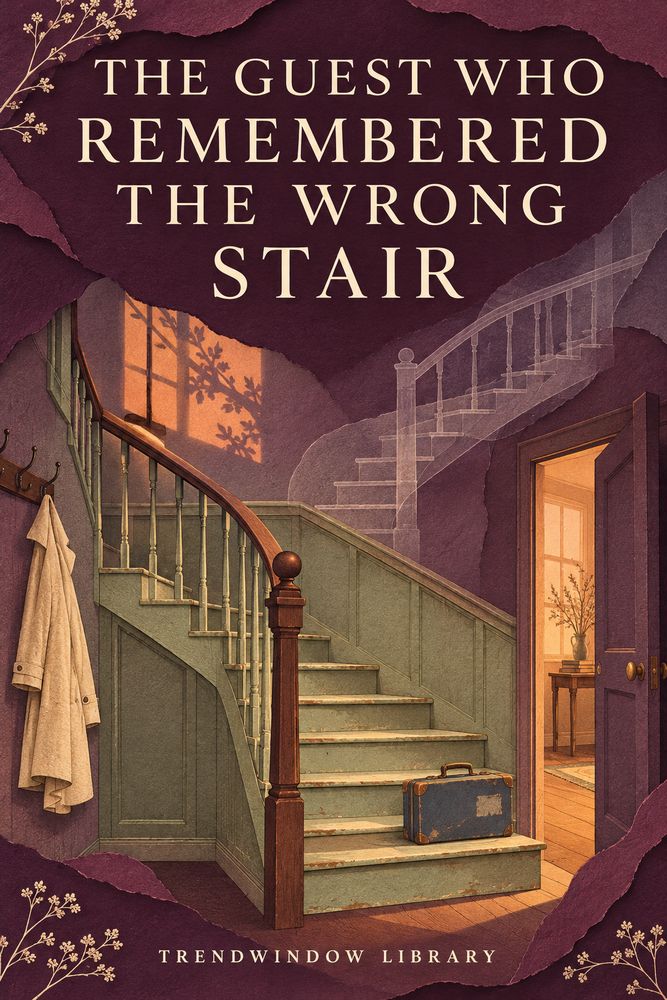
Front cover of The Guest Who Remembered the Wrong Stair

Mystery, Crime & Thriller

The Guest Who Remembered the Wrong Stair

By TrendWindow Library

A complete original short mystery. A long-lost brother returns with familiar names and a childhood memory of a staircase built after he left. Nora Pell questions a carefully arranged reunion before someone else writes its ending.

Read this complete edition, including its ending and notes. No purchase is required.

1. The Cup Without a Saucer

Elin Rowan set out three cups and put the fourth away. Then she took it out again. Nora Pell, who had come to shorten a curtain, watched from the dining-room door. The fourth cup was blue, with a small chip near its handle. Elin placed it where the late light would find it.

“He always chose that one,” she said.

Nora knew who she meant. Theo had left the house in 1986, at nineteen. His sister Elin, three years older, had told him not to write. For forty years, she had repeated those words as if repetition might eventually turn them into something less final.

Now Elin’s daughter June was bringing him home.

June’s message had arrived that morning: I have found him. Please don’t ask everything at once. Nora had offered to leave, but Elin had asked her to stay. “You can be the person who remembers to pour.”

The man at the door carried a worn blue suitcase. He was thin, with grey hair brushed carefully back. June stood beside him, her hand beneath his elbow although he did not appear to need support.

“Ellie,” he said.

Elin made a sound Nora had never heard from her. She did not embrace him immediately. She looked first at his mouth, then at his hands, searching for a young man in an older stranger.

“You came,” she said at last.

“I should have come sooner.”

June closed the door quickly. At the table the man took the blue cup after Elin pushed it towards him. He spoke of the pear tree, their father’s red bicycle and a dog named Button. Elin supplied more details than he did, and he received each one gently.

Nora poured. She reminded herself that a reunion was not an examination. A person could forget a dog and still be a brother. A sister could recognise a voice that sounded unfamiliar to everyone else.

Yet June never took off her coat. Her fingers remained fastened around one button, as if the whole afternoon depended on keeping it closed.

2. A Childhood on the Landing

The visitor refused a second piece of cake. “I used to race up those stairs,” he said, looking through the open dining-room door. “Left at the bend, straight towards the front window. We hid behind the curtain when Father called.”

Nora stopped with the knife above the plate.

“And the white mark on the third tread,” he continued. “He never let us forget who spilled the paint.”

June laughed too loudly. Elin looked towards the hall. “That mark is still there,” she said.

It was. Nora had stepped over it that morning. But she remembered a younger staircase, steep and straight, running beside the kitchen wall. She had helped her father carry tools out when it was removed in 1998. The present staircase curved left beneath the front window. Theo had already been gone for twelve years.

“Did you visit after you left?” Nora asked.

The man’s hand tightened around his cup. June answered before he could. “He said this was the first time.”

“First time inside,” he added. “I saw pictures. Perhaps I mixed things up.”

That was possible. Nora put the knife down. One misplaced memory did not identify a stranger. She had herself called a borrowed story a memory until someone showed her a photograph taken before she was born.

Elin asked about the journey. The visitor described a train that had been crowded and a station where he had waited in the rain. His answers had become short. June interrupted to offer him the guest room, then glanced at the clock.

“There’s plenty of time,” Elin said.

“I thought you might be tired.”

“I have waited forty years. I can manage tea.”

The visitor lowered his eyes. Nora noticed that he had not touched the suitcase since putting it beside his chair. Its handle pointed towards the door. It looked less like luggage brought home than something placed where it could be picked up quickly.

3. The Year on the Photograph

In the kitchen Elin asked Nora to find a clean cloth. The man had spilled a little tea. June remained at the table with him, speaking too quietly for their words to reach the sink.

“You heard it too,” Elin said.

Nora turned. “The stairs?”

“My father never saw them. He died the year before they were built.” Elin pressed her palms against the draining board. “But perhaps Theo saw a picture. Perhaps he wanted to give me something I could remember.”

“Perhaps,” Nora said. “You don’t have to decide by wanting it hard enough.”

Elin opened the drawer where she kept household papers. The receipt for the staircase was folded inside a photograph album. Nora recognised her father’s handwriting on the bill: September 1998. Elin had kept it because he had drawn a tiny ladder beside his total.

The album fell open at a photograph of June’s fifth birthday in 2001. June stood on the curved stairs wearing a paper crown. There was the front window. There was the white splash, made when Elin had painted the hall after the work was finished. On the back Elin had written the date and June’s name.

“I sent June a copy last winter,” Elin said. “She wanted pictures of the house.”

Nora looked at the drawer. Beneath the album lay a cream envelope addressed to Elin in unfamiliar handwriting. Its corner had been caught under a folded shopping bag.

“Is that yours?”

Elin lifted it. “I don’t know.”

The envelope was already open. Inside were two sheets, one fresh and one yellowed along a fold. Elin read the first line of the newer sheet and sat down.

Dear Elin, I was married to your brother Theo.

Nora did not take the letter. She waited until Elin held it out. The date was in 2025. Its writer, Claire, said Theo had died the previous year. She had found an unsent letter among his papers and was enclosing it.

Elin looked through the doorway at the man drinking from her brother’s cup.

4. A Name Given Back

Nora asked June to come into the kitchen. Elin kept both letters on her lap. For a moment June looked at the empty envelope rather than her mother.

“I meant to explain,” she said.

“When?” Elin asked.

June started to cry. “After you’d had a little time with him.”

“With whom?”

The man appeared in the doorway. He had heard enough. He put the blue cup on the counter, carefully clear of the letters.

“My name is Martin,” he said. “Martin Shaw. I’m not your brother.”

Elin’s face did not change. Nora moved the chair behind her a little closer, but Elin stayed seated where she was.

Martin said he acted in a small amateur company. June had seen him in a play and later asked him to help with a private family meeting. At first she had described it as reading a scene about a reconciliation. Then she had asked him to arrive as Theo and let her mother say what she needed to say.

“I knew what I was doing before I came through the door,” he said. “This wasn’t a misunderstanding.”

June had given him names, the bicycle, the dog and the photograph of the stairs. He had turned a picture into a childhood because he thought a specific detail would make him convincing. When Nora asked about a later visit, he had tried to retreat into an innocent explanation.

“I should have stopped then,” he said. “I should never have started.”

Elin looked at June. “You found Claire’s letter?”

“It came when I stayed here last spring. I opened it. I was afraid to tell you. Then every visit became another time I hadn’t told you.”

“So you hid it in my own drawer.”

June nodded. She had thought she would find the courage later. Instead she had arranged an afternoon in which her mother could apologise to someone who would promise forgiveness.

Nora thought of all the details that had felt wrong. None had been enough alone. The staircase had exposed a story that needed questions. Now two people had answered them.

5. The Letter That Was Not a Reply

“What were you going to say?” Elin asked Martin.

He looked towards June. “That there was nothing to forgive. That he had always known you loved him.”

“You don’t know either thing.”

“No.”

“Neither do you,” Elin said to her daughter.

June pulled her coat open at last. From its inside pocket she took a page of notes. Elin did not ask to read them. “Put that away,” she said. “I am finished with a conversation you have written for me.”

Martin offered to return the money June had paid him. Elin told him that was between them. He asked whether he could help in any other way.

“You can leave as yourself.”

He picked up the suitcase. At the door he said he was sorry, without adding that he had meant well. Nora watched him go down the path. Then she closed the door and returned to the kitchen.

Elin unfolded the older sheet. It was dated 1990. Theo had written about a room above a bakery, a bicycle with a basket and the silence that had grown between them. He said he had left in anger too. He missed her, but he did not know whether she wanted to hear from him. The letter ended with a question: Would you like me to write again?

There was no declaration of forgiveness. No final account of the next thirty-four years. Claire’s covering letter said only that the sheet had remained among his papers. She included an address and wrote that Elin could contact her if she wished.

“It may be real,” Elin said. “I want to find out for myself.”

Nora nodded. June’s confession explained where the envelope had been. It could not turn every word inside it into a certainty, or supply a reply Theo had never received.

“He asked,” Elin said, looking again at the last line.

Her tears came then. Nora sat beside her. June remained standing by the sink, without trying to take the letter or reach for a forgiveness she had already tried to arrange.

6. A Door Left in Its Frame

When the light faded, Elin asked Nora to put the cake away. She asked June to stay, but not to speak for a while. They worked around one another in a kitchen where every familiar object seemed to have acquired a different weight.

Later June said, “I wanted to give you the ending you never had.”

“You gave me another person to lose.”

June did not defend herself. She said she would settle the payment with Martin herself, and would tell her mother exactly what she had sent him. Elin asked her to write that account down, including when the letter had arrived. She wanted the truth available when she was ready to look at it, not another story softened in the telling.

They did not embrace before June left. Elin said she would call when she wanted to talk. June accepted that, although accepting it plainly cost her more than another promise would have done.

Nora stayed to finish the curtain. She shortened the hem by the kitchen lamp while Elin sat across from her with a blank sheet of paper. At the top Elin wrote Dear Claire. Beneath it she put: Your letter has only just reached me. I would like to ask you about Theo, if you are willing.

She did not send it that evening. She placed it beside the two old sheets, in an envelope she would keep where she could see it. In the morning she could choose whether to finish it.

“I thought I would know him,” she said.

“You were allowed to hope.”

Elin touched the blue cup. “I won’t throw it away.”

“You don’t have to.”

Nora hung the curtain back on its hooks. The bottom edge cleared the sill evenly. Through the hall door she could see the staircase, its left turn and the small white splash on the third tread. It belonged to the years Elin had actually lived here, not to a childhood someone had borrowed from a photograph.

Before leaving, Nora asked whether Elin wanted the hall light on.

“Yes,” she said. “For me.”

Edition Note

This is a complete original work of fiction. All people, letters, places and events are invented. It is an AI-assisted digital short book with original conceptual English cover artwork and complete aligned translations; it does not claim independent human authorship, native-human certification, a real case, an ISBN or a print proof. The staircase illustrations express the story’s theme and are not a measured floor plan.

Explore more books →