BOOK LIBRARY · Complete books · Purchases disabled
TrendWindow

← Book Library · Complete book

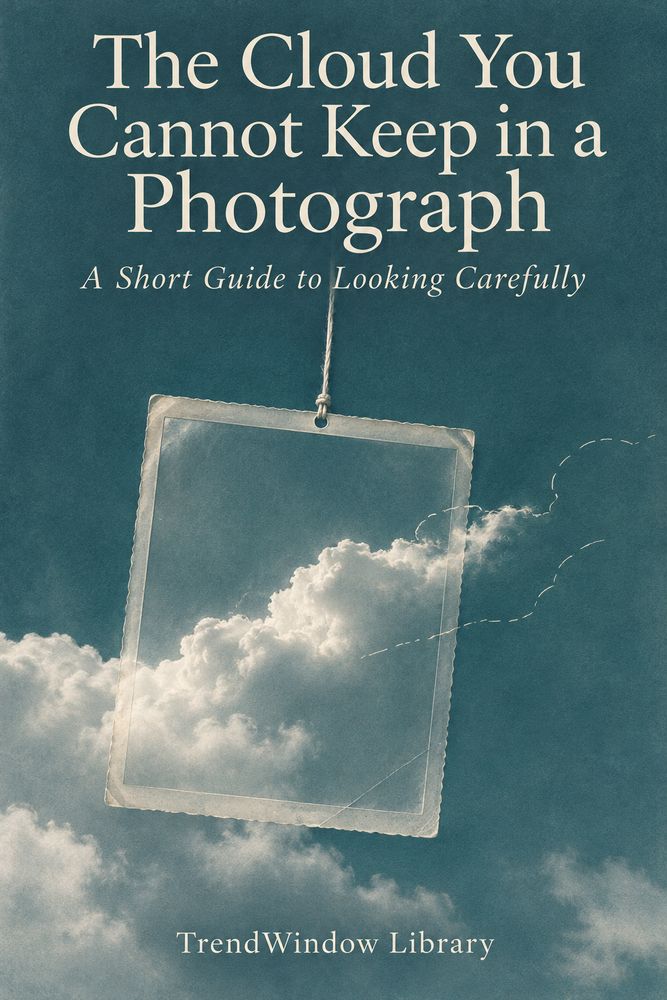
Front cover of The Cloud You Cannot Keep in a Photograph

Science, Technology & Nature

The Cloud You Cannot Keep in a Photograph

By TrendWindow Library

A complete short guide in eight chapters to observing clouds without overclaiming what a photograph proves. Six primary sources support brief scientific foundations; original imaginary exercises connect description, naming, simple arithmetic, time sequences and forecast limits.

Read this complete edition, including its ending and notes. No purchase is required.

About this guide and its sources

A complete short introduction to cloud observation in eight chapters. The notebook, photographs and times used in the exercises are invented, not field measurements. The six primary sources listed below were consulted on 17 November 2026. This book teaches careful description; it does not provide local forecasts or professional meteorological training. Observe only from an ordinary safe place; use your official local weather service for weather decisions. The original cover art is an illustration, not an observed sky.

Source key

S1 — WMO International Cloud Atlas: Clouds — https://cloudatlas.wmo.int/en/clouds.html

S2 — NASA: What Are Clouds? Grades 5–8 — https://www.nasa.gov/learning-resources/for-kids-and-students/what-are-clouds-grades-5-8/

S3 — NASA GPM: What are clouds made of? — https://gpm.nasa.gov/resources/faq/what-are-clouds-made-are-they-more-likely-form-polluted-air-or-pristine-air

S4 — NOAA: How Clouds Form — https://www.noaa.gov/jetstream/clouds/how-clouds-form

S5 — NOAA: Ten Basic Clouds — https://www.noaa.gov/jetstream/clouds/ten-basic-clouds

S6 — NWS: Forecast Process — https://www.weather.gov/about/forecast-process

© 2026 TrendWindow Library. Original AI-assisted writing and translations, reviewed by an AI assistant. No independent human-editor or native-speaker certification is claimed.

1. The edge that moved

Imagine three photographs taken through the same window at 14:00, 14:05 and 14:10. In the first, a white shape has a small notch along its left edge. In the second, the notch is shallower. In the third, you cannot confidently find it. These pictures do not exist outside this exercise. Their purpose is to make a familiar question precise: what, exactly, did the camera keep?

It kept a view during each exposure. It did not keep the cloud as one keeps a stone in a drawer. A photograph lets us return to an arrangement of brightness and outline. Returning to the file is not returning to the atmosphere at that moment. The distinction matters before any difficult cloud name enters the notebook.

Start by writing a sentence another reader could check against the imagined first picture: a notch is visible on the left side of the white patch. Compare that with a stronger sentence: the same piece of cloud moves east. The second requires information absent from the first. We have not established direction, tracked a persistent feature or distinguished movement from changing shape.

The WMO definition identifies liquid droplets, ice particles or both suspended in the atmosphere as constituents of clouds. [S1] The object we casually call a cloud therefore deserves a different observational habit from a rigid object. Give the visible patch a temporary label, such as A, without promising that every particle or boundary under that label remains the same.

Draw a small box around the portion you mean. Note whether the window frame appears, whether the camera moved and whether the image was cropped. None of these details makes the picture less beautiful. They make your statement easier to understand. A reader who knows the limits of the view can disagree usefully rather than guess what you meant.

Keep two lines beneath the drawing: description and question. On the first, record the notch. On the second, ask what changed between exposures. Leaving that question open is the beginning of this book's work, not an unfinished answer disguised as knowledge.

2. Water you can and cannot see

Water vapour is invisible; cooling air can bring water into the liquid form we associate with visible cloud. [S2] Tiny airborne particles provide surfaces around which cloud droplets form. [S3] These two brief facts correct a tempting caption: the photograph does not show a white mass of water vapour. It shows a visible cloud, whose particular composition has not been measured by our camera.

For a paper exercise, divide a page into three columns headed visible, supplied by a source and not established here. Put the white patch in the first column. Put the distinction between vapour and liquid droplets in the second. Put the temperature inside this particular cloud in the third. A source explains a process; it does not retrospectively turn our imaginary picture into an instrument reading.

This separation helps with language as well as science. In ordinary conversation, mist, steam, vapour and cloud can be used loosely. A clear observation note needs fewer interchangeable words. If you mean the pale feature in the image, call it that. If you mean gaseous water, write water vapour. Do not use a technical word simply because it sounds more exact than your evidence.

Now imagine someone adding a temperature to the caption because a weather application displayed a number nearby. Ask where and when that value applies. A ground-level reading associated with a town has not, by that association alone, measured the temperature of the photographed patch. Preserve the number with its own location and time if it is relevant; do not silently move it into the cloud.

The same discipline applies to absence. An apparently clear part of the image is not proof that there is no water in the air. The photograph and the definition address different things. One records visible appearance within a frame; the other distinguishes forms of water. Keeping them together without merging them is more useful than filling the margin with impressive but unearned measurements.

At the bottom of the page, write one correction to the original caption: visible cloud, composition not measured. That modest sentence carries less drama and more information.

3. Naming without pretending certainty

NOAA presents ten basic cloud types, including filament-like cirrus, heaped cumulus and layered stratus. [S5] Those contrasts offer a starting vocabulary. They are not a three-answer test in which every patch must immediately fit one of three words. A cloud atlas is a reference for comparison, not a machine that removes uncertainty from a poor photograph.

Return to patch A. Suppose the imaginary image includes only a narrow strip of its upper edge. You may describe that strip as rounded. You cannot yet describe the shape of the entire cloud. Write rounded visible edge before choosing a name. The shorter, less ambitious description may survive when a wider image later changes your classification.

A useful entry has three parts: candidate name, supporting feature and missing feature. For example, a learner might propose cumulus because the visible portion looks heaped, then note that the base and surroundings are outside the frame. This is an exercise in recording a proposal, not an identification of an actual cloud. Do not copy the example into a real notebook as if an expert had confirmed it.

There is also a difference between recognising a general form and measuring its height. A familiar name may refer to a characteristic cloud family; it does not give the camera a rangefinder. In this exercise we have neither altitude data nor a method for deriving it. Leave the height field blank or write not measured. A blank with a reason is preferable to an attractive number borrowed from a generic chart.

Two learners can preserve different candidate names while agreeing on the visible features. Ask each to underline the part of the picture that supports the proposal. If neither can do so clearly, return to description. The aim is not to win the naming round. It is to produce a note that can be improved by better evidence.

End the entry with a confidence statement in ordinary language: tentative because the view is cropped. Such wording tells the next reader what would help. It also makes revision an expected part of observation, rather than an embarrassment to conceal.

4. The photograph and its missing dimensions

A rectangle is a choice. The frame includes some sky and leaves other sky outside. Before calculating anything, identify what the rectangle represents. Our invented image is a partial view through a window, not an all-sky instrument. No amount of careful counting inside it can restore the excluded directions.

Here is a deliberately simplified arithmetic exercise. Place a grid of twenty equal squares over a sketch. Mark twelve squares entirely cloudy and eight entirely clear. The marked cloud area is twelve twentieths, or sixty percent of that drawing. This exact result belongs to the stipulated drawing. It is not a measured cloud-cover percentage for a town, a hemisphere or even the actual sky visible from a real window.

Now change the exercise: eleven squares are wholly cloudy, six clear and three mixed. Counting every mixed square as clear gives eleven twentieths, or fifty-five percent. Counting every mixed square as cloudy gives fourteen twentieths, or seventy percent. These are bounds under the stated square-counting rule. They are not a scientific uncertainty interval for the atmosphere. The rule is crude, but making it explicit reveals why an apparently precise percentage needs a method beside it.

Depth is another missing dimension. Two shapes touching in a picture need not be touching in space. To see the logical problem without making a claim about real clouds, hold two paper circles at different distances and imagine looking along a line that overlaps them. The flat view alone does not tell you the distance between the circles. Our cloud picture likewise cannot settle every spatial relationship it suggests.

Keep the original frame with any cropped version. Label the crop and preserve the time information separately if the editing process removes it. A dramatic enlargement may be the right artistic choice; an observation record should still make that choice visible.

The photograph has not failed because it does not contain everything. It becomes useful when the question matches what it contains. Counting a defined drawing can teach arithmetic. Describing a framed view can teach attention. Neither needs to pretend it has measured the entire sky.

5. A sky that changes between notes

Cloud boundaries change as condensation and evaporation continue within moving air. [S4] This is a reason to resist treating every change of outline as the travel of one durable object. Our three invented frames can support a sequence of descriptions without establishing a complete history of the material between them.

At 14:00, record the notch. At 14:05, record a shallower indentation in roughly the same part of the frame. At 14:10, write that the feature cannot be identified confidently. Do not replace that last sentence with the notch disappeared at 14:07. There was no photograph at 14:07. A story that supplies the missing minute is more detailed than the record, not more accurate.

A time series also needs a stable comparison. If the camera points farther left in the second picture, a shift within the frame may come from the camera. If the third image is enlarged, apparent growth may come from the enlargement. Record such changes before interpreting them. A fixed window edge can help identify framing changes, but it does not by itself measure a cloud's true speed or distance.

Try another paper task. Write two explanations for a changed outline: movement through the view, and alteration of the visible shape. Leave room for both acting together. Then list information that would help distinguish them, such as a longer sequence with consistent framing. This is a plan for better observation, not proof that the additional sequence would answer every question.

Missing data should remain visible. A gap caused by leaving the window is a gap, even if the first and last pictures look similar. Do not fill it with an invented intermediate photograph, a generated sky or a copied image from another time. An illustration may explain a possibility when labelled as an illustration; it cannot repair the observational gap.

When reviewing the sequence, keep observation times separate from the later time when you wrote the interpretation. This small distinction lets another reader see which words accompanied the event and which arrived after comparison. The notebook then preserves both the evidence and the development of your thinking.

6. The distance from a cloud to a forecast

The NWS describes forecasting as combining observations, models and meteorological judgment, with uncertainty remaining part of the process. [S6] A personal cloud picture does not supply that complete system. It can prompt a question about weather; it should not be promoted into a complete forecast merely because the cloud looks familiar.

Distinguish three sentences. The first says that a dark area appears in the image. The second proposes that rain may occur. The third announces that rain will begin at a particular place and minute. These statements make progressively different demands. The photograph may support the first description while leaving the second and third unevaluated. Greater confidence in your caption does not supply the missing information.

For practical decisions, consult the official weather service for your location and read the time and area attached to its information. Keep a copied forecast separate from your observation, clearly attributed and dated. Do not present the service's words as a conclusion you derived from patch A. If the information changes, preserve which version you used rather than quietly replacing the old record.

Suppose our fictional notebook contains a forecast issued before 14:00 and a picture taken at 14:05. The forecast's issue time, its valid period and the photograph's exposure time are three different entries. Writing only afternoon hides those differences. A tidy record does not require a complicated database: three labelled lines are enough for this elementary exercise.

Nor does one later event establish the quality of an entire forecasting method. If rain occurs after one photograph, that coincidence does not validate a rule that every similar-looking cloud predicts rain. A fair test would require a defined rule, a defined outcome and records of occasions when the rule did not work as well as when it seemed to work. This book has performed no such study.

Let the photograph do its smaller job well. It can preserve a view, make a descriptive claim discussable and raise a better question. You do not have to turn an ordinary act of looking into a promise about the future for it to matter.

7. A small honest observing record

Build one notebook page that another person could use without your spoken explanation. Give it a date, location description, time zone, observation time, view direction if known, and image filename. Include the words not known where appropriate. The purpose is traceability, not the appearance of a professional instrument log.

For our invented sequence, write exercise only at the top. Use filenames A-1400, A-1405 and A-1410. State that the camera position and framing are assumed unchanged for the main comparison; if you explore the changed-camera alternative, put it in a separate version of the exercise. Otherwise incompatible assumptions can slip into the same conclusion.

Next write the visible description in plain language. Put a candidate cloud name on a separate line with its reason and limitation. Keep a third area for interpretation and a fourth for questions. A simple question such as does the notch remain recognisable is more useful here than an unsupported declaration about the whole weather system.

If you include the grid exercise, name its denominator: twenty squares in a drawing. Preserve the rule for mixed squares. If you include an official forecast in a real notebook, record its source, issue time and valid period. If you include a fact from a reference, identify the reference. These entries prevent numbers and statements from becoming detached from the circumstances that made them meaningful.

Finally, read the page as an unfamiliar reader. Can you distinguish an actual observation from a worked example? Can you tell whether a blank means zero, not visible or not measured? Can you find the original file rather than only an edited crop? Can you identify what would make the interpretation change?

Correct the page while preserving the earlier wording where the revision matters. A short note such as changed east to left in frame because direction was not recorded is enough. It shows precisely what improved. An honest record is not one that never needs correction; it is one whose corrections make the evidence easier to follow.

8. Letting the cloud go

Return once more to the three imaginary photographs. We began with a notch and a desire to keep it. We end with something more durable than the shape: a description that says what was visible, a sequence that admits its gaps and a question that has not been answered by force.

The finished exercise has a limited conclusion. Across the stipulated images, the chosen outline feature becomes harder to recognise. The example does not establish a geographical direction, an altitude, a physical speed or a future rainfall time. Those limits are part of its result. They are not small print to be removed when the picture is shared.

If you share a real photograph, a useful caption can hold both pleasure and precision. Describe the appearance, say when and where the image was taken at an appropriate level of location detail, and distinguish a tentative identification from a confirmed one. Do not publish private location details merely to make a casual record look complete. Keep the unedited original for your own comparison if appropriate.

The six references in this book provide brief foundations for cloud constituents, invisible vapour, droplet formation, changing outlines, naming and the forecast process. They were consulted as explanatory webpages, not as confirmation of any particular sky in these exercises. No real photographic sequence, atmospheric measurement or forecast evaluation has been conducted here. The arithmetic and notebook designs are original teaching examples.

A next step can be modest: read an authoritative cloud description and practise writing one careful sentence about an ordinary safe view. You need not assign every label or answer every question. If a better view changes your first interpretation, record the change. That is a successful continuation of the exercise.

Close the notebook with the final entry intact: feature not confidently identified in the last frame. The image remains available; the imagined cloud has moved beyond what we can claim for it. What you have kept is a way of looking that does not confuse possession of a picture with possession of the sky.

Explore more books →