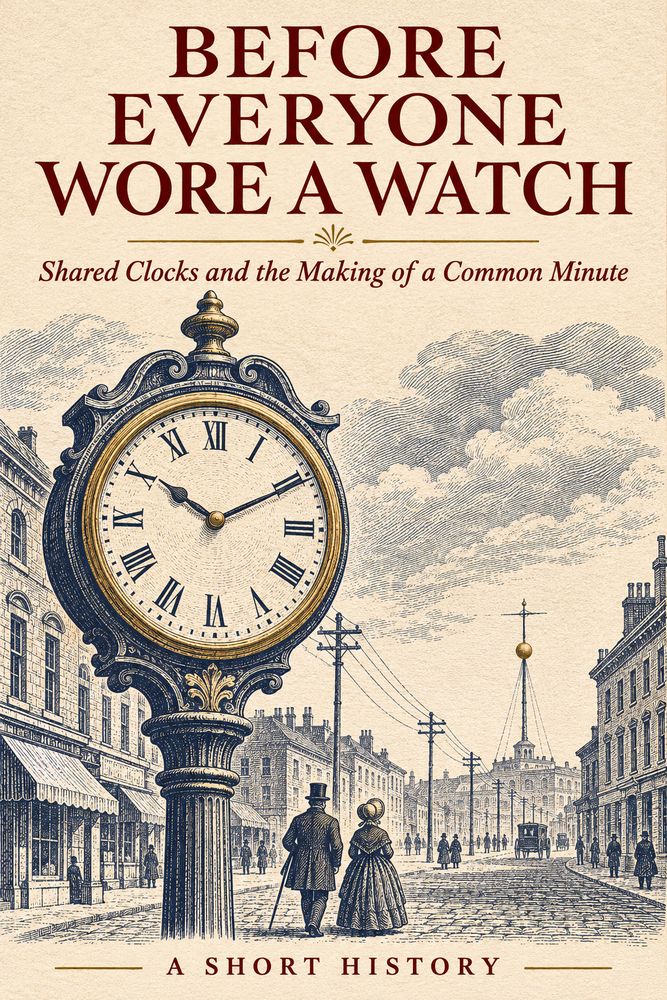
Return to the imagined meeting beside a public clock. We can now see more of the arrangement. Someone maintains a reference. A mechanism or person carries it. A face, movement, or sound communicates something intelligible. An observer receives it, compares expectations, and decides what to do. None of these stages is guaranteed merely because a clock exists.
The examples in this book offered different ways of making that connection. Greenwich made a moment visible. Westminster reminds us to distinguish a clock from its audible signal. The Belville service put a person between instruments. An electrical system connected displays to a reference elsewhere. A railway order specified both correction and permission. These are comparisons, not a universal sequence of progress.
The argument also ends without making the wristwatch a final liberation from shared time. A portable instrument changes where a person may consult an indication. Our historical railway example already shows that owning a portable timekeeper could coexist with a duty to compare. The owner of an instrument can still depend on a common arrangement beyond it.
Nor should we romanticize dependence on a public signal. A signal that serves one observer may be unavailable to another. These pages have asked us to investigate access, not to assume that the past offered either universal harmony or universal confusion. Both pictures would erase the practical differences the evidence reveals.
If you encounter an old clock in a station, street, or museum, you can therefore ask more than when it was made. What did its users expect it to tell them? Where did its reference come from? Which part did they see or hear? What happened when indications disagreed? Those questions open a human history inside an apparently mechanical object.
Our imagined visitors finally meet. Nothing in the example proves that the clock is perfect. What makes their meeting possible is a sufficiently shared understanding of how to use it. That is where this short history ends: with a minute made useful through reference, communication, attention, and agreement, and with the people who performed that work restored to view.
### Sources and scope
Research consulted 9 November 2026. Institutional interpretations are identified separately from historical records. No invented dialogue or illustrative observer is presented as a documented person. Modern operating status is not projected into the nineteenth century.
[S1] Royal Museums Greenwich, [Greenwich Time Ball](https://www.rmg.co.uk/royal-observatory/attractions/greenwich-time-ball).
[S2] Royal Museums Greenwich, [Greenwich Time Lady: Ruth Belville](https://www.rmg.co.uk/stories/time/greenwich-time-lady-ruth-belville).
[S3] Royal Museums Greenwich, [Electrical motor clock, ZAA0531](https://www.rmg.co.uk/collections/objects/rmgc-object-79636), including an extract from Airy's 1853 report.
[S4] University of Nebraska, Railroads and the Making of Modern America, [S. T. Smith's general order, 14 November 1883](https://railroads.unl.edu/documents/view_document_id=rail.gen.0002.html), transcription of a record held by the Library of Virginia.
[S5] U.S. Naval Observatory, [U.S. Time Zones](https://aa.usno.navy.mil/faq/us_tzones), historical section.
[S6] UK Parliament, [Constructing the most accurate clock in the world](https://www.parliament.uk/about/living-heritage/building/palace/big-ben/building-clock-tower/constructing-the-most-accurate-clock-in-the-world/).
[S7] Hansard, Commons, [Big Ben (Centenary), 3 February 1959](https://hansard.parliament.uk/Commons/1959-02-03/debates/82a5cd5c-8201-4c62-a410-30eb0a9a44c9/BigBen(Centenary)).