BOOK LIBRARY · Complete books · Purchases disabled
TrendWindow

← Book Library · Complete book

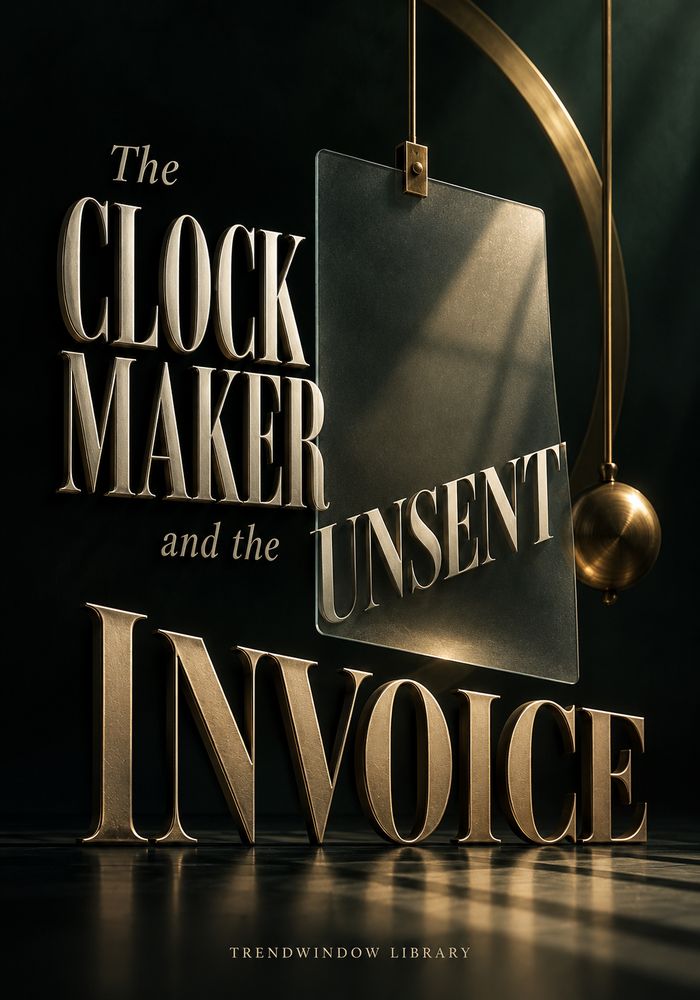
Front cover of The Clockmaker and the Unsent Invoice

Mystery, Crime & Thriller

The Clockmaker and the Unsent Invoice

By TrendWindow Library

An unsent invoice leads a repairer through a stopped town clock, a missing maintenance payment and the promise that kept her uncle silent. A complete original mystery.

Read this complete edition, including its ending and notes. No purchase is required.

1. The Drawer That Stuck

The drawer opened when Leena stopped pulling it straight.

She raised its left corner, eased the right one forward, and felt something release at the back. Her uncle had shown her the trick when she was thirteen. She had forgotten it during the fourteen years in which she repaired other people's kitchen cabinets and told herself that was a different trade.

Under a roll of thin brass sheet lay an invoice, folded once. The paper had browned along the fold. At the top, in her uncle's neat capital letters, were the words NORTH QUAY TOWN CLOCK. The date was 18 November 1998. Below it he had written: Twenty-four weeks' winding and attendance. Balance carried forward.

There was no amount. Across the bottom, in smaller writing, someone had added: Do not send this one to the council.

Outside, the clock above the fish market showed eleven twenty. It had shown eleven twenty for nearly twenty-eight years. Pigeons used the lower ledge. A banner advertising the harbour fair hung across the tower door, its bottom corner beating softly against a padlock.

Her uncle's funeral had been on Tuesday. On Thursday the council's property officer had come to ask whether she would sign a clearance form. The workshop stood on council land; its long lease would end with the estate. They wanted the keys before the fair.

Leena had said she needed time to sort the tools.

'Of course,' the officer said. His name was Colin Vale. 'We're not monsters. Monday would help.'

Now it was Friday. The drawer contained three invoices for mantle-clock repairs, a bus timetable, and this unfinished bill. Nothing else mentioned the tower.

She put the paper on the bench and opened the workshop's customer ledger. November 1998 occupied six cramped pages. There were kettle repairs as well as clocks; Uncle Arun had never enjoyed explaining the difference between a clockmaker and a shop that fixed things.

On the eighteenth, beneath a carriage clock returned to Mrs Yates, he had written: Tower stopped. Told C. Full winding not done. Paid M. from own pocket.

Leena read it twice. The words were plain. Their arrangement made no sense.

At four, she crossed to the market office to ask for the tower key.

2. Two Copies

The woman behind the market-office counter was using a biscuit tin to keep a window open. On her desk, the electric clock ran three minutes fast.

'We don't give out that key,' she said.

'I'm Arun Sen's niece.'

'I know. You brought him soup last winter.'

That was fair. Leena had come twice, not once, and had counted both journeys as proof she was helping.

The woman introduced herself as Marta. She remembered the stopped clock. Everyone did. The town's usual account was that Arun had quarrelled over a bill and refused to mend it. A newspaper had printed a photograph of him outside the workshop with his arms folded. It had looked like a declaration. Leena remembered the picture on her mother's fridge.

'Was that what happened?' she asked.

'I was sixteen. I knew what the paper said.' Marta turned her screen away from the window glare. 'What are you looking for?'

Leena showed her the invoice.

'He never charged for twenty-four weeks together,' Marta said. 'He came in every Friday. My mother used to give him the market-office wages envelope.'

'Your mother worked here?'

'Until 2001. She kept copies of everything because the duplicator made two whether you needed them or not.'

The old market-office papers, she said, had gone to the local-history room at the library. She could not promise what survived. She would ask about supervised access to the tower, but it would not happen that afternoon.

At the library, the relevant box was labelled MARKET: MISC. Inside were rent lists, a complaint about a gutter, and a folder secured with a strip of cotton tape.

The Friday payment sheets ended on 5 June 1998. Arun's name appeared each week against the same sum. Beneath his signature, another hand had written: Collected for M. Hale, attendance.

The final sheet had two copies. On the cream copy, the column headed PAYMENT RECEIVED contained a signature: C. Vale. On the pink copy, that space was blank.

Leena did not yet know what a difference between copies meant. She photographed both with the librarian's permission, including their edges, the heading, and the notes on the reverse. Then she wrote down the box reference instead of trusting her memory.

3. The Woman at Number Twelve

M. Hale was Miriam Hale. She lived at number twelve, a small house whose doorstep had been painted blue in two slightly different shades.

'I did the winding,' she said when Leena asked. 'Your uncle did the clock work. Those aren't the same thing.'

She invited Leena into the kitchen. There was a walking stick against the cupboard and a radio playing low beside the sink. Miriam switched it off without waiting for the weather.

Twice a week she had walked to the tower, opened the door, and wound the mechanism under Arun's arrangement with the market office. When something sounded wrong, she told him. She had kept a small notebook of her visits. She had stopped climbing the stairs after a fall in 2003; the clock had already been still for years.

'Uncle's ledger says he paid you himself.'

'For the last twenty-four weeks, yes.'

'Why?'

'Because the council said they'd paid him.'

Miriam brought out a green notebook. On its first page she had listed bus fares. The tower entries began halfway through, fitted around shopping lists and her daughter's school dates. Each week had two marks for attendance. The final entry read: Wednesday, 18 Nov. Stopped at 11.20. Arun says leave it. Wait for written instruction.

'Why would he tell you to leave it?'

'He'd found damage. He didn't want anyone taking responsibility for starting it until the repair had been agreed.'

'And that never happened?'

'No. Then they said he'd stopped it because of money. He wouldn't contradict that in public.'

Miriam took the invoice in both hands. She did not unfold it, only looked at the line about the council.

'You wrote that?' Leena asked.

'No. That's his writing. He used a different pen for little instructions.'

Leena had imagined a second hand. The letters were smaller, but the capital D had the same flat top. She put a question mark beside that assumption in her own notebook.

'Would you let me make copies of these entries?'

'You can copy them. You can't take the book away.'

Leena moved her tea away from the pages before she opened her camera.

4. Eleven Twenty

On Monday, Colin brought the tower key and a contractor who knew the building. Leena had expected an argument about the clearance deadline. Instead he asked whether she had found a buyer for the benches.

'Not yet.'

'I'd rather they were used,' he said. 'My father had a place like that.'

He said it so ordinarily that she found herself hoping there was a simple explanation for his signature.

Inside the tower, the stairwell smelled of cold stone and feathers. The contractor inspected the landing before allowing them farther. Leena touched nothing. She was here to look, not to repair an unfamiliar mechanism because her surname gave her a sentimental claim to it.

The clock stood behind a timber guard. A narrow strip of paper was tied to the guard with faded red thread. Arun had written on it: Do not operate. Inspect coupling. Report dated 18/11/98.

Leena photographed it from outside the guard.

'Have you seen this before?' she asked Colin.

'Not that I remember.'

'Was there a report?'

'Possibly. We'd need to check.'

He looked older in the grey light. She could not tell whether he was surprised or merely uncomfortable. She asked him about the payment sheets when they were back at street level, where she could hear his answer without the stairwell multiplying it.

He looked at her photographs.

'That was an advance,' he said. 'I collected a wages advance. Completely separate.'

'It is on the clock attendance sheet.'

'We reused forms. It was a small office.'

'Why isn't it on the other copy?'

'I don't know.'

He handed the phone back carefully. 'Don't make an accusation from a carbon copy, Leena.'

She had not made one. She knew, however, that she had arrived wanting his name to mean something definite. She wrote down his explanation next to the photograph numbers. If she was going to ask people to believe a paper trail, she would have to keep the parts that did not suit her as well.

The workshop clearance form remained on her bench. She had not signed it.

5. A Report Without a Clock

The report was filed under the address of the market, not under clock maintenance. The librarian found it on Tuesday after Leena supplied the date and the exact wording from the guard.

It was one page. Arun described a damaged coupling and proposed a repair. He also listed unpaid attendance fees from early June. At the bottom, under a line for the receiving officer, Colin had signed and dated it 19 November 1998.

Attached was a covering note from the market manager. The manager had written: Payment recorded as collected. Resolve internally before authorising further cost.

There was no reply.

Leena wanted to take this page to the newspaper. Instead she rang Marta and asked who had been market manager that year.

'Edith Marr. She died in 2012.'

'Was there a cash book?'

'Probably. The Friday sheets weren't the accounts. They were the record at the counter.'

The surviving cash book was still in council storage. Marta could request it through the current records officer. She would not promise a date.

That evening, Leena sat in the workshop with a takeaway balanced on a wooden offcut. For years she had repeated the story of her stubborn uncle. It had been a useful story. It explained why he never liked council letters, why the clock stayed still, why he did not want to come to the harbour fair. It had also let her imagine that leaving North Quay was the opposite of becoming him.

She opened the ledger again. Paid M. from own pocket. Each payment had an entry, not a flourish. He had made twenty-four of them.

The unfinished invoice troubled her more now. Why had he not demanded the money? Why tell himself not to send a bill to the people who owed it?

She turned the paper toward the bench lamp. The lower half showed two tiny square marks, evenly spaced. Something had been stapled there. Whatever it was, her uncle had removed it before folding the invoice into the drawer.

She went back through the drawer, this time lifting out the brass sheet.

6. The Small Envelope

The envelope was caught behind the drawer runner. It held a note and four faded receipts, each signed by Miriam. The note was addressed to Arun.

Please don't send another demand through the office. Colin came to see me. He says the missing money will cost someone their job and he will pay it back himself. I can't have this at my door. I just want to finish my Fridays and be left out of it. M.

Leena did not photograph it until she had telephoned Miriam.

'I thought he'd thrown that away,' Miriam said.

'May I bring it over?'

This time the radio stayed on. Miriam read the note in silence, pressing a thumb against one edge.

'He did come,' she said. 'He said the office had made a mistake. He didn't say he'd taken anything. He said there were people who would blame me because I wasn't on the staff.'

'Was that true?'

'I don't know. It was enough that I believed him.'

Arun had promised to keep Miriam's name out of an argument she did not want. He had kept paying her while he tried to resolve the account. Then the clock had failed, the repair had not been authorised, and the public story had settled into its convenient shape.

'You don't have to agree to anything now,' Leena said.

Miriam folded the note along its old creases.

'I'm eighty-one, not a child. I can decide.'

Leena waited.

'You can show it with the payment records,' Miriam said. 'And if someone asks why I was frightened, tell them I was trying to keep a small job. Don't turn me into the brave woman who knew all along.'

On the way home, Leena called Colin. She said she had found a note mentioning a visit he had made to Miriam and would give him a copy. She wanted his account before submitting the records for review.

He asked whether they could speak without anyone else there.

'At the market office,' she said. 'Marta can take notes.'

7. What Was Collected

The cash book arrived on Thursday in a cardboard transit box. Marta set it on a clean table in the meeting room. The records officer stayed with it while Leena compared the dates.

The payment on 5 June was entered as twenty-four weeks of clock attendance in advance. Colin's initials appeared beside the receipt number. There was no separate wages advance under his name that week. A later reconciliation listed the clock account as settled. The paper trail did not show where the cash went after collection.

Colin came at two. He brought no papers.

Marta read back the question: what had he done with the money collected on 5 June?

For a while he said nothing. He looked at the biscuit tin holding the window open.

'I used it,' he said.

Leena had expected an explanation to arrive with the words. None did.

'All of it?' Marta asked.

'Yes. I meant to replace it before anyone needed it. Then your mother asked about the attendance money, and I told her Arun had it. After that I couldn't see how to put it back without explaining.'

He had gone to Miriam because Arun had begun asking questions. He had told her there would be trouble. He acknowledged writing no correction after the clock stopped and the newspaper ran its story.

'Your uncle knew,' he said to Leena.

'He knew the money hadn't reached him.'

'I told him I'd repay it.'

'You didn't.'

'No.'

Marta asked whether he agreed that her notes could accompany the copied records to the current council manager. He said yes. She read the notes aloud. He corrected one date and signed them. Leena took a copy. She did not describe the meeting as a legal finding, and she did not accept the cash he offered to withdraw that afternoon.

'This was public money,' she said. 'You need to put your account in writing to the council. I can't settle it for everyone in this room.'

He nodded. When he left, he forgot his umbrella. Marta put it behind the counter with the others.

8. A Name on the Record

The council's response took longer than Leena wanted. Its manager acknowledged the documents, removed Colin from handling the market records while the matter was reviewed, and asked for a formal account from him. Leena kept the acknowledgement with her copies. Acknowledgement was not resolution. She had learned to read the difference.

The newspaper corrected its old account after examining the report and speaking to Miriam. It printed that the clock had stopped because a repair was required, that Arun had warned against operating it, and that he had paid attendance fees himself after the recorded council payment failed to reach him. Colin's admission was reported as his admission, with the council review still open.

There was no new photograph of a triumphant niece.

At the workshop, Leena found customers beginning to tell a different version of Arun. Now he had become a man who never made mistakes, a silent guardian who had sacrificed everything for others.

'He could be impossible,' she told one of them. 'He also did this work and wasn't paid. Both can be true.'

Miriam read the correction at the kitchen table. She wanted one sentence changed in the council's proposed historical note. It called her an assistant clockmaker.

'I wound it,' she said. 'He repaired it. Write down what we actually did.'

Leena carried that correction back herself.

The lease question was separate. She could not inherit a permanent workshop merely because the town felt guilty. She asked for an extension to clear it properly and a chance to apply for a small repair tenancy if the building remained available. The council gave her six weeks. The rest would require an ordinary application.

That evening she priced the benches, listed the tools that belonged to customers, and rang the woman who had asked her to fix a cupboard door before all this began.

'Friday,' she said. 'If you're still waiting, I can come on Friday.'

9. The First Minute

The town clock did not start when the newspaper correction appeared. It did not start when Colin returned money through the council's proper account, or when the manager published the outcome of the internal review: the old payment had not reached its intended recipient, the maintenance record would be corrected, and further handling of Colin's admitted conduct had been referred through the appropriate channels. Leena could say what had been established without pretending she controlled everything that followed.

It started in the spring, after a qualified specialist inspected the mechanism, completed an agreed repair, and recorded the work. The town had chosen to pay for maintenance openly this time. Miriam was invited to stand in the market courtyard while the clock was returned to service. She brought a folding chair.

Leena had secured a one-year tenancy for a smaller part of the workshop. Her first month's bookings were mostly cabinets, a loose banister and two lamps. She had put CLOCKS BY ARRANGEMENT on the door because confidence was not the same as competence.

Before the restart, she took the invoice from its protective sleeve. It still had no amount. She could now calculate what Arun had paid Miriam, but adding a number to his handwriting would make the paper say something he had never written.

She placed it beside the receipts, the corrected record, and a copy of the note Miriam had agreed to share. The originals would go into the agreed archive collection; Leena would keep copies. She put the staple marks in the description because they had mattered.

At eleven twenty, the minute hand moved.

No one clapped at first. People looked up, checked their phones, and looked up again. Then Miriam said, 'That's one minute properly accounted for.'

Leena laughed. It was not the line she would have chosen for a newspaper. It was better.

Later she made out an invoice for the repaired cupboard door. She described the work, entered the price they had agreed, and sent it before closing the workshop. Through the open window came the market's ordinary noise: a trolley wheel, a man asking for change, a woman calling that the fish had arrived.

Above it all, the clock kept going. Leena did not wait to hear the next stroke. She had promised a customer she would telephone.

10. About This Edition

This is complete original short digital mystery fiction. North Quay, its council and market, all people, documents, sums and events in this story are invented. The narrative does not report an actual financial investigation. Repair details establish the fictional plot and are not instructions for accessing a tower, diagnosing machinery or restarting a clock.

The central mystery is resolved: a recorded advance was diverted, an unpaid worker was paid privately, a repair warning was ignored in the public account, and an unsent invoice reflected a promise to protect a frightened worker. Documentary differences invite questions; the admission and corroborating records establish the story's answer. Subsequent official action is kept distinct from Leena's own conclusions. The ending does not award her an automatic tenancy or make personal repayment a substitute for proper accounting.

English is the canonical original. Writing, reader translations and editorial review are AI-assisted. No human-authorship claim, independent native-language proofreading certificate, ISBN or print proof is supplied. Original built-in generated English front and back cover artwork is conceptual and depicts no real document or institution. Ten fixed digital content units include nine narrative chapters and this edition note; these are not a claim about printed page count.

The complete approved edition, including its ending and this note, is intended for public reading. Purchases and payment providers remain disabled. The five reading translations preserve the full narrative, evidence sequence, consent boundaries and qualified official outcome; the original cover artwork remains English.

Explore more books →