BOOK LIBRARY · Complete books · Purchases disabled
TrendWindow

← Book Library · Complete book

Front cover of Four Boxes for a House We Sold

Contemporary & Literary Fiction

Four Boxes for a House We Sold

By TrendWindow Library

Ruth and Simon have one day to clear the things their mother left in her sold house. Four equal boxes cannot measure their different memories or years of care. A blue bowl and a wooden boat lead them toward a more honest way to share. A complete short story in eight chapters.

Read this complete edition, including its ending and notes. No purchase is required.

About this book

A complete short story about the things a family can divide, and the things it cannot

This is fiction. The family, house, sale and events are invented. It is not an account of a real family or advice about property or inheritance.

Original complete short literary fiction prepared with AI assistance. Family, house, sale and events are invented; not personal testimony or property or inheritance advice. Original conceptual covers. Translation meaning reviewed with AI, without independent native-language certification.

1. Names in black ink

My brother brings four identical boxes because he believes an argument can sometimes be prevented by buying the right size of container. He puts them in the kitchen and writes RUTH, SIMON, MUM and ASK on the flaps. His handwriting leans forward. Mine has learned to look patient even when I am not.

“One each,” he says. “One for anything she's forgotten. One for decisions.”

Mum has moved to a flat on the other side of town. She has taken the good chair, the television, her clothes and a surprising number of spoons. The house is sold. We are here to clear the ordinary things she has specifically left for us to choose from. The large furniture has already gone, and the new owners will receive the keys tomorrow.

I have come by train. Simon has come from twelve minutes away, a distance he does not mention and I can hear in everything he says.

On the counter Mum has left a list: cupboard by cooker, drawer under window, upstairs landing shelf. Underneath: anything with my name on it is already packed. Phone if unsure. Then, in a different pen: don't take the tea bags. I want those.

Simon sets his phone beside the list. He has arranged for the local second-hand shop to receive a small box of suitable household things this afternoon, but only if we have something to give. He has not promised them the contents of the house.

I choose the blue mixing bowl before we have begun. He watches me lift it from the cupboard.

“That takes half your box,” he says.

“Then I'll have to be careful.”

2. What fits inside a bowl

The bowl has a chip outside the rim, a pale crescent where the blue has gone. I put it on the table rather than inside my box. In it, I can see the cakes Mum made on Sundays when we were small, although seeing is the wrong word. There is no cake. There is the readiness to remember one.

Simon takes a heavy brass doorstop shaped like a pear. I remember it holding the back door open. He remembers carrying it upstairs to stop his bedroom door banging when the windows were open.

“I thought that was always downstairs.”

“Not always.”

We begin with this small disagreement because it is small enough to survive.

I tell him about the cakes. He says Mum often used the bowl for soaking tea towels. I know that. I say I know that too quickly.

For years Simon has done the everyday jobs that do not become attractive anecdotes: collecting a repaired lamp, waiting for a delivery, carrying the winter bedding down. I have sent money when Mum needed it and made long visits when work allowed. Neither account is false. Neither fits into the blue bowl, though I feel us both trying to put it there.

“You can have it,” he says.

“I wasn't asking for permission.”

He looks at the doorstop in his hand. “I wasn't trying to give it.”

We both have objects to look at now. That helps us avoid each other's faces.

3. The drawer under the window

The drawer contains rubber bands, a kitchen timer that no longer works, three loose buttons and a yellow envelope marked HOUSE. Simon opens the envelope just far enough to see old appliance instructions, then closes it. We leave it for Mum to check. A large word on an envelope does not make every paper inside ours to sort.

Under a folded cloth lies a small wooden boat. One side is painted red. The other is bare, except for a pencil line intended as a window.

“I made that,” I say.

Simon turns it over. My initials are on the bottom, crooked and deep.

“You started it. I finished the hull.”

I remember a wet afternoon and Dad's hand over mine on a piece of sandpaper. Dad died eleven years ago. His absence has had time to become part of the furniture, though the furniture is now gone.

Simon remembers the following weekend. I had gone to a friend's birthday party. He had sat with Dad and sanded the underside of the boat flat so it would stop tipping on the table. He cannot prove this. Neither can I prove that he did not.

We put the boat in ASK. It is our first successful decision, though it settles ownership of nothing.

Then he finds a photograph of Mum beside a bus, wearing a red coat. I say it is the morning I left for college. Simon says it was her coach trip to the coast a year later. On the back, in Mum's handwriting, is the name of the seaside town.

“I remember the coat,” I say.

“Yes.”

He does not add anything. I am grateful, then annoyed at needing to be.
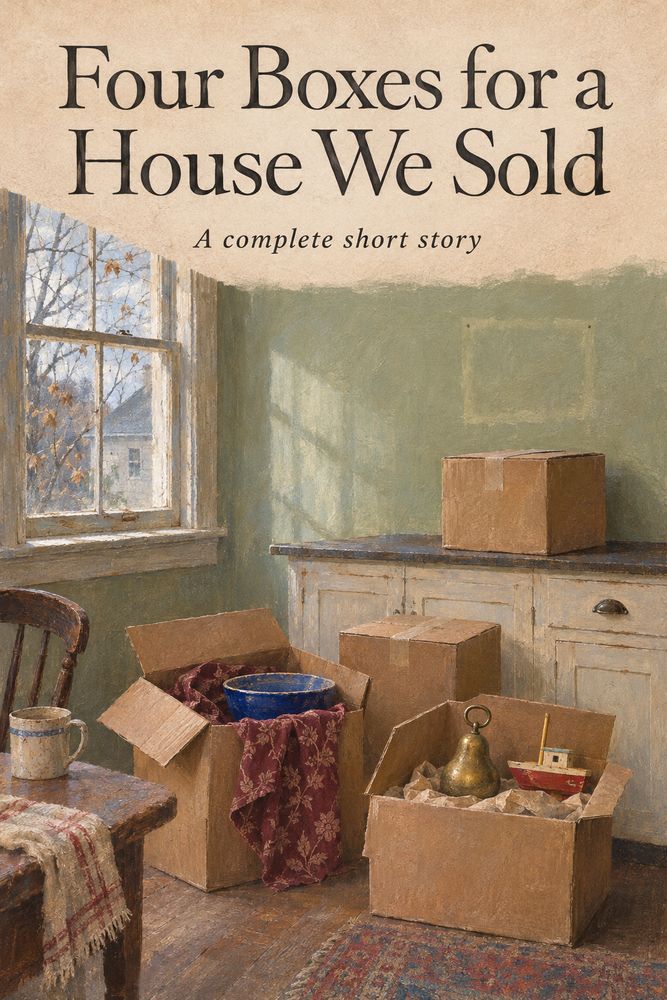
4. Equal boxes

By noon, Simon's box holds the pear-shaped doorstop, a small lamp and a framed print he has always disliked but now wants because it hung above his bed. Mine holds the bowl and a folded tablecloth. There is room for more, but I do not know what would make more mean enough.

I suggest counting. Not money, I explain quickly. Just objects, so that neither of us feels the division is uneven.

Simon sets down the print.

“Three buttons count as three? And that bowl counts as one?”

“You know what I mean.”

“I don't think I do.”

I hear a judgement about my visits. He hears an attempt to turn his years of small jobs into an inventory. Neither of us has said those things. We have left the other to say them silently.

At last he says, “Last winter, when the delivery was delayed, I sat here two whole afternoons. I know you couldn't just get on a train. I still hated being the one who was already nearby.”

I tell him about the evening Mum called me after an argument with him. I listened for nearly two hours, then went to work the next morning with no way to repair what I had heard. I had not told him because it would sound like competing.

“It does sound like competing,” he says.

“Yes. I don't know how else to say it yet.”

We stop counting. We do not agree that our contributions are equal. We agree that this room and these boxes cannot establish the answer.

5. Mum has a different list

Mum arrives at half past twelve carrying sandwiches. She walks past the bowl without looking sentimental and asks whether we have found the tea bags.

Simon gives her the photograph. She names two women outside the edge of the picture and the cafe where they had lunch. Neither of our memories contains them. The red coat belongs to a day larger than our argument.

She checks the yellow envelope and puts it in her bag. Then she picks up the wooden boat.

“I thought I'd lost this.”

I begin to explain who made which part. Mum says she remembers both of us working on it, but not which afternoon. For a moment I want her to remember harder. As if there is a drawer inside her which she has not bothered to open.

“Do you want it?” Simon asks.

“No. I was pleased to find it. That isn't the same thing.”

She says the boat can go to whichever of us wants it, if we can agree. She has already chosen what she wants in the flat. She does not want a fifth box delivered next month because we cannot bear to decide.

Then she points to the tablecloth in my box.

“That one makes me think of ironing.”

I remember birthdays. Simon remembers having to sit still while someone took a photograph. Mum remembers the iron.

We eat the sandwiches on the bare counter. She tells us her new neighbour has lent her a chair for the little balcony until she finds one she likes. We ask about the neighbour. It is the first conversation all morning that begins somewhere other than this house.

6. The thing we do not divide

After Mum leaves with the tea bags and her envelope, Simon puts the boat between us. He says he would like it, but not badly enough to argue over my initials.

I could insist on them. They are visible evidence, and visible evidence has been scarce today. But an initial can tell you who held a pencil without telling you every person who worked beside them.

I ask what he would do with it.

“Put it on the shelf by the stairs. Probably forget to dust it.”

I imagine the boat travelling home inside my bowl, then sitting on a shelf I do not have space for. This does not make his wish better. It makes mine more specific.

“Take it,” I say. “I'd like a photograph before you pack it.”

He asks if I am sure. I am sure enough for today, which is the only kind of sure I can honestly give. He takes a picture of the boat on the empty counter, then one with both of our hands beside it. We look older in the second photograph, though our faces are outside the frame.

The boat goes into his box without a new inscription. We do not put two sets of initials on it to make the past tidier.

I keep the bowl. We wrap it in the tablecloth after I decide I still want the cloth, even knowing what it cost Mum in ironing. It is possible to like a thing without asking everyone else to like it in the same way.

The broken timer remains on the counter. Neither of us wants it. We separate it from the things suitable for the shop. Simon puts it in a separate carrier to take away and deal with appropriately. Not everything discarded is a betrayal. Not everything old needs a rescue story.

7. The fourth box

We cross out ASK and write SHOP below it. Into that box go two plain serving dishes, a clean jug and four cups, all from the things Mum has authorised us to pass on. Simon rings the shop to check they still want those items. They do. We do not add the timer beneath a layer of better things.

The MUM box holds only a little packet of spare shelf pegs she asked us to keep. We could fold the box flat and put the packet in a pocket. Instead Simon uses the spare space for the empty plant pots she has just asked him to bring from the approved landing shelf. She intends to plant something on the new balcony. She has not decided what.

I carry my box to the car. Simon carries his. Mine is lighter than I expected. His is heavier. We do not fetch the scales.

At the shop, a woman checks the dishes before accepting them. She thanks us for bringing only what we had described. Through the back doorway, I see other boxes waiting. Our family has not invented the problem of objects continuing after their first purpose.

Simon asks whether I want the empty fourth box. I say no. The woman says she can use it. We leave it there without photographing it.

On the drive to Mum's flat, he asks what time my train leaves. I tell him, then ask whether there is time to see her balcony. There is. The afternoon has not become generous without limits. It has room for one more visit.

8. A different kind of space

Mum's balcony is barely wide enough for the borrowed chair and a person standing beside it. Simon puts the pots against the wall where she directs him. I hold the packet of shelf pegs until she finds a drawer. She chooses one herself.

The empty box stands by the door. Mum asks us to fold it. We do. No one has to keep a container simply because it once had their name on it.

She shows me where the good chair faces the window. The flat is not a smaller version of the house. The furniture has new neighbours. A lamp that always stood behind the television now lights the place where she reads. There is no space waiting to be filled with our approval.

Before leaving, I tell Simon that next time Mum needs someone to wait for a delivery, he can ask whether I can arrange a day. I cannot promise every day. He says he will ask before assuming the answer. It does not reimburse last winter. It gives us a different sentence to try next time.

On the train, I put the box between my feet. Simon sends the photograph of our hands beside the boat. I save it without adding a caption about the best father or the happiest house. I write back that the red paint looks brighter than I remembered.

At home, I unwrap the bowl and put it on the kitchen shelf. The tablecloth goes in the drawer below. There are no cakes in the bowl and no tea towels. For the moment it holds nothing.

I call Mum to say I have arrived. She tells me the evening light reaches the balcony later than she expected.

I ask what she can see.

Explore more books →