BOOK LIBRARY · Complete books · Purchases disabled
TrendWindow

← Book Library · Complete book

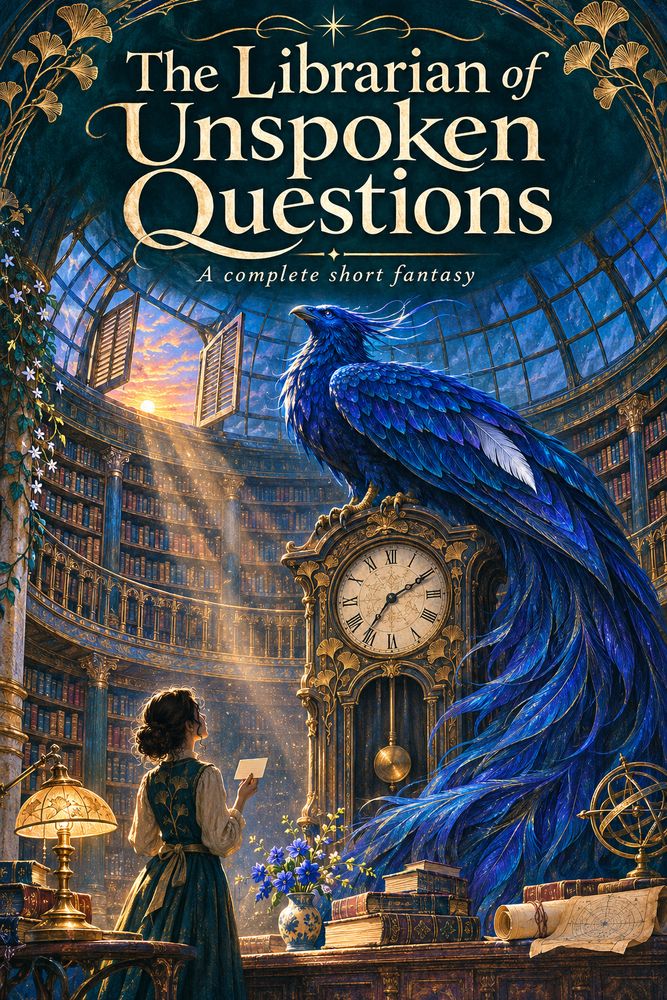
Front cover of The Librarian of Unspoken Questions

Fantasy & Science Fiction

The Librarian of Unspoken Questions

By TrendWindow Library

In Aster, deliberately unasked questions become birds. Librarian Sera has hidden the owner of one enormous blue bird for nine years. A library move forces her to correct its record and find a willing witness. A complete short fantasy in eight chapters.

Read this complete edition, including its ending and notes. No purchase is required.

About this book

A complete short fantasy about a borrowed silence and the courage to give it back

This is fiction. Aster, its people, its library and the behaviour of its question-birds are invented.

Original complete short fantasy prepared with AI assistance. Aster, its people, library and magical question-birds are fictional. Not personal testimony, therapy or animal-care advice. Original conceptual covers. Translation meaning reviewed with AI, without independent native-language certification.

1. The bird above the clock

At first light, a yellow bird appeared inside a baker's empty flour bowl. By noon, he had brought it to the Library of Unspoken Questions, with the bowl, because he did not trust himself to hold something so light.

“Does it bite?” he asked.

“Not for asking that,” said Sera.

The bird came from a different question. In Aster, a question fully formed but deliberately left unasked took feathers at the next dawn. It remained a question-bird until its owner asked it aloud: to the person concerned, or, if that person could not be reached, to a willing witness. Questions addressed to oneself still needed another listener. The answer might never come. The asking was what changed the bird.

The library kept the birds their owners were not ready to release. Owners supplied their names and could choose whether to describe the question. Sera did not read minds, and no question appeared on a wing. People often found this disappointing. They preferred a mysterious librarian to an ordinary woman who needed a properly completed card.

The baker gave his name, Orven, then asked for a week. Sera wrote the return date and opened a low perch. He left the bowl too.

Above the clock, a dark blue bird watched her. It had a white feather in its left wing and a tail now longer than the clock's pendulum. Its card said UNCLAIMED. Sera had written that word nine years earlier. It was the only card in the room that she knew to be a lie.

Her apprentice Pell followed her glance.

“It has grown again.”

“They do, when they wait.”

“I know. I meant we have run out of space to pretend it hasn't.”
2. A room for waiting

Pell had worked through one winter. He knew how to leave the roof shutters open for ordinary birds and closed against heavy rain. He knew that question-birds ate no grain, though a saucer of water might please a visitor who wanted to do something useful. He also knew that borrowed silence required records.

That afternoon he spread a plan across the desk. The council had approved repairs to the glass roof. For six weeks the collection would move to the old map room, whose windows opened onto the inner court. Its doorway was narrow. The blue bird could not pass through with its wings folded.

“We can use the roof opening,” Sera said.

“The workers need that opening. And the map room still has the same door.”

He did not say it triumphantly. Sera found this harder to bear than a triumph.

They had seven days before the move. All owners had been invited to collect their birds, extend their loans or ask their questions. The notice did not tell anyone to be brave. Some questions concerned people who would punish the asking. Keeping a bird could be a deliberate protection, not merely a failure of nerve.

But UNCLAIMED had no address to notify.

Pell suggested the city register, then the harbour notices, then an announcement without a description. Sera rejected each proposal with a different reasonable sentence.

Finally he put down his pencil.

“Are we trying to find the owner, or trying to avoid finding one?”

The clock struck four beneath the bird. Its tail brushed the minute hand and held the sound back for half a beat.

3. The crossing she had not made

Sera's sister Neri had left Aster nine years ago to build bridges in the western marshes. She had offered Sera a place in the cart, then in the house she hoped to rent. Sera had stayed to run their mother's small binding shop after their mother's death.

That was the explanation she gave everyone. It was true, but not complete.

The shop had already been sold. The new owner had offered Sera three months of paid work to finish the remaining orders. Neri had offered to wait those three months. Sera had said there were other things to settle. When asked what things, she had grown so cold that her sister stopped asking.

At dawn after the cart departed, a blue bird sat on the unused cushion by Sera's kitchen window. She carried it to the library, where she was then a part-time clerk, and entered it as unclaimed. No one had seen her arrive.

She was good at keeping a room orderly. Over nine years that talent had become her profession. Neri's letters arrived twice a year, sometimes with drawings of bridges that looked too narrow to hold their own shadows. Sera answered with accounts of weather, book repairs and the increasing price of lamp oil.

She did not ask the question. She had never said it aloud, not even alone.

Why did I stay?

It seemed an accusation without a suitable defendant. Saying it to Neri might sound like blaming her for leaving. Saying it to a stranger might loosen the story that had made Sera's life appear inevitable.

That night, she took the old card home. Under the lamplight, UNCLAIMED looked less like an administrative error than it ever had.

4. What the baker asked

Orven returned on the third morning. He brought his daughter, a young woman with flour on one sleeve and a blue ribbon tied around a packet of drawings.

“This is not about whether she loves me,” he told Sera before anyone asked.

His daughter closed her eyes briefly.

The yellow bird hopped into its bowl. It was larger now, but still small enough to be cupped in two hands.

Orven faced his daughter. “Do you want to keep the bakery when I stop?”

“No,” she said.

The bird shook itself. A little yellow dust fell from its feathers, and it became an ordinary finch. It looked around for food with the offended impatience of a creature that had just discovered hunger.

Sera opened the upper shutter. The finch flew to the courtyard tree. There would be no card for its next journey.

Orven sat down. His daughter did too. She untied the packet and showed him drawings of boats, not loaves. Their conversation did not become easy merely because the bird had become light. He asked who would take the shop. She said she did not know. He asked how long she had known she wanted something else. Her answer hurt him.

Sera brought two cups of water and left them to talk. She did not write RESOLVED on the card. She wrote QUESTION ASKED and returned the bowl.

From above the clock came a sound like cloth pulling tight. The blue bird had spread one wing. Its white feather touched the edge of the roof beam.

5. The wrong remedy

Sera stayed after closing and moved the tallest shelves. She thought that if the bird could stand lower, its body might fit beneath the map-room lintel. The idea survived until she measured the bird. Then she moved the shelves back.

She considered telling the question to an empty room. But the library's rule was not a trick of sound. Asking required an attempt to be heard. An empty room could hold a rehearsal; it could not be a willing witness.

She also considered asking a different question. Why had Neri left? Why had no one insisted Sera go? If she kept those unasked too, they might produce other birds. Asking them would not change this one. She knew that much from years of seeing people try to exchange a question they owned for one they preferred.

Pell found her standing on the low step beside the clock. He had returned for his raincoat. The blue bird lowered its head until its eye was level with hers.

“It is mine,” she said.

The bird did not change.

Pell looked at the card in her hand. “Then we need your name on it.”

“You are not going to ask what the question is?”

“You tell other people they don't have to tell us.”

Sera climbed down. Together they made a correction without erasing the old entry. Sera, owner; earlier record inaccurate; corrected that evening. Pell added his initials beside hers. It was a small piece of work. She had imagined confession would be larger and less practical.

Before leaving, he said the map-room problem remained.

“I know.”

“I can listen tomorrow. If listening is what you need.”

6. A witness, not an answer

In the morning, Sera put two chairs in the courtyard. Pell chose the one without the broken cane seat. She had forgotten about the seat. He pointed it out; she fetched a sound chair and laughed once at the timing of ordinary things.

She told him about the cart, the sold shop and the offer to wait. She did not make Neri generous beyond recognition or herself secretly heroic. She had loved the shop. She had also feared being a beginner somewhere that did not already know her name.

“I can't tell you which reason was the real one,” she said.

“Perhaps there was more than one.”

Above them, the library shutter stood open. The blue bird watched from the clock. It was too wide for the shutter as it was now.

“The question is to me,” Sera said. “Not to my sister.”

Pell nodded. He would hear it; he would not answer in her place.

Sera felt an absurd wish for a ceremonial bell. Without one, she would have to decide for herself when to begin.

“Why did I stay?”

For a moment nothing happened. The clock kept time. Somewhere a cart wheel struck a loose stone. Then the bird drew its enormous wings against its body, and blue dust drifted down through a shaft of light. It grew smaller, not younger. In another breath it was a blue jay with one white feather, perched on the clock's wooden rim.

It flew through the open shutter, passed over the two chairs and landed on the courtyard wall. Sera could not tell whether it would remain in Aster. That was no longer a decision the library could make.

She had asked. She still did not know the whole answer.

7. The letter that made room

Sera wrote to Neri that afternoon. She began three times. The first version apologised for everything so broadly that it explained nothing. The second made the years sound like a misunderstanding her sister should have corrected. She set both aside.

In the third, she wrote that the shop had not been the only reason she stayed. She had been frightened of leaving, proud of being needed and angry at Neri for being able to imagine another life. None of that made the coldness fair.

She did not ask her sister to certify this explanation. It was the clearest account she could give that day, not a final judgement on her younger self.

Then she asked whether a visit in spring would be welcome. She could arrange leave, if they found a time that suited both of them. She wanted to see a bridge Neri had built. She did not offer to move west forever or announce that nine years in the library had been wasted.

Pell saw the addressed envelope on the desk and said nothing about it. Instead he asked whether the lowest perch should go beside the map-room window or farther from the draught.

They tested both positions with the window open, then chose the sheltered corner. The yellow finch returned to the courtyard tree while they worked. Neither could prove it was Orven's former bird. They left that pleasant possibility unrecorded.

At dusk, Sera took her letter to the post room. The clerk stamped it and placed it in the westbound bag. Nothing in the bag glowed. The ordinary journey would take as long as ordinary journeys did.

8. The space above the clock

The collection moved on the seventh day. Owners who wished to keep waiting had renewed their arrangements; their birds were carried carefully to the map room. The workers began on the roof. No one was required to tell a private question merely to make the move convenient.

Sera's corrected card travelled with the records. She added QUESTION ASKED and the date. Below that she wrote: answer unfinished. Pell asked whether that last line belonged in the public register.

“No,” she said after a moment. “It belongs to me.”

She moved that last line to a private piece of paper, leaving her name, the correction, QUESTION ASKED and the date in the register. Even a lesson she had learned honestly was not a reason to abandon another useful boundary.

Neri's reply arrived three weeks later. A spring visit would be welcome. There was a bridge she wanted to show Sera, though it was less impressive than her drawings made it look. She was glad about the letter. She was also still hurt by some of the old ones. Could they talk about those when Sera came?

Sera read the page twice. Then she wrote yes.

Six weeks after the move, they returned to the repaired library. The clock sounded clearer without a tail across its face. Sera stood beneath the empty perch and looked through the open shutter. A blue bird crossed the courtyard, too quickly for her to see its left wing.

She did not call it back to settle the matter.

A visitor waited at the desk with a small grey bird inside a basket. Sera asked for the owner's name and how long they wished the library to keep it. There was space on the shelf. There was a spring journey on her calendar. Between those two facts, her life had become neither entirely new nor entirely explained.

It had become possible to ask what came next.

Explore more books →