BOOK LIBRARY · Complete books · Purchases disabled
TrendWindow

← Book Library · Complete book

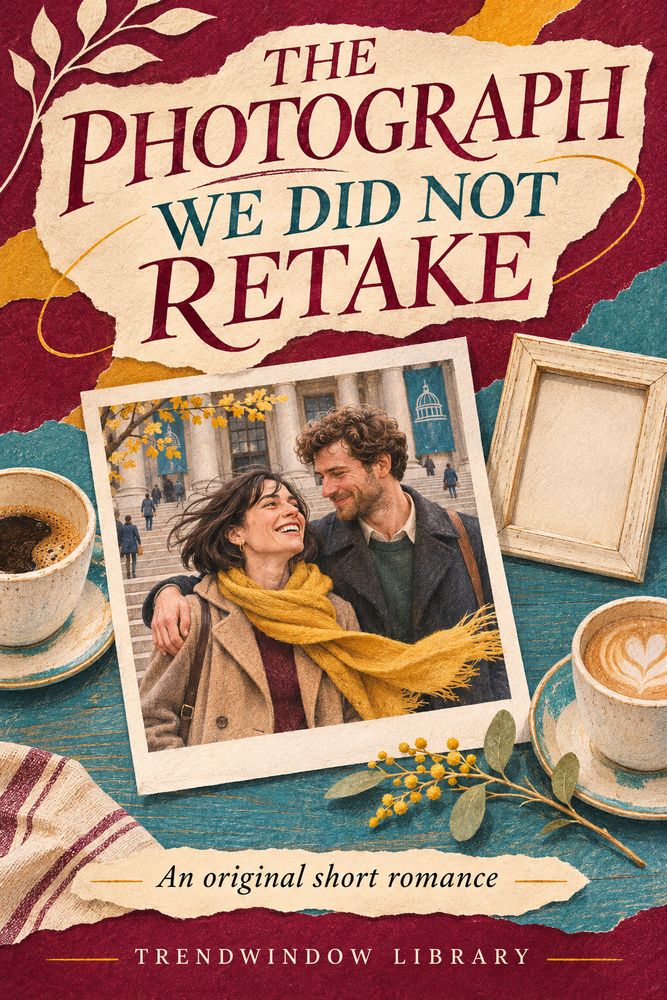
Front cover of The Photograph We Did Not Retake

Romance & Relationships

The Photograph We Did Not Retake

By TrendWindow Library

An original complete short romance. For their second anniversary, Tessa wants a new photograph together. Owen wants a say in its audience. A windy morning and an imperfect picture help two adult spouses choose how to be seen without pretending every difference has disappeared.

Read this complete edition, including its ending and notes. No purchase is required.

1. The Empty Frame

For their second wedding anniversary, Tessa bought a frame with no photograph in it. She set it on the kitchen table between the sugar bowl and Owen's unopened post. It was blue, slightly crooked and large enough to make her plan look more settled than it was.

“Saturday,” she said. “Same steps. Same coats, if we can find them. A photograph of us two years later.”

Owen looked up from his toast. At thirty-six he still wore his brown curls longer than he intended. Tessa, thirty-four, had cut her dark hair short since the wedding, which was one reason she wanted another picture. In the framed wedding photograph in the hall she looked like someone she remembered being rather than someone she met in the mirror.

“The exact same pose?” he asked.

“Approximately. We can leave room for the hair.”

“And the fact that I've become distinguished.”

“That may not fit in the frame.”

He laughed, then said yes. Tessa wrote Saturday, eleven, civic steps on the small calendar. Their wedding had been a quiet invented civic ceremony in their own town, with two friends and a lunch that ran into dinner. She did not want a larger anniversary. She wanted a photograph she had not taken herself, with both of them present.

Owen was usually behind the camera. On their trips she had twenty pictures of him and he had twenty of the place. In family photographs he stood at the edge, looking prepared to leave room for a person who had not arrived. Tessa had begun to feel that she was asking him to step into their life whenever she asked him to stand beside her for a picture.

She did not say that at breakfast. She placed the frame on the windowsill and began looking for her coat.

2. Where the Pictures Went

On Wednesday Tessa's sister sent a message about Sunday lunch. Under it was a photograph from last month's family gathering. There were seven people in the picture, including Tessa. Owen had taken it. Below, somebody had written: Lovely to have everyone together.

Tessa put down her phone harder than she meant to. Owen heard it from the sink.

“What happened?”

“Apparently everyone was together.”

She showed him. He shrugged. “I was holding the phone.”

“I know. You always are.”

“Because someone has to take it.”

“Someone else could.”

The conversation stopped at those three words. Owen went back to the plates. Tessa knew he had made her tea that morning and fixed the loose kitchen handle without being asked. She was not compiling a case that he did not love her. She was trying to name a place where she missed him, and every sensible answer seemed to move him farther out of the picture.

Later Owen asked if she intended to post Saturday's photograph online. She said she had thought about sending it to family, perhaps posting it too.

“I don't really want that,” he said.

“You don't want a picture with me?”

“I didn't say that.”

“It sounded close.”

He sat down opposite her. “I don't like finding out afterwards that something private has become an announcement. Last year you posted the picture of me asleep on the train.”

Tessa remembered the photograph. She had thought it affectionate. Owen had asked her to take it down, and she had, but she had also teased him about being mysterious. Remembering the joke now, she could hear how little room it had left for his actual answer.

“I shouldn't have made fun of that,” she said. “I still want a picture together. I don't want to confuse those two things.”

Neither yet knew how to separate them. They left Saturday on the calendar.

3. The Wrong Coat

On Friday Owen found his wedding coat behind a suitcase. When he put it on, a button came off in his hand. He stood in the bedroom holding the button while Tessa tried to remember whether her yellow scarf had been in the original photograph.

“We don't have to look identical,” she said.

“Then why are we doing the same picture?”

She heard impatience. He heard a demand to be less impatient. Neither was quite what the other meant.

“Because I want to see us,” she said at last. “Now. Not just as the people who got married. And not as me beside a landmark while you hold the phone.”

Owen sat on the bed. The loose button looked absurdly important in his palm.

“When you start arranging my shoulders and telling me to smile again, I feel like there's a correct husband for the photograph and I'm failing to produce him.”

Tessa remembered asking for another smile at a birthday, then another because the first looked forced. She had wanted a happy picture. She had not wondered what it felt like to be told that the visible version of your happiness was wrong.

“I don't need a correct husband,” she said. “I do want you to choose to be in the picture. That's the bit I haven't said properly.”

“I can choose that,” he replied. “I don't want the choice to include an audience I haven't agreed to.”

They made a smaller plan. They would go to the steps in whatever coats were ready. Their friend Jules, who had taken the wedding photograph, would take a few pictures. None would be shared without both agreeing. They would choose one for the blue frame. If the outing became miserable, they could stop and still have their anniversary lunch.

Tessa sent Jules the new plan. Owen found a different coat. The button went into a saucer, where it could remain a repair rather than a symbol.

4. In the Wind

Saturday arrived windy. Jules met them at eleven with a camera and a paper bag of biscuits. The civic steps were empty except for a man waiting for a friend and a gull investigating the bag with professional interest.

“Where do you want to stand?” Jules asked.

Tessa glanced at the old photograph on her phone. Two years earlier they had stood on the third step. Owen had held her hand, and she had leaned towards him with the startled confidence of someone who had just said something important in public.

“Here is fine,” she said, choosing the first step instead.

Owen stood beside her. She reached for his hand, then asked, “All right?”

“Yes.”

The first picture caught Tessa looking at a bus. The second caught Owen trying to stop her scarf from blowing into his face. In the third, the gull made a sudden hopeful move towards the biscuits, Jules shouted a surprised protest, and both Tessa and Owen laughed.

Tessa began to say, “One more, with the scarf—” Then she stopped. Owen turned to her, waiting to see what she would ask.

“Do you want another one?” she said.

He considered it. “I'd rather look at those first.”

They sat on a low wall and looked at the screen. In the third picture, Owen's hand was wrapped around the end of the yellow scarf. Tessa's hair stood up on one side. His mouth was open in a laugh, and hers had become an unplanned grin. Neither looked like the wedding photograph. Both looked like people who had heard the same ridiculous thing.

“That one,” Owen said quietly.

Tessa looked again. She could see the temptation to improve it: straighten the scarf, flatten her hair, move the bus out of the distant background. She could also see his hand, and the ease of her own shoulders.

“That one,” she agreed.

They did not retake it. Jules accepted a biscuit in payment for nothing more binding than friendship. The gull received none. They went to lunch, and nobody asked the day to become evidence that their marriage had no difficulties.

5. Everyone Together

Jules sent the photographs that afternoon. Tessa and Owen chose the third image for a print, using a printer they already had at home. It took two attempts because the first sheet went in crooked. Owen trimmed the white edge, Tessa fitted the print, and the frame turned out to be straighter than its first position on the table had suggested.

They put it beside the wedding photograph in the hall. The newer image did not replace the old one. They were two occasions, not a competition for the official version of their happiness.

“Can we send it to your mother and my sister?” Tessa asked.

Owen said yes to a private message, and she sent it only to those two people, asking them not to post it. They decided not to put it online. Tessa noticed a brief disappointment: she had imagined the public pleasure of showing them together. She could acknowledge that wish without making it Owen's obligation to satisfy it.

“I do want people to know you're with me,” she said.

“They do,” he answered, then paused. “But I think you're asking for more than a fact everybody knows.”

She nodded. “I want not to be the only one arranging how we show up together.”

On Sunday at her sister's lunch, the familiar gathering began to form near the garden door. Owen reached for the phone, then stopped. He asked Tessa's sister to take the picture and stood beside Tessa in the middle. It was a family photograph, meant for the family group they had both agreed it could be sent to. No wider sharing was promised.

Tessa did not straighten his collar. Owen did not hide behind the person next to him. Afterward he stayed to help clear the table, and she joined him. The image mattered, but so did the afternoon they were still having after it.

6. What Stayed in the Hall

The next week, Owen sewed the button back on his old coat. Tessa found him at the kitchen table, frowning at the thread, and offered to hold the lamp nearer. He accepted. Neither said that the coat would now be ready for a better photograph.

The picture in the blue frame became something they passed on the way out. Some days Tessa noticed her hair. Some days she noticed the hand around her scarf. Owen said the gull was just outside the frame, which made it their least visible family friend.

One evening Tessa came home to find him looking at it. “Do you regret not doing the proper one?” he asked.

“That is the proper one,” she said. “It was us on Saturday.”

He nodded, then admitted that he still disliked being photographed without warning. She said she still liked having photographs together. Neither statement had been abolished by the anniversary. They could keep asking instead of pretending the difference had disappeared.

Owen put an arm around her. “We could go back to that lunch place next month.”

“For a photograph?”

“For the potatoes.”

“A convincing reason.”

He kissed the side of her head, and she leaned against him. They stood there for a moment with the two photographs, the newer one slightly lower because Tessa had measured the hook badly. She did not ask him to move while she fixed it. They went into the kitchen together to decide what to cook.

The frame had a photograph now. Their anniversary had an ending: a picture chosen by both, a lunch remembered, a small promise put into practice at a family door. Beyond it was the ordinary life they would go on making, visible to each other even when no one lifted a camera.

Edition Note

This complete short romance is original fiction. Tessa, Owen, Jules, their families, town, ceremony and photographs are invented. Tessa is thirty-four and Owen thirty-six; they are adult spouses celebrating two years of marriage. No real private photograph, family message or personal case is reproduced. The story provides no marriage-law, photography, medical or psychological advice. A mutually chosen picture does not guarantee that every difference in a relationship is resolved. Original AI-assisted writing and translations with editorial review; no independent human-authorship or native-human certification is claimed. Original conceptual English cover illustrations are generated artwork, not documentary images. Digital edition without an ISBN or print proof.

Explore more books →