BOOK LIBRARY · Complete books · Purchases disabled
TrendWindow

← Book Library · Complete book

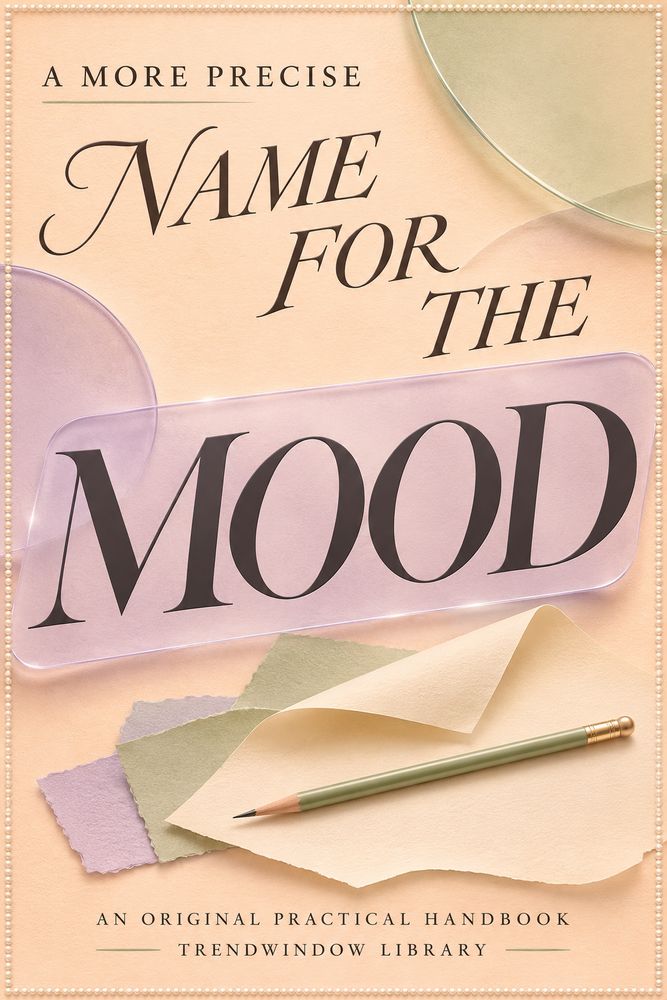
Front cover of A More Precise Name for the Mood

Personal Growth & Psychology

A More Precise Name for the Mood

By TrendWindow Library

Describe ordinary feelings with clearer words. A short handbook with a complete fictional example, a six-heading record and bounded primary research notes.

Read this complete edition, including its ending and notes. No purchase is required.

Chapter 1 — Begin with the Moment, Not a Verdict

Emil arrived at the bookbinding workshop with a cloth bag of loose pages. The door was shut. A notice said that a burst pipe had forced the session to be cancelled. The organiser would email participants on Monday about a replacement date and ticket options.

‘Bad mood,’ he told his friend Suri on the way home.

It was not a false description. It was also not very informative. He had travelled across town, wanted to show someone his pages and still had an errand he had promised to finish that afternoon. Several things were sitting inside those two words.

This handbook offers an original exercise in describing ordinary feelings more precisely. Emil and Suri are fictional; their experience is not research data. The title uses ‘mood’ in its everyday sense. The exercises do not distinguish clinical conditions, diagnose anyone or replace care for persistent or severe distress.

Start with a moment small enough to describe. ‘Outside the closed workshop on Saturday morning’ gives your words a setting. ‘My whole life is a failure’ is a verdict far beyond the available scene. You may genuinely feel that verdict, but writing it does not establish it as a fact.

Separate a few observable details from the description of your response. The door was shut. The notice mentioned a pipe. No email had yet arrived. Those are parts of Emil’s invented event. ‘Nobody cares about my time’ is an interpretation of other people’s motives, not something the notice says.

You do not need a polished account. A sentence such as ‘I was standing at the locked door after travelling there’ is enough to begin. Nor must you identify a feeling instantly. ‘I don’t have a word for it yet’ is a usable starting point.

The aim is not to find an impressive term. It is to describe a moment in words you can recognise when you read them back.

Chapter 2 — Try Two Nearby Words

Emil considers ‘angry’. He does not want to shout at anyone. He is bothered by the wasted journey, but the larger feeling is that something he wanted has not happened. ‘Disappointed’ fits that part better. ‘Irritated about the journey’ fits another.

These are not official definitions with sharp borders. In this exercise, disappointment points toward an expectation that was not met; irritation names the smaller aggravation of travelling unnecessarily. Another person might use the words differently. The test is whether the wording clarifies Emil’s own account, not whether he passes a vocabulary examination.

Try two nearby words instead of searching an endless list. What would make one fit better than the other? If you choose ‘lonely’ rather than ‘bored’, perhaps you are missing company rather than an activity. If you choose ‘uncertain’ rather than ‘afraid’, perhaps the unknown detail matters more than an anticipated danger. These are possible distinctions to consider, not diagnoses made from a single word.

Emil writes, ‘Disappointed because I wanted to try binding my pages with someone who knows the process. Irritated because I travelled before seeing the notice.’ The two sentences carry more information than ‘bad mood’. They do not make the workshop reopen.

Everyday words are welcome. ‘Let down’, ‘on edge’ or ‘a bit flat’ may be more natural for you than an abstract label. A phrase can be precise without being one dictionary entry. If you use more than one language, choose the wording that makes sense in that language; do not force every feeling into an identical word-for-word slot.

You can stop after a reasonable attempt. No hidden perfect label is waiting to reward you for spending the whole afternoon looking.

Chapter 3 — Let More Than One Feeling Be Present

On the bus, Emil notices another response: relief. The cancellation leaves enough time to collect the repaired lamp he had promised to pick up for his neighbour. He had been wondering whether the workshop would run late.

Relief does not prove that he never wanted the workshop. Disappointment does not prove that the free afternoon is worthless. Both descriptions fit different parts of the same morning.

Write each with its own object. ‘Disappointed about missing the workshop. Relieved to have time for the errand.’ This is clearer than making the feelings argue about which one is authentic. You do not have to turn them into percentages that add up to a hundred.

The same permission applies to pleasant occasions. You may feel proud of a finished task and nervous about showing it. You may welcome a visitor and feel tired after preparing. These combinations are not evidence, by themselves, of hypocrisy or a disorder. They are possibilities to describe in context.

Keep the description close to what you know. If Suri says she would have felt only annoyed, Emil does not have to replace his relief with her answer. She is reporting a different imagined response. Neither account gives her access to his internal experience.

There is research on putting feelings into words, but it should not become a promise attached to this exercise. Lieberman and colleagues’ 2007 laboratory study involved labelling emotional images during brain scanning. Its findings are not a guarantee that naming an everyday feeling will calm you or resolve the event that prompted it.

Emil still wishes he had been inside learning to bind his pages. He also gets off the bus in time to collect the lamp. The vocabulary makes room for both facts without pretending that one cancels the other.

Chapter 4 — Distinguish a Feeling from a Story About Someone

At the repair shop, Emil checks his phone again. There is still no message from the workshop. He writes, ‘Rejected by the organiser.’

Then he reads the notice he photographed. It says that the session was cancelled for everyone and that an email would come on Monday. It is still Saturday. He has no evidence of a personal refusal.

‘Rejected’ describes how the morning feels to him, but in this sentence it also implies an action by another person. He revises it: ‘Disappointed, and self-conscious about how much I wanted someone to see my pages.’ The revision does not deny the sting. It removes a claim he cannot support.

A feeling can be genuine while the explanation attached to it is uncertain. ‘I felt embarrassed when nobody replied’ reports a response. ‘They stayed silent to humiliate me’ adds an intention. If the intention matters, it needs evidence beyond the fact that embarrassment was present.

You do not have to assume every interpretation is wrong. There may be a real broken agreement or unkind act. Keep the evidence and the response distinct so that neither has to do the other’s job. A clear account might say, ‘They promised to reply by Friday and did not. I feel frustrated. I do not know why the reply is late.’

Emil’s case is different: Monday has not arrived, so the organiser has not missed the stated email date. This small correction prevents him from treating a future deadline as an overdue promise.

Try reading your own sentence for words such as ‘ignored’, ‘betrayed’ or ‘used’. Sometimes they describe supported events. Sometimes they contain an inference. Ask what you observed and what remains unknown before treating the whole sentence as settled fact.

Chapter 5 — Notice What a Pleasant Word Leaves Out

On Sunday, Emil lays his loose pages on the table at home. He has chosen a simple cover colour and arranged the pages in the order he wants. He has not bound them yet. ‘Happy’ fits a little, but it leaves much of the moment unnamed.

He tries ‘proud’. He has completed work he kept postponing. He tries ‘curious’. He wants to see how the binding will change the pile into an object he can handle. ‘Content with the preparation’ also fits. None means that the finished book is already made.

More precise words are useful for pleasant experiences too. Gratitude can name appreciation of someone’s help. Amusement can name what you enjoyed in a joke. Anticipation can point toward something you are looking forward to. These are ordinary examples, not a compulsory map of emotion or a universal cultural classification.

Do not invent a pleasant response because you think the exercise should end positively. If ‘happy’ does not fit, you may leave it out. If the best honest word remains ‘disappointed’, having a larger vocabulary does not require you to decorate it.

Nor does ‘proud’ have to become a judgment that you are superior to someone else. Emil is describing satisfaction in his preparation, not ranking his pages against Suri’s work. If comparison enters the account, he can describe that separately rather than pretending that every pleasant feeling has the same source.

You might collect a few words that already belong to your speech. Give each a small example you actually recognise. Keep them as possibilities, not a menu that tells you what you must be feeling. Leave room for a phrase you have not written before.

Emil returns the prepared pages to the bag. The work he completed is real; the binding he still wants to learn is unfinished. His description can acknowledge both without inflating either.

Chapter 6 — Choose an Action Without Making the Word a Command

A feeling word can help describe what matters. It does not automatically tell you what to do. ‘Irritated’ does not order you to complain. ‘Relieved’ does not require you to give up the workshop. A practical choice also depends on facts, responsibilities and available options.

Monday’s email offers a replacement workshop the following Saturday at the same time. The original ticket is valid. Participants who cannot attend may request a refund by replying to the message. These are the invented organiser’s options, not a statement about anyone’s legal refund rights.

Emil checks his calendar. He can attend. He replies to confirm the replacement session, then asks Suri whether she would like to see his prepared pages that evening. Suri says yes. He is not asking her to pronounce him talented or to repair his disappointment.

They look through the pages after supper. Suri asks why he put the final image first. Emil explains the sequence, then realises that he prefers the image at the end. He moves it. That ordinary conversation gives him something specific to work on. It does not establish that labelling feelings caused a therapeutic improvement.

For a situation of your own, put two short lines beside the description: ‘What can I check?’ and ‘What action, if any, do I choose?’ An action may be asking a factual question, keeping an arrangement, postponing a decision or doing nothing further for now. Avoid making a word into a rule that overrides the actual situation.

Do not turn this into constant self-monitoring. A 2021 study by Hoemann, Barrett and Quigley examined intensive emotional reporting; reporting frequency related differently to positive and negative differentiation. It does not establish that more frequent logging is always better or validate this handbook’s brief exercise.

If describing the feeling becomes an exhausting loop, you may put the exercise aside. A more accurate sentence is useful only within a life that also needs to be lived.

Chapter 7 — Keep a Description You Can Revise

At the replacement workshop, the door is open. Emil checks in with his original ticket, learns the binding steps and completes a small bound book with the pages he prepared. When he gets home, he puts it on the shelf beside the empty cloth bag.

His earlier disappointment was not a mistake because the later session went well. His relief about the errand was not a secret vote against learning. Those were descriptions of Saturday morning. They need not become permanent descriptions of him.

A finished record can be short. Use six headings: the moment; what I observed; possible feeling words; what makes them fit; what I still do not know; what I chose to do. These headings and the sequence in this handbook are original editorial tools, not a validated test or treatment.

Emil’s record reads: ‘Outside the cancelled workshop, Saturday morning. Door shut, pipe notice, Monday email promised. Disappointed about missing the lesson; irritated about the journey; relieved to have time for the lamp. I do not yet know the replacement date. Read Monday’s email before deciding.’ After Monday, he adds the actual choice and confirmation. After the workshop, he notes that the binding is complete.

He does not rewrite Saturday as a happy morning to make the ending tidy. He adds the later event beside it. If you return to an old note, distinguish what you thought then from what you know now. Revision can preserve the earlier perspective without pretending it was the final explanation.

You may keep the note privately, shorten it or discard it when it has served its purpose. You do not owe anyone access to it. Do not use the headings to label another person against their wishes or score their emotional skill.

The complete exercise is small: locate a moment, try words that fit, separate observation from inference, consider a practical choice and leave the description open to correction. The aim is a recognisable account, not a new obligation to describe yourself all day.

Emil’s book is bound. The first Saturday is still the morning he was disappointed, irritated and relieved. He now has words for the differences, and something else to do besides searching for another word.

Research and Edition Notes

Research consulted 3 November 2026. This is an original, non-clinical short handbook. Its fictional example, word comparisons and six-heading record are editorial exercises. No claim is made that they diagnose, treat or prevent a condition, change a particular brain response or guarantee calm. Persistent, severe or concerning distress deserves appropriate professional support; choosing a word is not an assessment.

Lieberman, Eisenberger, Crockett, Tom, Pfeifer and Way (2007), Putting Feelings Into Words. Primary author-hosted paper: abstract and selected method, result and discussion text consulted. Image-labelling during scanning is not this everyday exercise. No figures reproduced. https://teams.semel.ucla.edu/sites/default/files/publications/May%202007%20-%20Putting%20Feelings%20Into%20Words.pdf

Hoemann, Barrett and Quigley (2021), Emotional Granularity Increases With Intensive Ambulatory Assessment. Primary paper: abstract and selected methods, results and discussion consulted, including differing associations for positive and negative differentiation. Not proof of a minimum or universal self-help routine. https://pmc.ncbi.nlm.nih.gov/articles/PMC8355493/

Complete short digital book: seven chapters and one research unit, not a printed page-count claim. English original and five complete reading translations prepared with AI assistance and checked for meaning alignment. No independent native-human certification is claimed. Original generated English front and back covers; no ISBN or print-proof claim.

Explore more books →