BOOK PREVIEWS · First five content pages · Purchases not yet available
TrendWindow

← Book Library · Five-page preview

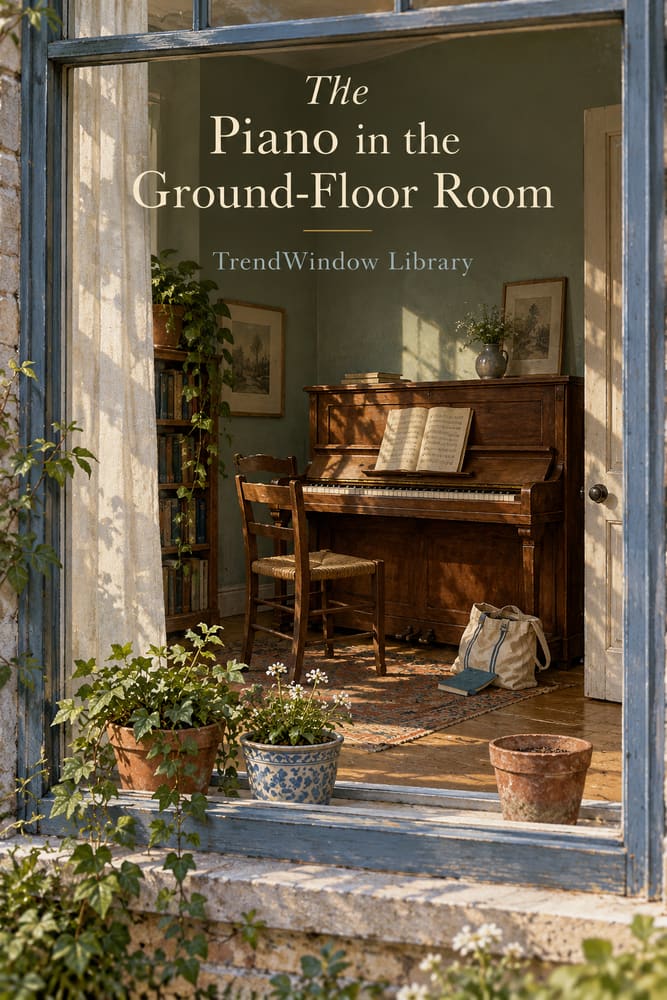
Front cover of The Piano in the Ground-Floor Room

Contemporary & Literary Fiction

The Piano in the Ground-Floor Room

By TrendWindow Library

Piano mover Rowan Bale arrives expecting a simple delivery. Celia North has chosen a different destination. A complete short literary story about what people keep.

First five fixed content pages only. Full-book access and purchases are not available.

1. The Name on the Booking

By nine in the morning I had been called Ryan twice and asked whether a piano would fit in a lift by a man who had not measured either.

My name was Rowan Bale. I was thirty-five and moved pianos with Kit Mercer, who was forty-three and believed a question should be allowed to finish before it was answered. It was one of the reasons we worked well together. The other was that Kit could drink tea in a moving van without regarding the cup as an enemy.

The booking said Ellis North. The woman who opened the door said Celia.

"My son arranged it," she explained. "He likes arranging."

She was sixty-two, in paint-marked trousers and a white shirt with the sleeves folded unevenly. She did not look like a person in need of rescue. There were boxes in the hall, all labelled in the same handwriting except one marked MISC, which had been crossed out and replaced with KITCHEN THINGS I HAVEN'T DECIDED ABOUT.

The piano stood in the front room. A brown upright, polished recently. Above it, a pale rectangle showed where a picture had hung.

Kit put the paperwork on a clear table. We had not touched the instrument when Celia read the destination.

"That's my new flat," she said.

"That's where we're booked to take it."

"It isn't going there."

From upstairs a man's voice called, "Mum, we've discussed this."

Celia looked at the ceiling.

"Yes," she said. "That's part of the difficulty."

2. What Could Be Carried

There are things I can tell by looking at a room. Where somebody has moved a chair to make a space seem larger. Which doors will need our professional assessment before a job can proceed. Whether the person offering tea is offering tea or asking us to slow down.

I cannot tell who owns a memory. I have nevertheless been invited to take sides in more than one.

Ellis came down carrying a lampshade. He was thirty-four, almost my age, with the careful expression of a man who had done the difficult part of a task and expected gratitude for the easy part.

"We had the flat checked," he said. "There's room."

"I know," Celia said. "I want the room."

He set the lampshade on a box and turned to us.

Kit stayed beside the paperwork.

"Before we move anything, we need an agreed instruction and a destination we can accept. We can call the office."

It was not a judgment about either of them. It was the boundary of our job. We had enough weight to carry without picking up a family's argument.

Celia took out her phone.

"I spoke to Leila at the rooms on Cress Street. They have a ground-floor music room. She wants the piano."

"A donation?" Kit asked.

"Yes. Mine."

Ellis looked at the instrument as though it had been asked a question it might answer differently.

"It was Dad's," he said.

Celia did not raise her voice.

"No. It was ours. And before that, it was mine."

3. The Photograph That Wasn't There

We called the office and paused the move. Nobody changed an address on a guess. Celia and the proposed recipient would need to confirm the instruction, and the revised job needed its own checks. Our manager asked for a little time. Kit took the van keys outside and moved us from a neighbour's gate.

I stayed in the hall while Celia found the recipient's details. Through the open front-room door, I could see the piano stool. One corner had a rubbed patch where someone's heel must have rested for years.

Ellis stood by the pale rectangle above the instrument.

"Where's the photograph?"

"Wrapped."

"You could put it above the piano again."

"I could put it somewhere else."

Her husband Martin had died two years earlier. I learned this because Ellis said it, not because I could read a house. People in my work are often credited with an understanding we have only borrowed from what we overhear.

He asked whether she was sure about the flat.

"Yes."

"It doesn't have a garden."

"No."

"You like a garden."

"I like going outside. I don't like spending every Saturday trying to keep one small patch of outside under control."

He smiled despite himself. She smiled too, but neither smile ended the conversation.

I looked away when she reached for the photograph's wrapped parcel. It seemed the least I could do in a hallway where I had become, through no merit of my own, an audience.

4. A Lesson Book

While we waited, Celia lifted a thin book from the stool. Inside were exercises, pencilled numbers and a child's name: CELIA HART, in letters determined to remain upright.

"I started at seven," she told Ellis.

"I know."

"Do you remember me telling you, or do you remember the piano being old?"

He opened his mouth, then closed it.

She turned a page. There were more numbers, a small ink blot and a pencilled GOOD that had survived better than the paper around it.

"Your father liked listening. I liked playing, for a while. Then I liked other things."

Ellis touched the edge without taking the book.

"You played at Christmas."

"Because someone had to get you all to stop singing in different keys."

He laughed. It was the first laugh that did not sound as though it might be withdrawn.

"Were we that bad?"

"Your uncle had convictions. They weren't musical ones."

Kit came in for the phone and heard only that sentence. He looked at me. I gave him the smallest possible shrug.

Celia kept the lesson book in her hands.

"I'm not throwing the years away," she said. "I just don't want to sit beside a large piece of furniture because nobody has asked whether I still play."

Ellis looked toward the keys. For once he did not ask her to demonstrate.

5. The Revised Journey

The office rang back. The instruction had been confirmed by Celia, the piano's present owner, and Leila had confirmed that she could receive it. The ground-floor rooms were a venue our team had assessed before. The manager had checked this particular revised move and agreed the scope with the people involved. None of that made it a journey we could improvise from a doorway.

Kit put the corrected paperwork on the table. Celia read it before signing.

Ellis watched, then asked whether he could drive to the venue after finishing one thing upstairs.

"You can," she said.

"If you want me there."

"I'd like you there."

He nodded. It was a small change from announcing where he would be.

We began the work. I will not describe the handling as if a few paragraphs could teach it. There were the checks, equipment and people required for that job, and the piano moved through the house under our team's control. Celia stayed clear and watched from the kitchen doorway.

The empty patch it left was smaller than I had expected. Rooms can look large around a thing and suddenly ordinary when it goes.

Celia stepped into the front room after we had finished there. She did not run a hand along the wall or make a speech.

"I'd forgotten that socket," she said.

I liked her for saying what she had actually noticed.

Explore more book previews →