BOOK LIBRARY · Complete books · Purchases disabled
TrendWindow

← Book Library · Complete book

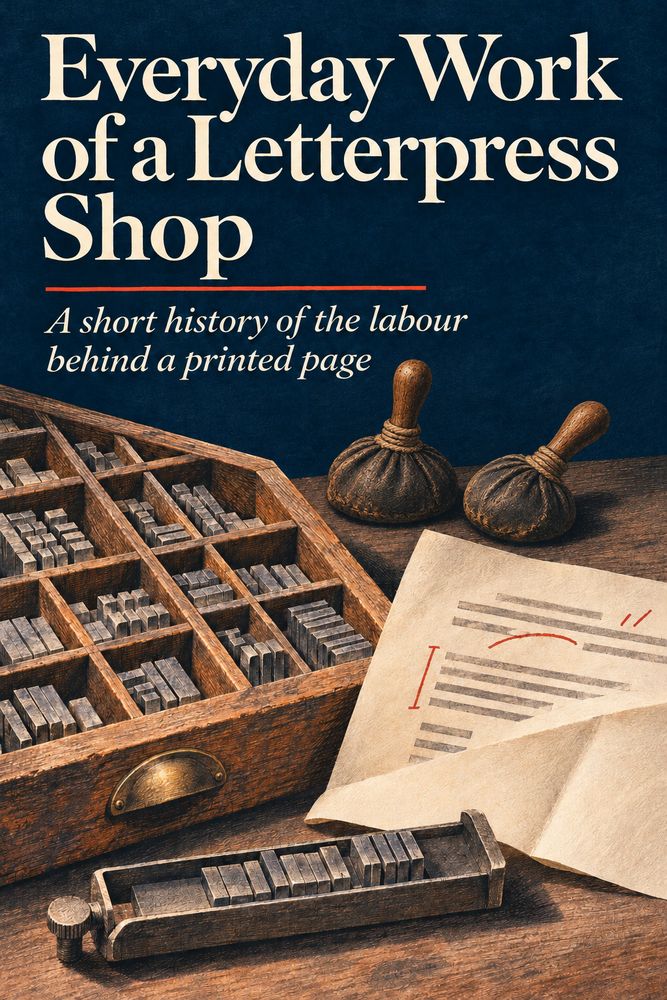
Front cover of Everyday Work of a Letterpress Shop

History & Culture

Everyday Work of a Letterpress Shop

By TrendWindow Library

An eight-chapter short history of the labour between manuscript and printed sheet, following Joseph Moxon’s account of hand composition, correction, press work and gathering. An openly invented four-page booklet makes the work visible; modern museum demonstrations are distinguished from historical evidence.

Read this complete edition, including its ending and notes. No purchase is required.

About this book

A short history of the labour between a manuscript and a printed sheet

This book follows the hand-composition and hand-press work described by Joseph Moxon in his English printing manual of 1683–1684. It is a focused reading of a historical source, not a claim that every printing shop, language or century worked alike. The source used here is the public-domain 1896 reprint, volume 2, available through Project Gutenberg. Modern library and museum examples are identified separately. Sources were consulted on 10 November 2026.

The River Room booklet used below is an invented teaching example, not an archival discovery. Descriptions explain work and evidence; they are not instructions for operating a press, handling historic type or preparing old cleaning mixtures.

Original complete short history prepared with AI assistance. River Room is an invented teaching example, not an archival discovery. A focused reading of Moxon, not a universal history or operating manual. Original research date retained; claims rechecked on 22 November 2026 using historical scans and institutional pages. Original conceptual covers. Translation meaning reviewed with AI, without independent native-language certification.

1. Before the press moves

A printing press makes an excellent centrepiece. It has weight, a recognisable outline and a moment when a sheet becomes an image. Yet if we begin and end with that moment, we overlook much of the work that allowed it to happen. A page had to become printable before anyone could take an impression. Afterwards, the printed material still needed attention.

Moxon's account gives us several places to look. Its sections distinguish the compositor, the corrector, press workers and the warehouse keeper. These are described responsibilities, not proof that every small business employed a separate person for each one. Reading the divisions helps us ask what tasks were necessary without inventing a complete staff list for a shop we have never documented. [1]

Start with an imagined four-page booklet for a reading circle at the River Room. The organiser has written an introduction, meeting details and a short reading list. In this example, the handwritten copy gives Tuesday but omits the hour. A beautiful impression cannot supply the missing information. Someone must notice the omission and obtain an answer before reproducing it hundreds of times.

This example offers our first distinction: making a mark successfully and communicating something correctly are different achievements. A press can reproduce an error with impressive consistency. We should therefore look not only for the machine in a workshop picture but for the copy from which people were working, the means of checking it and the people who could answer questions about it.

The ordinary beginning is not a dramatic pull of a handle. It is a decision about what, exactly, is going to be printed.

2. A sentence becomes a collection of objects

In hand composition, the words become an arrangement of individual pieces of type. Moxon describes cases divided into compartments and a composing stick used while setting lines. He explicitly observes that the arrangement of letters in cases was not identical in every printing house. A neat diagram should not be mistaken for a universal floor plan of the trade. [1, section 22]

Our reading-circle introduction contains the name River Room several times. On paper, repeating a name seems effortless. In a hand-set page, each occurrence needs material occupying its own place. While a page remains set, those pieces are unavailable for another page. The difference is useful to imagine: a written word is also a small demand on the shop's stock of letters.

The compositor is not simply copying shapes without understanding. Moxon discusses spelling, punctuation and the difficulties of poorly prepared copy. His expectations belong to his own context, and they do not mean every compositor had the same authority to rewrite an author's work. They do reveal that judgement existed alongside dexterity. [1]

The organiser now adds the missing hour. Imagine that this new handwritten entry could mean either six or seven. Selecting a plausible character would fill the line, but would not resolve the uncertainty. In our example, the copy is clarified to six before composition continues. This is an editorial choice in the invented example, not a reported incident from Moxon's shop.

Looking at a case, then, we can see more than an attractive grid. We can imagine searching, recognising, remembering locations and making a line that will need to coexist with every line around it.

3. The spaces do work too

A reader tends to notice the letters first. The gaps can appear to be nothing at all. In composed type, however, arranging a line involves both characters and spacing material. Moxon's discussion of justification concerns fitting the line to its measure; his account also describes the trouble caused by setting too closely or too widely. This is physical arrangement as well as visual judgement. [1, section 22]

Consider the reading list in our invented booklet. A long title does not become shorter because the allotted line is narrow. Changing its wording would change the content. Choosing a different arrangement would change the setting. The distinction helps us recognise why an apparently small editorial alteration can create work beyond the altered word itself.

Suppose a missing word is discovered after a paragraph has been set. It may fit with a local adjustment, or it may push material onward. Moxon describes corrections that require resetting beyond the immediate place of the error. We should not assign every correction a fixed number of minutes, but we can understand why the length and position of a change matter. [1]

There is a tempting story in which old printing was slow simply because old machines were slow. The composed line complicates that story. Time could also be spent deciding, arranging and rearranging before a press was involved. A history attentive to those actions gives skilled preparation its place.

For the visitor, a useful question is not only “How many pages could this press print?” It is also “What had to be ready before this particular page could be printed?” The second question brings the spaces back into view.

4. The page that asks to be corrected

A proof is a printed opportunity to examine the setting before treating the work as finished. Moxon describes a reader following the copy aloud while a corrector examines the proof. He also describes checking a later proof against earlier corrections. Marking a fault and confirming its repair are separate acts. [1, section 23]

Our invented booklet includes a sentence saying that books must not be removed from the room. If the word “not” disappears, the remaining sentence may look perfectly respectable while saying the opposite. A blurred letter might attract the eye immediately; a cleanly printed omission may require careful comparison with the copy. The appearance of the impression alone cannot decide whether the sentence is right.

This does not turn proofreading into a magical guarantee. Moxon's detailed instructions tell us what he wanted a corrector to do. They do not establish that every historical sheet received flawless attention. A manual is evidence of described practice and expectations; a surviving defective page is evidence that deserves attention in its own right.

In the teaching example, the missing word is restored and a fresh proof is examined. The reader checks both the corrected sentence and the neighbouring text affected by resetting. This invented sequence makes the difference between requesting a correction and seeing the corrected result easy to follow.

A proof covered in marks can look less accomplished than a clean page in a display case. Yet those marks may reveal work that a polished final sheet conceals. They can show the page in negotiation, while there was still an opportunity to change it.

5. Why the pages are not simply in order

The arrangement that suits a flat sheet is not necessarily the order in which a reader will encounter the pages. Moxon defines imposition through that relationship: pages are placed so that the printed sheet can be folded into the intended sequence. His diagrams describe particular formats. They are not evidence that every book used one identical arrangement. [1, section 22]

For a simple demonstration unrelated to operating a press, fold a clean scrap of paper once to make a four-page booklet. Number the pages in reading order, then open the sheet. Observe which numbers share a side. This little paper model is an original teaching exercise; it does not reconstruct every detail of historical production.

The reading-circle booklet now has a front, an inside opening and a back. Its introduction must lead into the meeting information rather than into the middle of the reading list. A page can be correct on its own and still occupy the wrong place in the whole. That is why checking only spelling does not settle the question of order.

Moxon's corrector also examines titles, page numbers and the connection between successive pages. The work reaches beyond the individual line. His description encourages us to read the book as an assembled sequence, not merely as a stack of separately attractive surfaces. [1, section 23]

An unfolded printed sheet may initially seem puzzling. Instead of calling its arrangement chaotic, ask what happens when it is folded. Sometimes the apparent disorder is evidence of planning for a later stage that the flat object has not yet reached.

6. The impression and the work around it

Now the press enters our account without swallowing the rest of it. Moxon describes coordinated inking and pulling, the preparation of the press for a particular form, and attention to the resulting sheets. His term for pulling includes several associated operations, not merely one movement of a handle. A short name can hide a sequence of actions. [1, section 24]

We do not need to copy his bodily instructions or chemical preparations to recognise the underlying point. A finished-looking apparatus does not make every sheet equivalent automatically. The workers still have to attend to what is happening. Historical descriptions of the process are worth studying, while practical operation belongs with appropriate equipment, training and supervision.

In our invented example, the corrected River Room text is ready, but one trial sheet has an unevenly legible line. The content decision has been settled; the quality of the impression has not. Keeping these two questions distinct avoids a false choice between caring about words and caring about their physical presentation.

Modern demonstrations offer another kind of evidence. Colonial Williamsburg describes its printers setting individual letters and using reproduction presses. That is evidence of how an institution presents the craft today, not an untouched scene transported from the eighteenth century. [2]

A visitor can learn much from watching trained hands. The careful observer also reads the label: original, reproduction, reconstruction, demonstration. These words do not make the experience worthless. They tell us what kind of experience it is, and prevent us from turning a useful explanation into a claim the evidence cannot support.

7. After the last impression

The last printed sheet is an exciting milestone, but it is not the end of every task. Moxon gives the warehouse keeper responsibilities that include drying, arranging and gathering sheets. He also describes distributing used type back into the case. The print job moves onward while some of its material returns to readiness for another job. [1, sections 22 and 25]

Two different kinds of order matter here. Sheets must belong in the right sequence for the reader. Pieces of type must return to useful locations for the compositor. One order preserves this text; the other makes future texts possible. Looking only at the finished booklet hides the second achievement almost completely.

In the invented River Room job, a completed copy is checked from beginning to end. It contains the introduction, Tuesday at six, the rule about keeping books in the room and the reading list. Checking one attractive cover would not establish that the inside pages were present and correctly arranged. The object must be considered as the reader will encounter it.

The shop's day should not become a sentimental picture in which nobody tires and every task feels satisfying. Our source assigns duties; it does not give us every worker's private feelings. Nor does the presence of beautiful surviving work prove that its makers enjoyed equal status or comfortable circumstances. Those questions require their own evidence.

What we can carry away is simpler and well grounded: the work surrounding printing is part of printing's history. Preparation, correction and putting material in order deserve to remain visible after the press has stopped.

8. Reading the workshop again

Return to the image of a press in a room. The machine is still interesting. Now, however, the eye has somewhere else to go: to copy awaiting clarification, a case holding reusable material, a proof under review, a sheet arranged for folding, and a gathering not yet ready to become a complete book.

The Bodleian Libraries describe their workshop as a place for practical teaching and reconstructions of early printing techniques. This reminds us that present-day practice can help us ask historical questions without becoming a substitute for documentary evidence. A reconstruction can illuminate a task; it does not establish how every person performed it in the past. [3]

The River Room booklet has reached its modest ending. Its missing hour has been supplied, the omitted negative restored, the impression checked and the pages read in sequence. No real historical customer has been invented to endorse the account. The example has done its job by giving us a small object to follow through several kinds of work.

Moxon's manual gives a more demanding ending. It asks us to recognise how much judgement can be hidden inside an apparently repeatable process. We need not treat his every assertion as timeless truth to learn from his descriptions. We can place the text in its period, distinguish its instructions from observed outcomes, and ask what another source might add or contradict.

A printed page can now be read twice: once for the words it carries, and once for the labour that made those words available. The second reading does not replace the first. It gives the page more people, more decisions and a longer life than the instant when it left the press.

Sources and scope: [1] Joseph Moxon, *Mechanick Exercises*, printing volume issued 1683–1684; [1896 reprint, volume 2](https://www.gutenberg.org/cache/epub/78991/pg78991-images.html), sections 22–25. Public-domain historical primary text; later editorial notes were not silently attributed to Moxon. [2] Colonial Williamsburg, [Printer](https://www.colonialwilliamsburg.org/events/printer/), present institutional description. [3] Bodleian Libraries, [Printing and book arts](https://www.bodleian.ox.ac.uk/csb/book-arts), present institutional description. Consulted 10 November 2026. No comprehensive world history, historical production-rate claim or operating manual is implied.

Explore more books →